Why in News?
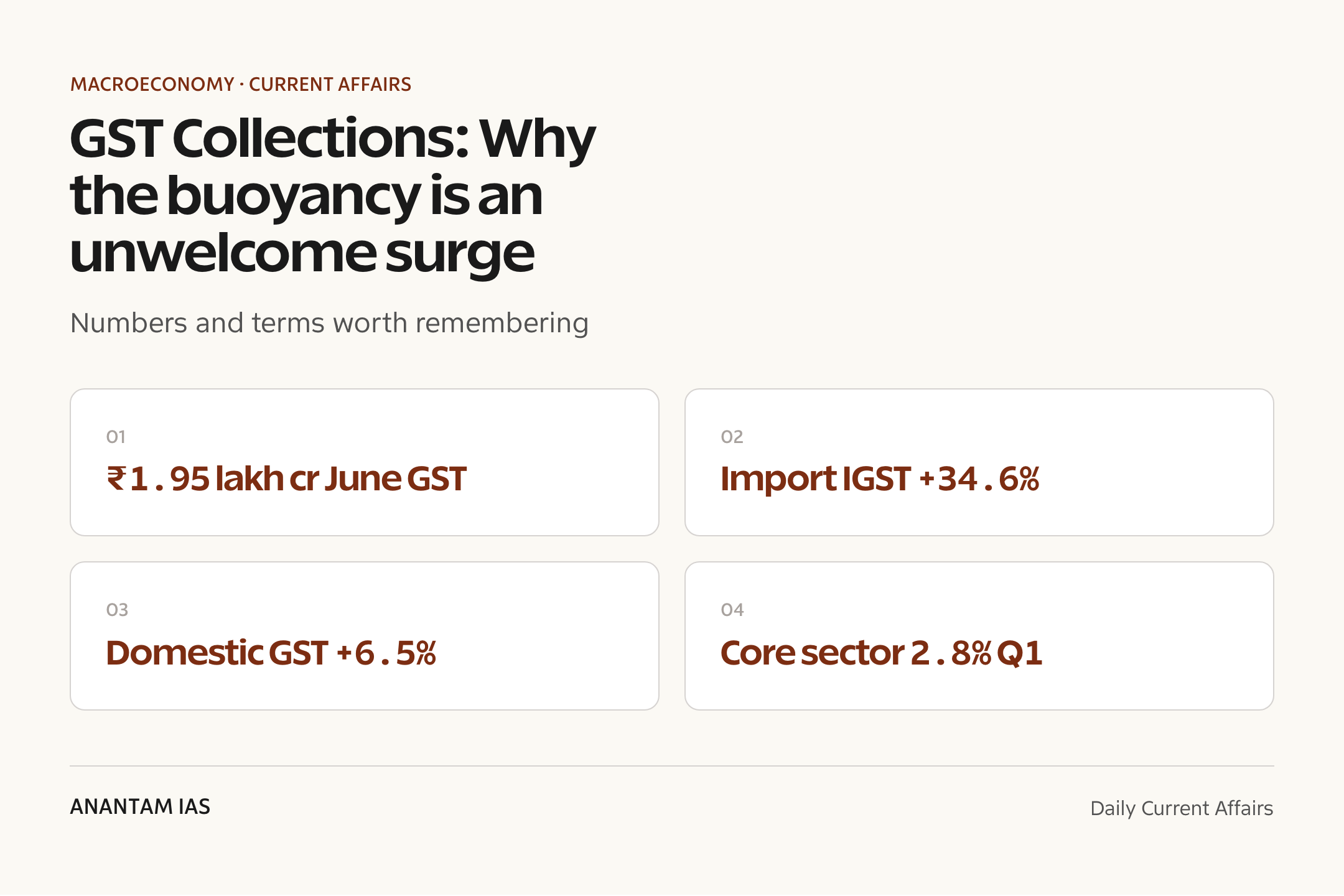
India’s gross GST collections for June 2026 rose 13.9% year-on-year to about ₹1.95 lakh crore, among the strongest monthly prints since the tax was introduced. On the face of it, this looks like a robust revenue performance as GST completes nine years of operation.
A Hindu editorial titled ‘Unwelcome surge’ has unpacked the composition of this growth: IGST on imports surged 34.6% over June 2025, while domestic GST collections grew a modest 6.5%. The editorial argues the buoyancy is being underwritten by imported inflation and a depreciating rupee rather than stronger domestic value addition — a distinction with direct relevance to how aspirants should read headline tax data.
- Gross GST collections in June 2026: about ₹1.95 lakh crore, up 13.9% year-on-year.
- Import IGST grew 34.6% YoY in June, accelerating from 17.2% growth in May.
- Domestic GST collections grew only 6.5% — the domestic engine is far weaker than the headline suggests.
- June collections reflect May’s economic activity, when crude and petroleum imports rose 54% and gold imports 34% by value.
- The government had raised the gold import duty from 6% to 15% on May 13, adding to the import-tax kitty.
- The rupee depreciated by almost 6% against the US dollar since late February, mechanically inflating the import tax base.
The development matters in the context of:
- The episode is a textbook illustration of tax buoyancy that flatters to deceive — revenue growing faster than underlying output because prices, duties and the exchange rate inflated the tax base.
- It matters for the Union Budget arithmetic: revenue projections built on import-price-driven collections are fragile if commodity prices or the rupee reverse.
- For GS3 answers, it supplies ready data to distinguish healthy buoyancy (consumption- and formalisation-led) from unhealthy buoyancy (inflation- and duty-led).
UPSC Relevance
Prelims Relevance
- GST — destination-based, multi-stage consumption tax introduced on 1 July 2017 via the 101st Constitutional Amendment Act, 2016.
- Components: CGST (Centre), SGST/UTGST (States/UTs), IGST on inter-state supplies and imports, plus compensation cess on select goods.
- IGST on imports is levied under the Customs framework alongside basic customs duty — a weaker rupee or costlier imports directly raises this collection.
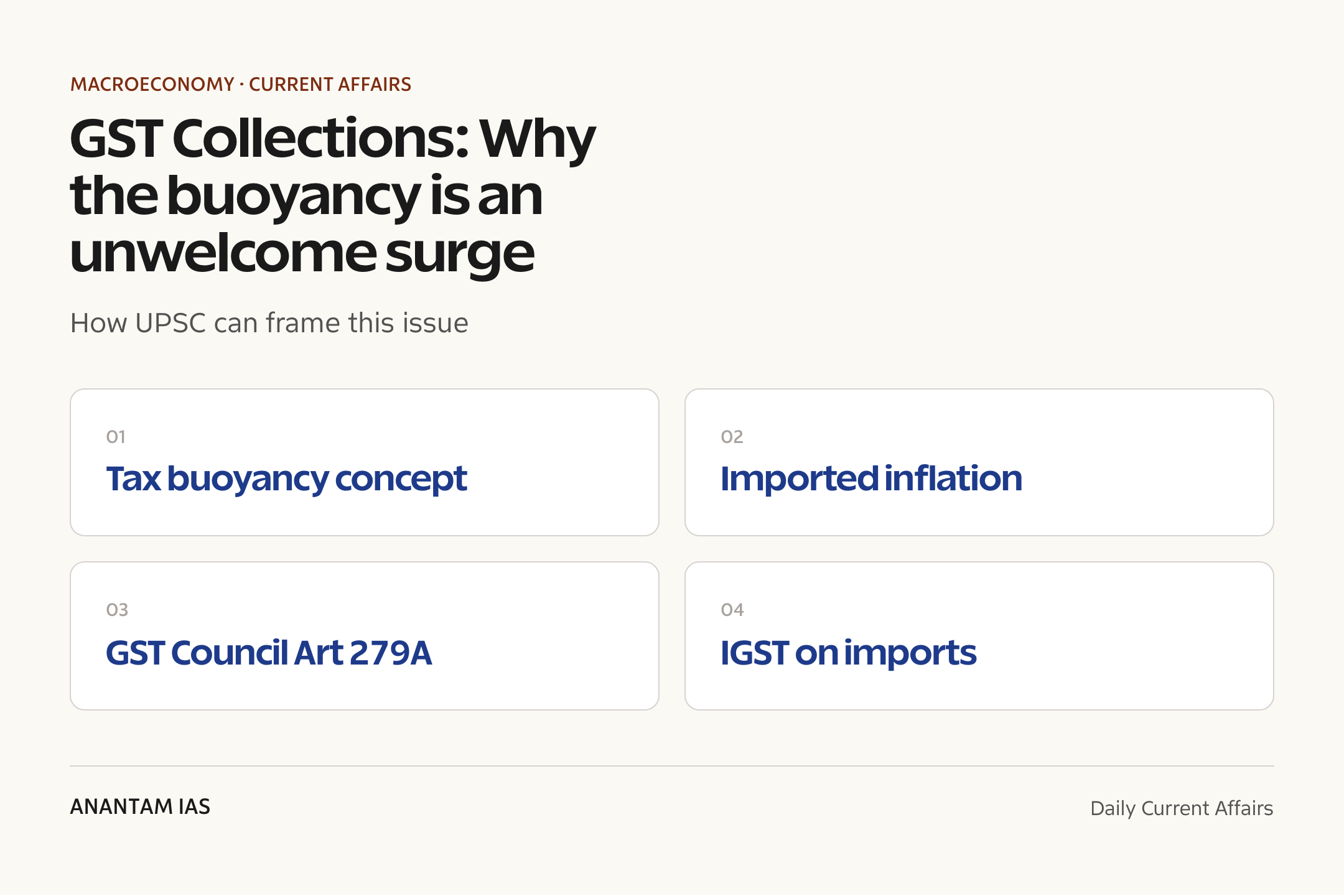
- GST Council — constitutional body under Article 279A; Union Finance Minister chairs it; states hold two-thirds of the vote weight.
- Tax buoyancy — percentage change in tax revenue relative to percentage change in nominal GDP, including the effect of rate/base changes; buoyancy above 1 means taxes outpace GDP.
- Tax elasticity — the same responsiveness measured with the tax structure held constant (no rate changes); buoyancy is the observed, elasticity the structural measure.
- Imported inflation — domestic price rise transmitted through costlier imports, driven by global prices, freight or currency depreciation.
- Eight core industries — coal, crude oil, natural gas, refinery products, fertilizers, steel, cement, electricity; about 40% weight in the IIP; grew ~2.8% in Q1 FY27.
- GST taxpayer base expanded from about 66 lakh in 2017 to over 1.65 crore today.
Mains Relevance
GS Paper 3
- Mobilisation of resources: why the composition of tax revenue matters as much as its level — import-IGST-led growth vs domestic-consumption-led growth.
- Growth diagnostics: reading GST data alongside the core sector (2.8% in Q1 FY27) and the manufacturing PMI (54.2) to assess real momentum.
- External sector: how currency depreciation and global commodity/gold prices transmit into domestic indirect tax collections.
- Nine years of GST: base expansion and formalisation versus unresolved input tax credit, litigation and rate-structure issues.
GS Paper 2
- Fiscal federalism: revenue-sharing and compensation concerns of states within the GST Council framework.
- Cooperative federalism in tax administration — the Council under Article 279A as India’s most active intergovernmental body.
Essay
- Headline numbers conceal more than they reveal — the ethics of reading data honestly in public policy.
- Nine years of GST: one nation, one tax as a work in progress in a federal polity.
Background and Context
GST architecture in brief: the machine behind the monthly number
The monthly collection figure aggregates four distinct streams, and knowing them is essential to reading the data.
- GST is a destination-based consumption tax that replaced a web of central and state indirect levies from 1 July 2017, enabled by the 101st Constitutional Amendment Act, 2016.
- The gross figure combines CGST (accrues to the Centre), SGST/UTGST (accrues to states and UTs), IGST (on inter-state supplies and on imports, later apportioned between Centre and states) and the compensation cess.
- IGST on imports is collected at the customs stage on the value of imported goods. Its size moves with import volumes, global prices, customs duty rates and the exchange rate — none of which reflects domestic production.
- The GST Council, set up under Article 279A, decides rates, exemptions and rules; the Union commands one-third of the voting weight and states two-thirds, with decisions needing a three-fourths majority. See the detailed note on the GST Council’s composition and voting.
- GST sits on the indirect side of India’s tax system; the direct vs indirect taxes distinction matters here because indirect collections respond to prices, not just incomes.
What the June 2026 data actually show
The Hindu’s editorial decomposition of the June print reveals a two-speed picture.
- Gross collections: about ₹1.95 lakh crore, up 13.9% year-on-year — a record-strength headline.
- Import IGST: up 34.6% over June 2025, sharply accelerating from 17.2% growth recorded in May.
- Domestic GST (CGST + SGST + domestic IGST): up only 6.5% — barely ahead of nominal GDP growth, suggesting no broad-based surge in domestic value addition.
- Timing matters: GST collected in June reflects May’s transactions. May’s merchandise import data show crude and petroleum products up 54% by value and gold up 34% year-on-year.
- Non-oil imports rose 14.5% in May at elevated global prices, further widening the import tax base.
Tax buoyancy: the concept UPSC actually tests
Buoyancy is the bridge between tax data and the real economy — and the June numbers show why the bridge can mislead.
- Tax buoyancy = percentage change in tax revenue ÷ percentage change in nominal GDP. A buoyancy above 1 means revenue grows faster than the economy.
- Buoyancy captures everything — real growth, inflation, better compliance, and discretionary changes like rate or duty hikes. Tax elasticity strips out the discretionary changes and measures only the structural response.
- Healthy buoyancy comes from rising consumption, formalisation and compliance — it signals a stronger economy and is durable.
- Unhealthy buoyancy comes from inflation, currency depreciation or duty hikes inflating the tax base in value terms — it can coexist with a slowing real economy and reverses when prices normalise.
- June 2026 is a live case of the second kind: the gold import duty hike (6% to 15% on May 13), a 60% surge in gold prices between May 2025 and May 2026, and a ~6% rupee depreciation since late February all mechanically pumped up import IGST.
Imported inflation: how prices abroad become taxes at home
Three channels turned global price pressure into record GST collections.
- Commodity prices: costlier crude, petroleum products and gold raise the customs value of imports, and IGST is levied on that value — higher world prices mean higher collections with zero extra domestic activity.
- Currency depreciation: with the rupee down almost 6% against the dollar, every imported unit costs more in rupees, expanding the tax base again. A spike in freight charges compounded this.
- Duty policy: the hike in gold import duty from 6% to 15%, intended to curb gold imports, raised per-unit tax incidence. The government’s earlier move is covered in the note on the gold and silver import duty hike.
- The gold surge itself signals stress, not strength — a near-60% price rise and heavy buying suggest hedging during uncertain times rather than productive investment demand.
- Imported inflation eventually shows up in the CPI too, squeezing households even as it flatters the exchequer; the transmission is explained in the note on the Consumer Price Index.
The domestic economy: what the other dials say
Read against real-activity indicators, the domestic picture is subdued rather than surging.
- The eight core industries expanded only about 2.8% in Q1 FY27, against roughly 6% in the same quarter last year.
- Weakness was concentrated in crude oil, natural gas, refinery products, fertilizers and electricity — the energy-and-inputs backbone of industry.
- The HSBC Manufacturing PMI reading of 54.2 shows factories still expanding, but at the second-lowest pace in 13 months — steady, not accelerating.
- Domestic GST growth of 6.5% is consistent with this moderate-activity picture, not with a 13.9% revenue boom.
- Together the dials say: the economy is growing modestly while the import bill — inflated by prices, duty and the currency — is doing the heavy lifting in the tax data.
Nine years of GST: real gains, unfinished agenda
The anniversary context gives the balanced-assessment material a GS3 answer needs.
- Taxpayer base: from about 66 lakh registrants in 2017 to over 1.65 crore today — evidence of formalisation and improved compliance.
- Process gains: e-invoicing, e-way bills and faster refunds have reduced cascading and logistics friction, strengthening India’s indirect tax architecture.
- Unresolved: input tax credit disputes and blocked credits, mounting litigation, and questions of federal balance in revenue sharing after the end of guaranteed compensation.
- The rate structure remains multi-slab, and petroleum products, electricity and real estate stay largely outside GST — limiting the ‘one nation, one tax’ promise.
- The June episode adds a new caution: even the celebrated revenue buoyancy needs decomposition before it is claimed as a reform dividend.
Way Forward
Decompose before declaring victory
- Official monthly releases should routinely publish the domestic vs import split, volume vs price effects, and state-wise trends so buoyancy claims can be independently assessed.
- Budget revenue projections should discount price-and-duty-driven collections and anchor estimates to domestic-base growth, keeping fiscal arithmetic honest.
Rebuild the domestic engine
- Reviving core sector momentum — energy, fertilizers, electricity — and private capex is the durable route to healthy GST buoyancy.
- Rationalising the rate structure, settling input tax credit disputes and cutting litigation would raise compliance-led collections rather than price-led ones.
Manage the external channel
- Stabilising the rupee’s real value and diversifying energy sourcing reduce the pass-through of imported inflation into both prices and fragile revenue.
- Gold-demand management needs instruments beyond duty hikes — deepening financial savings alternatives addresses the hedging motive that drove May’s surge.
Conclusion
The June 2026 GST print is a reminder that a tax on value rises whenever value rises — whether because Indians produced more, or because the world charged India more. With import IGST growing at 34.6% and domestic collections at 6.5%, the record collection owes more to imported inflation, a weaker rupee and a gold-duty hike than to domestic dynamism.
For the exam, the takeaway is analytical, not cynical: GST remains a structural achievement, and its base expansion from 66 lakh to over 1.65 crore taxpayers is real. But tax buoyancy must always be decomposed — by source, by price-versus-volume, by policy change — before it is read as a sign of economic health. The composition of revenue is the story; the headline is only its cover.
UPSC Practice Questions
Prelims MCQ 1
With reference to India’s GST collections in June 2026, consider the following statements:
- Gross GST collections rose about 13.9% year-on-year to roughly ₹1.95 lakh crore.
- IGST on imports grew several times faster than domestic GST collections.
- GST collections reported for a month reflect economic activity of that same month.
How many of the above statements are correct?
(a) Only one (b) Only two (c) All three (d) None
Answer: (b) Only two
Explanation:
Statements 1 and 2 are correct: collections rose 13.9% to about ₹1.95 lakh crore, with import IGST up 34.6% against 6.5% domestic growth. Statement 3 is wrong — a month’s collections reflect the previous month’s transactions (June collections capture May activity).
Prelims MCQ 2
Which of the following best describes ‘tax buoyancy’?
(a) The ratio of total tax revenue to GDP in a financial year (b) The percentage change in tax revenue in response to a percentage change in nominal GDP, including the effect of rate and base changes (c) The responsiveness of tax revenue to GDP growth with the tax structure held constant (d) The share of indirect taxes in gross tax revenue
Answer: (b) The percentage change in tax revenue in response to a percentage change in nominal GDP, including the effect of rate and base changes
Explanation:
Buoyancy is the observed responsiveness of revenue to nominal GDP and includes discretionary changes (rate hikes, new levies). Option (c) describes tax elasticity, which holds the tax structure constant. Option (a) is the tax-to-GDP ratio.
UPSC Mains Questions
- Record tax collections do not always signal a healthy economy. With reference to the composition of recent GST revenues, distinguish between buoyancy driven by domestic value addition and buoyancy driven by imported inflation and currency depreciation. (250 words)
- Nine years after its rollout, GST has widened the tax base and formalised the economy, yet input tax credit disputes, litigation and federal revenue-sharing concerns persist. Critically evaluate GST as a reform in progress. (250 words)
- How do global commodity prices, import duties and exchange-rate movements transmit into India’s indirect tax collections? Suggest measures to make revenue analysis and budget projections more robust to such distortions. (150 words)
Source: The Hindu Editorial.
Frequently Asked Questions
Why did GST collections surge in June 2026?
Gross collections rose 13.9% to about ₹1.95 lakh crore, but the surge came mainly from IGST on imports, which jumped 34.6%. Costlier crude and gold, a gold import duty hike from 6% to 15%, and a rupee depreciation of nearly 6% inflated the import tax base. Domestic GST grew only 6.5%.
What is tax buoyancy?
Tax buoyancy measures the percentage change in tax revenue for a given percentage change in nominal GDP. It includes the effects of rate changes, duty hikes and compliance gains. Buoyancy above 1 means revenue is growing faster than the economy. Tax elasticity is the same measure with the tax structure held constant.
What is imported inflation?
Imported inflation is a rise in domestic prices transmitted from abroad — through higher global commodity prices, costlier freight, or a depreciating currency that makes every imported unit more expensive in rupees. It raises the value of imports and, with it, taxes levied on that value, such as IGST at customs.
What is IGST and who collects it?
Integrated GST (IGST) is levied on inter-state supplies of goods and services and on imports into India. It is collected by the Centre and later apportioned between the Centre and the destination state. On imports it is charged at the customs stage on the import value, alongside basic customs duty.
Why is import-driven GST growth considered unhealthy?
Because it reflects higher prices, duties and a weaker currency rather than more domestic production or consumption. Such revenue can coexist with a slowing real economy — core industries grew just 2.8% in Q1 FY27 — and it reverses when commodity prices or the exchange rate normalise, making budget projections fragile.
How much has the GST taxpayer base grown?
The registered taxpayer base has expanded from about 66 lakh at GST’s launch in July 2017 to over 1.65 crore now. This reflects formalisation, e-invoicing and better compliance, and is counted among GST’s genuine structural achievements even as litigation and input tax credit issues persist.
Tell Google you want more of this.
Add Anantam IAS as a preferred sourceOne tap, and this site shows up more often in your own Top Stories, AI Overviews and AI Mode. Remove it any time.