Why in News?
India and Uzbekistan have elevated their ties to a Comprehensive Strategic Partnership and set a target of increasing annual bilateral trade from over $1 billion to $5 billion by 2030.
Eleven agreements were concluded across uranium supply, critical minerals, digital payments, defence, tourism and cultural conservation.
| UPSC Relevance: GS-2 International Relations: India and its neighbourhood; bilateral relations Prelims: Uzbekistan, Central Asia, Uranium, Chabahar Port Mains: India’s engagement with Central Asia and energy security |
Major Highlights:
- Uranium cooperation: A framework will be established for the long-term supply of Uranium from Uzbekistan to India for peaceful civil nuclear use.
- Critical minerals: Both sides will undertake joint projects in geological exploration, mining, processing and integrated mineral value chains.
- Trade and investment: Market-access barriers, banking arrangements, payment systems and connectivity constraints will be addressed systematically.
- Digital integration: An agreement between NPCI International Payments Ltd and Uzbekistan’s National Interbank Processing Centre will allow Indian UPI applications to scan Uzbekistan’s UZQR for merchant payments.
- Defence and security: The countries will promote direct industry linkages, co-production and co-development while strengthening cooperation against terrorism, extremism and separatism.
- Wider cooperation: Agreements cover infrastructure, agriculture, pharmaceuticals, healthcare, Ayurveda, education, tourism and digital public infrastructure.
- Cultural diplomacy: India will assist in restoring the Buddhist sites of Fayaz Tepa and Kara Tepa, which testify to the spread of Buddhism through the Silk Road.
- Climate cooperation: India announced a $1-million grant for afforestation in the Aral Sea region, which faces severe desertification and ecological degradation.
Strategic Significance:
- Energy security: Uzbek Uranium will diversify India’s nuclear fuel supply and reduce dependence on a limited group of suppliers. It can support India’s clean energy transition and its objective of expanding nuclear power capacity to 100 GW by 2047.
- Access to critical resources: Uzbekistan possesses significant deposits of uranium, gold, copper and other strategic minerals. Cooperation in exploration and processing can strengthen India’s supply chain resilience and support its manufacturing and clean energy industries.
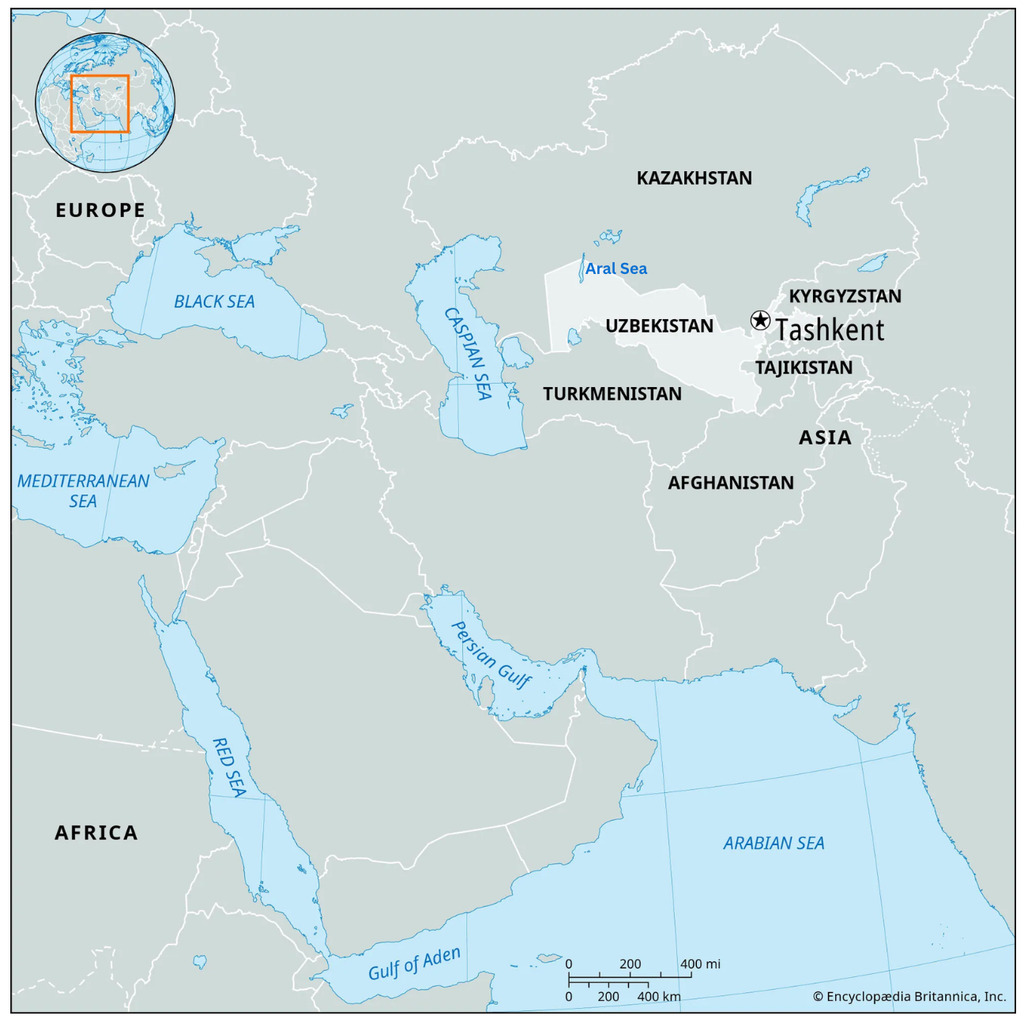
- Gateway to Central Asia: Located at the centre of the region and sharing borders with all other Central Asian republics, Uzbekistan is central to India’s Connect Central Asia Policy, India-Central Asia Dialogue and engagement through the Shanghai Cooperation Organisation (SCO).
- Security convergence: Both countries have common concerns regarding terrorism, radicalisation, narcotics trafficking and instability in Afghanistan. Defence cooperation, including the DUSTLIK joint military exercise, reflects growing strategic trust.
- Soft-power linkages: Buddhist heritage, Silk Road connections, Sufi traditions, education, Ayurveda and tourism provide a strong civilisational foundation for contemporary relations.
Challenges:
- Absence of direct land connectivity limits trade and raises transport costs.
- India’s access through Pakistan and Afghanistan remains constrained.
- Bilateral trade remains modest compared with its potential.
- Banking, customs, visa and payment difficulties impede business exchanges.
- China’s extensive economic presence and Russia’s traditional influence intensify geopolitical competition in Central Asia.
- Uranium supplies require reliable transport arrangements, long-term commercial viability and adherence to international nuclear-safeguard obligations.
Way Forward:
- India should operationalise connectivity through Iran’s Chabahar Port and the International North-South Transport Corridor
- Expand direct air-cargo links and facilitate banking settlements.
- Joint ventures in uranium, pharmaceuticals, textiles, agriculture and critical-mineral processing should be prioritised.
- Regular defence dialogue, capacity-building and cultural restoration can give the partnership greater strategic depth.
The Comprehensive Strategic Partnership moves India-Uzbekistan relations beyond diplomatic engagement towards energy, economic and security interdependence.
Effective implementation of the uranium, connectivity and critical-mineral agreements can make Uzbekistan a key pillar of India’s long-term engagement with Central Asia.
Tell Google you want more of this.
Add Anantam IAS as a preferred sourceOne tap, and this site shows up more often in your own Top Stories, AI Overviews and AI Mode. Remove it any time.