Why in News?
On 4-5 July 2025, Prime Minister Narendra Modi held talks with Argentine President Javier Milei in Buenos Aires — the first bilateral visit by an Indian PM to Argentina in 57 years. The two sides agreed to widen the bilateral trade basket and deepen cooperation across critical minerals, energy, defence, space and pharma.
News on AIR reported that energy and critical minerals were a key focus, with Argentina’s reserves of lithium, shale gas and oil framed as a reliable input for India’s clean-energy transition.
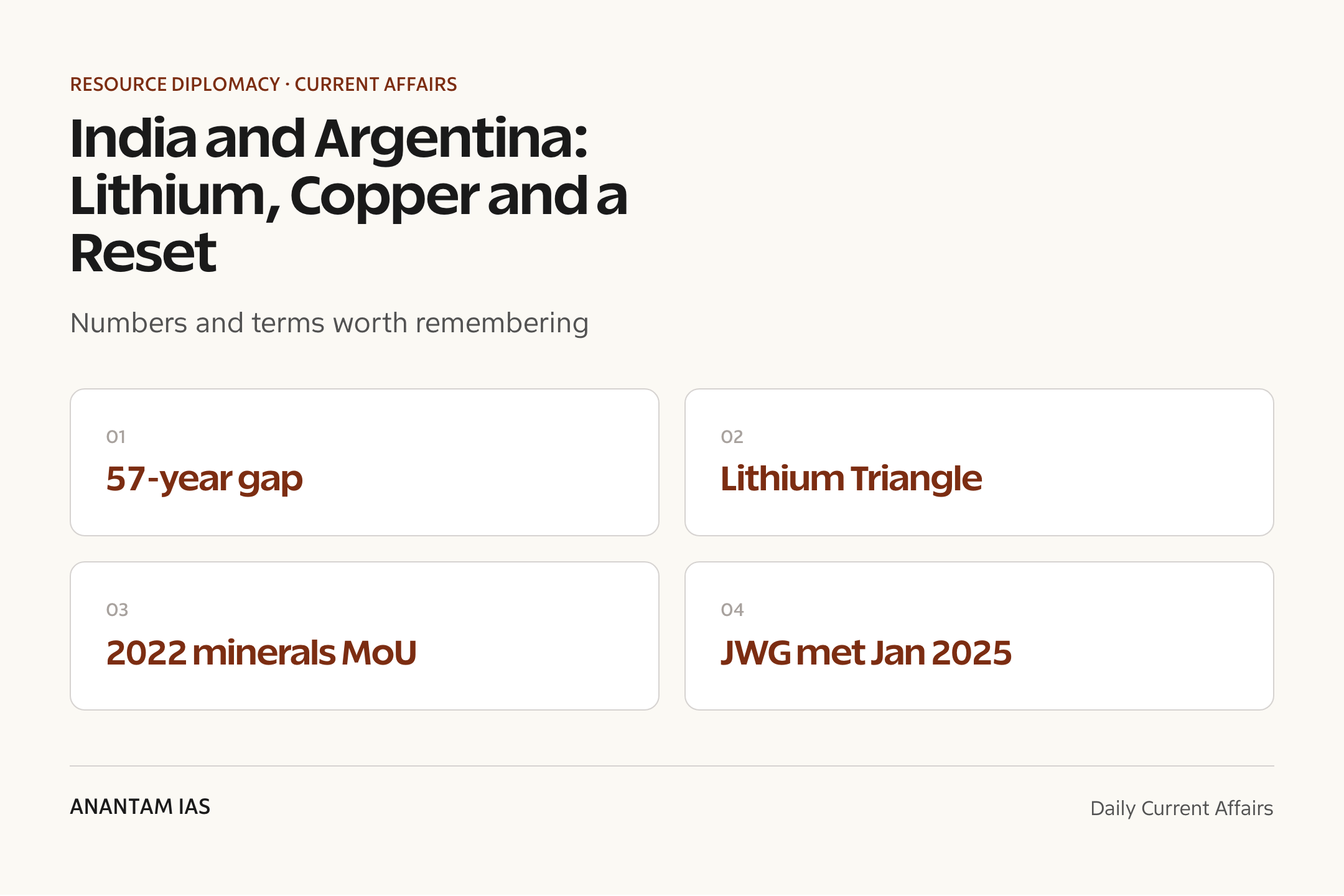
- Talks built on the 2022 critical-minerals MoU; the first Joint Working Group on minerals met in January 2025.
- Cooperation widened to lithium, copper and rare earths, plus energy, defence, space, health and pharma.
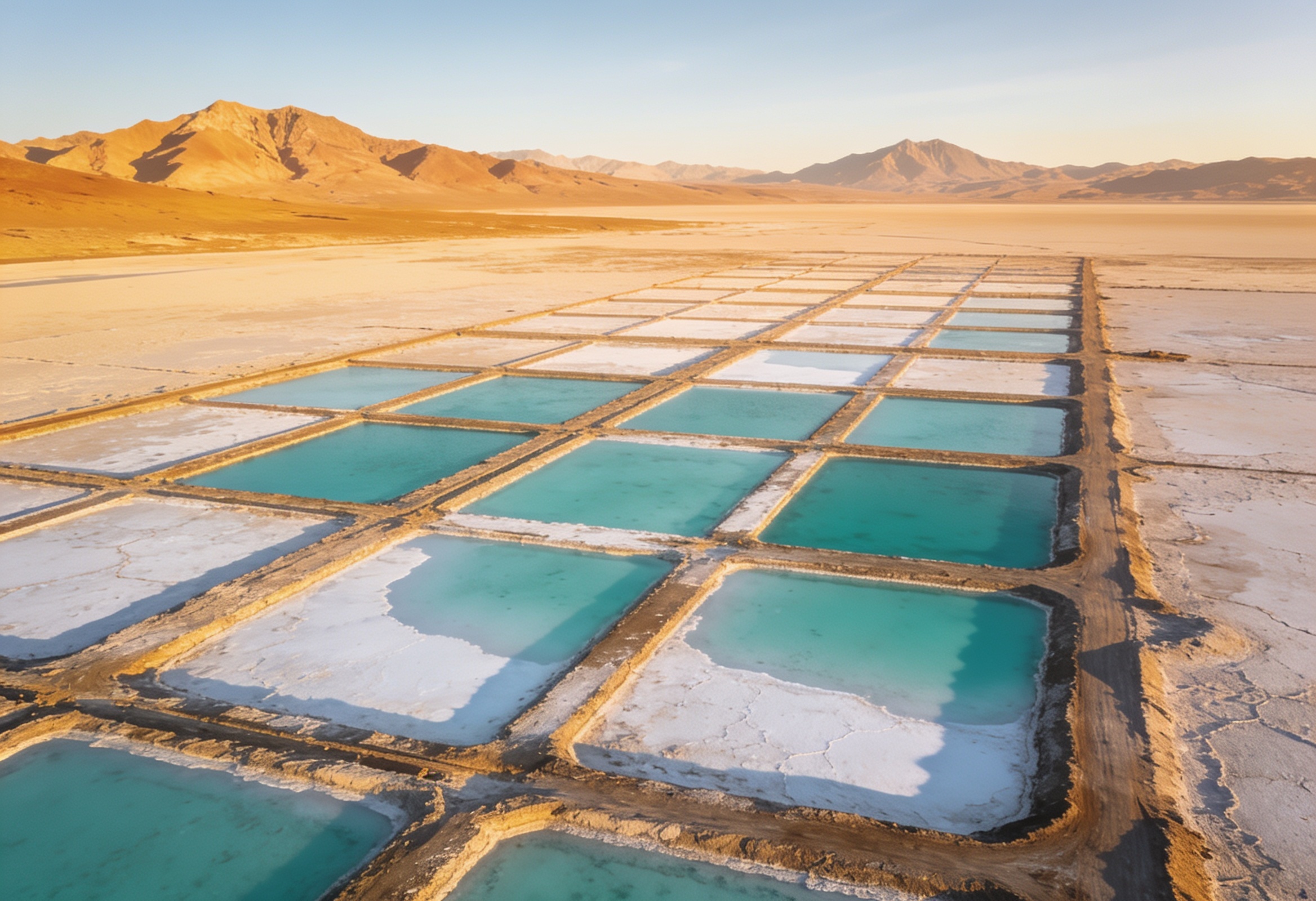
- Argentina sits in the Lithium Triangle (with Bolivia and Chile), which holds over half the world’s lithium resources.
- Argentina agreed to ease entry for Indian pharma firms, accepting medicines with US FDA or EMA approvals.
- India sought Argentine backing to expand the India-MERCOSUR preferential trade agreement (in force since 2009).
- President Milei expressed interest in India’s UPI; both agreed to a central-bank exchange to study its role.
The development matters in the context of:
- Why it matters: India imports nearly all of its lithium and depends heavily on China for processed critical minerals.
- Latin America is emerging as a non-China resource partner for India’s batteries, EVs and renewables build-out.
UPSC Relevance
Prelims Relevance
- Lithium Triangle — Argentina, Bolivia, Chile; holds the bulk of world lithium reserves in Andean salt flats (salars).
- Argentina’s lithium sits in the Salar del Hombre Muerto and other brine salt flats.
- KABIL (Khanij Bidesh India Ltd) — joint venture of NALCO, HCL and MECL for overseas critical-mineral assets.
- KABIL signed a lithium exploration deal in Catamarca province (with state firm CAMYEN) in January 2024.
- India-MERCOSUR Preferential Trade Agreement — in operation since 2009; MERCOSUR members include Argentina, Brazil, Paraguay, Uruguay.
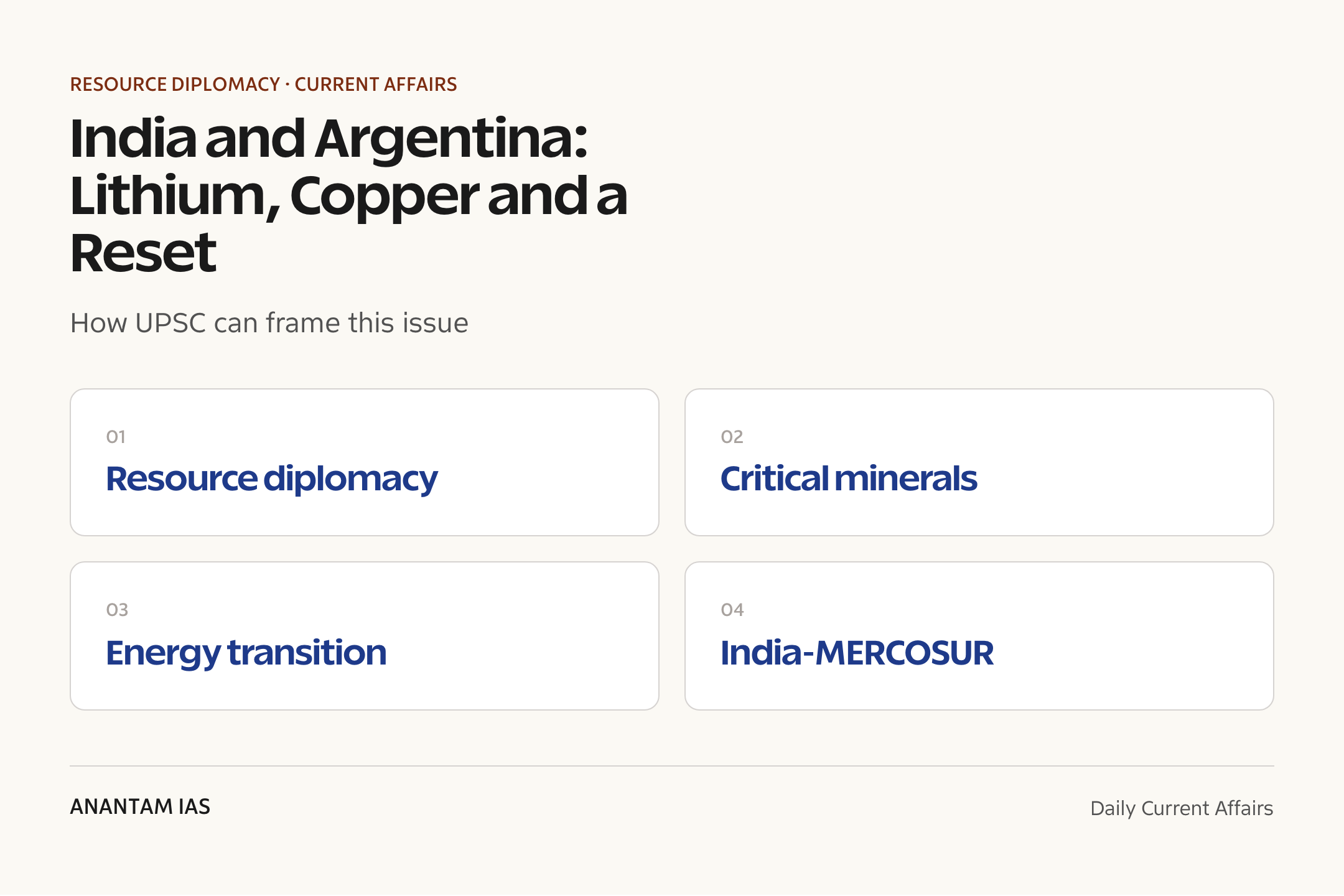
- Critical minerals — lithium, cobalt, nickel, copper, graphite, rare earths; vital for batteries, EVs and electronics.
- National Critical Mineral Mission (NCMM), 2025 — India’s framework for securing critical-mineral supply.
- Lithium is an alkali metal; brine extraction from salars versus hard-rock (spodumene) mining.
- UPI — Unified Payments Interface, run by NPCI; subject of the India-Argentina fintech exchange.
Mains Relevance
GS Paper 2
- India’s outreach to Latin America and the diversification of strategic partnerships beyond traditional theatres.
- Resource diplomacy as a tool of statecraft and the contest to de-risk supply chains from a single source.
GS Paper 3
- Critical-mineral security for the energy transition: securing lithium, copper and rare earths for EVs and renewables.
- Overseas mineral acquisition (KABIL) versus domestic exploration and processing capacity.
Essay
- Energy security in an age of green transition — minerals as the new oil.
- Diplomacy beyond the neighbourhood: India’s search for reliable partners.
Background and Context
A reset after 57 years
The visit reopened a relationship that had drifted despite a long-standing strategic partnership.
- First bilateral visit by an Indian PM to Argentina in 57 years — earlier visits were on the margins of summits like the G20.
- India and Argentina have been strategic partners since 2019; this trip put substance behind the label.
- PM Modi thanked Argentina for its support after the Pahalgam terror attack and invited President Milei to India.
- Both sides agreed to diversify the trade basket beyond the current commodity-heavy mix.
Why Argentina, why lithium
Argentina’s geology makes it central to India’s battery and clean-energy ambitions.
- Argentina lies in the Lithium Triangle with Bolivia and Chile, which together hold well over half of global lithium resources.
- Lithium is concentrated in high-altitude salars (salt flats) such as the Salar del Hombre Muerto, extracted from brine.
- Argentina is among the fastest-growing lithium producers and is expanding output sharply this decade.
- India imports almost all its lithium and remains exposed to China for mining and, crucially, processing.
- Beyond lithium, Argentina also offers copper, rare earths, shale gas and oil — a broad energy-and-minerals menu.
The institutional scaffolding
The 2025 talks rested on agreements built patiently over the preceding years.
- A critical-minerals MoU was signed in 2022 to frame cooperation on lithium and allied minerals.
- The first Joint Working Group on critical minerals met in January 2025 to operationalise the MoU.
- KABIL — the NALCO-HCL-MECL joint venture — had already entered Argentina, signing an exploration pact for lithium blocks in Catamarca (with state miner CAMYEN) in January 2024.
- A continuing Joint Working Group on Agriculture anchors the wider economic relationship.
Beyond minerals: the wider basket
The two leaders cast the partnership across several sectors, not minerals alone.
- Defence and space: collaboration discussed, including drone use-cases and space-sector ties.
- Pharma: Argentina agreed to ease imports of Indian medicines cleared by US FDA or EMA, easing market entry.
- Fintech: Milei showed interest in India’s UPI; a central-bank exchange was planned to study its monetary-policy role.
- Trade: India pressed for expansion of the India-MERCOSUR preferential trade agreement to deepen market access.
Where this fits in India's minerals strategy
Argentina is one node in a wider drive to secure critical minerals from many sources.
- Domestically, the National Critical Mineral Mission (2025) targets exploration, recycling and stockpiling.
- Overseas, India is courting Australia, Chile, the US and African producers alongside Argentina to spread risk.
- The aim is to de-risk from over-reliance on China, which dominates processing of most critical minerals.
- Securing upstream assets is only half the task — refining and battery-grade processing remain the harder gap.
The constraints to watch
Memoranda are easy; bankable mineral flows are hard.
- Lithium projects are capital-intensive and slow, with long lead times from exploration to output.
- Argentina’s macroeconomic volatility — inflation, currency swings, policy shifts — raises investment risk.
- Geographic distance and the absence of a processing ecosystem limit how fast raw lithium turns into Indian batteries.
- Competition is fierce: China and Western firms are already entrenched in Argentine lithium.
Way Forward
Convert MoUs into projects
- Move from the Joint Working Group stage to firm equity stakes and offtake agreements via KABIL.
- Sequence exploration in Catamarca and other provinces toward bankable, producing assets.
Build the missing middle
- Pair overseas mining with domestic refining and battery-grade processing so raw lithium creates Indian value.
- Tie supply into the EV and battery manufacturing push at home.
Diversify and de-risk
- Treat Argentina as one of several sources — alongside Chile, Australia and Africa — never a single point of failure.
- Use the India-MERCOSUR track to widen trade so the relationship is broader than minerals.
Conclusion
The Buenos Aires visit was less about a single deal and more about resetting a long-neglected relationship around a clear logic — Argentina has the minerals and energy India’s transition needs, and India offers a large market, pharma capacity and digital public goods like UPI.
The test now is execution: turning the 2022 MoU and the 2025 talks into producing lithium and copper assets, and into a trade basket that no longer leans only on commodities. If the institutional scaffolding holds, this could become one of India’s more durable resource partnerships in the global South.
UPSC Practice Questions
Prelims MCQ 1
With reference to the Lithium Triangle, consider the following statements:
- It comprises Argentina, Bolivia and Chile.
- Its lithium is largely found in high-altitude salt flats (salars).
- India is a constituent of the Lithium Triangle.
How many of the above statements are correct?
(a) Only one (b) Only two (c) All three (d) None
Answer: (b) Only two
Explanation:
Statements 1 and 2 are correct — the triangle spans Argentina, Bolivia and Chile, with lithium in Andean salars. Statement 3 is wrong; India is not part of it.
Prelims MCQ 2
KABIL (Khanij Bidesh India Ltd), often in the news for securing overseas critical minerals, is a joint venture of which entities?
(a) ONGC Videsh, GAIL and IOC (b) NALCO, Hindustan Copper and Mineral Exploration Corporation (c) Coal India, NMDC and SAIL (d) NTPC, NHPC and SJVN
Answer: (b) NALCO, Hindustan Copper and Mineral Exploration Corporation
Explanation:
KABIL is a joint venture of NALCO, HCL and MECL, set up to acquire and develop critical-mineral assets abroad, including lithium in Argentina.
UPSC Mains Questions
- Critical minerals have been called the new oil of the energy transition. Examine why securing lithium and copper has become central to India’s foreign and economic policy, with reference to its outreach to Latin America.
- Diversifying supply chains away from a single dominant source is easier to declare than to achieve. Discuss the opportunities and constraints in operationalising India’s critical-minerals partnership with Argentina.
Sources: News on AIR (Prasar Bharati) and Business Standard.
Frequently Asked Questions
Why was PM Modi’s 2025 Argentina visit significant?
It was the first bilateral visit by an Indian Prime Minister to Argentina in 57 years. Held on 4-5 July 2025 in Buenos Aires, it reset a long-neglected strategic relationship and widened cooperation across critical minerals, energy, defence, space, pharma and trade.
What is the Lithium Triangle?
The Lithium Triangle is an Andean region spanning Argentina, Bolivia and Chile. Its high-altitude salt flats, or salars, hold over half of the world’s lithium resources, making it strategically vital for batteries, electric vehicles and the global clean-energy transition.
Why does India want Argentine lithium?
India imports almost all of its lithium and depends heavily on China for processed critical minerals. Argentina’s large, growing lithium output offers a non-China source to feed India’s battery, EV and renewable-energy industries as it pursues its clean-energy transition.
What is KABIL and what did it do in Argentina?
KABIL (Khanij Bidesh India Ltd) is a joint venture of NALCO, Hindustan Copper and Mineral Exploration Corporation, created to secure critical minerals abroad. In January 2024 it signed an agreement to explore lithium blocks in Argentina’s Catamarca province with state miner CAMYEN.
What was agreed on pharma and trade?
Argentina agreed to ease entry for Indian pharmaceutical firms by accepting medicines approved by the US FDA or Europe’s EMA. On trade, India sought support to expand the India-MERCOSUR preferential trade agreement, in force since 2009, to broaden market access.
How does this fit India’s critical-minerals strategy?
It complements the domestic National Critical Mineral Mission (2025) and overseas outreach to Chile, Australia, the US and Africa. The goal is to de-risk supply chains from China, secure upstream assets through KABIL, and build domestic processing and battery capacity.
Tell Google you want more of this.
Add Anantam IAS as a preferred sourceOne tap, and this site shows up more often in your own Top Stories, AI Overviews and AI Mode. Remove it any time.