Why in News?
A WHO-reported meeting in Dakar from 19–22 October 2026 is reviewing practical lessons from the GEF-7 dental-amalgam project on mercury-free care and mercury-containing waste management.
- Senegal, Thailand and Uruguay are the pilot countries; the Dakar event combines an African workshop with the project’s global closing meeting.
- Senegal tested amalgam separators, trained oral-health professionals and improved collection and storage of mercury-containing waste.
- The 2034 phase-out decision predates this meeting: parties adopted it at Minamata COP-6 in 2025. Dakar is reviewing implementation, not announcing a new ban.
- Dental services connect health policy with pollution control: changing materials does not automatically solve waste from existing amalgam use.
- The policy challenge is to protect affordable oral care while reducing mercury releases through prevention, suitable alternatives and reliable waste management.
UPSC Relevance
Prelims Relevance
- Dental amalgam contains elemental mercury mixed with other metals.
- The Minamata Convention addresses human-caused mercury emissions and releases.
- Amalgam separators intercept mercury-containing dental waste before sewer discharge.
- GEF funds the project, UNEP implements it and WHO executes it.
- The WHO oral-health target and Minamata phase-out deadline are distinct commitments.
Mains Relevance
GS Paper 2
- Coordinating health and environment institutions while maintaining access to affordable dental care.
GS Paper 3
- Pollution prevention at source, hazardous-waste handling and the limits of end-of-pipe treatment.
Essay
- Healthcare sustainability requires attention to what happens after treatment as well as during it.
Background and Context
Why Dental Materials Become an Environmental Issue
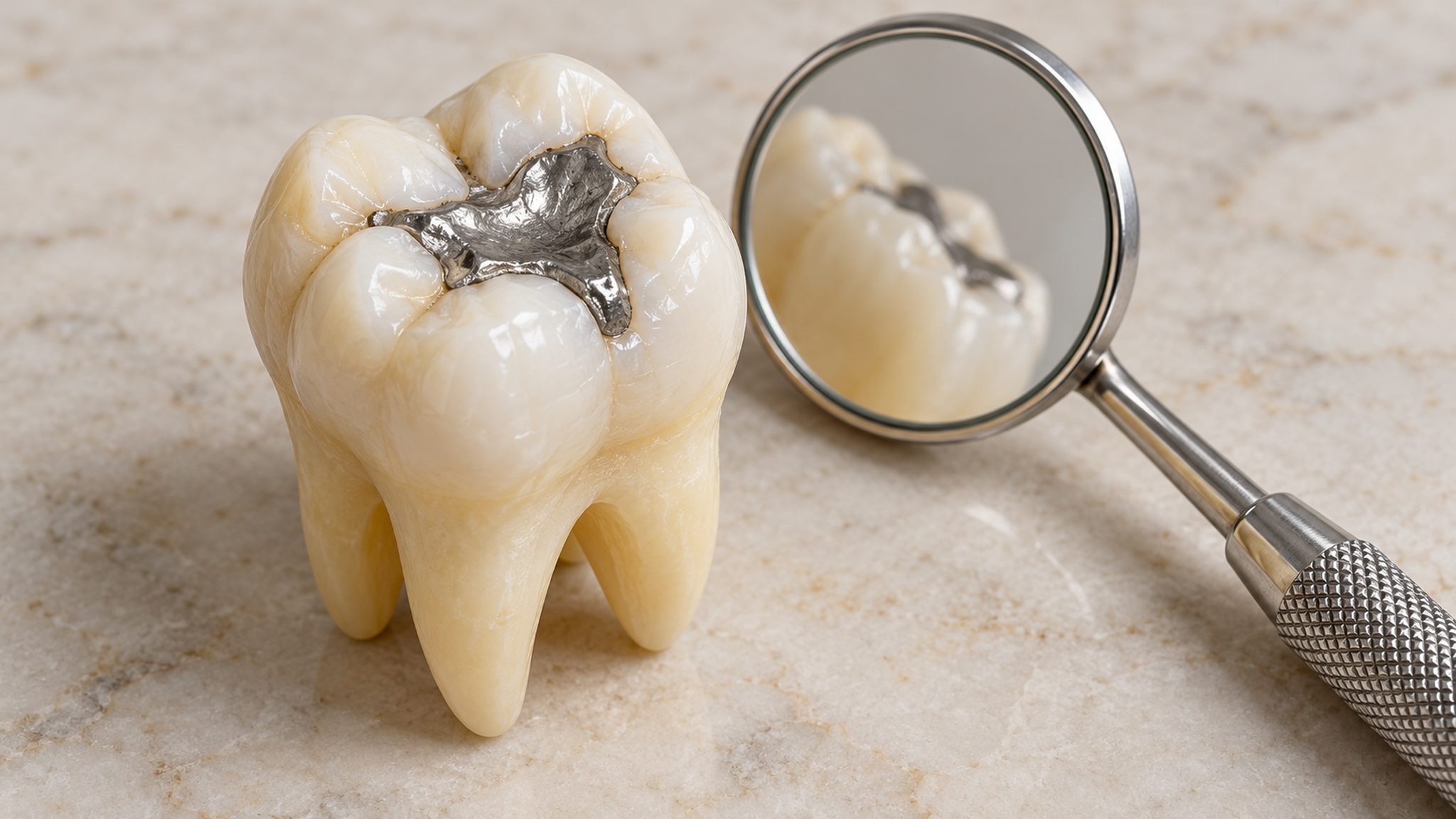
Dental amalgam is a filling material; its environmental significance comes from mercury moving through the material’s life cycle.
- Dental amalgam contains about half its weight as elemental mercury, combined with other metals. The concern extends beyond the finished filling to material handling, clinical waste and what happens after disposal.
- Mercury releases can occur when fillings are placed or removed and when waste is managed poorly. Waste entering water or soil links an individual dental practice to a wider environmental problem.
- Life-cycle control matters because mercury cannot be destroyed. WHO describes pathways through wastewater, air emissions and landfill leachate; moving waste into another stream does not eliminate the substance or its pollution potential.
- Prevention reduces the need for restorative treatment, while suitable mercury-free materials reduce new amalgam use. These measures address future demand; they do not make mercury-containing waste already generated disappear from the system.
- Mercury-free does not mean environmentally impact-free. WHO also identifies plastic waste, energy use and chemical releases associated with oral care, so procurement must consider material suitability and waste consequences together.
How Separators Interrupt the Wastewater Route
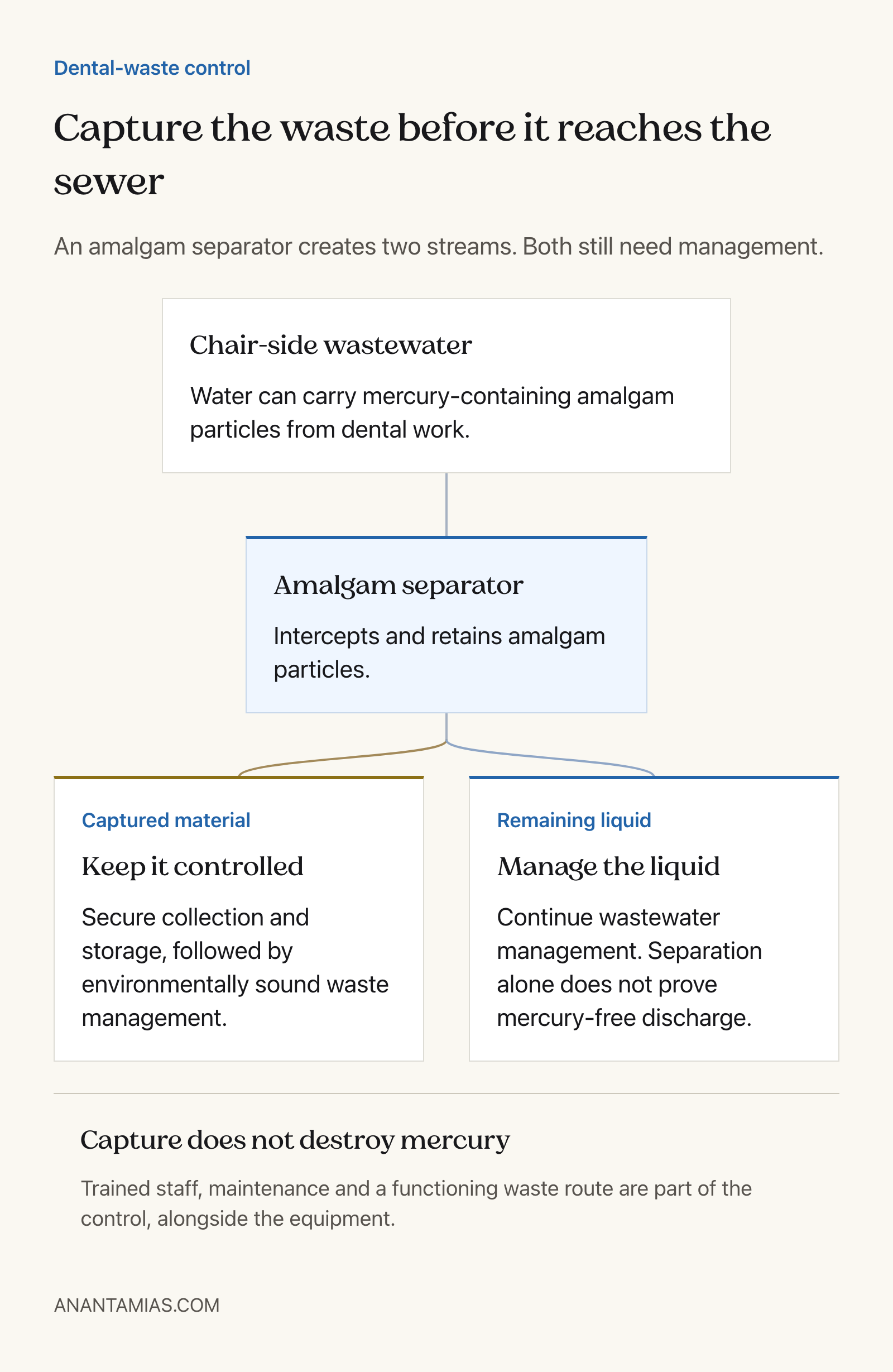
A separator provides an interception point before dental wastewater reaches the sewer, but the captured material still requires controlled handling.
- Chair-side drains can receive amalgam particles during placement or removal procedures. Without interception, this mercury-containing waste travels with wastewater towards sewage treatment, extending the pollution-control task beyond the clinic that generated it.
- The US Environmental Protection Agency explains that amalgam separators capture mercury and other metals before sewer discharge. This illustrates a control mechanism; American dental-effluent requirements are not Indian law.
- Capture is not destruction: separation creates a retained waste stream that must be collected and managed. The liquid continues along its wastewater route; neither stream becomes automatically safe merely because separation occurred.
- Sewage treatment can transfer mercury into sludge. EPA identifies subsequent pathways through sludge incineration, landfilling or land application, as well as water discharge; this is why upstream interception has an environmental purpose.
- Collection, storage and downstream management must accompany the device. Senegal’s pilot combined these steps, illustrating that equipment installation alone cannot substitute for trained personnel, maintenance and a functioning route for captured waste.
What the Dakar Meeting Changes—and What It Does Not
The current development is an implementation review, offering practical lessons for translating an existing international commitment into routine dental services.
- The Minamata Convention protects health and the environment from human-caused mercury emissions and releases. WHO places dental-amalgam provisions in Annex A and reports the COP-6 decision to phase out amalgam by 2034.
- The WHO 2030 target is different: 90% of countries should have implemented measures to phase down dental amalgam or phased it out. It measures country action, not a universal clinical deadline.
- Phase-down reduces use, whereas phase-out moves towards ending it. Confusing these terms obscures whether a country is improving practice, reducing demand or implementing the later endpoint agreed through the treaty process.
- Senegal’s experience linked a national assessment, coordination between health and environment authorities, professional training and waste controls. The lesson is institutional: material substitution works better when service delivery and environmental management develop together.
- Domestic implementation still needs applicable national measures and workable services. The Dakar report establishes neither a newly enacted Indian ban nor a reason to remove sound fillings; individual treatment decisions require professional clinical assessment.
Way Forward
Make the Entire Waste Route Accountable
- Pair professional training and suitable alternatives with prevention, so the transition protects treatment quality and affordability.
- Assess waste routes before buying equipment: identify who maintains separators, collects captured material and manages it downstream.
- Track implementation through functioning practices and waste handling, rather than counting devices installed or commitments announced.
Conclusion
- Dental mercury control requires both reduced use and control of waste already produced. A separator intercepts one pathway; safe collection and downstream management determine whether that interception delivers an environmental benefit.
- For an answer on sustainable healthcare, connect international commitments with everyday service capacity: trained professionals, affordable alternatives and waste accountability must operate together, with treaty deadlines distinguished from domestic legal measures.
UPSC Practice Questions
Prelims MCQ 1
With reference to dental amalgam and mercury control, consider the following statements:
- Amalgam separators destroy the mercury present in dental wastewater.
- Captured amalgam waste requires further management.
- The WHO 2030 country-action target is identical to the Minamata 2034 phase-out deadline.
How many of the above statements are correct?
(a) Only one (b) Only two (c) All three (d) None
Answer: (a) Only one
Explanation:
Only statement 2 is correct. Separators capture waste; they do not destroy mercury. The WHO target measures country action, while the Minamata decision concerns a phase-out endpoint.
Prelims MCQ 2
Why is interception of amalgam waste before it enters a sewer environmentally useful?
(a) It converts mercury into a harmless element. (b) It prevents the need for all wastewater treatment. (c) It reduces mercury entering sewage treatment and potentially transferring into sludge. (d) It makes captured waste suitable for unrestricted disposal.
Answer: (c) It reduces mercury entering sewage treatment and potentially transferring into sludge.
Explanation:
EPA describes mercury partitioning into sewage sludge and later environmental pathways. Interception reduces that input but does not replace wastewater treatment or controlled waste management.
UPSC Mains Questions
- Explain how dental-amalgam waste management illustrates the need for coordination between health and environmental regulators.
- Distinguish material substitution from pollution prevention at source. Discuss their complementary roles in sustainable oral healthcare.
Sources: WHO Regional Office for Africa and WHO.
Frequently Asked Questions
What is dental amalgam?
Dental amalgam is a filling material containing elemental mercury combined with other metals. Its environmental significance includes releases during handling, placement, removal and waste disposal, which require controls throughout the material’s life cycle.
What does an amalgam separator do?
It captures mercury-containing amalgam waste before it enters the sewer. It does not destroy mercury or complete wastewater treatment; the captured material still requires collection and environmentally sound management.
Did the Dakar meeting announce a new dental-amalgam ban?
No. It reviews implementation lessons from the GEF-7 project. WHO attributes the 2034 phase-out decision to Minamata COP-6 in 2025; the Dakar meeting itself does not establish a new Indian ban.
How does the WHO 2030 target differ from the 2034 phase-out?
WHO’s target concerns countries implementing phase-down measures or completing phase-out by 2030. The Minamata decision establishes a later phase-out endpoint. These are related but different measures of progress.
Tell Google you want more of this.
Add Anantam IAS as a preferred sourceOne tap, and this site shows up more often in your own Top Stories, AI Overviews and AI Mode. Remove it any time.