Why in News?
India’s Commerce Secretary met Chile’s Vice-Minister for International Economic Relations in Santiago on 26 August 2026 to advance the ongoing India-Chile CEPA negotiations.
- Both governments are working toward concluding negotiations by year-end, but this is a negotiating target, not a signed or operational agreement.
- The proposed Comprehensive Economic Partnership Agreement would build on the bilateral Preferential Trade Agreement rather than replace a vacuum in trade relations.
- Chile reported that most chapters were closed, while work continued on market-access conditions, critical minerals and other unresolved matters.
- The Indian side identified healthcare, pharmaceuticals, energy, minerals, agriculture, machinery and engineering as possible areas of deeper cooperation, without announcing negotiated concessions.
- The shift from selected tariff preferences to a wider negotiating agenda makes the talks a test of India’s economic engagement with Pacific South America.
- Chile’s copper and lithium base gives critical-mineral cooperation a strategic dimension beyond ordinary merchandise trade.
- The final value of a CEPA will depend on its agreed schedules, rules and implementation institutions; official expectations do not establish guaranteed market-access outcomes.
UPSC Relevance
Prelims Relevance
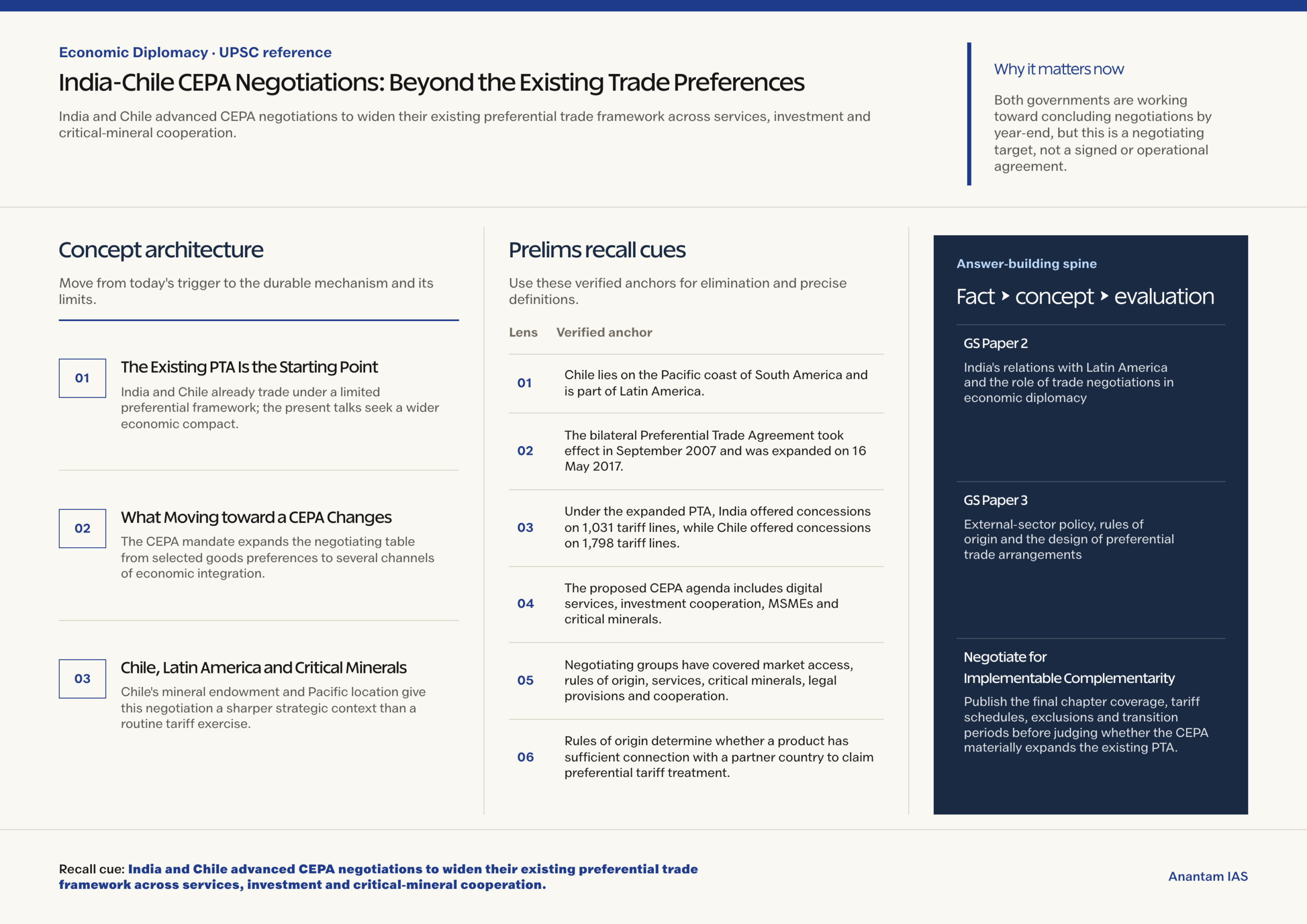
- Chile lies on the Pacific coast of South America and is part of Latin America.
- The bilateral Preferential Trade Agreement took effect in September 2007 and was expanded on 16 May 2017.
- Under the expanded PTA, India offered concessions on 1,031 tariff lines, while Chile offered concessions on 1,798 tariff lines.
- The proposed CEPA agenda includes digital services, investment cooperation, MSMEs and critical minerals.
- Negotiating groups have covered market access, rules of origin, services, critical minerals, legal provisions and cooperation.
- Rules of origin determine whether a product has sufficient connection with a partner country to claim preferential tariff treatment.
Mains Relevance
GS Paper 2
- India’s relations with Latin America and the role of trade negotiations in economic diplomacy
- South-South cooperation through balanced institutions rather than commodity exchange alone
GS Paper 3
- External-sector policy, rules of origin and the design of preferential trade arrangements
- Critical-mineral security, processing partnerships and resilient clean-energy supply chains
Essay
- A durable economic partnership must connect market access with technology, investment and resilient supply chains.
Background and Context
The Existing PTA Is the Starting Point
India and Chile already trade under a limited preferential framework; the present talks seek a wider economic compact.
- The India-Chile PTA was signed in March 2006, entered into force in September 2007 and was expanded by both countries in May 2017, giving it an established institutional base.
- A PTA grants tariff concessions on an agreed selection of goods; it does not automatically provide comprehensive treatment for services, investment or regulatory cooperation.
- The expanded arrangement covers selected agricultural and industrial products, including pharmaceuticals, chemicals, textiles, machinery, iron, steel and copper-related goods across the two countries’ schedules.
- It also contains product-specific rules of origin and protocols on sanitary measures and technical barriers, showing that even limited preferences require compliance rules.
- The negotiated tariff lines, concession margins and origin tests govern actual eligibility; the label preferential does not mean duty-free access for every product.
What Moving toward a CEPA Changes
The CEPA mandate expands the negotiating table from selected goods preferences to several channels of economic integration.
- The May 2025 Terms of Reference launched negotiations to build on the PTA and cover digital services, investment promotion and cooperation, MSMEs and critical minerals.
- Separate negotiating tracks on goods access, services and rules of origin matter because progress in one chapter does not settle obligations in another.
- Investment provisions can support longer business relationships, but their legal protections, exclusions and dispute arrangements depend on the text that the parties eventually accept.
- Services discussions are relevant to India’s digital and professional capabilities, yet no sector-specific access can be assumed until commitments and domestic regulatory conditions are published.
- Chile’s statement that most chapters are closed signals advanced drafting; unresolved access conditions can still shape the agreement’s commercial balance and timetable.
Chile, Latin America and Critical Minerals
Chile’s mineral endowment and Pacific location give this negotiation a sharper strategic context than a routine tariff exercise.
- Chile is a major producer and exporter of copper and lithium, materials central to electricity networks, batteries, renewable-energy systems and several advanced manufacturing chains.
- For India, cooperation could cover geological knowledge, responsible extraction, processing, recycling, technology and predictable commercial relationships rather than only purchases of unprocessed mineral output.
- For Chile, India offers another large Asian market and a possible partner for value addition, helping diversify commercial relationships without guaranteeing demand for any particular product.
- A minerals chapter cannot by itself secure supplies; projects still need finance, environmental safeguards, community legitimacy, processing capacity, logistics and contracts between viable commercial entities.
- The CEPA also fits India’s wider engagement with Latin America, where commodity complementarity must be matched by services, technology, investment, diversified trade and durable institutional contact beyond episodic diplomatic visits.
Way Forward
Negotiate for Implementable Complementarity
- Publish the final chapter coverage, tariff schedules, exclusions and transition periods before judging whether the CEPA materially expands the existing PTA.
- Design workable rules of origin and customs procedures that enable genuine bilateral production while preventing simple trans-shipment through either economy.
- Link critical-mineral cooperation to processing, recycling, skills, technology and transparent environmental standards instead of treating higher extraction volumes as the sole measure of success.
- Create regular government-business review channels to identify regulatory obstacles and assess whether smaller firms can use the agreement after implementation.
Conclusion
- The current development is progress in negotiations, not the conclusion of a CEPA; the 2007 PTA, as expanded in 2017, remains the operative trade arrangement.
- A balanced answer should explain the proposed shift toward services, investment and mineral cooperation, then test future claims against the signed text, schedules and implementation record.
UPSC Practice Questions
Prelims MCQ 1
With reference to India-Chile trade relations, consider the following statements:
- The bilateral Preferential Trade Agreement entered into force in 2007.
- The expanded PTA provides concessions on selected tariff lines rather than universal duty-free access.
- The India-Chile CEPA was signed in August 2026.
How many of the above statements are correct?
(a) Only one (b) Only two (c) All three (d) None
Answer: (b) Only two
Explanation:
Statements 1 and 2 are correct. India and Chile were still negotiating the CEPA in August 2026; no concluded agreement was announced.
Prelims MCQ 2
Which one of the following is included in the stated scope of the proposed India-Chile CEPA?
(a) A common currency (b) A bilateral military command (c) Critical-mineral cooperation (d) A common agricultural tax
Answer: (c) Critical-mineral cooperation
Explanation:
The Terms of Reference identify critical minerals alongside digital services, investment promotion and cooperation and MSMEs within the proposed CEPA’s broader scope.
UPSC Mains Questions
- The proposed India-Chile CEPA represents a shift from selective tariff preferences toward wider economic cooperation. Discuss its significance for India’s engagement with Latin America.
- Critical-mineral partnerships must extend beyond mineral imports to create resilient and responsible value chains. Examine with reference to India-Chile economic relations.
Sources: PIB, Ministry of Commerce and Industry and SUBREI, Government of Chile.
Frequently Asked Questions
Has India signed a CEPA with Chile?
No. As of 31 August 2026, the two countries were negotiating a CEPA and aiming for an early conclusion. The existing bilateral PTA remained in force.
How is the proposed CEPA different from the existing PTA?
The PTA grants concessions on selected goods. The CEPA negotiations have a wider stated scope covering services, investment cooperation, MSMEs, critical minerals and related institutional rules.
Why are critical minerals important in India-Chile relations?
Chile has substantial copper and lithium strengths, while India needs resilient inputs and processing partnerships for clean energy, electricity networks, batteries and advanced manufacturing.
What do rules of origin do in a trade agreement?
They establish when a product qualifies as originating in a partner country and can claim preferential tariffs, while limiting simple trans-shipment from third countries.
What should be watched as negotiations continue?
The decisive details are final tariff schedules, exclusions, transition periods, services commitments, origin rules, mineral-cooperation provisions and the institutions created to implement and review the agreement.
Tell Google you want more of this.
Add Anantam IAS as a preferred sourceOne tap, and this site shows up more often in your own Top Stories, AI Overviews and AI Mode. Remove it any time.