
Why in News?
India is estimated to have modestly expanded its nuclear arsenal in 2025 and continued developing new nuclear delivery systems, according to the Stockholm International Peace Research Institute (SIPRI) Yearbook 2026.
International Campaign to Abolish Nuclear Weapons (ICAN) reported a significant rise in global nuclear weapons expenditure in 2025, highlighting concerns about a renewed global nuclear arms race.
| UPSC Relevance: GS-2 International Relations: Reports and Indices; GS-3: Defence Technology Prelims: SIPRI Yearbook 2026: Key Highlights |
Key Findings of SIPRI Yearbook 2026:
1. India’s Nuclear Arsenal:
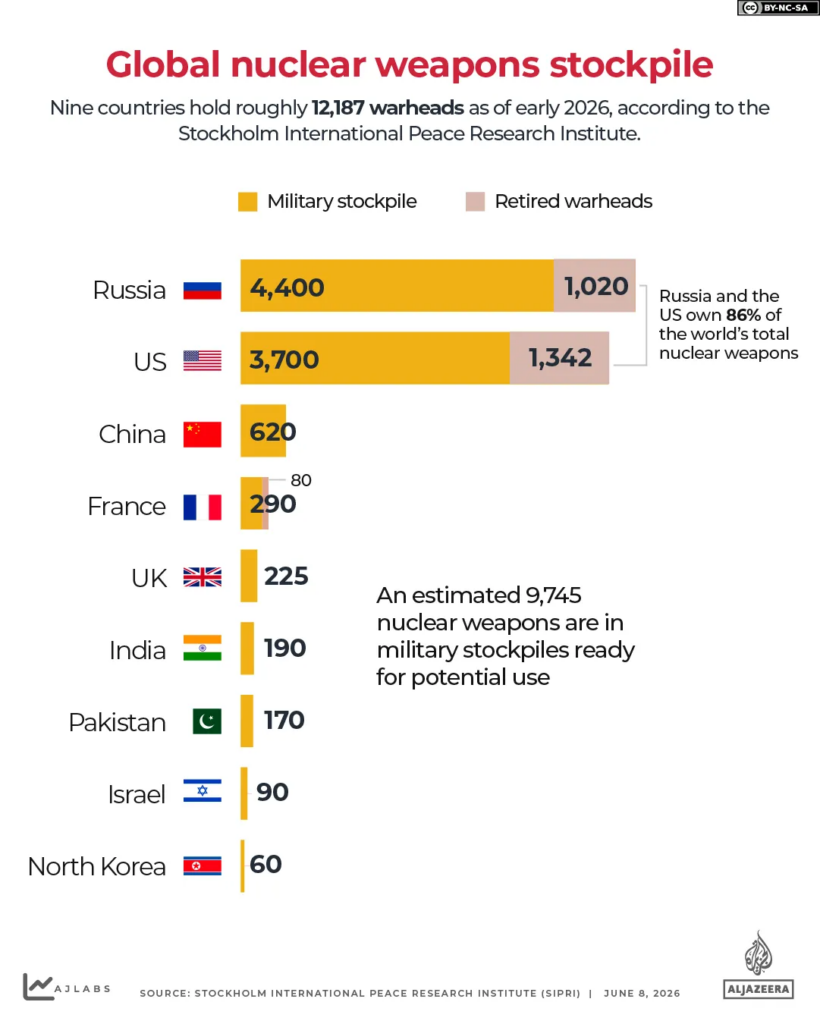
- India possessed approximately 190 nuclear warheads in early 2026. The stockpile increased from around 180 warheads in 2025.
- India continued to develop new long-range nuclear delivery systems. The modernisation programme increasingly focuses on longer-range capabilities capable of reaching targets across China.
Comparison:
- Pakistan is estimated to possess around 170 nuclear warheads.
- China remains the fastest-growing nuclear power with an estimated 620 nuclear warheads.
2. Global Nuclear Landscape:
- Nuclear-Armed States: Nine countries currently possess nuclear weapons:
- United States
- Russia
- United Kingdom
- France
- China
- India
- Pakistan
- North Korea
- Israel
- Together, they possessed approximately 12,187 nuclear warheads in early 2026. Around 9,745 warheads were in military stockpiles and potentially operational. Although total numbers continue to decline due to the dismantlement of retired warheads by the United States and Russia, operationally available nuclear weapons are increasing.
3. Military Expenditure: India’s Position
- India retained its position as the world’s fifth-largest military spender in 2025. SIPRI estimated India’s military expenditure at $92.1 billion, an increase of 8.9% over the previous year.
- The country ranked behind only the United States ($954 billion), China ($336 billion), Russia and Germany in defence spending.
Nuclear Spending:
According to ICAN estimates for 2025:
- According to ICAN’s latest assessment, India spent an estimated $2.5 billion on its nuclear weapons programme in 2025.
- The United States remained by far the largest spender, investing $69.2 billion in nuclear weapons last year, more than all other nuclear-armed countries combined.
- China emerged as the second-largest spender after the United States, allocating an estimated $13.5 billion towards its nuclear arsenal in 2025, more than five times India’s expenditure.
India’s Nuclear Doctrine:
India’s nuclear policy is built upon the principle of credible minimum deterrence.
- No First Use (NFU): India pledges not to use nuclear weapons first but reserves the right to retaliate massively if attacked with nuclear weapons.
- Credible Minimum Deterrence: India seeks only the minimum nuclear capability required to deter adversaries rather than pursuing numerical parity.
- Civilian Political Control: Nuclear weapons remain under civilian oversight through the Nuclear Command Authority.
- Assured Retaliation: India aims to maintain a survivable second-strike capability.
India’s Nuclear Triad:
A mature nuclear deterrent requires delivery capabilities from land, air and sea.
- Land-Based Systems
- Agni series ballistic missiles
- Agni-V and emerging longer-range systems
- Air-Based Systems: Modified fighter aircraft capable of delivering nuclear weapons
- Sea-Based Systems:
- Nuclear-powered ballistic missile submarines (SSBNs)
- K-series submarine-launched ballistic missiles
The sea-based component significantly enhances survivability and second-strike capability.
The expiry of New START-related limits and the failure of the 2026 Nuclear Non-Proliferation Treaty Review Conference to produce a final outcome document indicate growing stress in the global nuclear arms control regime. SIPRI warns that the absence of strategic dialogue and rising opacity may increase nuclear risks.
About Stockholm International Peace Research Institute:
- SIPRI is an independent international institute dedicated to research into conflict, armaments, arms control and disarmament.
- Established in 1966, it publishes reports on global arms transfers, tracking trends in arms imports and exports to provide data-driven insights for policy-making in global security and military affairs.
Tell Google you want more of this.
Add Anantam IAS as a preferred sourceOne tap, and this site shows up more often in your own Top Stories, AI Overviews and AI Mode. Remove it any time.