Why in News?
On 3-4 July 2025, the Indian Prime Minister paid an official visit to the Republic of Trinidad and Tobago at the invitation of Prime Minister Kamla Persad-Bissessar. PMINDIA’s joint statement called it the first bilateral visit by an Indian PM in 26 years, last held in 1999, and timed it to the 180th anniversary of the 1845 arrival of Indian indentured immigrants.
India announced it would issue Overseas Citizenship of India (OCI) cards up to the sixth generation of the Trinidad and Tobago diaspora, up from the fourth, and welcomed Trinidad & Tobago becoming the first Caribbean country to adopt the Unified Payments Interface (UPI).
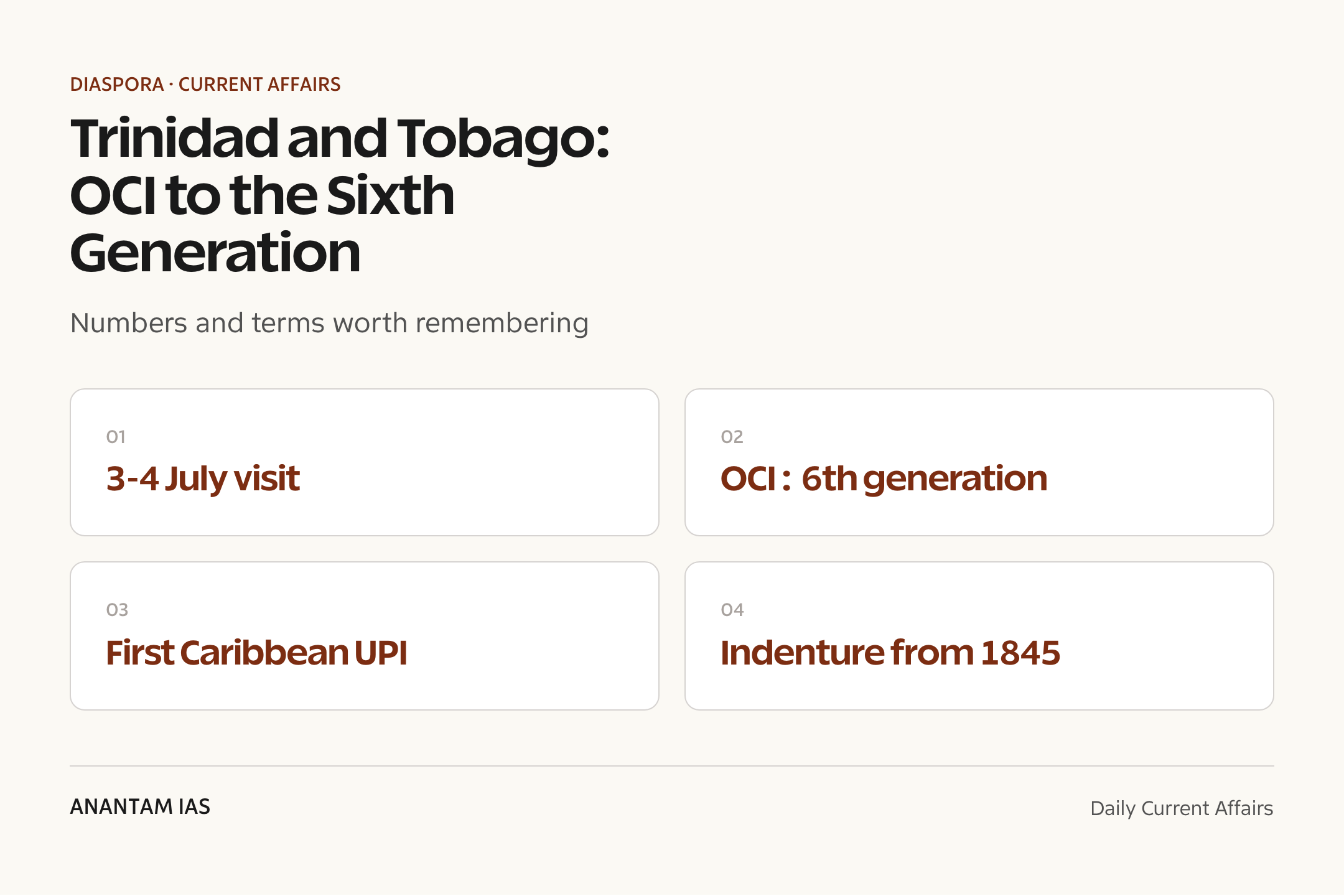
- Visit dates: 3-4 July 2025; first bilateral Indian-PM visit in 26 years (since 1999).
- Six MoUs/agreements signed across pharmaceuticals, development cooperation, academia, cultural exchange, diplomatic training and sports.
- OCI eligibility extended to the sixth generation of the Indian-origin diaspora in Trinidad & Tobago.
- Trinidad & Tobago became the first Caribbean nation to adopt UPI, India’s flagship digital payments rail.
- PM conferred the Order of the Republic of Trinidad and Tobago, the country’s highest national honour, by President Christine Kangaloo.
- Tangible support: 2,000 laptops, USD 1 million agro-machinery for NAMDEVCO, 20 haemodialysis units, 2 sea ambulances and an 85-slot annual ITEC quota.
The development matters in the context of:
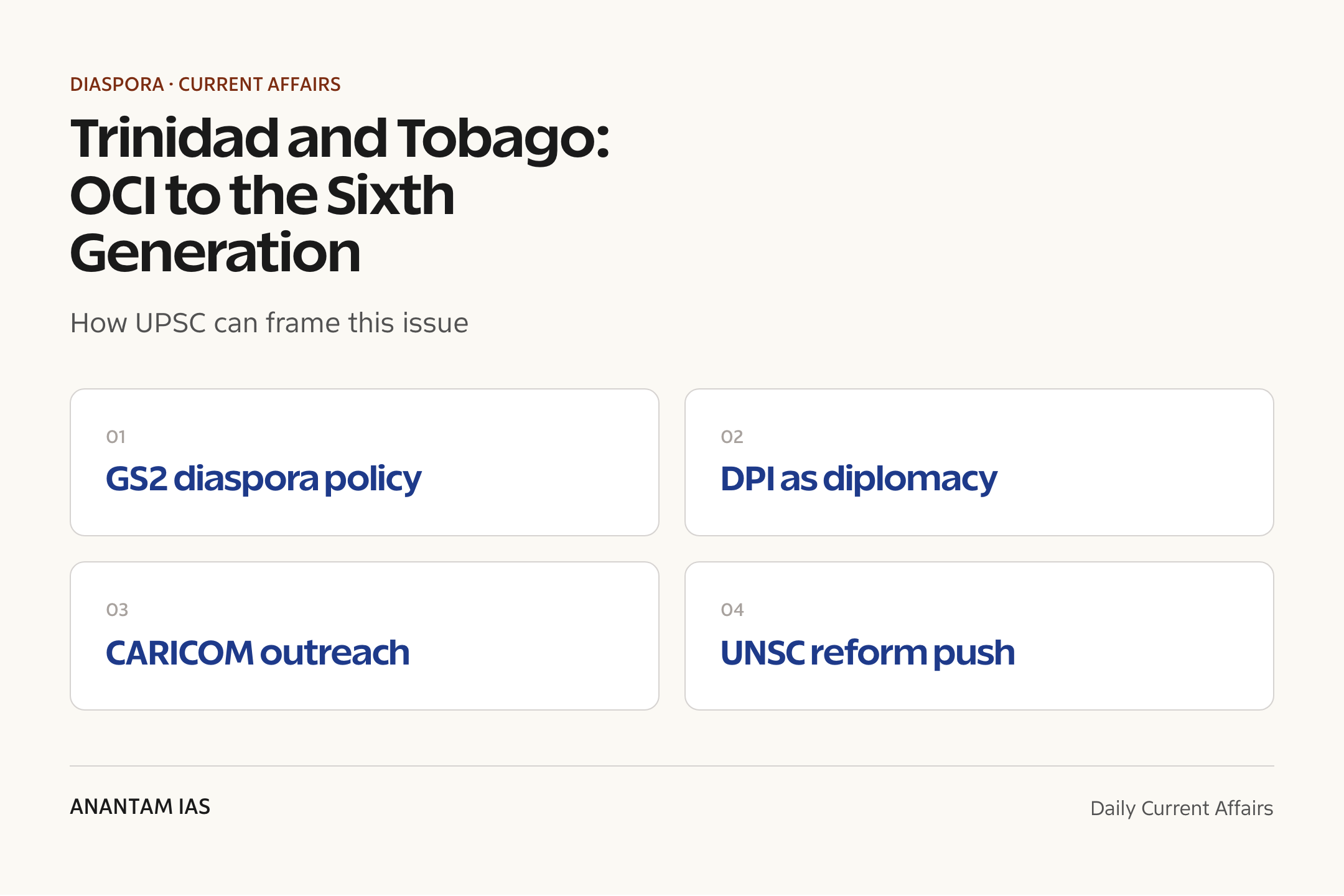
- Anchors India’s diaspora diplomacy in the deep history of 19th-century indentured migration to the Caribbean.
- Shows the export of Digital Public Infrastructure (DPI) — UPI and India Stack — as a tool of foreign policy.
- Strengthens India’s outreach to CARICOM and the Global South ahead of UN reform pushes.
UPSC Relevance
Prelims Relevance
- OCI is a lifelong visa-cum-residency status, not dual citizenship; India’s Constitution bars dual citizenship.
- OCI is governed by the Citizenship Act, 1955 (Section 7A inserted by the 2005 amendment), replacing the earlier PIO card scheme merged in 2015.
- First Indian indentured immigrants reached Trinidad on 30 May 1845 aboard the ship Fath Al Razack.
- UPI is operated by the National Payments Corporation of India (NPCI); Trinidad & Tobago is the first Caribbean adopter.
- CARICOM is the Caribbean Community; the 2nd India-CARICOM Summit was held in November 2024.
- Trinidad & Tobago joined the Coalition for Disaster Resilient Infrastructure (CDRI) and the Global Biofuel Alliance.
- The Mahatma Gandhi Institute for Cultural Cooperation in Port of Spain was established in 1997.
- India will support Trinidad & Tobago’s UNSC non-permanent seat bid for 2027-28; T&T backs India for 2028-29.
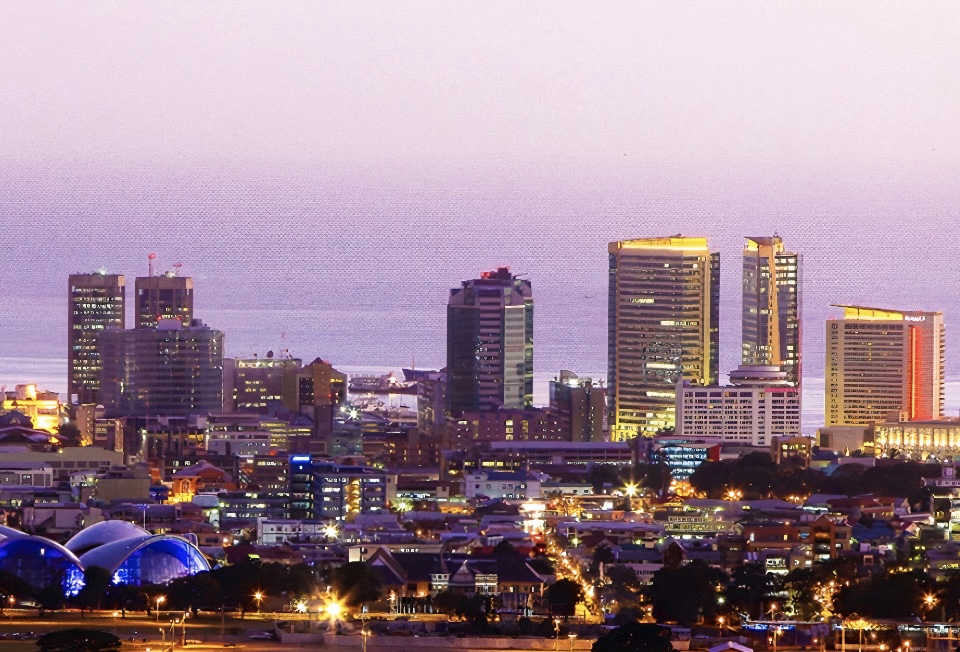
- Capital of Trinidad & Tobago: Port of Spain; it lies off the coast of Venezuela.
- India Stack components offered: DigiLocker, e-Sign and the Government e-Marketplace (GeM).
Mains Relevance
GS Paper 2
- Diaspora as a soft-power and foreign-policy asset: how OCI policy and cultural ties advance Indian interests in the Caribbean.
- Bilateral relations and groupings (CARICOM, Global South) and India’s push for UN Security Council reform and expansion.
GS Paper 1
- The social history of 19th-century indentured (‘girmitiya’) migration and the formation of the overseas Indian community.
GS Paper 3
- Digital Public Infrastructure as an export: UPI and India Stack as instruments of techno-diplomacy.
Essay
- Roots and wings: how a diaspora carries a civilisation across oceans.
- Technology as the new language of diplomacy.
Background and Context
From indenture to identity: the historical thread
The visit was deliberately framed around a 180-year-old migration story.
- On 30 May 1845, the first ship of Indian indentured labourers reached Trinidad to work the sugar estates after the abolition of slavery.
- These ‘girmitiya’ workers (from the English word ‘agreement’) signed indenture contracts that bound them for fixed terms on plantations across the Caribbean, Fiji, Mauritius and beyond.
- People of Indian origin now form a large share of Trinidad & Tobago’s population, sustaining Bhojpuri-rooted culture, Hinduism, Islam and Indian music such as chutney and steel-pan fusion.
- Both leaders flagged Nelson Island as a site of cultural tourism and called for digitisation of Indian arrival records at the National Archives.
OCI to the sixth generation: what changed
The headline announcement reset the depth of eligibility for the diaspora.
- India will now issue OCI cards up to the sixth generation of the Indian diaspora of Trinidad & Tobago, raising the bar from the fourth generation.
- OCI grants lifelong, multiple-entry visa-free travel and the right to live and work in India without restrictions, but it is not citizenship and carries no vote or public-office rights.
- It rests on the Citizenship Act, 1955; the scheme was created by the 2005 amendment and absorbed the older PIO card in 2015.
- The deeper reach matters because Caribbean Indian-origin families are many generations removed from the original migrants, so a fourth-generation cap excluded most.
UPI and the India Stack export
Digital Public Infrastructure was the standout cooperation lever.
- Trinidad & Tobago became the first Caribbean country to adopt UPI, India’s interoperable real-time payments system run by NPCI.
- Both sides agreed to explore DigiLocker, e-Sign and the Government e-Marketplace (GeM) as part of the broader India Stack.
- Trinidad & Tobago sought Indian help to digitise and upgrade its state land-registration system.
- The pitch positions DPI as a low-cost development good, extending the model already taken to the UAE, Singapore, France, Sri Lanka, Mauritius and Nepal.
The deliverables: MoUs, gifts and grants
The visit produced a dense package of concrete commitments.
- Six MoUs/agreements spanning pharmaceuticals, development cooperation, academia, cultural exchange, diplomatic training and sports.
- Gifts: 2,000 laptops for education, USD 1 million of agro-machinery for NAMDEVCO, 20 haemodialysis units and 2 sea ambulances.
- Health: recognition of the Indian Pharmacopoeia to ease access to affordable generics, plus a prosthetic-limb camp for 800 people.
- A MoU on Quick Impact Projects for community development, and renewal of the cultural-exchange programme (2025-28) under the Mahatma Gandhi Institute.
The wider geopolitics: CARICOM, Global South, UN reform
The bilateral fed directly into India’s multilateral strategy.
- Both sides built on the 2nd India-CARICOM Summit (November 2024) and pledged faster implementation.
- Trinidad & Tobago joined the CDRI and the Global Biofuel Alliance, India-led climate and energy coalitions.
- A reciprocal UNSC arrangement: India backs T&T’s non-permanent bid for 2027-28; T&T backs India for 2028-29 and India’s permanent-seat claim.
- Both reaffirmed amplifying the Global South and comprehensive UN reform, including Security Council expansion.
Why diaspora diplomacy works for India
The episode is a textbook case of culture-led statecraft.
- A ~32-million-strong overseas Indian network is the world’s largest diaspora and India’s top source of remittances.
- Engagement runs through Pravasi Bharatiya Divas, the OCI scheme and the Ministry of External Affairs’ diaspora wing.
- Soft-power tools deployed here included Yoga training, Hindi and Indian-studies academic chairs at the University of the West Indies, and training for temple Pundits.
- The diaspora becomes a constituency that smooths trade, investment and political access in host states.
Way Forward
Operationalise the announcements
- Notify the sixth-generation OCI rule with clear documentary norms so descendants can prove lineage without bureaucratic friction.
- Move the six MoUs from signature to delivery with timelines, especially Quick Impact Projects and the NAMDEVCO machinery.
Deepen the digital and people links
- Scale UPI usage with merchant onboarding and follow through on DigiLocker, e-Sign and GeM pilots.
- Expand scholarships, ITEC slots and academic chairs to keep the next generation tethered to India.
Sustain the CARICOM and Global South push so a single high-profile visit matures into durable, institutionalised engagement rather than a one-off.
Conclusion
The visit fused history and futurism: a 180-year-old indentured-migration story anchored a modern package of OCI reform, UPI export and development grants. For UPSC, it is a clean case study in how India converts diaspora ties and Digital Public Infrastructure into foreign-policy capital.
The sixth-generation OCI move signals that India sees its overseas communities as a strategic, multi-generational asset. The real test is delivery — turning signed MoUs and announced gifts into lived cooperation across the Caribbean.
UPSC Practice Questions
Prelims MCQ 1
With reference to the Overseas Citizen of India (OCI) scheme, consider the following statements:
- OCI status confers dual citizenship and the right to vote in India.
- The OCI scheme is provided for under the Citizenship Act, 1955.
- In 2015, the Person of Indian Origin (PIO) card scheme was merged with the OCI scheme.
How many of the above statements are correct?
(a) Only one (b) Only two (c) All three (d) None
Answer: (b) Only two
Explanation:
Statement 1 is wrong: OCI is not dual citizenship and gives no voting rights, as India’s Constitution bars dual citizenship. Statements 2 and 3 are correct: OCI flows from the Citizenship Act, 1955, and the PIO card was merged into OCI in 2015.
Prelims MCQ 2
Trinidad and Tobago, in news during a 2025 Indian PM visit, became the first country in which region to adopt India’s Unified Payments Interface (UPI)?
(a) Sub-Saharan Africa (b) The Caribbean (c) Central Asia (d) The Pacific Islands
Answer: (b) The Caribbean
Explanation:
Per PMINDIA’s joint statement, Trinidad and Tobago became the first Caribbean country to adopt UPI, India’s flagship digital payments platform operated by NPCI.
UPSC Mains Questions
- India’s 2025 outreach to Trinidad and Tobago has been described as diaspora diplomacy in action. Examine how India leverages its overseas community as an instrument of foreign policy, with reference to the OCI scheme and cultural soft power. (250 words)
- Digital Public Infrastructure is emerging as a new currency of Indian diplomacy. Discuss the significance of exporting UPI and the India Stack to partner countries, and the challenges involved. (250 words)
Sources: PMINDIA, Prime Minister's Office and NewsOnAir, Prasar Bharati.
Frequently Asked Questions
What is the OCI scheme in simple terms?
Overseas Citizenship of India (OCI) is a lifelong, multiple-entry status for foreign nationals of Indian origin or their spouses. It allows visa-free travel and the right to live and work in India without restrictions. It is not dual citizenship: an OCI holder cannot vote, hold constitutional office, or buy agricultural land in India.
What changed for Trinidad & Tobago’s diaspora in July 2025?
India announced it would issue OCI cards up to the sixth generation of the Indian-origin diaspora in Trinidad & Tobago, deepening eligibility from the fourth generation. Because Caribbean Indian families are many generations removed from the 1845 indentured migrants, the wider reach lets far more descendants qualify.
Why is 1845 significant for India-Trinidad ties?
On 30 May 1845, the first ship of Indian indentured labourers reached Trinidad to work sugar estates after slavery was abolished. The July 2025 visit was timed to the 180th anniversary of this arrival, anchoring modern diplomacy in a deep, shared migration history.
Why does UPI adoption by Trinidad & Tobago matter?
Trinidad & Tobago became the first Caribbean country to adopt UPI, India’s real-time digital payments system run by NPCI. It shows India exporting its Digital Public Infrastructure as a development tool and soft-power asset, alongside DigiLocker, e-Sign and the Government e-Marketplace.
What is the UNSC arrangement the two countries agreed?
They agreed reciprocal support for UN Security Council seats. India will back Trinidad & Tobago’s bid for a non-permanent seat for 2027-28, while Trinidad & Tobago will support India’s non-permanent candidature for 2028-29 and India’s claim to a permanent seat in a reformed Council.
What is CARICOM and how does it relate to this visit?
CARICOM, the Caribbean Community, is a regional bloc of Caribbean states. The visit built on the 2nd India-CARICOM Summit held in November 2024, with both sides pledging to speed up its initiatives as India expands engagement with the Caribbean and the wider Global South.
Tell Google you want more of this.
Add Anantam IAS as a preferred sourceOne tap, and this site shows up more often in your own Top Stories, AI Overviews and AI Mode. Remove it any time.