Why in News?
The External Affairs Minister of India and his Indonesian counterpart co-chaired the 8th Indonesia-India Joint Commission Meeting in New Delhi.
The Prime Minister of India is scheduled to visit Indonesia in July 2026 as part of a broader three-nation Indo-Pacific tour that will also include stops in New Zealand and Australia.
| UPSC Relevance: GS-2 International Relations: Bilateral Relations Mains: India-Indonesia Relations |
8th India-Indonesia Joint Commission Meeting:
- The two Ministers reviewed the full spectrum of bilateral relations under the India-Indonesia Comprehensive Strategic Partnership and discussed avenues for further strengthening cooperation in political, defence and security, maritime, trade and investment, pharma and healthcare, digital, energy, connectivity, space, education, consular and culture domains, and people-to-people exchanges.
The Ministry of External Affairs (MEA) reaffirmed that Indonesia is a key pillar of India’s Act East Policy.
India-Indonesia Relations: A Key Pillar of India’s Act East Policy
India and Indonesia are two major maritime democracies of the Indo-Pacific. Both are large, developing economies, members of the G20, and important voices of the Global South.
For India, Indonesia is not merely another ASEAN partner. It is central to India’s Act East Policy, Indo-Pacific strategy and maritime security architecture.
For Indonesia, India provides a major economic, defence and diplomatic partner beyond its traditional engagements with China, Japan, Australia and the West.
Historical and Civilisational Linkages:
- India and Indonesia share deep cultural and civilisational ties dating back to ancient maritime trade across the Bay of Bengal and the Indian Ocean.
- The Ramayana and Mahabharata continue to have a strong cultural presence in Indonesia, especially in Java and Bali.
- The Bali Yatra festival in Odisha commemorates ancient maritime links between eastern India and Southeast Asia. These cultural memories provide a soft-power foundation for modern diplomacy.
Evolution of Bilateral Relations:
- India and Indonesia established diplomatic relations in 1950. Both countries were active supporters of decolonisation and played a major role in the Bandung Conference of 1955, which laid the foundation for Afro-Asian solidarity and later the Non-Aligned Movement.
- In the post-Cold War period, relations gained momentum through India’s Look East Policy, later upgraded to the Act East Policy.
- In 2018, during the Indian Prime Minister’s visit to Jakarta, the relationship was elevated to a Comprehensive Strategic Partnership.
- Both countries have adopted the Shared Vision of India-Indonesia Maritime Cooperation in the Indo-Pacific, giving a clear maritime and strategic orientation to the partnership.
Key Pillars of India-Indonesia Relations:
Strategic and Maritime Cooperation:
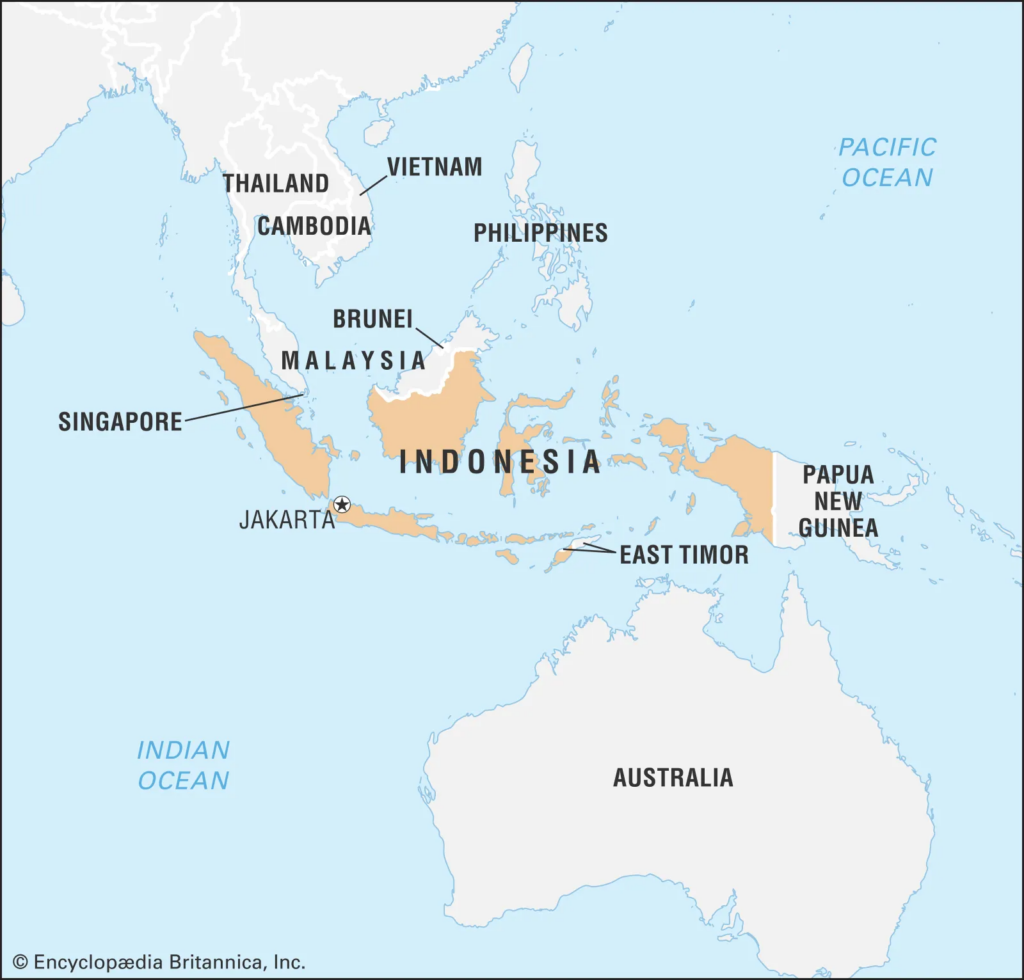
- Indonesia’s location makes it crucial for India’s maritime strategy. It sits at the junction of the Indian and Pacific Oceans and controls access to key sea lanes, including the Malacca, Sunda and Lombok Straits. These routes are vital for India’s trade, energy security and naval mobility.
- India and Indonesia share concerns over piracy, illegal fishing, trafficking, maritime terrorism and unilateral attempts to alter the status quo in the Indo-Pacific. Their cooperation includes naval exercises such as Samudra Shakti, coordinated patrols, staff-level talks and port calls.
- The 2018 Shared Vision on Maritime Cooperation provides a framework for cooperation in maritime safety, blue economy, disaster risk reduction, connectivity and freedom of navigation.
- The development of Sabang Port near the Strait of Malacca has also been discussed as a strategic connectivity opportunity.
Defence and Security Cooperation:
- A major area of discussion has been Indonesia’s interest in the BrahMos supersonic cruise missile system, jointly developed by India and Russia. If finalised, such a deal would strengthen India’s position as a defence exporter and deepen strategic trust with Indonesia.
- Both countries cooperate on counter-terrorism, cyber security, de-radicalisation and intelligence-sharing, which are significant given the presence of transnational extremist networks in the wider Indo-Pacific region.
Economic and Trade Relations:
- Indonesia is currently India’s second-largest trade partner in the ASEAN grouping, and two-way trade has increased from $4.3 billion in 2005-06 to $28.15 billion in 2024-25. India is the second largest buyer of coal and the biggest buyer of crude palm oil from Indonesia. However, the trade relationship is marked by a large trade deficit for India, mainly due to high imports of coal and palm oil.
- Indonesia is rich in nickel, tin, bauxite and other minerals that are vital for electric vehicles, batteries and clean energy technologies. India’s growing focus on critical mineral security makes Indonesia a natural partner in building resilient supply chains.
ASEAN and Act East Policy:
- Indonesia is the largest country in ASEAN by population, geography and economy. Indonesia can help India deepen its presence in Southeast Asia, especially as India seeks to balance China’s growing influence in the region.
Indo-Pacific and Regional Order:
- India and Indonesia share a vision of an open, inclusive, rules-based Indo-Pacific. Both support freedom of navigation, peaceful settlement of disputes and respect for international law, including the United Nations Convention on the Law of the Sea (UNCLOS). Their partnership can help prevent the Indo-Pacific from becoming a theatre of great-power rivalry alone.
Multilateral Cooperation:
- India and Indonesia cooperate in several multilateral forums, including the United Nations, G20, ASEAN-led mechanisms, the Indian Ocean Rim Association and BRICS.
- Indonesia became a full member of BRICS in 2025, creating an additional platform for India-Indonesia cooperation on Global South issues.
Significance for India:
India-Indonesia relations are significant for five major reasons.
- Indonesia strengthens India’s Act East Policy by serving as a gateway to ASEAN and the wider Indo-Pacific.
- Maritime cooperation with Indonesia helps India secure vital sea lanes and strengthen its presence near the Malacca Strait.
- Indonesia supports India’s energy and critical mineral security through coal, palm oil, nickel and other resources.
- The partnership helps India expand its defence exports and security cooperation in Southeast Asia.
- Cooperation with Indonesia enhances India’s Global South diplomacy, especially in G20, BRICS, ASEAN-led forums and climate negotiations.
Challenges in India-Indonesia Relations:
Despite strong potential, the relationship faces several constraints.
- Trade Imbalance: India runs a significant trade deficit with Indonesia due to high imports of coal and palm oil. Without diversification, economic ties may remain commodity-heavy and vulnerable to price shocks.
- Underdeveloped Connectivity: Direct shipping, air connectivity and business linkages remain below potential. Weak connectivity limits tourism, investment and supply-chain integration.
- China Factor: Indonesia has deep economic ties with China, especially in infrastructure, mining and investment. While Indonesia follows an independent foreign policy, China’s influence can shape its strategic choices.
- Slow Defence Deals: Although defence cooperation is growing, major defence transactions such as the BrahMos deal have moved slowly. Bureaucratic delays, financing issues and competing suppliers remain obstacles.
- Limited Public Awareness: Despite civilisational links, India and Indonesia do not occupy enough space in each other’s public imagination. Cultural diplomacy remains underutilised.
A stronger India-Indonesia partnership can help create a more balanced, inclusive and rules-based Indo-Pacific order.
Mains Practice Question:
India-Indonesia relations are central to India’s Act East Policy and Indo-Pacific vision. Discuss the strategic, economic and maritime dimensions of the partnership.
Tell Google you want more of this.
Add Anantam IAS as a preferred sourceOne tap, and this site shows up more often in your own Top Stories, AI Overviews and AI Mode. Remove it any time.