Why in News?
Recently, the Indian Navy took delivery of INS Mahendragiri, the sixth ship of the Nilgiri-class (Project 17A) and the fourth constructed by Mazagon Dock Shipbuilders Limited in Mumbai.
| UPSC Relevance: GS-3 Science and Technology: Defence Technology Prelims: INS Mahendragiri; Nilgiri-class frigates; Project 17A |
About INS Mahendragiri:
- INS Mahendragiri is a state-of-the-art stealth guided-missile frigate designed as a versatile multi-mission platform to tackle contemporary and future maritime challenges.
- Designed by the Warship Design Bureau (Indian Navy’s in-house design organisation) and built by Mazagon Dock Shipbuilders Limited, Mumbai.
- The ship displaces approximately 6,670 tonnes and represents a generational leap in indigenous naval architecture.
The frigate is named “Mahendragiri” after the mountain range Mahendragiri, a prominent peak in the Eastern Ghats.
Project 17A (Nilgiri-Class Frigates):
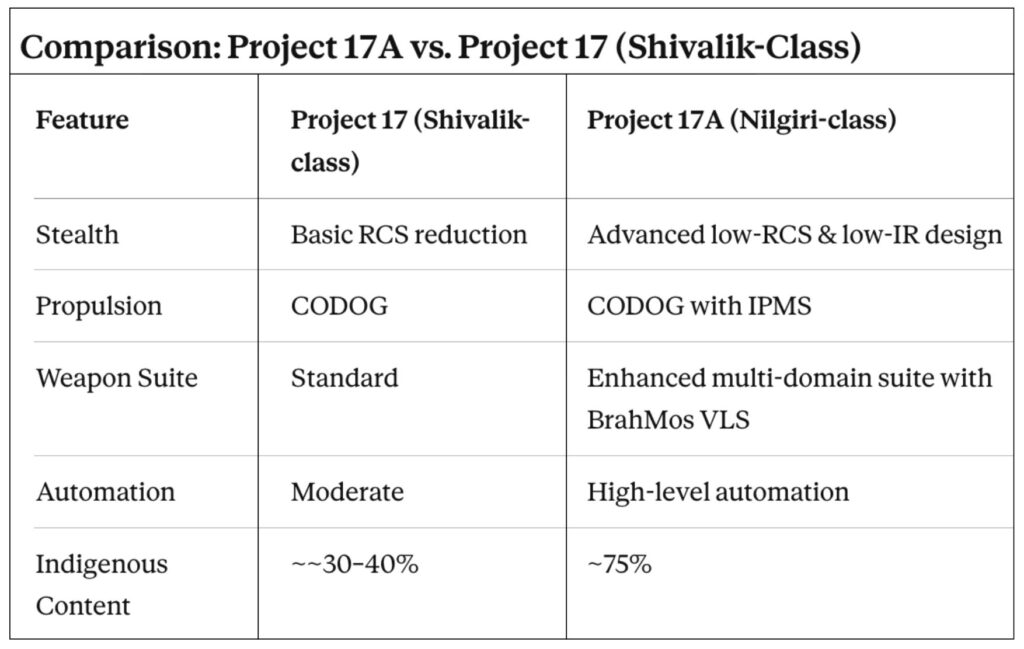
- Project 17A is the follow-on programme to the earlier Shivalik-class frigates (Project 17).
- In 2015, the Cabinet Committee on Security (CCS) approved the project at a total cost of over ₹45,300 crore to induct seven vessels.
- MDSL (Mumbai): Contracted to build four frigates
- GRSE (Kolkata): Contracted to build three frigates
- The seven ships of this class include: INS Nilgiri, INS Himgiri, INS Udaygiri, INS Dunagiri, INS Taragiri,, INS Mahendragiri, and INS Vindhyagiri.
Key Features and Capabilities of Project 17A:
- Stealth Design: The Nilgiri-class frigates are built with low radar cross-section (RCS) and reduced infrared signature, making them significantly harder to detect by adversary sensor systems compared to the Shivalik-class.
- Propulsion: P17A ships are configured with Combined Diesel or Gas (CODOG) propulsion plants, comprising a diesel engine and a gas turbine, and are managed through an integrated platform management system.
- Automation and Survivability: High levels of automation reduce crew requirements and improve operational efficiency. Enhanced damage-control and survivability systems ensure better resistance in combat scenarios.
Weapon Systems in INS Mahendragiri:
The frigates carry a potent multi-domain weapon package:
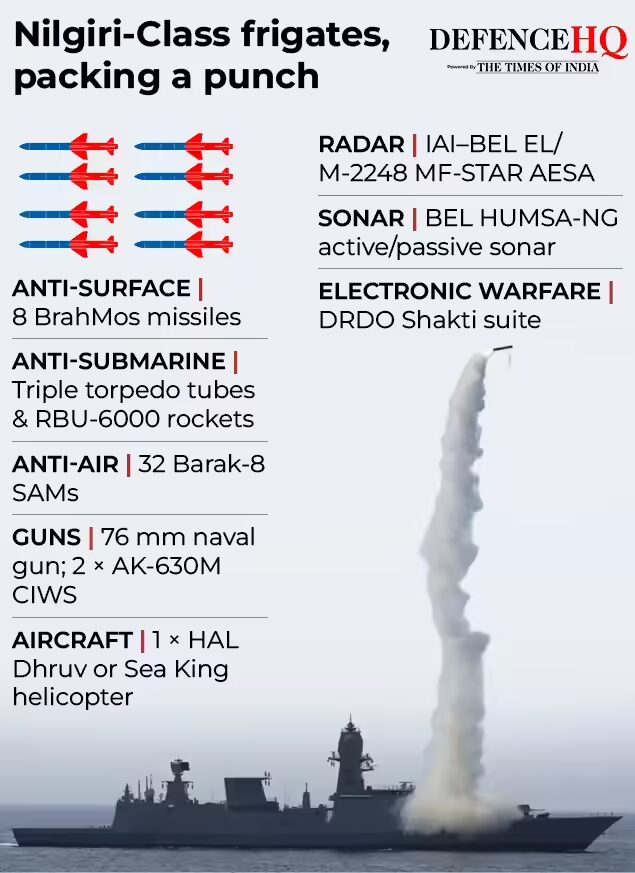
- Anti-Ship & Land Attack: 8 BrahMos supersonic cruise missiles housed in a vertical launch system (VLS), capable of striking targets with extreme precision and speed.
- Air Defence: 32 Barak-8 (LR-SAM) missiles in 4 × 8-cell VLS configurations. These missiles provide a 360-degree protective shield against aircraft, cruise missiles, and ballistic threats at ranges up to 100 km.
- Main Artillery: 1 × BHEL-manufactured OTO Melara 76 mm Super Rapid Gun Mount (SRGM) for surface and air targets.
- Close-In Weapon System (CIWS): 2 × AK-630M 30 mm rapid-fire guns for “last-ditch” defence against incoming missiles and aircraft.
- Anti-Submarine Warfare (ASW):
- Triple-tube torpedo launchers for firing indigenously developed Varunastra or TAL Shyena lightweight torpedoes.
- RBU-6000 (Rocket Launchers) for firing ASW projectiles to depths of 1000 meters.
Sensor Suite & Electronics in INS Mahendragiri:
- Primary Radar: EL/M-2248 MF-STAR AESA radar, an advanced S-band system capable of simultaneous tracking and missile guidance for multiple air and surface threats.
- Sonar Suite: BEL HUMSA-NG bow-mounted active/passive sonar, often complemented by a towed array sonar for detecting deep-water or stealthy submarines.
- Electronic Warfare (EW): Shakti EW suite (developed by DRDO/BEL) for electronic support, interception, and jamming, alongside Kavach decoy launchers for missile defence.
- Combat Management System: CMS-17A, which integrates all onboard sensors and weapons into a unified command-and-control interface.
Significance:
- Aatmanirbharta (Self-Reliance): 75% indigenous content across all P17A ships. Over 200 MSMEs involved in construction at MDSL alone. Direct employment of approximately 4,000 personnel and indirect employment of over 10,000 personnel.
- Strategic Importance: The Nilgiri-class frigates are slated to form part of the Eastern Fleet as well as the Carrier Battle Group (CBG) of INS Vikrant, India’s first indigenous aircraft carrier. Their induction significantly enhances India’s:
- Maritime surveillance capabilities across the Indian Ocean Region (IOR)
- Blue-water deterrence against surface, sub-surface, and aerial threats
- Rapid power-projection capacity in the Indo-Pacific.
The navy is working on the Next Generation Frigates (NGF), under Project 17B, a follow-on for the Nilgiri-class.
Practice MCQ:
Q. Consider the following statements regarding INS Mahendragiri and Project 17A:
1. INS Mahendragiri is a stealth guided-missile frigate designed for multi-mission roles.
2. It has been constructed by Mazagon Dock Shipbuilders Limited in Mumbai.
3. Project 17A is a continuation of the Shivalik-class frigates programme.
4. INS Mahendragiri is equipped with ballistic missiles capable of carrying nuclear warheads.
Which of the statements given above are correct?
(a) 1, 2 and 3 only
(b) 1, 3 and 4 only
(c) 2 and 4 only
(d) 1, 2, 3 and 4
Answer: (a)
Tell Google you want more of this.
Add Anantam IAS as a preferred sourceOne tap, and this site shows up more often in your own Top Stories, AI Overviews and AI Mode. Remove it any time.