

Why in News?
On 16 October 2026, the Department of Science and Technology reported Indian research identifying terrestrial hydrous sulphates that help interpret past water–rock interactions on Mars.
- The University of Kerala team identified melanterite at Neyveli in Tamil Nadu and gypsum in Chile’s Atacama Desert and the Tiruchirappalli Badlands.
- A DST-FIST-supported laser Raman spectrometer identified distinctive mineral fingerprints, providing laboratory evidence for comparisons with Martian environments.
- The release describes two papers in Journal of Geophysical Research: Planets; its announcement date should not be treated as either paper’s publication date.
- Terrestrial analogues let scientists examine samples and processes directly, helping interpret distant observations without assuming that Earth and Mars are identical.
- Mineral evidence can reconstruct water activity and guide exploration, but identifying a potentially habitable environment does not establish that organisms lived there.
UPSC Relevance
Prelims Relevance
- Hydrous sulphates: sulphate minerals containing water within their crystalline structure.
- Melanterite: associated here with sulphide oxidation and short-lived wet, acidic conditions.
- Gypsum: records past aqueous activity and may preserve biosignatures.
- Raman spectroscopy: identifies materials using characteristic spectral fingerprints.
- Analogue site: a terrestrial setting comparable to selected conditions or processes on another planetary body.
Mains Relevance
GS Paper 3
- Laboratory infrastructure and terrestrial fieldwork strengthen planetary exploration.
- Distinguishing mineral identification, environmental reconstruction and biological interpretation prevents scientific overclaiming.
GS Paper 1
- Weathering and mineral formation preserve evidence of past environmental conditions.
Essay
- Scientific progress depends on asking what evidence establishes, and what it leaves unresolved.
Background and Context
What Makes an Earth Site a Mars Analogue?
An analogue is a useful comparison for a defined scientific question, rather than a miniature version of an entire planet.
- A terrestrial analogue shares selected geological, chemical or physical features with the environment being investigated. Researchers use that resemblance to study processes that cannot be observed directly and repeatedly on distant Mars.
- The relevant connection here is water–rock interaction, recorded by hydrous sulphates. These minerals offer evidence about aqueous conditions even when liquid water is no longer present at the sampled surface today.
- Neyveli contributes melanterite associated with its lignite-bearing setting, while the Atacama Desert and Tiruchirappalli Badlands contribute gypsum. The sites provide different geological examples rather than interchangeable replicas of the Martian surface.
- Field samples allow researchers to connect mineral identity with geological context. Knowing where a mineral occurs and how it formed makes the comparison more informative than matching a mineral name alone.
- The comparison remains process-specific: a mineral-forming pathway may be relevant to Mars without establishing identical climate, duration of wet conditions or biological history. Each additional inference needs its own supporting evidence and explanation.
What Melanterite and Gypsum Tell Scientists
Both minerals record aqueous activity, but the reported interpretations differ in the conditions and preservation questions they help researchers examine.
- Melanterite provides evidence of short-lived wet conditions associated with sulphide oxidation. The release connects the Neyveli mineral to wet, acidic and oxidizing conditions, making this pathway relevant to interpreting Martian sulphate formation.
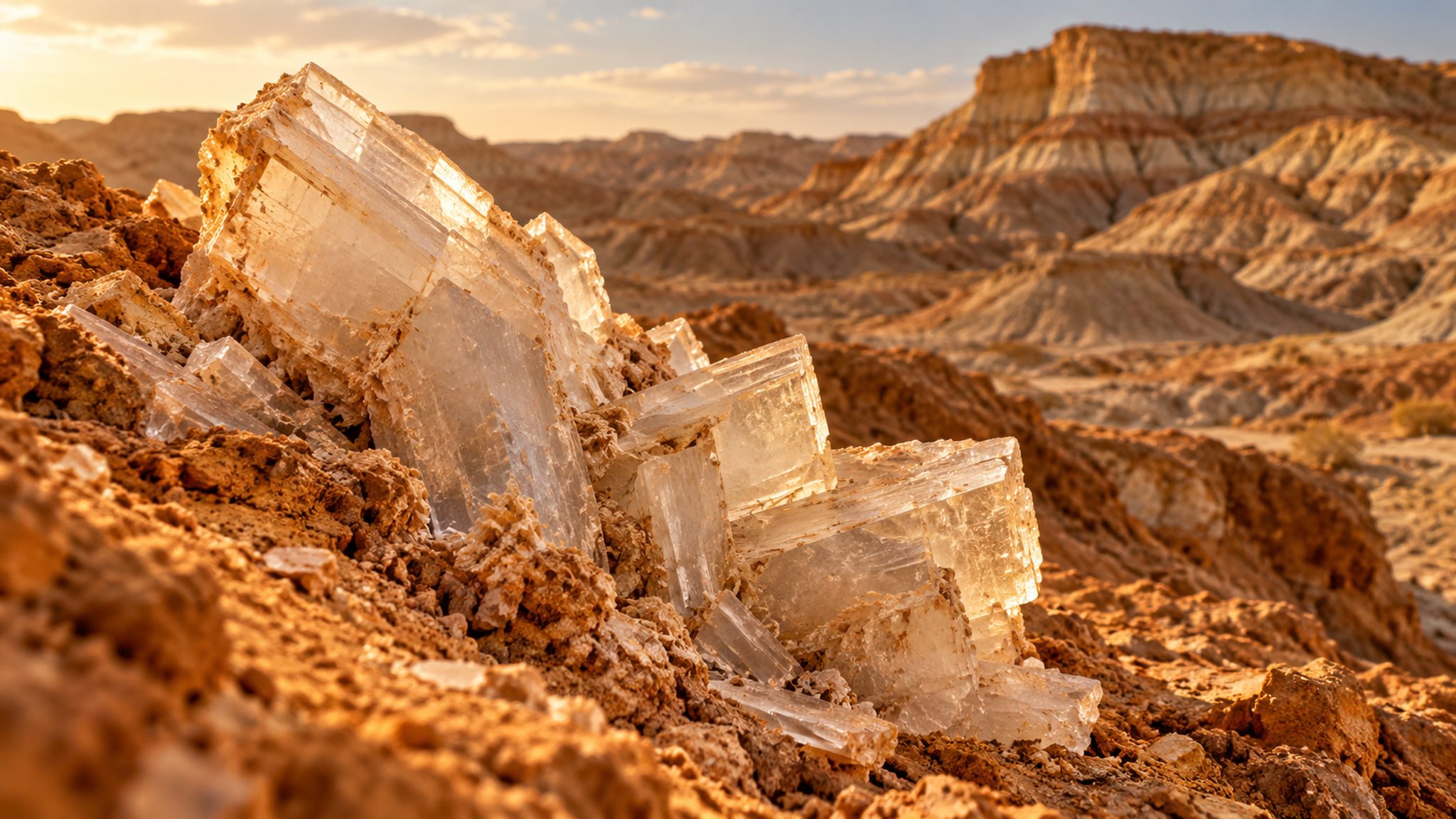
- Gypsum records past aqueous environments and can preserve biosignatures within its mineral matrix. This preservation potential makes it useful for selecting promising material for examination, without implying that a biological signal is already present.
- The central distinction is between formation evidence and preservation potential. A mineral can help reconstruct the environment in which it developed; its ability to retain other signals is a separate scientific question.
- Laser Raman spectroscopy supplies distinctive spectral fingerprints for mineral identification. In this research, the instrument helped confirm which minerals were present, strengthening the material basis for subsequent comparisons between terrestrial and Martian environments.
- Laboratory measurements complement orbital observations by supporting more detailed mineral characterization. The release says orbital data alone cannot fully characterize Martian minerals; this is an argument for combining evidence, not dismissing remote sensing.
Why Water Evidence Is Not Life Detection
Minerals can narrow a search for past habitable environments, but each step from water to life requires a different evidentiary claim.
- Past water activity means a geological record supports interaction with water. It does not by itself establish how long conditions lasted, whether they supported organisms, or whether life actually developed at that location.
- Habitability concerns whether an environment could support life; life detection requires evidence that organisms existed. Treating those terms as equivalent converts a useful geological finding into a conclusion the research has not demonstrated.
- A potential biosignature requires careful evaluation of its origin. The ability of gypsum to preserve such signals cannot substitute for finding and establishing a biological signal within a particular mineral sample under investigation.
- The reported work identifies analogue minerals and environments; it does not announce life on Mars. Its immediate contribution is better interpretation of mineral evidence and more informed choices about where future investigations might look.
- For an examination answer, separate observation, interpretation and implication: identified sulphates are the observation, water-related formation is the interpretation, and guiding future exploration is the implication. Keep uncertainty attached to each subsequent inference.
Way Forward
Link Mineral Fingerprints With Geological Context
- Build reference measurements from well-characterized terrestrial samples so planetary observations can be compared with known mineral properties.
- Examine formation conditions and preservation separately; promising mineral chemistry should guide further investigation rather than become a shortcut to claims about life.
- Report analogue limits alongside similarities, making clear which process a terrestrial site can illuminate and which planetary conditions it cannot reproduce.
Conclusion
- Hydrous sulphates are geological evidence of water–rock history, not automatic biological evidence. Their value lies in connecting identifiable minerals with plausible environmental processes while retaining the limits of terrestrial comparisons.
- The exam-ready distinction is water activity → possible habitability → evidence of life: these are separate questions, and answering the first does not settle the next two.
UPSC Practice Questions
Prelims MCQ 1
With reference to the reported Martian analogue research, consider the following statements:
- Melanterite was identified at Neyveli in Tamil Nadu.
- Gypsum can preserve biosignatures within its mineral matrix.
- The identification of a hydrous sulphate necessarily establishes past life.
How many of the above statements are correct?
(a) Only one (b) Only two (c) All three (d) None
Answer: (b) Only two
Explanation:
The first two statements follow the reported findings. Hydrous sulphates record water-related processes; their identification alone does not establish past life.
Prelims MCQ 2
What was the principal role of laser Raman spectroscopy in this research?
(a) Establishing that organisms currently live on Mars (b) Measuring the duration of every Martian wet period (c) Identifying minerals through distinctive spectral fingerprints (d) Reproducing the entire Martian environment on Earth
Answer: (c) Identifying minerals through distinctive spectral fingerprints
Explanation:
The instrument detected characteristic mineral fingerprints and supported identification. It did not independently demonstrate life or recreate all Martian conditions.
UPSC Mains Questions
- How do terrestrial analogue sites strengthen planetary exploration? Discuss with reference to hydrous sulphates and the limits of Earth–Mars comparisons.
- Distinguish evidence of past water activity, habitability and life detection. Why does this distinction matter in interpreting planetary science findings?
Source: PIB, Ministry of Science & Technology.
Frequently Asked Questions
What is a Martian analogue site?
It is a terrestrial site sharing selected geological, chemical or physical features with Mars. Scientists use the comparison to investigate specific processes; it does not imply that all planetary conditions are identical.
Which Indian sites feature in this research?
The report identifies melanterite from Neyveli and gypsum from the Tiruchirappalli Badlands, both in Tamil Nadu. Gypsum from Chile’s Atacama Desert provides another terrestrial comparison for interpreting past aqueous environments.
Why are hydrous sulphates useful in planetary science?
They record water-related mineral formation and help scientists reconstruct past aqueous conditions. Their geological context and laboratory characteristics can support interpretation of planetary observations and inform the selection of future investigation sites.
Did this research find life on Mars?
No. The reported work concerns terrestrial mineral analogues and water–rock history. Gypsum’s potential to preserve biosignatures makes it scientifically interesting, but preservation potential is not an observed or verified biological signal.
Tell Google you want more of this.
Add Anantam IAS as a preferred sourceOne tap, and this site shows up more often in your own Top Stories, AI Overviews and AI Mode. Remove it any time.



