Why in News?
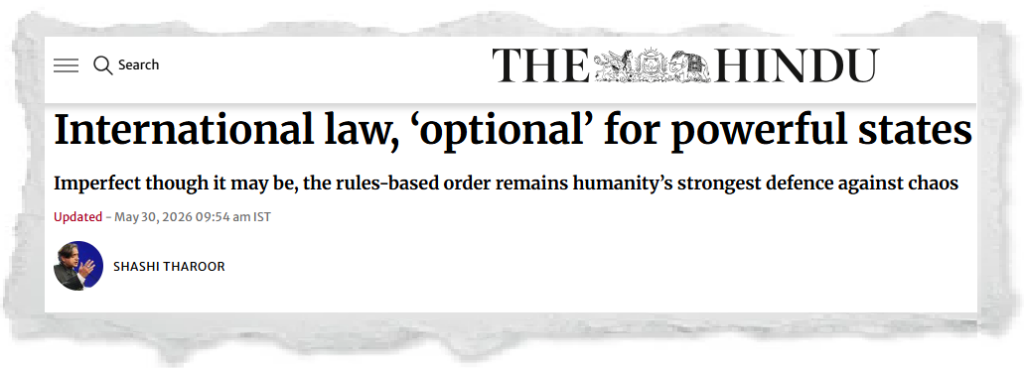
Recent geopolitical developments, including the Russia–Ukraine conflict, tensions in West Asia, disputes in the South China Sea, and growing challenges to multilateral institutions, have revived concerns about the effectiveness of international law. Increasing instances of states disregarding international norms have raised questions about whether the rules-based international order is weakening in the face of power politics.
UPSC Relevance
Prelims: United Nations, UN Charter, UNCLOS, International Court of Justice (ICJ), International Criminal Court (ICC), Geneva Conventions, Paris Agreement, JCPOA.
Mains:
GS-II: International Relations, International Institutions, Global Governance and Multilateralism,
GS-III: Security Challenges.
Background
International law developed over centuries as an attempt to regulate relations among sovereign states and reduce the likelihood of conflicts. Following the devastation of two World Wars, a comprehensive framework of treaties, conventions, institutions, and norms emerged to promote peace, stability, human rights, and international cooperation.
Key pillars of this framework include:
- The United Nations Charter governing the use of force.
- International humanitarian law regulating conduct during armed conflicts.
- Maritime law under UNCLOS.
- Human rights conventions.
- Arms control and non-proliferation agreements.
- International environmental agreements.
However, the effectiveness of these frameworks depends largely on voluntary compliance and collective enforcement. In recent years, repeated violations by both major and regional powers have exposed structural weaknesses in the international legal order.
Understanding International Law
What is International Law?
International law refers to the set of rules, norms, and principles that govern relations among states, international organisations, and, in certain cases, individuals.
Unlike domestic law, there is no global government possessing a monopoly over enforcement. Compliance largely depends on:
- Treaty obligations, Reciprocity among states, Diplomatic pressure, Economic sanctions, International institutions and courts.
This makes international law fundamentally different from municipal law.
Sources of International Law
Under Article 38 of the Statute of the International Court of Justice, major sources include:
- International treaties and conventions.
- International customs and state practices.
- General principles of law recognised by civilised nations.
- Judicial decisions and scholarly writings as subsidiary sources.
The Rules-Based International Order
The post-1945 international system sought to replace raw power politics with institutionalised cooperation.
United Nations Charter
The UN Charter prohibits aggressive use of force and upholds:
- Sovereign equality of states, Territorial integrity, Peaceful settlement of disputes, Collective security.
The Charter remains the foundation of contemporary international law.
International Humanitarian Law
The Geneva Conventions and their protocols regulate warfare by protecting:
- Civilians, Prisoners of war, Medical personnel, Humanitarian operations.
These rules seek to minimise human suffering even during armed conflicts.
UNCLOS
The United Nations Convention on the Law of the Sea provides a legal framework governing:
- Territorial waters.
- Exclusive Economic Zones (EEZs).
- Freedom of navigation.
- Deep-sea resources.
UNCLOS is often described as the “Constitution of the Oceans.”
Why Is International Law Facing Challenges?
Rise of Geopolitical Competition
The return of great-power rivalry has weakened consensus within global institutions.
Strategic competition among major powers increasingly influences interpretations of international law and often obstructs collective action.
Selective Compliance
States frequently invoke international law when it supports their interests but disregard it when perceived national security or geopolitical objectives are involved.
This selective approach undermines the credibility of legal norms.
Weak Enforcement Mechanisms
Unlike domestic legal systems, international law lacks a central enforcement authority.
International courts often depend on state cooperation for implementing judgments, limiting their effectiveness.
Security Council Paralysis
The veto powers of permanent members often prevent collective responses to major international crises.
As geopolitical divisions deepen, the Security Council’s ability to enforce international norms has weakened.
Major Areas of Concern
Use of Force and Sovereignty
One of the most significant challenges concerns the prohibition on the use of force.
The UN Charter permits military action only under limited circumstances such as self-defence or Security Council authorisation.
Recent conflicts have generated debates over:
- Sovereignty.
- Territorial integrity.
- Humanitarian intervention.
- Pre-emptive self-defence.
Such controversies have exposed differing interpretations of international law among major powers.
Maritime Disputes and UNCLOS
The South China Sea remains one of the most contested maritime regions in the world.
Competing territorial claims, artificial island construction, and naval deployments have raised questions about:
- Freedom of navigation.
- Maritime boundaries.
- Compliance with arbitration awards.
These disputes highlight the difficulties of enforcing maritime law against powerful actors.
Human Rights Violations
Numerous conflicts and internal security operations across the world continue to generate allegations involving:
- Civilian casualties, Forced displacement, Arbitrary detention, Suppression of dissent, Ethnic persecution.
The ability of international institutions to address such violations remains limited by political considerations.
Nuclear Non-Proliferation and Arms Control
Several arms control agreements that contributed to Cold War stability have weakened in recent years.
Concerns include:
- Collapse of key arms-control treaties.
- Expansion of missile programmes.
- Modernisation of nuclear arsenals.
- Emerging technologies such as hypersonic weapons.
These developments increase strategic uncertainty and raise the risk of arms races.
Environmental Governance Challenges
Climate change represents one of the greatest tests of international cooperation.
Although frameworks such as the Paris Agreement provide a common platform, implementation gaps remain substantial.
Challenges include:
- Rising greenhouse gas emissions.
- Uneven burden-sharing.
- Financing constraints.
- Biodiversity loss.
- Marine ecosystem degradation.
Why International Law Still Matters
Despite its limitations, international law continues to play a crucial role.
Predictability in International Relations: Shared rules reduce uncertainty and provide a basis for diplomatic engagement even among rivals.
Protection of Smaller States: International legal norms offer smaller and weaker countries a framework to defend their rights against more powerful actors.
Conflict Management: International law creates mechanisms for peaceful dispute resolution through negotiation, arbitration, and adjudication.
Global Commons Governance: Issues such as climate change, oceans, outer space, and cyberspace require collective regulation that only international legal frameworks can provide.
India’s Perspective on International Law
India has traditionally supported:
- Strategic autonomy.
- Respect for sovereignty.
- Peaceful dispute resolution.
- Reform of multilateral institutions.
- Rule-based international order.
India’s positions on maritime security, climate justice, counter-terrorism, and global governance generally emphasise adherence to international law while seeking greater representation for developing countries in global institutions.
India’s Role in Strengthening Multilateralism
India advocates:
- Reform of the UN Security Council.
- Greater voice for the Global South.
- Strengthening international cooperation.
- Respect for international maritime law.
- Equitable climate governance.
Through platforms such as the G20, BRICS, SCO, Quad, and the United Nations, India seeks to balance national interests with support for a stable international order.
Challenges Before the International Legal Order
Power Asymmetry: Powerful states often possess greater ability to evade legal consequences than weaker states.
Politicisation of Institutions: International institutions sometimes face accusations of selective application and geopolitical bias.
Lack of Enforcement Capacity: Many international legal bodies lack independent enforcement mechanisms.
Emerging Domains: New challenges such as cyber warfare, artificial intelligence, space militarisation, and autonomous weapons require updated legal frameworks.
Way Forward
Strengthening Multilateral Institutions
International organisations must become more representative, transparent, and effective to maintain legitimacy.
Reforming Global Governance
Reforms in institutions such as the UN Security Council can improve their responsiveness to contemporary realities.
Enhancing Accountability Mechanisms
Greater support for international courts, arbitration systems, and monitoring bodies can improve compliance.
Promoting Cooperative Security
States should prioritise diplomacy, confidence-building measures, and peaceful dispute resolution over coercive approaches.
Developing Rules for Emerging Technologies
International cooperation is needed to establish legal norms governing cyberspace, artificial intelligence, and outer space activities.
Conclusion
International law remains imperfect, but it continues to provide the most viable framework for managing relations among states in an increasingly interconnected world. While recent geopolitical developments have exposed weaknesses in the rules-based order, abandoning international law would risk a return to unrestrained power politics. The challenge before the international community is not merely to preserve existing institutions, but to reform and strengthen them so that law, rather than power alone, continues to shape global affairs.
Practice Questions
Prelims Question 1 (Inference-Based)
Consider the following statements:
I. International law largely depends on the willingness of states to comply with agreed norms and treaties.
II. Weak enforcement mechanisms can reduce the effectiveness of international legal frameworks.
III. Strengthening multilateral institutions may improve compliance with international norms.
Which of the following relationships among the above statements is/are correct?
- Statement II explains a limitation inherent in the system described in Statement I.
- Statement III can be viewed as a potential solution to the concern raised in Statement II.
- Statement I contradicts Statement III because stronger institutions eliminate the need for state consent.
(a) 1 only
(b) 1 and 2
(c) 2 and 3
(d) 1, 2 and 3
Answer: (b)
Explanation: Statement II logically identifies a weakness arising from the state-consent-based nature of international law. Statement III seeks to address that weakness. Statement I and III are complementary, not contradictory.
Prelims Question 2
Match List-I with List-II:
| List-I | List-II |
|---|---|
| A. UNCLOS | 1. Regulation of armed conflict |
| B. Geneva Conventions | 2. Law of the Sea |
| C. Paris Agreement | 3. Climate Change |
| D. New START Treaty | 4. Strategic nuclear arms limitation |
Select the correct answer using the code below:
(a) A-2, B-1, C-3, D-4
(b) A-1, B-2, C-4, D-3
(c) A-2, B-3, C-1, D-4
(d) A-4, B-1, C-3, D-2
Answer: (a)
Explanation: UNCLOS governs maritime affairs; Geneva Conventions regulate armed conflicts; Paris Agreement deals with climate change mitigation; New START concerns strategic nuclear arms reduction.
Mains Questions
- The effectiveness of international law depends less on legal texts and more on political will. Critically examine in the context of contemporary global conflicts and geopolitical rivalries. (250 words)
- Discuss the challenges confronting the rules-based international order in the 21st century. How can multilateral institutions be strengthened to improve compliance with international law? (250 words)
Tell Google you want more of this.
Add Anantam IAS as a preferred sourceOne tap, and this site shows up more often in your own Top Stories, AI Overviews and AI Mode. Remove it any time.