Why in News?
The Hindu reported that the Union government’s High-Level Committee on Demographic Changes reached Jammu to study claims of demographic change in areas near the border with Pakistan.
- The Ministry of Home Affairs constituted the national committee on 26 May 2026 under retired Supreme Court judge Justice Prakash Prabhakar Naolekar.
- Its members include the Census Commissioner, retired civil servant Durga Shankar Mishra, retired police officer Balaji Srivastava and economist Shamika Ravi; the Joint Secretary (Foreigners-I), MHA, is Member Secretary.
- The committee has a one-year reporting period, extendable by the MHA by up to six months if needed.
- On 1 July 2026, the committee told the Union Home Minister that it would visit States and Union Territories for first-hand inputs and had prepared a questionnaire for administrations before field visits.
- The Jammu visit should be read as part of that nationwide process. No public committee report or verified Jammu-specific conclusion had been announced at the time of writing.
- Population change has several components: births, deaths, internal migration, international migration, changes in administrative boundaries and differences in enumeration. Security claims need to distinguish among them.
- Jammu’s border setting raises legitimate questions about infiltration and document fraud, but residence, migration or community identity by themselves are not proof of unlawful entry.
- The latest completed decennial Census remains Census 2011. Administrative records can provide newer signals, but they were created for different purposes and cannot silently replace a transparent population methodology.
UPSC Relevance
Prelims Relevance
- The High-Level Committee on Demographic Changes was constituted by the Ministry of Home Affairs in May 2026 and is chaired by a retired Supreme Court judge.
- The Census Commissioner is a member, linking the inquiry to India’s official population-statistics system.
- The committee is an executive body; it is not a constitutional or statutory commission and its recommendations do not themselves change law.
- The committee’s terms of reference are nationwide and cover demographic change, illegal immigration, border management, identification systems and Centre-State coordination.
- The Immigration and Foreigners Act, 2025 came into force on 1 September 2025 and regulates entry, stay, registration and related matters concerning foreigners.
- Section 36 of the 2025 Act repealed four earlier central laws, including the Foreigners Act, 1946, while saving compatible prior actions and instruments.
Mains Relevance
GS Paper 3
- Border management, illegal immigration, document fraud and the relationship between demographic evidence and internal-security risk assessment.
- Need to integrate human intelligence, lawful databases, border surveillance and district administration without treating identity as a proxy for threat.
GS Paper 2
- Centre-UT coordination across citizenship, immigration, police, land, civil registration and welfare systems.
- Procedural fairness, reasoned decisions, privacy safeguards and accessible review when nationality or residence status is disputed.
Essay
- Security becomes durable when the state can distinguish a verified threat from a socially amplified suspicion.
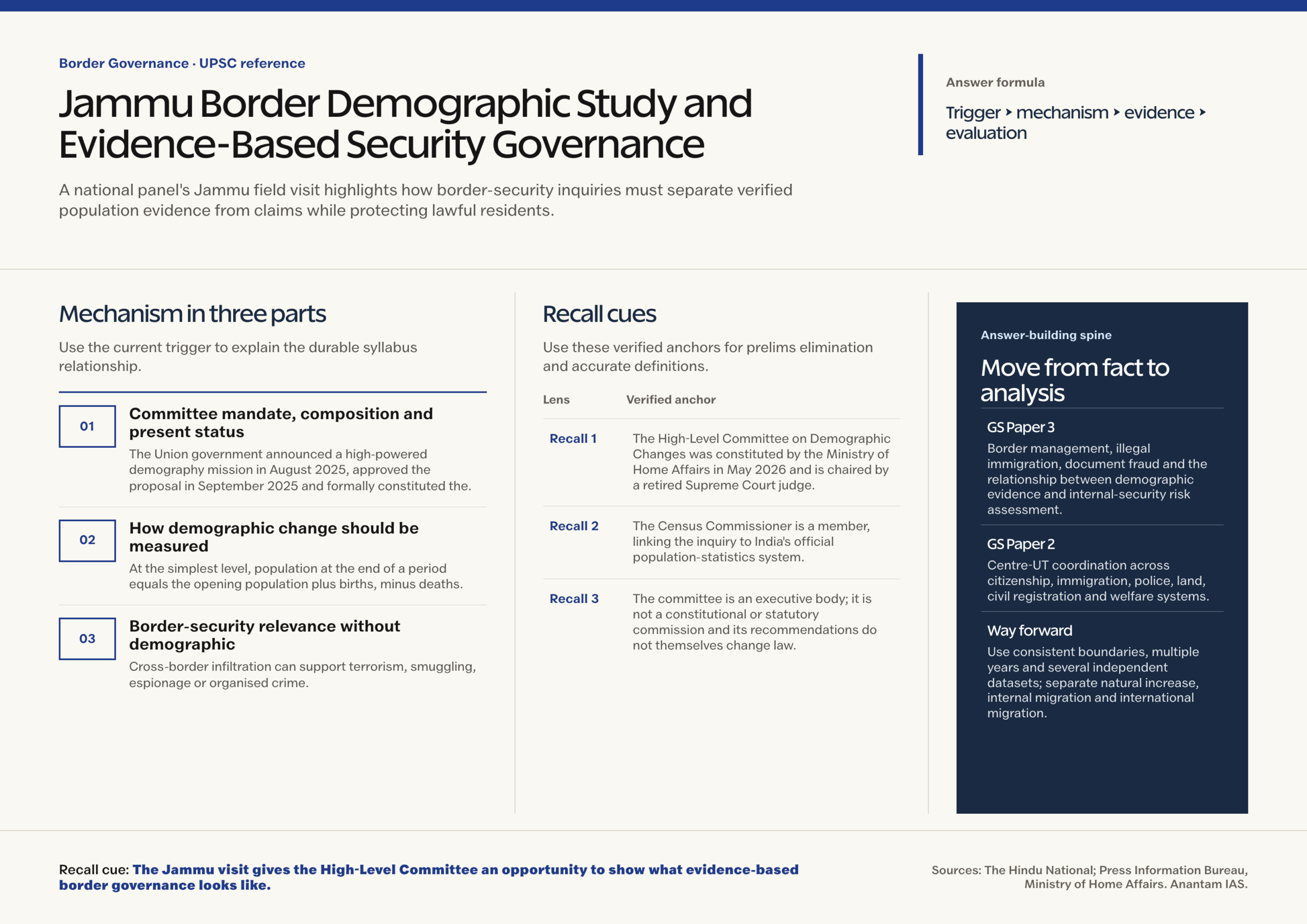
Background and Context
Committee mandate, composition and present status
The panel is conducting a nationwide inquiry and is still gathering evidence; its mandate should not be confused with a completed factual determination.
- The Union government announced a high-powered demography mission in August 2025, approved the proposal in September 2025 and formally constituted the committee in May 2026.
- The official terms ask it to examine possible causes of demographic change, analyse deviations from broader trends and recommend policy, legislative and administrative measures.
- They also ask for proposals on lawful identification, detention and deportation of illegal immigrants, stronger border management and better coordination between the Union and State governments.
- The July 2026 PIB update said the committee would collect questionnaires from States and Union Territories, visit them and consult Union ministries. The reported Jammu visit fits this fieldwork plan.
- Until a report or verified interim findings are published, phrases such as ‘demographic change in Jammu’ describe a claim under examination, not an established committee conclusion.
How demographic change should be measured
A population trend is an accounting result whose causes must be decomposed before a security inference is made.
- At the simplest level, population at the end of a period equals the opening population plus births, minus deaths, plus inward migration and minus outward migration.
- Researchers should compare consistent geographic units and time periods. A new ward, changed district boundary or altered enumeration practice can create an apparent shift without equivalent movement on the ground.
- Census tables, the Civil Registration System, Sample Registration System, electoral rolls, school enrolment, ration records, land registration and police data answer different questions. They have different coverage, definitions and error patterns.
- Administrative records may contain duplication, delayed deletion or exclusion. A mismatch across databases is a lead for verification, not automatic proof that a person is a foreigner.
- Analysis should publish definitions, base populations, denominators, confidence limits and alternative explanations. Community shares without absolute numbers can exaggerate a small numerical change.
Border-security relevance without demographic profiling
A border district needs sharper security capability, but population category and security threat are not interchangeable concepts.
- Cross-border infiltration can support terrorism, smuggling, espionage or organised crime, while irregular migration can create separate questions of documentation and legal status.
- Effective enforcement begins with specific indicators: border-crossing evidence, forged documents, unexplained identity chains, trafficking networks, suspicious financial links or corroborated intelligence.
- Religion, language, occupation, poverty, tenancy or migration from another Indian State cannot by themselves establish foreign nationality or hostile intent.
- Collective profiling wastes investigative capacity by producing false positives, weakens community trust and may discourage residents from sharing useful local intelligence.
- A better model is risk-based and behaviour-led: focus on routes, facilitators, fraudulent document supply chains and verified anomalies, followed by individualised legal process.
Legal and constitutional framework
Immigration control is a Union responsibility, but every coercive decision still needs legal authority, accurate identity work and fair procedure.
- The Seventh Schedule places citizenship, naturalisation and aliens, and admission, emigration and expulsion in the Union List. The Ministry of Home Affairs leads the central framework.
- The Immigration and Foreigners Act, 2025 consolidates rules on entry, visas, registration, stay and removal. It came into force on 1 September 2025 and replaced four older central statutes.
- A committee can recommend changes, but investigation, detention, prosecution or removal must rest on the applicable Act, rules, orders and delegated authority rather than on the committee’s existence.
- Articles 14 and 21 protect persons against arbitrary state action. Article 19 rights are textually reserved to citizens, an important distinction in questions involving foreigners.
- Nationality disputes need documented notice, an opportunity to respond, reasoned findings, competent review and consular coordination where relevant. Indefinite or identity-blind detention is not a substitute for a workable removal process.
Way Forward
Publish an evidence protocol
- Use consistent boundaries, multiple years and several independent datasets; separate natural increase, internal migration and international migration.
- Invite peer review from demographers, statisticians, security experts and constitutional-law scholars before causal claims are finalised.
- Target crossing routes, traffickers, forged-document networks, corrupt facilitators and finance rather than broad community categories.
- Create joint district teams with clear jurisdiction, recorded evidence standards and periodic supervisory review.
Conclusion
- The Jammu visit gives the High-Level Committee an opportunity to show what evidence-based border governance looks like.
- A credible state can be firm against illegal entry and document fraud without treating mobility or identity as guilt.
UPSC Practice Questions
Prelims MCQ 1
With reference to the High-Level Committee on Demographic Changes constituted in 2026, consider the following statements:
- It was constituted by the Ministry of Home Affairs.
- The Census Commissioner is one of its members.
- It is a constitutional body whose recommendations automatically have the force of law.
How many of the above statements are correct?
(a) Only one (b) Only two (c) All three (d) None
Answer: (b) Only two
Explanation:
Statements 1 and 2 are correct. The MHA constituted the executive committee and included the Census Commissioner. It is not a constitutional body, and its recommendations require separate lawful action before they can alter rights, duties or institutions.
Prelims MCQ 2
Which one of the following laws currently provides India’s consolidated central framework for entry, stay, registration and related regulation of foreigners?
(a) Foreigners Act, 1946 (b) Registration of Foreigners Act, 1939 (c) Immigration and Foreigners Act, 2025 (d) Citizenship Act, 1955 alone
Answer: (c) Immigration and Foreigners Act, 2025
Explanation:
The Immigration and Foreigners Act, 2025 came into force on 1 September 2025. Its repeal-and-saving provision replaced four earlier central laws, including the Foreigners Act, 1946 and Registration of Foreigners Act, 1939.
UPSC Mains Questions
- Demographic change in a border region is a hypothesis to be tested, not a security conclusion in itself. Discuss the evidence needed to distinguish natural increase, internal migration and illegal cross-border movement.
- Examine how India can strengthen identification and border management while protecting lawful residents from profiling, data errors and arbitrary coercion.
Sources: The Hindu National and Press Information Bureau, Ministry of Home Affairs.
Frequently Asked Questions
What is the High-Level Committee on Demographic Changes?
It is an executive committee constituted by the Ministry of Home Affairs on 26 May 2026. Chaired by retired Supreme Court judge Justice Prakash Prabhakar Naolekar, it is examining possible causes and consequences of demographic changes and may recommend policy.
Has the committee proved demographic change caused by illegal immigration in Jammu?
No public committee report establishing that conclusion had been released when this note was prepared. The reported Jammu visit is part of evidence gathering. Any causal finding must separate births, deaths, internal migration, cross-border movement, boundary changes and data errors.
Why is the Jammu visit relevant to internal security?
Jammu includes areas near the border with Pakistan, where infiltration, smuggling, terrorism and document fraud are legitimate security concerns. The policy challenge is to identify specific unlawful networks through corroborated evidence without treating residents, migrants or communities as presumptively suspect.
Which law now regulates foreigners in India?
The Immigration and Foreigners Act, 2025 has been in force since 1 September 2025. It consolidates provisions on passports or travel documents, visas, registration, entry and stay, and repealed four earlier central laws while saving compatible actions already taken under.
Why cannot one database establish illegal immigration?
Electoral rolls, ration cards, school records, land records and civil registration systems have different purposes and error patterns. A mismatch may reflect spelling, mobility, delayed updating or exclusion. A high-stakes nationality finding needs original documents, corroboration, field inquiry and lawful.
Tell Google you want more of this.
Add Anantam IAS as a preferred sourceOne tap, and this site shows up more often in your own Top Stories, AI Overviews and AI Mode. Remove it any time.