Why in News?
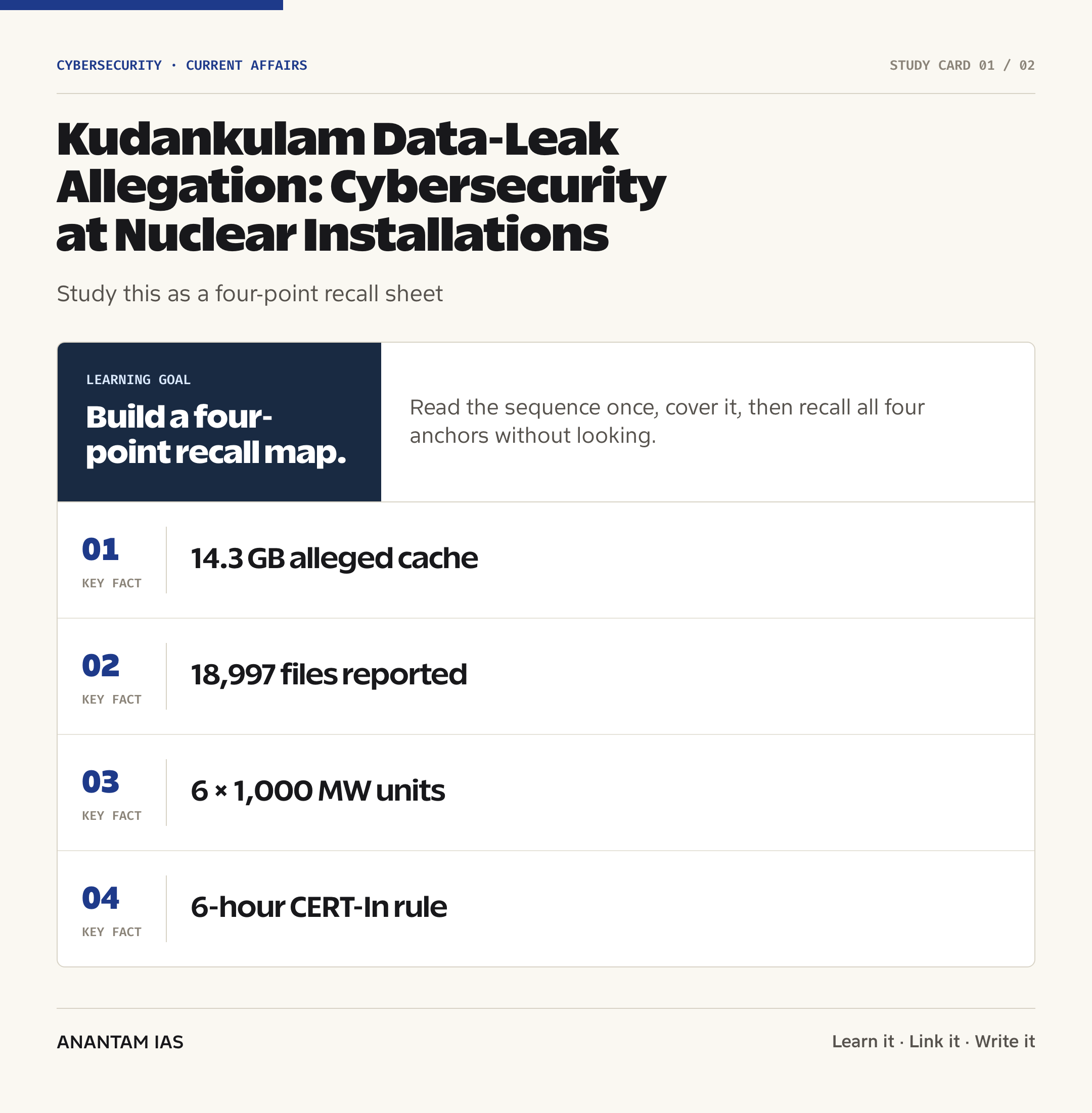
World Leaks, a ransomware-linked extortion group, allegedly placed files connected with the Kudankulam Nuclear Power Plant on the dark web. The Indian Express reported on July 17 that the purported KKNPP subset contained 18,997 files totalling 14.3 GB, but said it could not independently authenticate the documents.
Reliance Infrastructure acknowledged a partial breach of its data on a third-party-hosted server. NPCIL said the material reported as compromised concerned conventional Balance of Plant common services for Units 3 and 4, not nuclear safety or nuclear security systems. That statement limits what can responsibly be inferred: a contractor-side information breach is serious, but it is not proof that reactor-control or safety systems were penetrated.
- May 29: Yotta said it detected and stopped suspicious activity on a Reliance Infrastructure server.
- June 11: the purported files reportedly began appearing on World Leaks.
- July 15: NPCIL clarified its position after widespread media reporting.
- Reported contents: correspondence, inspections, progress reports, vendor material and drawings linked mainly to Units 3 and 4.
- Open questions: authenticity, intrusion route, credential exposure and the full scope of exfiltration.
The development matters in the context of:
- A weak contractor or hosted service can expose information about critical information infrastructure beyond its own network.
- India must combine nuclear secrecy with credible disclosure that limits speculation without revealing exploitable detail.
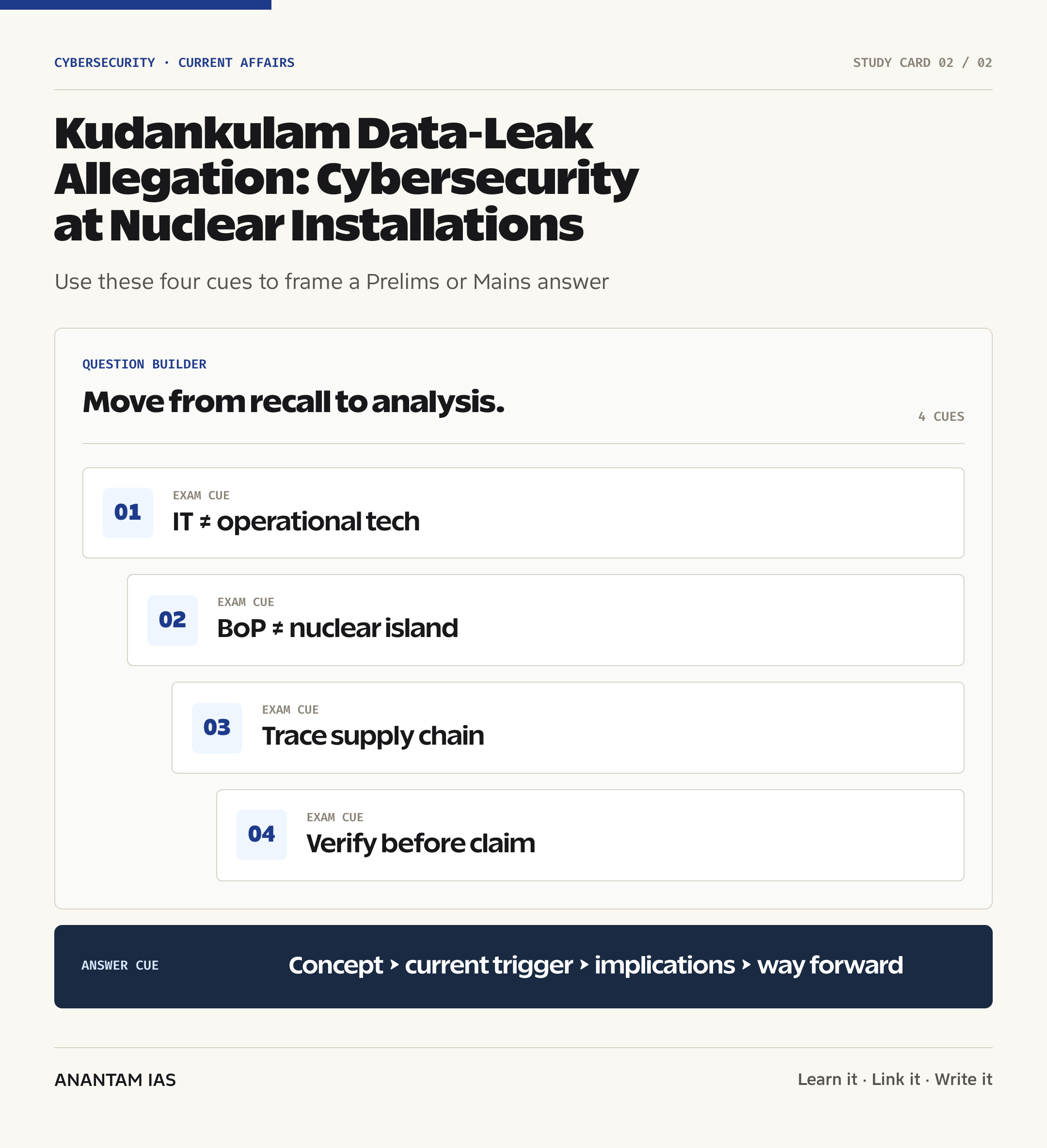
- The exam-critical distinction is between enterprise IT holding project data and operational technology controlling physical processes.
- Cyber risk spans the operator–contractor–cloud provider chain, not only the plant boundary.

UPSC Relevance
Prelims Relevance
- KKNPP is in Tirunelveli district, Tamil Nadu, and was developed with Russian technical collaboration.
- It has six VVER pressurised-water reactor units of 1,000 MW each; Units 1 and 2 operate.
- NPCIL, under the Department of Atomic Energy, operates India’s commercial nuclear power reactors.
- Balance of Plant covers supporting facilities outside the nuclear island; its information can still be sensitive.
- Critical Information Infrastructure is defined by the debilitating impact its loss may have on national security, the economy, public health or safety.
- Section 70 permits qualifying computer resources to be notified as protected systems.
- Section 70A underpins NCIIPC’s CII-protection role within NTRO.
- Section 70B provides for CERT-In’s national cyber-incident-response role.
- CISAG and TAFICS are DAE specialist groups for information security and I&C security.
Mains Relevance
GS Paper 3
- Internal security: CII protection, ransomware and the national-security value of technical information.
- Science and technology: enterprise IT, operational technology and safety-related instrumentation and control.
- Infrastructure resilience: defence in depth, segmentation, secure backups and recovery exercises.
- Supply-chain security: contractor access, cloud hosting, vendor assurance and least privilege.
GS Paper 2
- Governance: accountability and calibrated disclosure for essential infrastructure.
- Coordination: roles of NPCIL, DAE, AERB, CERT-In, NCIIPC and private partners.
- Regulatory capacity: enforceable contracts, audits and escalation duties.
Essay
- Security and trust: secrecy can protect a system, but unexplained silence weakens confidence.
- Interdependence: resilience depends on every organisation that designs, builds, maintains or hosts information.
Background and Context
What Is Alleged, Acknowledged and Still Unverified
A careful answer must separate the reported cache, the contractor’s admission and the plant operator’s technical clarification.
- The Indian Express said its search of the alleged cache found 18,997 KKNPP-related files occupying 14.3 GB, nested within a much larger purported Reliance Group dataset.
- Reliance Infrastructure acknowledged a partial breach of data held on a server hosted by Yotta, while Yotta said suspicious activity detected on May 29 was terminated and suspected ransomware execution was prevented.
- NPCIL’s position is that the reported information concerns conventional common services, not nuclear safety or security systems; no public evidence establishes an operational compromise.
- Document authenticity remains a live issue: stamps, signatures, familiar folder names or plausible drawings cannot independently prove that every file is genuine, current or complete.
- Forensic findings should establish the intrusion path, affected identities, data-access logs, persistence, exfiltration volume and whether any material was altered as well as copied.
Balance of Plant Is Not the Nuclear Island
The location and function of a system determine its safety significance; an alarming file name is not a substitute for that classification.
- NPCIL awarded Reliance Infrastructure a 2018 EPC contract for conventional Balance of Plant common services associated with Units 3 and 4.
- Balance of Plant is a broad engineering term for supporting facilities needed by a generating station but outside the reactor’s nuclear island and core safety systems.
- Reported files included site layouts, vendor records, inspection material, project correspondence and engineering drawings. Such information may be commercially or security sensitive even when it does not control a reactor.
- Information exposure can support reconnaissance, targeted phishing, impersonation, supplier mapping or physical-security planning, so ‘non-nuclear’ does not mean ‘no consequence.’
- Operational compromise requires separate evidence of access to, manipulation of or loss of availability in systems that monitor or control the physical process.
Enterprise IT, Operational Technology and Nuclear I&C
UPSC answers gain precision by treating the three digital layers according to the functions they perform.
- Enterprise IT supports email, finance, procurement, document management, design collaboration and administrative work; the alleged contractor-server breach sits primarily in this information domain.
- Operational technology monitors or controls equipment and physical processes, often with strict availability, timing and safety requirements that differ from office IT.
- Instrumentation and control systems connect sensors, logic and actuators used for monitoring, process control, protection and engineered safety functions inside a nuclear facility.
- Segmentation and isolation reduce pathways, but controls must also cover removable media, maintenance laptops, vendors, credentials and insiders; an air gap is only one defence layer.
- Analytical rule: compromise of one IT layer may increase risk to another, yet it does not by itself demonstrate that the second layer was breached.
Why Contractors and Hosted Services Expand the Attack Surface
A nuclear project distributes information across organisations long before a reactor enters operation.
- EPC contractors exchange specifications, drawings, inspection records, schedules and vendor data with the operator and original equipment manufacturers throughout construction.
- Third-party hosting creates shared responsibility for accounts, access, infrastructure security and evidence preservation.
- Supplier information can help an attacker craft convincing messages, imitate trusted parties or focus on smaller vendors with weaker security controls.
- Least privilege requires each contractor, employee and service account to receive only the data and access needed for a defined task and period.
- IAEA guidance applies a graded, defence-in-depth approach and expects operators to impose verifiable computer-security requirements on vendors, contractors and suppliers.
India's Legal and Institutional Cybersecurity Architecture
Several institutions have connected but distinct mandates; treating them as interchangeable hides accountability gaps.
- The Information Technology Act, 2000 defines CII by consequence; Section 70 enables notification of protected systems, while Section 70A underpins NCIIPC.
- CERT-In, under Section 70B, leads national cyber-incident response and may seek information or issue directions to service providers, data centres, body corporates and government organisations.
- The CERT-In Directions of 2022 require specified cyber incidents to be reported within six hours of detection or notification and prescribe measures including system-clock synchronisation and log retention.
- DAE’s CISAG and TAFICS frame and review cybersecurity and instrumentation-control security within the nuclear establishment, while NPCIL remains responsible for secure operation of its assets and projects.
- AERB regulates nuclear and radiation safety and publishes requirements for computer-based systems important to safety; its safety oversight should not be confused with CERT-In’s incident-response role.
The 2019 Kudankulam Malware Precedent
The earlier incident illustrates both the value of network separation and the cost of delayed or incomplete public communication.
- In 2019, malware was detected on a computer connected to KKNPP’s administrative network after CERT-In alerted NPCIL.
- The official Department of Atomic Energy response said the plant’s control and instrumentation system was isolated from the administrative network and was not affected.
- Official responses cited network hardening, removable-media restrictions and regular audits; a later DAE parliamentary reply described CISAG and TAFICS oversight.
- The two events differ: the 2019 case involved malware on an administrative computer at the plant, while the present allegation centres on contractor data hosted by a third party.
- The shared lesson is that segmentation must be paired with evidence-led disclosure, rapid scoping and controls extending beyond the operator’s own network.
Transparency Without Publishing a Road Map for Attackers
Critical-infrastructure disclosure must provide assurance and accountability without exposing exploitable operational detail.
- Disclosure must be calibrated: too little encourages rumour, while too much can reveal networks, controls, suppliers or investigative methods.
- Minimum credible disclosure should state what category of system was affected, whether essential services continued, what data classes are involved, which authority is investigating and what containment is complete.
- Provisional language should be explicit: facts may be updated as forensics progress, while unverified attacker claims should remain labelled as claims.
- Chain of custody matters because a dark-web archive may mix authentic, altered, duplicated and unrelated files; investigators need hashes, logs, timestamps and provenance.
- Public accountability should follow each party’s control over data, identities, infrastructure and reporting.
Way Forward
Complete a Joint, Evidence-Led Investigation
- CERT-In, NPCIL, Reliance and Yotta should preserve evidence, correlate timelines and identify every affected account, host and repository.
- Independent validation should classify documents by authenticity, age, sensitivity and any connection to protected systems.
- Credential rotation should cover users, vendors, service accounts, remote-access tools and cryptographic secrets.
Apply Defence in Depth Across IT and OT
- Network architecture should enforce zones, mediated data flows, deny-by-default access and boundary monitoring.
- Sensitive engineering data needs classification, encryption, rights management, download controls and expiry rules.
- Recovery exercises should test clean restoration, manual fallbacks and coordinated decisions.
Make Supply-Chain Security Contractual
- EPC and cloud contracts should specify controls, escalation support, evidence preservation, subcontractor duties and audit rights.
- Vendor assurance should combine risk-tiering, secure design exchange, exercises, credential reviews and timely access closure.
- Data-residency choices should follow sensitivity and threat assessment, alongside strong identity and retention controls.
Create a Calibrated Disclosure Protocol
- Named lead agencies should issue timely statements and distinguish verified facts from attacker claims.
- Safety assurance should explain system category and impact without exposing layouts or vulnerabilities.
- Protected oversight can examine compliance, vendor accountability and remediation when public detail must remain limited.
Measure Resilience, Not Paper Compliance
- Boards should track detection, containment, reporting, recovery, privileged access, restoration tests and high-risk vendor findings.
- Cross-domain exercises should test legal and technical hand-offs among operators, contractors, providers, regulators and cyber agencies.
- Lessons learned should improve procurement, plant design, training and incident playbooks across the nuclear programme.
Conclusion
The Kudankulam allegation should neither be minimised as ordinary contractor paperwork nor inflated into an unproven reactor-system breach. The defensible conclusion is narrower: reported project information may have escaped from a contractor environment, while NPCIL says nuclear safety and security systems were not involved.
India’s strongest response is verified facts, layered defence and enforceable supply-chain accountability. Credible disclosure can protect both security and trust when it identifies the affected digital layer, explains operational impact and shows that remediation extends across every organisation holding sensitive infrastructure data.
UPSC Practice Questions
Prelims MCQ 1
With reference to India’s critical-information-infrastructure framework, consider the following statements:
- Section 70A of the Information Technology Act designates CERT-In as the national agency for cyber-incident response.
- Section 70B of the Information Technology Act provides the statutory basis for CERT-In’s national cyber-response role.
- Critical Information Infrastructure is defined by the debilitating impact that its incapacitation or destruction may have on national security, the economy, public health or safety.
How many of the above statements are correct?
(a) Only one (b) Only two (c) All three (d) None
Answer: (b) Only two
Explanation:
Statements 2 and 3 are correct. Section 70A concerns the national nodal agency for CII protection, performed by NCIIPC; Section 70B provides for CERT-In’s incident-response functions.
Prelims MCQ 2
Which one of the following is the most accurate inference from a breach of a nuclear-project contractor’s document server?
(a) The reactor protection system must also have been compromised (b) All exposed project documents are automatically part of the nuclear island (c) The breach may create reconnaissance and supply-chain risk, but operational-system compromise requires separate evidence (d) Network isolation removes the need for vendor-security controls
Answer: (c) The breach may create reconnaissance and supply-chain risk, but operational-system compromise requires separate evidence
Explanation:
Enterprise IT and operational I&C perform different functions. Exposure of contractor data can increase risk, but it does not prove access to systems controlling the plant.
UPSC Mains Questions
- A cyber incident in a contractor’s enterprise network can threaten critical infrastructure without directly compromising operational technology. Explain this distinction in the Kudankulam context, and assess the reconnaissance, credential and supply-chain risks that may persist even when nuclear safety systems remain isolated. (150 words)
- Examine India’s institutional architecture for cybersecurity at nuclear installations, with reference to NPCIL, AERB, DAE’s specialist groups, CERT-In and NCIIPC. Suggest mechanisms for assigning and regularly testing enforceable responsibility across operators, EPC contractors, original-equipment manufacturers and cloud or data-centre providers. (250 words)
- Critical-infrastructure incident disclosure must protect both national security and public trust. Discuss how a calibrated protocol can report system category, operational impact, investigation status and remediation during an active inquiry while withholding details that would assist hostile reconnaissance. (150 words)
Sources: The Hindu Editorial and The Indian Express Explained.
Frequently Asked Questions
Was Kudankulam’s reactor-control system hacked?
No public evidence establishes that conclusion. NPCIL says the reported material concerned conventional Balance of Plant services, not nuclear safety or security systems. Investigators still need to authenticate the purported files, determine the contractor-side breach’s scope and check for exposed credentials.
What does Balance of Plant mean?
Balance of Plant covers supporting facilities outside the nuclear island and core safety systems. These may be conventional, but their drawings, supplier records and project information can still aid reconnaissance, impersonation or targeted supply-chain attacks. Conventional doesn’t mean public or harmless.
How are IT and operational technology different?
Enterprise IT handles documents, email and business processes. Operational technology monitors or controls physical equipment, while nuclear I&C includes monitoring, protection and safety functions. A breach in one layer can raise risk for another without proving both were compromised. This distinction must guide impact claims.
What do CERT-In and NCIIPC do?
CERT-In, under Section 70B, coordinates national cyber-incident response, alerts and advisories. NCIIPC, under Section 70A and within NTRO, is the nodal agency for CII protection. Their mandates complement the responsibilities of DAE, AERB and NPCIL, because no single body owns every layer.
Why can contractor data still be risky?
Contractor repositories may reveal engineering context, suppliers, schedules and trusted correspondence. Attackers can use these for phishing, vendor impersonation, physical reconnaissance or follow-on intrusion attempts. The risk remains even when the files cannot operate a reactor or bypass a safety system.
What should a credible public update disclose?
A credible update should identify the affected system category, operational impact, data classes, investigating authority and containment status. It should label attacker claims as unverified until forensics confirms them, protect exploitable detail and state when the next review is due.
Tell Google you want more of this.
Add Anantam IAS as a preferred sourceOne tap, and this site shows up more often in your own Top Stories, AI Overviews and AI Mode. Remove it any time.