Why in News?
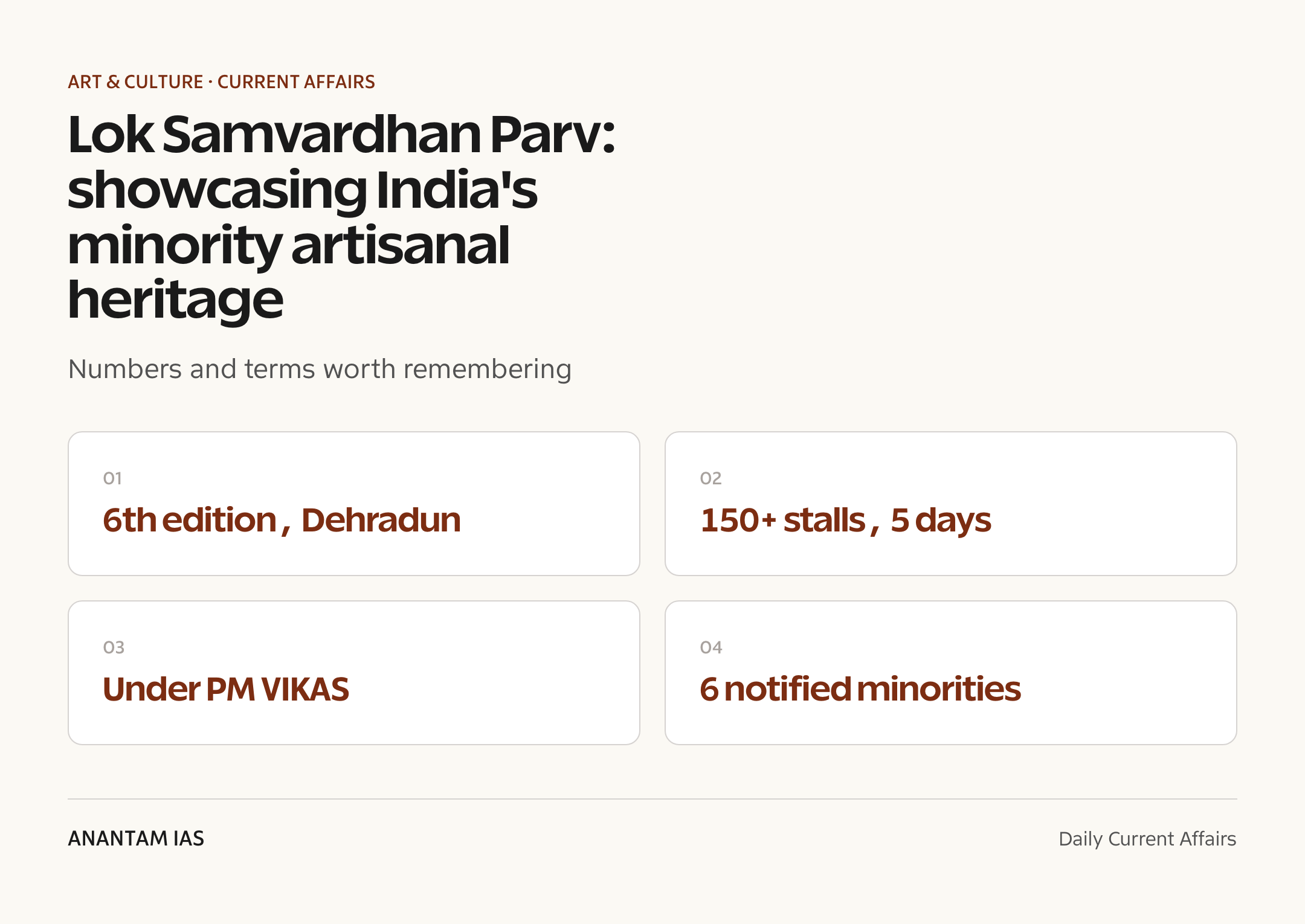
The Ministry of Minority Affairs opened the 6th Lok Samvardhan Parv at the Parade Ground, Dehradun, on 11 July 2026, a five-day showcase of traditional crafts, cuisine and cultural performances by artisans from India’s minority communities.
Union Minister Kiren Rijiju inaugurated the fair alongside Uttarakhand Chief Minister Pushkar Singh Dhami — the first edition run in formal partnership with a state government, held under the PM VIKAS scheme.
The event matters as a working example of an inclusion-through-livelihood model: it treats a community’s traditional crafts as both intangible cultural heritage worth preserving and an economic asset worth monetising, connecting artisans directly to buyers, exporters and market trends rather than to one-time subsidy.
- Over 150 artisanal and food stalls with live craft demonstrations and cultural performances across five days.
- Organised under Pradhan Mantri Virasat Ka Samvardhan (PM VIKAS) by the Ministry of Minority Affairs.
- First Lok Samvardhan Parv co-hosted with a state — the Uttarakhand government.
- Aimed at connecting minority artisans to national and international buyers and current market trends.
- Framed as a celebration for all Indians, not only minorities, to preserve shared cultural heritage.
- Successor to the earlier Hunar Haat exhibitions, now run under PM VIKAS after the older USTTAD scheme was folded into it.
- Positioned to link craft clusters with tourism, e-commerce and export channels, so market access outlives the five-day event.
The development matters in the context of:
- Lok Samvardhan Parv is the successor to the earlier Hunar Haat craft fairs, now run under PM VIKAS instead of the older USTTAD scheme.
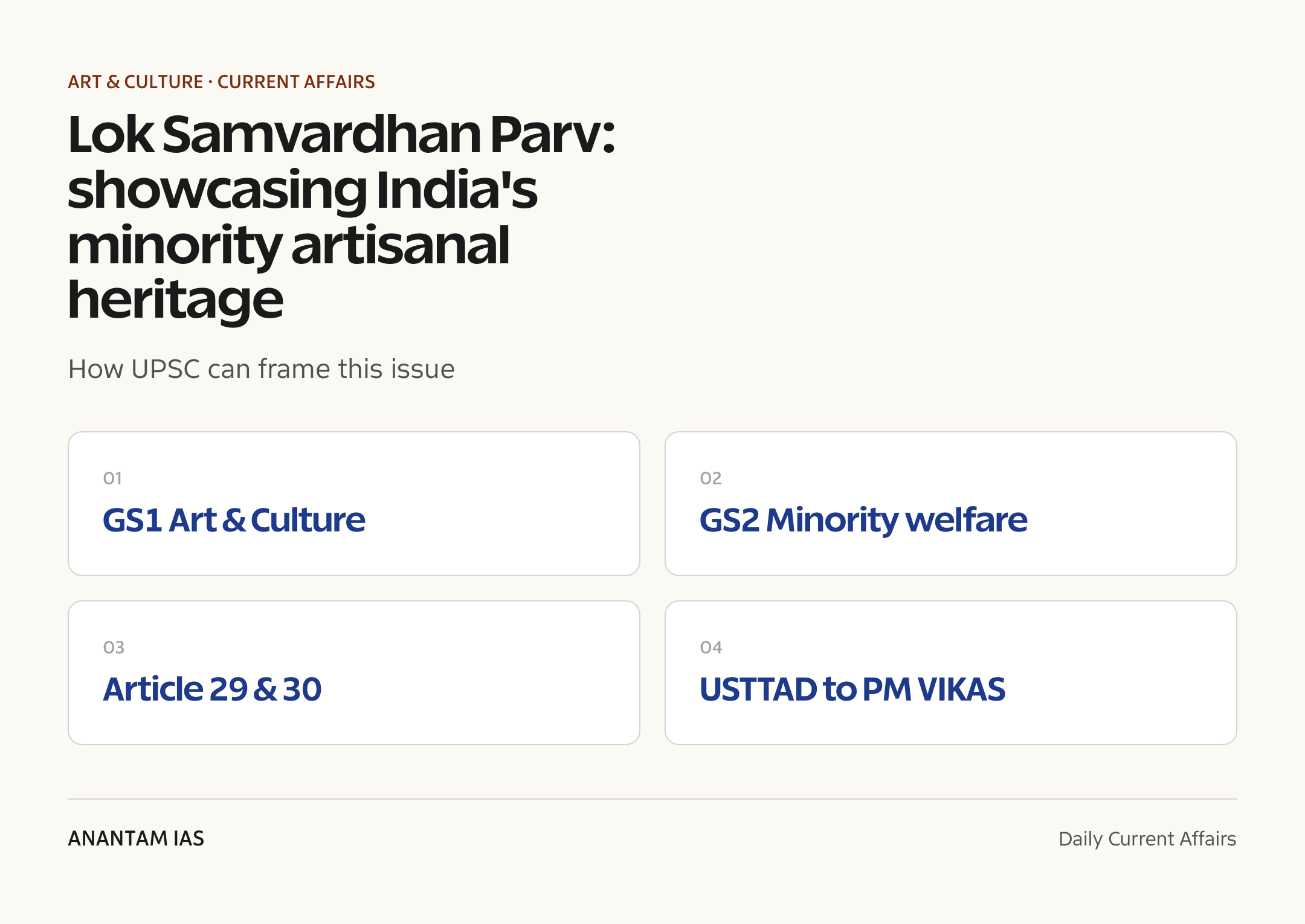
- It ties cultural-heritage preservation (a GS1 theme) to minority welfare and market access (a GS2 social-justice theme).
UPSC Relevance
Prelims Relevance
- Lok Samvardhan Parv — craft-and-culture fair of the Ministry of Minority Affairs.
- PM VIKAS — Pradhan Mantri Virasat Ka Samvardhan, launched 2023 by merging five schemes.
- Five merged schemes: Seekho Aur Kamao, Nai Manzil, Nai Roshni, USTTAD, Hamari Dharohar.
- Six notified minorities: Muslims, Christians, Sikhs, Buddhists, Jains, Zoroastrians (Parsis).
- Notification is under the National Commission for Minorities Act, 1992; Jains added in 2014.
- USTTAD = Upgrading the Skills and Training in Traditional Arts/Crafts for Development.
- Vishwakarma Villages — art-and-craft hubs under PM VIKAS’s hub-and-spoke model.
- Constitutional anchors: Article 29 (conserve culture) and Article 30 (minority educational institutions).
- Nodal ministry: Ministry of Minority Affairs, carved out in 2006.
- Venue 2026: Parade Ground, Dehradun, Uttarakhand.
Mains Relevance
GS Paper 1
- Role of traditional arts, crafts and handicrafts in India’s cultural heritage and their transmission.
- Preserving intangible cultural heritage of minority communities while making it economically viable.
GS Paper 2
- Government schemes for the welfare of minorities and vulnerable sections; skilling and livelihood interventions.
- Constitutional and statutory safeguards for minorities and their cultural rights.
Essay
- Heritage as livelihood: markets, dignity and the artisan.
- Inclusion is not charity — it is the return of what a community already gives.
Background and Context
What the Parv is
A recurring craft-and-culture festival that doubles as a marketplace for minority artisans.
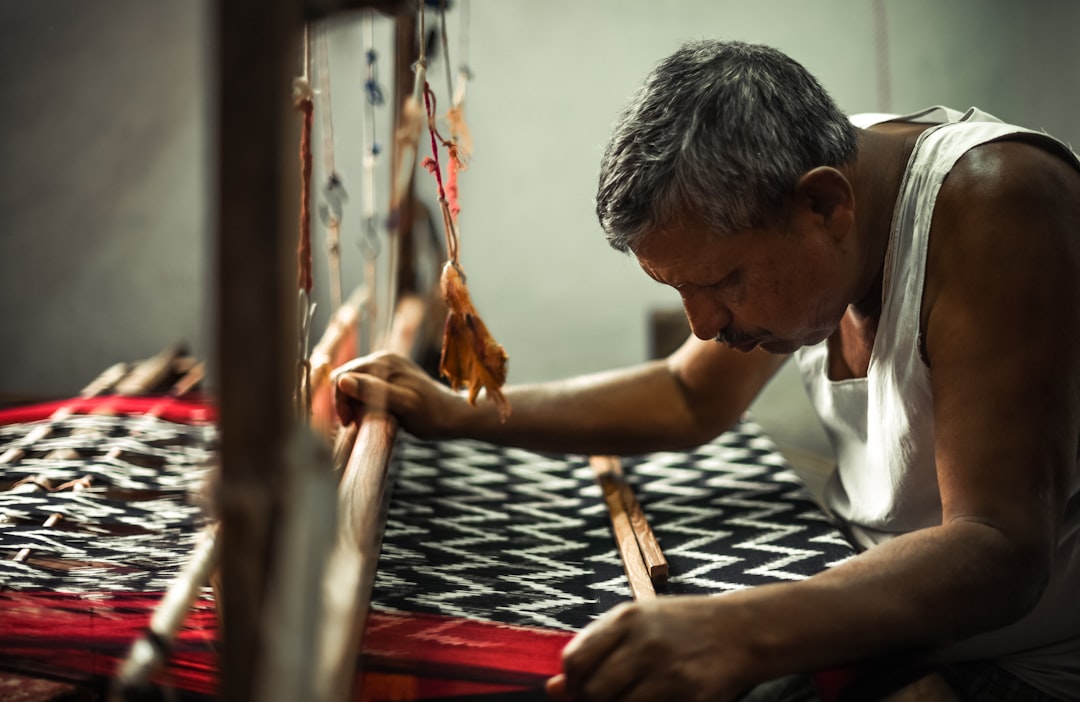
- The Lok Samvardhan Parv gathers weavers, craftspersons, culinary experts and entrepreneurs to display and sell traditional products.
- PIB describes it as a national platform for artisans and craftspersons to reach buyers, read market trends and find new business.
- The Ministry frames it as a festival for all Indians to celebrate the country’s plural heritage, not a minorities-only event.
- The 2026 Dehradun edition is the 6th, and the first held in partnership with a state government.
- Over 150 stalls spread crafts, textiles, cuisine and cultural performances across five days, with live demonstrations of skills.
- The state-partnership model is meant to plug the fair into local tourism circuits and craft clusters, giving it roots beyond a single Union-ministry showcase.
The PM VIKAS umbrella
The Parv is the shop-window of a larger skilling scheme launched in 2023.
- PM VIKAS (Pradhan Mantri Virasat Ka Samvardhan) merged five older schemes — Seekho Aur Kamao, Nai Manzil, Nai Roshni, USTTAD and Hamari Dharohar.
- It focuses on skilling, entrepreneurship, leadership training for minority women and educational support for school dropouts.
- A traditional-training sub-component targets skilling of about one lakh minority artisans.
- Infrastructure runs on a hub-and-spoke model through Vishwakarma Villages that blend crafts with tourism and commerce.
- The scheme’s design pairs skill upgradation with credit and market linkage, aiming to turn artisans into micro-entrepreneurs rather than wage-earners.
- It sits within the Ministry of Minority Affairs’ wider portfolio of scholarships, skilling and welfare for the six notified minority communities.
From Hunar Haat to Lok Samvardhan Parv
The fair is a rebranding and reset of an older marketing platform.
- The Ministry earlier ran Hunar Haat under the USTTAD scheme to market artisans’ work.
- With USTTAD folded into PM VIKAS, the marketing exhibitions were relaunched as the Lok Samvardhan Parv.
- The purpose stays constant: giving craftspeople direct market access and cutting out exploitative middlemen.
- Live demonstrations let visitors watch skills that are otherwise invisible in a finished product.
- By hosting artisans from across the country in one venue, the fair also builds peer networks and exposure to design and pricing practices beyond a craftsperson’s home region.
Who the minorities are
The scheme’s beneficiaries are the six communities notified by the Union government.
- Notified minorities: Muslims, Christians, Sikhs, Buddhists, Zoroastrians (Parsis) and Jains.
- The first five were notified in 1993 under the National Commission for Minorities Act, 1992; Jains were added in 2014.
- Many artisanal crafts — from Kashmiri weaves to embroidery and metalwork — sit within these communities’ living traditions.
- The National Commission for Minorities is the statutory body that safeguards their interests.
Constitutional and cultural stakes
Craft preservation connects to the Constitution’s cultural-rights guarantees.
- Article 29 protects the right of any section of citizens to conserve its distinct language, script or culture.
- Article 30 gives minorities the right to establish and administer educational institutions of their choice.
- Traditional crafts are a form of intangible cultural heritage — knowledge carried in hands and passed down generations.
- Several such crafts also carry Geographical Indication (GI) tags, linking cultural identity to legal and market protection.
- Article 29 is a general cultural right available to any section of citizens, while Article 30 is a special right of religious and linguistic minorities — together they anchor India’s protection of plural traditions.
- Preserving a craft protects not just a product but a transmission chain of skill, motif and technique that dies out if the next generation cannot earn a living from it.
Why it matters for policy
The Parv is a small event but a useful test of an inclusion-through-livelihood model.
- It reframes minority welfare from subsidy toward enterprise, skilling and dignity of work.
- Craft-based livelihoods are labour-intensive and can retain artisans in their home regions, easing distress migration.
- Physical fairs still matter where artisans lack the digital literacy or capital to sell online at scale.
- But one-off fairs need to connect to durable channels — e-marketplaces, GI branding and steady procurement — to move the needle.
- The state-partnership template, if repeated, could weave craft clusters into tourism circuits and give artisans a year-round rather than seasonal market.
- Success is best judged not by footfall or stall count but by whether artisan incomes, repeat orders and access to credit actually rise after the fair.
Way Forward
From fairs to markets
- Link the Parv to permanent digital storefronts so sales continue after the stalls close.
- Push GI tagging and design support to lift value capture for the artisan, not the trader.
Deepen the skilling
- Pair traditional training with literacy, digital and financial skills so artisans run their own enterprises.
- Track outcomes — incomes, repeat buyers, credit access — rather than counting footfall alone.
Institutionalise state partnerships, as with Uttarakhand, so craft clusters and tourism circuits reinforce each other rather than being showcased once a year.
Conclusion
The Lok Samvardhan Parv is a modest but telling intervention: it treats a community’s heritage as an economic asset and its artisans as entrepreneurs, not welfare recipients.
Its lasting value will depend on whether the fair becomes a gateway to steady markets, credit and design support — or stays an annual celebration that fades when the stalls are packed away.
For UPSC, the Parv is a compact case study bridging GS1 art and culture (handicrafts, intangible heritage, GI-tagged crafts) and GS2 governance (minority-welfare schemes, constitutional safeguards under Articles 29 and 30, and the shift from subsidy to enterprise) — useful for answers on preserving living heritage while building sustainable artisan livelihoods.
UPSC Practice Questions
Prelims MCQ 1
With reference to the PM VIKAS scheme, consider the following statements:
- It is implemented by the Ministry of Minority Affairs.
- It was formed by merging several earlier minority-focused schemes, including USTTAD.
- It exclusively provides scholarships and has no skilling or entrepreneurship component.
How many of the above statements are correct?
(a) Only one (b) Only two (c) All three (d) None
Answer: (b) Only two
Explanation:
PM VIKAS is run by the Ministry of Minority Affairs and merged five schemes such as USTTAD, Seekho Aur Kamao and Nai Manzil. Statement 3 is wrong — its core is skilling, entrepreneurship and leadership training, not just scholarships.
Prelims MCQ 2
The ‘Lok Samvardhan Parv’ is best described as:
(a) A craft-and-culture fair marketing the products of minority artisans (b) A stock-market index for the handicrafts sector (c) An inter-state river-water dispute mechanism (d) A defence-technology exhibition
Answer: (a) A craft-and-culture fair marketing the products of minority artisans
Explanation:
The Lok Samvardhan Parv, held under PM VIKAS, is the Ministry of Minority Affairs’ exhibition-cum-marketplace for artisans, weavers and culinary experts — the successor to Hunar Haat.
UPSC Mains Questions
- Traditional crafts are a form of living cultural heritage as much as an economic activity. Examine how schemes like PM VIKAS attempt to preserve minority artisanal heritage while improving livelihoods, and the challenges they face.
- Government support to artisans often stops at showcasing rather than market-building. Discuss how craft fairs such as the Lok Samvardhan Parv can be linked to durable market access for minority and other artisans.
Sources: PIB, Ministry of Minority Affairs and News on AIR.
Frequently Asked Questions
What is the Lok Samvardhan Parv?
It is a craft-and-culture festival organised by the Ministry of Minority Affairs where artisans, weavers and culinary experts from India’s minority communities showcase and sell traditional products. Held under the PM VIKAS scheme, it also offers live demonstrations and cultural performances, and helps craftspeople reach buyers and understand market trends.
Under which scheme is it held?
It is organised under PM VIKAS — Pradhan Mantri Virasat Ka Samvardhan — a skilling and livelihood scheme of the Ministry of Minority Affairs launched in 2023. PM VIKAS merged five earlier schemes, including USTTAD, and the Parv is essentially the successor to the older Hunar Haat craft fairs.
Which communities are ‘notified minorities’ in India?
Six communities are notified by the Union government under the National Commission for Minorities Act, 1992: Muslims, Christians, Sikhs, Buddhists and Zoroastrians (Parsis), with Jains added in 2014. PM VIKAS and the Lok Samvardhan Parv are aimed at artisans and craftspeople from these communities.
How is the 2026 edition different?
The 6th edition, at the Parade Ground in Dehradun, is the first Lok Samvardhan Parv held in formal partnership with a state government — Uttarakhand. It features over 150 artisanal and food stalls across five days, with live craft demonstrations and cultural performances.
How does it relate to the Constitution?
Craft and cultural preservation connect to Article 29, which lets any section of citizens conserve its language, script or culture, and Article 30, which protects minorities’ right to run educational institutions. Traditional crafts are intangible cultural heritage, and many also carry Geographical Indication tags.
Why is it important for UPSC?
It links two syllabus themes — GS1 Indian art and culture (heritage crafts, intangible heritage) and GS2 welfare of minorities (schemes, constitutional safeguards). It is a compact example of an inclusion-through-livelihood model and a ready case study for questions on artisans and cultural preservation.
Tell Google you want more of this.
Add Anantam IAS as a preferred sourceOne tap, and this site shows up more often in your own Top Stories, AI Overviews and AI Mode. Remove it any time.