Why in News?
The Archaeological Survey of India’s Bhopal Circle has sent a proposal to the Director-General, ASI, for a fresh excavation at Vaishya Tekri , an ancient mound at Undasa in Ujjain district, according to The Indian Express.
- The ASI’s current national register identifies the protected site cautiously as Ancient Mound (Vaishya Tekri) at Undasa, Ujjain. The register itself does not label it an Ashokan stupa or certify a date.
- The 1938-39 excavation report, quoted by The Indian Express, estimated a base of about 350 feet in diameter and a surviving or inferred height of not less than 100 feet. These are historical excavation estimates, not.
- The old report described a rammed local blackish murum core faced with large bricks in mud mortar, and cited brick dimensions plus a punch-marked coin and a cast Avanti coin while proposing a Mauryan-period context.
- The same report said the outer facing had largely disappeared and that the exact plan and elevation could not be reconstructed from what survived. This limitation matters more than the headline comparison with Sanchi.
- The report associated the mound with a stupa, but treated a direct link to Emperor Ashoka only as a possibility. It also recorded that excavation did not support the local palace tradition attached to the name.
- The story is not the discovery of a finished monument. It is a proposal to reopen an archaeological question using better documentation, scientific sampling and conservation planning.
- For exam answers, use a three-part evidence scale: established, the protected mound and 1938-39 excavated structural remains; proposed, a large stupa and early chronology; unproven, direct Ashokan patronage and the claim that it.
- The case connects ancient urban history with present heritage governance: excavation destroys the original stratigraphic relationship as it proceeds, so every layer must be recorded before removal.
UPSC Relevance
Prelims Relevance
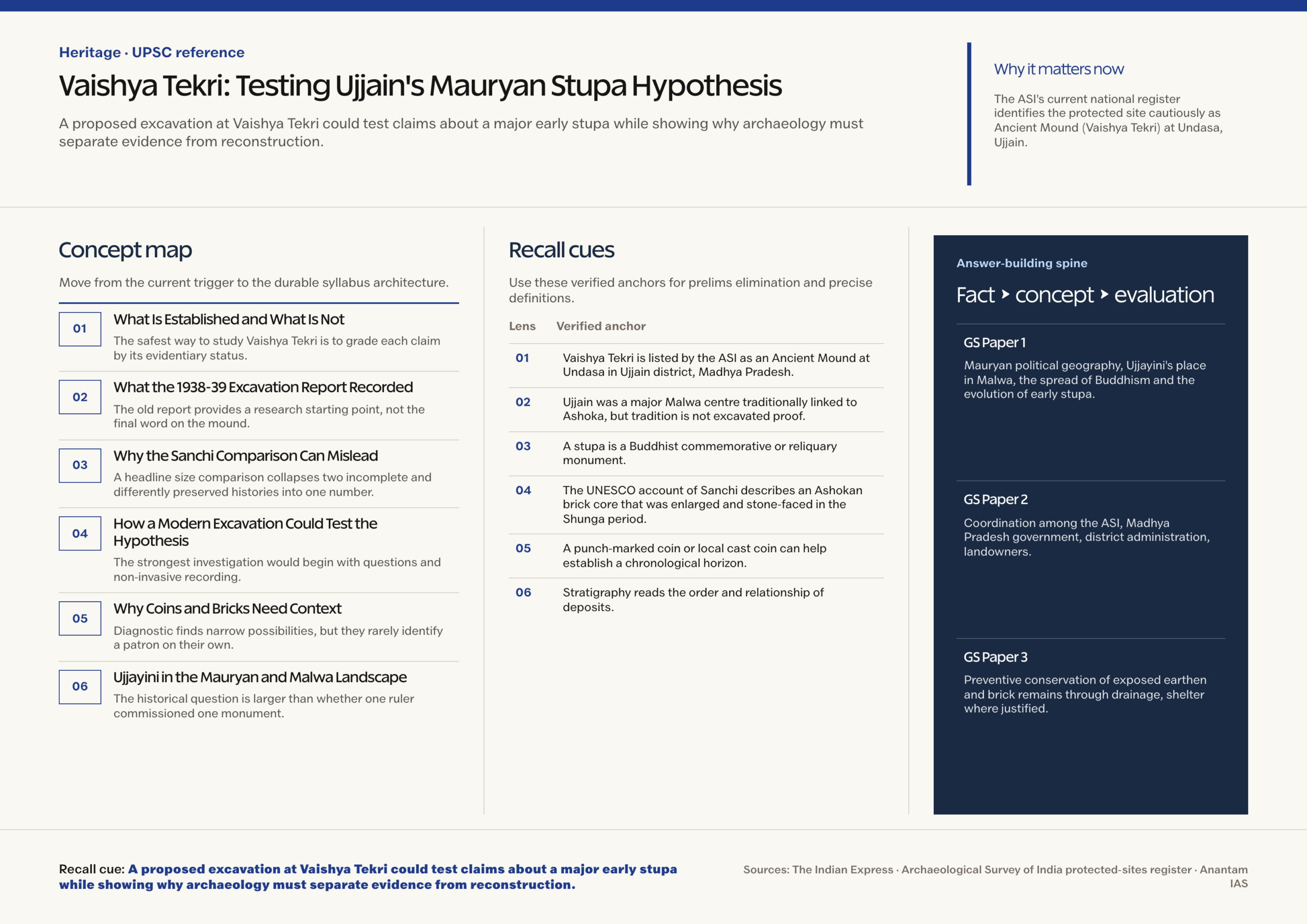
- Vaishya Tekri is listed by the ASI as an Ancient Mound at Undasa in Ujjain district, Madhya Pradesh.
- Ujjain, ancient Ujjayini, was a major political and commercial centre of Malwa and is traditionally associated with Ashoka before his accession, but tradition must be distinguished from excavated proof.
- A stupa is a Buddhist commemorative or reliquary monument. Its architectural vocabulary may include the anda, harmika, yashti, chhatra, medhi, vedika and torana, but not every early stupa preserves every element.
- The UNESCO account of Sanchi describes an Ashokan brick core that was enlarged and stone-faced in the Shunga period, with richly carved gateways added under the Satavahanas. Its present form is multi-period.
- A punch-marked coin or local cast coin can help establish a chronological horizon, but an artefact’s date does not automatically date every structural phase or identify a patron.
- Stratigraphy reads the order and relationship of deposits. A find without a secure archaeological context has much less dating value than one recorded in an undisturbed layer.
Mains Relevance
GS Paper 1
- Mauryan political geography, Ujjayini’s place in Malwa, the spread of Buddhism and the evolution of early stupa architecture.
- Methods for dating an archaeological site through stratigraphy, material typology, coins, construction phases and suitable scientific samples.
GS Paper 2
- Coordination among the ASI, Madhya Pradesh government, district administration, landowners, research institutions and local communities.
- Rule-based heritage administration under the AMASR Act, including access to protected land, excavation authority, documentation and custody of antiquities.
Essay
- Archaeology gives a society disciplined ways to remember: the past becomes credible when evidence is recorded, uncertainty is admitted and attractive legends remain open to testing.
Background and Context
What Is Established and What Is Not
The safest way to study Vaishya Tekri is to grade each claim by its evidentiary status.
- Established: the ASI register lists an Ancient Mound called Vaishya Tekri at Undasa, Ujjain, among centrally protected monuments and sites in Madhya Pradesh.
- Established through the old report: excavators in 1938-39 exposed structural remains and described a large engineered mound with a rammed murum core and brick-facing system.
- Proposed: the early excavators interpreted the remains as a major stupa and used large bricks and two coin finds to argue for an early, possibly Mauryan, chronology.
- Unproven: no cited inscription, relic deposit, securely dated foundation context or donor record has yet established that Ashoka commissioned the structure.
- Unresolved: the proposal for fresh excavation has been sent to the Director-General, ASI. Approval, research design, land arrangements and a completed modern excavation were not reported as finished steps.
What the 1938-39 Excavation Report Recorded
The old report provides a research starting point, not the final word on the mound.
- The excavation was undertaken by the Archaeological Department of the erstwhile Gwalior State and recorded in its annual administration report for Vikram Samvat 1995, corresponding to 1938-39.
- It estimated the stupa’s base at roughly 350 feet across and its height at not less than 100 feet, while also observing that erosion had removed the top and much of the exterior facing.
- The core was described as local blackish murum rammed hard, surrounded by brick masonry in mud mortar. The excavators also identified a bowl-shaped lower construction intended to resist outward thrust from the heavy fill.
- The largest reported bricks measured about 22.25 by 18.25 by 3.75 inches; another type measured about 22.25 by 15.25 by 3.75 inches. Brick size was used as chronological evidence, but modern dating must examine stratified context.
- Quarrying of murum around the monument was said to have produced a square moat-like depression, with vestiges of a western passage. A fresh survey must establish which features are ancient construction, later disturbance or landscape change.
Why the Sanchi Comparison Can Mislead
A headline size comparison collapses two incomplete and differently preserved histories into one number.
- The old Vaishya Tekri figures are reconstructed estimates from a badly denuded mound whose precise plan and elevation could not be recovered in 1938-39.
- The UNESCO-listed Buddhist Monuments at Sanchi preserve a long building sequence: an Ashokan core, Shunga enlargement and stone facing, and later Satavahana gateways.
- The visible height of Sanchi Stupa 1 today is not a neutral proxy for the size of its earliest Mauryan phase. Diameter, height, volume, preserved fabric and construction date answer different questions.
- The phrase larger than Sanchi should remain a testable hypothesis until modern survey defines Vaishya Tekri’s footprint, original form, chronological phases and loss through erosion.
How a Modern Excavation Could Test the Hypothesis
The strongest investigation would begin with questions and non-invasive recording, not with a race to expose the largest possible area.
- Create a topographic and geospatial baseline using total-station or GNSS survey, drone photogrammetry where legally permitted, historic maps and a site-wide grid tied to permanent reference points.
- Use suitable geophysical methods, such as ground-penetrating radar or electrical resistivity where soil conditions allow, to identify anomalies and target limited trenches. These methods guide excavation; they do not by themselves date a structure.
- Record every trench through stratigraphic units, plans, sections, three-dimensional coordinates, photographs and a finds register. Soil, mortar, brick, botanical remains and residues need a documented chain of custody.
- Apply scientific dating only to appropriate, secure samples. Radiocarbon dating requires suitable organic material; luminescence methods may be useful for selected sediments or fired materials, but results depend on sampling conditions and context.
- Test the construction sequence: the murum core, brick facing, passage, quarry depression and later repairs may belong to different phases. A single label such as Mauryan can hide centuries of change.
Way Forward
Approve a Research Design, Not Just an Excavation
- Set testable questions around chronology, function, construction phases, landscape setting and the relationship between the mound and ancient Ujjayini.
- Constitute a multidisciplinary team of field archaeologists, conservators, archaeological scientists, numismatists, ceramic specialists, geoarchaeologists, surveyors and epigraphists.
- Publish annual preliminary results and a final excavation report with trench plans, contexts, catalogues, sample methods and reasons for revised interpretations.
Conclusion
- Vaishya Tekri may prove to be a major early Buddhist monument, and its scale could reshape how we understand Ujjayini within the Mauryan and post-Mauryan landscape.
- The real measure of success will not be whether the new excavation produces a dramatic comparison with Sanchi.
UPSC Practice Questions
Prelims MCQ 1
With reference to Vaishya Tekri, consider the following statements:
- The ASI’s list of centrally protected monuments and sites records it as an Ancient Mound at Undasa in Ujjain district.
- The ASI register officially identifies the mound as a stupa commissioned by Ashoka.
- The present visible form of Sanchi Stupa 1 belongs entirely to one Mauryan construction phase.
How many of the above statements are correct?
(a) Only one (b) Only two (c) All three (d) None
Answer: (a) Only one
Explanation:
Statement 1 is correct. The ASI list uses the cautious label Ancient Mound (Vaishya Tekri). It does not certify Ashokan patronage. Sanchi Stupa 1 has an Ashokan core and important Shunga and Satavahana additions.
Prelims MCQ 2
Which provision of the Ancient Monuments and Archaeological Sites and Remains Act, 1958 specifically addresses excavations in protected areas?
(a) Section 6 (b) Section 19 (c) Section 21 (d) Section 30
Answer: (c) Section 21
Explanation:
Section 21 permits an archaeological officer, an authorised officer or a licensee to excavate a protected area after written notice to the Collector and owner.
UPSC Mains Questions
- Archaeological interpretation is strongest when independent lines of evidence converge. Discuss with reference to the proposed excavation of Vaishya Tekri and the limits of attributing monuments to named rulers. (150 words)
- Excavation without a conservation and publication plan can destroy more knowledge than it recovers. Examine the institutional and scientific safeguards required for excavating a centrally protected archaeological mound. (250 words)
Sources: The Indian Express and Archaeological Survey of India, Centrally Protected Monuments and Sites.
Frequently Asked Questions
What is Vaishya Tekri?
Vaishya Tekri is a centrally protected ancient mound at Undasa in Ujjain district, Madhya Pradesh. Excavation in 1938-39 exposed remains interpreted as a very large stupa. ASI’s current register uses the neutral label Ancient Mound, while a fresh excavation has.
Has an Ashokan stupa been discovered at Vaishya Tekri?
Not as an established modern finding. The old excavation report proposed a Mauryan date from construction features, large bricks and coin finds, and considered an Ashokan connection possible. No cited inscription or securely reported modern excavation result yet proves that.
Is Vaishya Tekri larger than Sanchi Stupa?
That remains a hypothesis. The 1938-39 report estimated a base around 350 feet across and a height of at least 100 feet, but also said the facing, exact plan and elevation had been lost. Sanchi’s surviving monument has several construction.
Why are the coins found at Vaishya Tekri important?
The reported punch-marked coin and cast Avanti coin support early activity and can help define a chronological horizon. Their value depends on precise archaeological context. Coins can circulate for long periods or enter disturbed layers, so they cannot by themselves.
Why can excavation damage an archaeological site?
Excavation removes soil layers in a sequence that cannot be recreated. If the relationship among deposits, structures and artefacts is not recorded before removal, that information is permanently lost. Exposure can also subject buried brick and earth to rain, salts.
Tell Google you want more of this.
Add Anantam IAS as a preferred sourceOne tap, and this site shows up more often in your own Top Stories, AI Overviews and AI Mode. Remove it any time.