Why in News?
Turkiye hosted the first Strategic Political and Defence Committee meeting under its new defence pact with Saudi Arabia and Pakistan in Istanbul on 31 August 2026.
- The committee was created under the pact, making the meeting an early institutional step rather than proof of a fully operational alliance.
- Turkiye’s official notice listed its foreign minister, defence minister and chief of general staff alongside Pakistani and Saudi officials.
- The notice announced the meeting but did not publish an agenda, decisions, command arrangement or agreed response procedure.
- The meeting followed the pact’s signing in Makkah on 7 August 2026 by Turkiye, Saudi Arabia and Pakistan.
- The arrangement links three states with different strategic assets, partnerships and threat perceptions, making implementation rules central to its credibility.
- For India, Pakistan’s participation raises questions about crisis signalling, defence cooperation and diplomatic balancing with Turkiye and Saudi Arabia.
- The careful distinction is between a political commitment to collective defence and the military machinery needed to execute it.
UPSC Relevance
Prelims Relevance
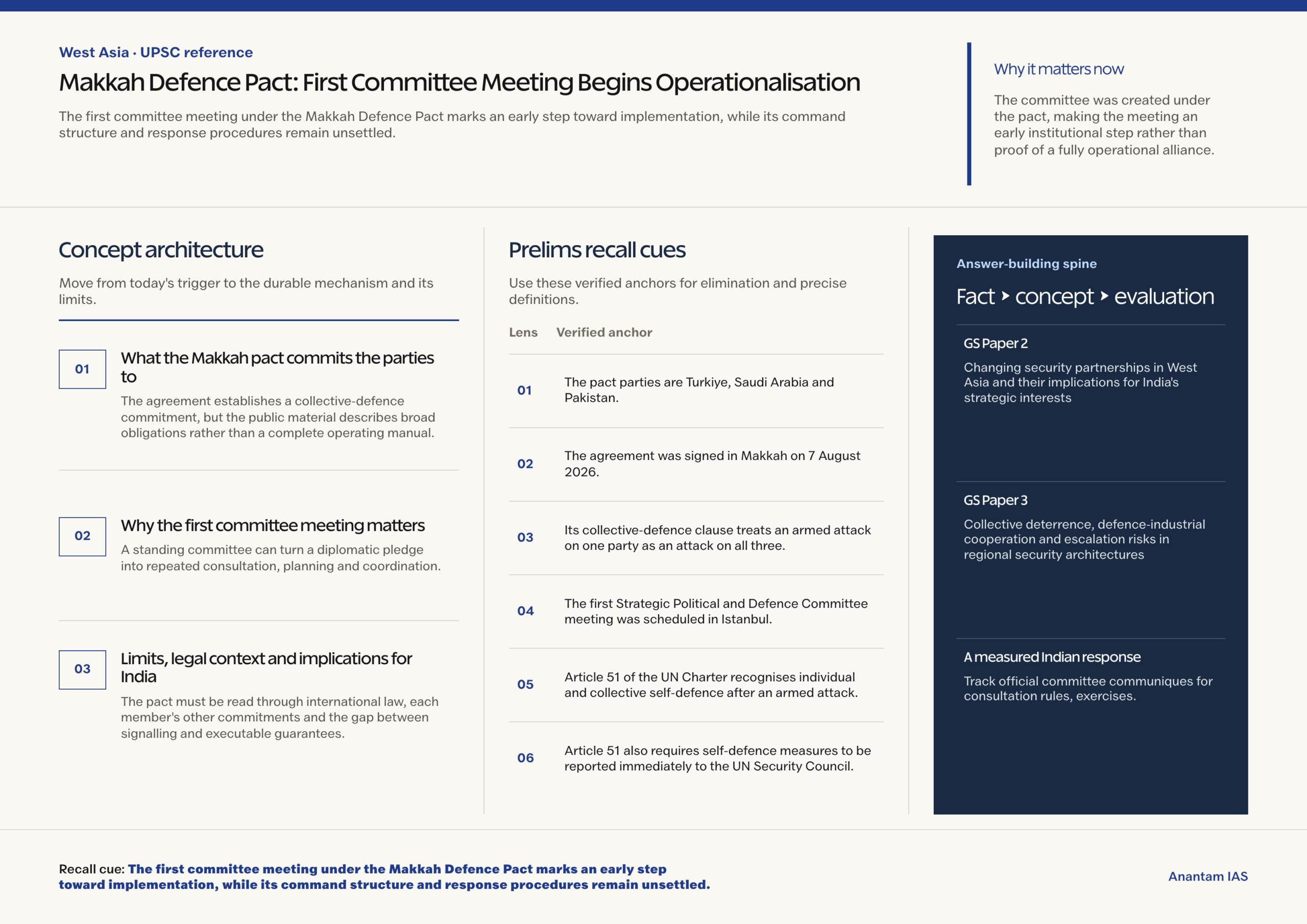
- The pact parties are Turkiye, Saudi Arabia and Pakistan.
- The agreement was signed in Makkah on 7 August 2026.
- Its collective-defence clause treats an armed attack on one party as an attack on all three.
- The first Strategic Political and Defence Committee meeting was scheduled in Istanbul.
- Article 51 of the UN Charter recognises individual and collective self-defence after an armed attack.
- Article 51 also requires self-defence measures to be reported immediately to the UN Security Council.
Mains Relevance
GS Paper 2
- Changing security partnerships in West Asia and their implications for India’s strategic interests
- Difference between treaty commitments, institutional coordination and operational military integration
GS Paper 3
- Collective deterrence, defence-industrial cooperation and escalation risks in regional security architectures
Essay
- Security institutions gain credibility through clear rules, communication and restraint, not declarations alone.
Background and Context
What the Makkah pact commits the parties to
The agreement establishes a collective-defence commitment, but the public material describes broad obligations rather than a complete operating manual.
- The central clause says an armed attack against any one party shall be regarded as an attack against all three.
- Official statements describe the pact as defensive, not directed against a named state, and intended to strengthen collective deterrence against external aggression.
- The pact also covers wider defence cooperation, including joint capabilities, defence-industry projects and cooperation against terrorism, so its scope extends beyond a crisis-response clause.
- Its public justification refers to UN Charter Article 51, which preserves individual and collective self-defence when an armed attack occurs against a UN member.
- The public statements do not establish that every attack produces an identical or automatic military response; implementation depends on agreed procedures and political decisions.
Why the first committee meeting matters
A standing committee can turn a diplomatic pledge into repeated consultation, planning and coordination, but one meeting does not prove operational integration.
- The committee’s combined political and defence character can connect diplomatic assessment, legal interpretation and military advice before any collective decision is made.
- Its first meeting creates a venue to clarify threats, consultation triggers, information sharing, crisis communication and the division of responsibilities among the parties.
- Credible deterrence requires potential adversaries to understand both political resolve and the partners’ capacity to coordinate under pressure without misreading defensive preparations as escalation.
- Effective coordination would eventually require interoperable communications, exercises, logistics and planning; none of these should be treated as established without official evidence.
- No publicly verified outcome was available when this note was prepared, so the meeting marks early operationalisation, not a completed security architecture.
Limits, legal context and implications for India
The pact must be read through international law, each member’s other commitments and the gap between signalling and executable guarantees.
- Article 51 applies after an armed attack, requires measures to be reported to the Security Council and preserves the Council’s continuing authority.
- Turkiye remains a NATO member, but the Makkah pact does not automatically convert a trilateral contingency into a NATO obligation; each treaty has its own parties and procedures.
- The three parties bring different military capabilities, economic resources and regional relationships, which may strengthen bargaining power while also complicating a common threat assessment and response choice.
- For India, the key concern is not an assumed automatic front but how the pact changes Pakistan’s diplomatic and defence options during a crisis.
- India should distinguish verified clauses from speculation about nuclear guarantees, integrated command or predetermined responses, none of which the cited public notices establish.
Way Forward
A measured Indian response
- Track official committee communiques for consultation rules, exercises, procurement links and any command or intelligence-sharing mechanisms.
- Maintain direct strategic dialogue with Saudi Arabia and Turkiye while conveying Indian concerns about crisis stability and cross-border terrorism.
- Strengthen India’s own maritime awareness, defence partnerships and evacuation planning across West Asia without treating the pact as a settled hostile bloc.
- Anchor diplomatic assessments in the pact’s published language and observed conduct rather than unsupported claims about automatic intervention or nuclear cover.
Conclusion
- The first committee meeting matters because it begins building an institutional bridge between a collective-defence promise and the consultation, planning and coordination needed to make it credible.
- In an answer, separate the pact’s verified legal-political commitment from unresolved questions of command, interoperability, trigger interpretation and the form of any response.
- For India, calibrated monitoring and sustained engagement offer a stronger response than treating an early-stage arrangement as a fully integrated alliance.
UPSC Practice Questions
Prelims MCQ 1
With reference to the Makkah Joint Defence Agreement, consider the following statements:
- It was signed by Turkiye, Saudi Arabia and Pakistan.
- It treats an armed attack against one party as an attack against all three.
- Its first Strategic Political and Defence Committee meeting was held in Makkah.
How many of the above statements are correct?
(a) Only one (b) Only two (c) All three (d) None
Answer: (b) Only two
Explanation:
Statements 1 and 2 are correct. The pact was signed in Makkah, but the first committee meeting was scheduled in Istanbul.
Prelims MCQ 2
Which provision of the UN Charter expressly recognises the inherent right of individual and collective self-defence after an armed attack?
(a) Article 2(4) (b) Article 33 (c) Article 51 (d) Article 99
Answer: (c) Article 51
Explanation:
Article 51 recognises this right, requires measures taken in self-defence to be reported immediately to the Security Council and preserves the Council’s authority.
UPSC Mains Questions
- The credibility of a collective-defence pact depends as much on institutions and procedures as on treaty language. Discuss with reference to the Makkah Joint Defence Agreement.
- Assess the implications of the emerging Turkiye-Saudi Arabia-Pakistan security arrangement for India’s interests in West Asia and its crisis-management choices.
Sources: Republic of Turkiye Ministry of Foreign Affairs and The Hindu.
Frequently Asked Questions
What is the Makkah Joint Defence Agreement?
It is a 2026 agreement among Turkiye, Saudi Arabia and Pakistan that treats an armed attack on one as an attack on all and seeks stronger defence cooperation.
Why is the first committee meeting significant?
It creates an institutional venue for political and defence coordination. It signals movement toward implementation, but does not by itself prove an integrated command or agreed response mechanism.
Does the pact require an automatic military response?
The public clause establishes collective-defence solidarity, but the cited official material does not specify an identical automatic response, operational trigger process or pre-agreed military action.
How is UN Charter Article 51 connected to the pact?
Article 51 recognises individual and collective self-defence after an armed attack, requires immediate reporting to the Security Council and preserves the Council’s responsibility for international peace.
Why does the pact matter to India?
Pakistan’s participation may affect regional signalling and defence cooperation. India must monitor implementation while sustaining relations with Saudi Arabia and Turkiye and avoiding claims unsupported by public evidence.
Tell Google you want more of this.
Add Anantam IAS as a preferred sourceOne tap, and this site shows up more often in your own Top Stories, AI Overviews and AI Mode. Remove it any time.