Why in News?
On 11 July 2025, the UNESCO World Heritage Committee, meeting at its 47th session in Paris, inscribed the Maratha Military Landscapes of India on the World Heritage List. The serial property bundles twelve forts built, adapted or expanded by the Marathas between the late 17th and early 19th centuries.
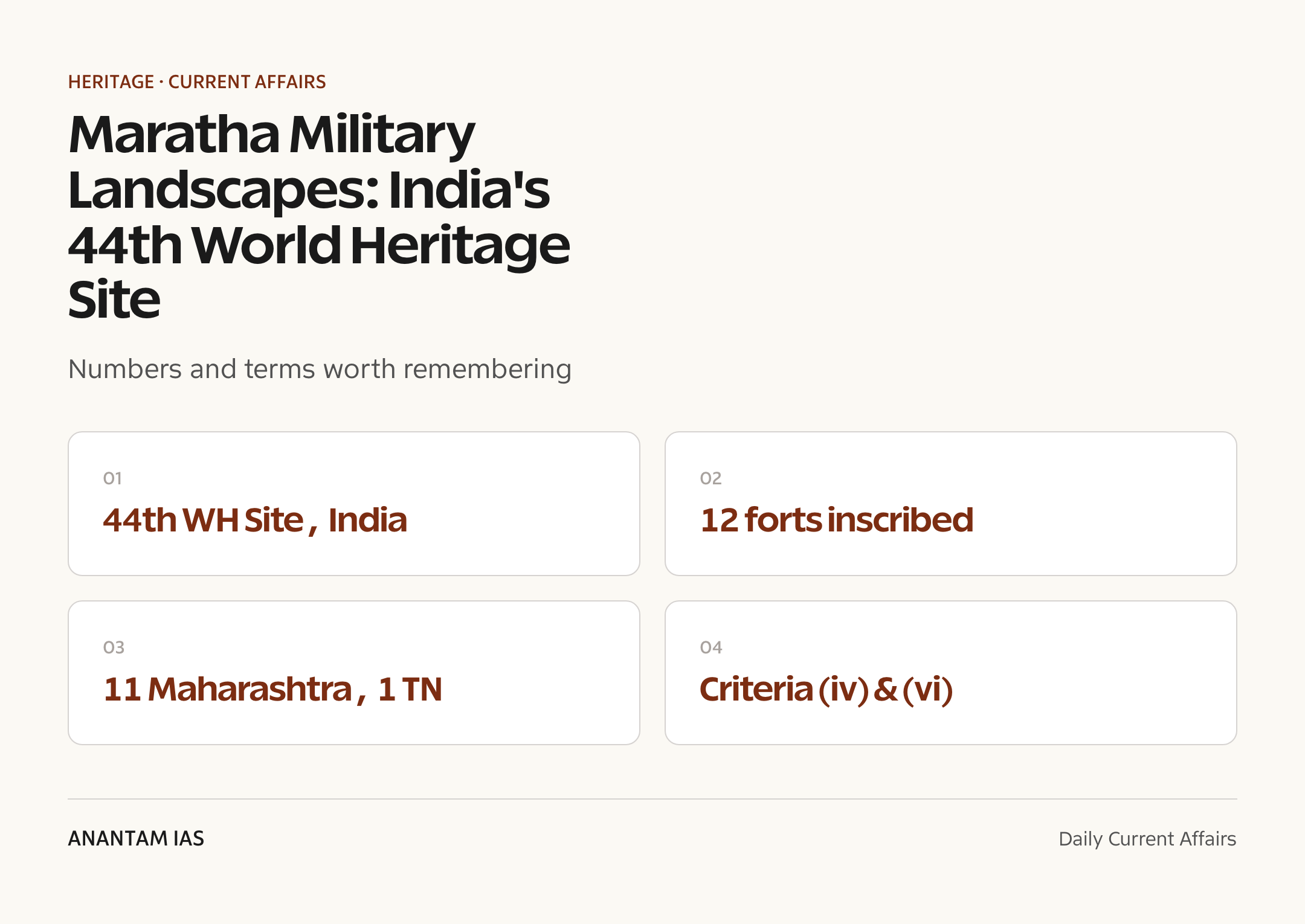
It becomes India’s 44th World Heritage property, recognised under cultural criteria (iv) and (vi). Eleven forts lie in Maharashtra and one, Gingee, in Tamil Nadu — spanning hill, coastal and island typologies that defined Maratha defensive geography.
- Inscribed 11 July 2025 at the 47th session of the World Heritage Committee, UNESCO HQ, Paris.
- A serial nomination of 12 forts — 11 in Maharashtra plus Gingee in Tamil Nadu (Villupuram district).
- Recognised under criteria (iv) (outstanding fort architecture) and (vi) (association with Maratha military traditions and history).
- India’s 44th World Heritage Site and the 7th from Maharashtra.
- Forts span the period from Chhatrapati Shivaji Maharaj (1600s) through the Peshwa era (early 1800s).
The development matters in the context of:
- Shows how cultural-criteria nominations increasingly favour serial landscapes over single monuments — terrain itself is read as heritage.
- Strengthens India’s profile in the Asia-Pacific, where it already ranks among the most-inscribed states.
UPSC Relevance
Prelims Relevance
- Total India World Heritage tally after this: 44 (cultural + natural + mixed).
- Inscription criteria used: (iv) and (vi) — both cultural.
- The 12 forts: Raigad, Shivneri, Rajgad, Pratapgad, Lohgad, Salher, Panhala, Sindhudurg, Vijaydurg, Suvarnadurg, Khanderi (all Maharashtra) and Gingee (Tamil Nadu).
- Raigad was the Maratha capital and Shivaji’s coronation site (1674).
- Shivneri is the birthplace of Chhatrapati Shivaji Maharaj.
- Typologies: hill forts, a hill-forest fort (Pratapgad), a hill-plateau fort (Panhala), a coastal fort (Vijaydurg), and island forts (Sindhudurg, Khanderi, Suvarnadurg).
- Serial property reference number on the World Heritage List: 1739.
- World Heritage Committee = the 21-state body under the 1972 World Heritage Convention; meets annually.
Mains Relevance
GS Paper 1
- Maratha fort architecture and military geography as a distinct strand of medieval Indian heritage.
- How serial, terrain-based nominations broaden the idea of what counts as cultural heritage.
GS Paper 1 (Geography)
- How the Sahyadri (Western Ghats) ridgelines and the Konkan coast shaped a layered hill-coast-island defence system.
GS Paper 2
- Role of multilateral cultural diplomacy and the federal coordination (Centre, Maharashtra, Tamil Nadu) behind a successful nomination.
Essay
- Heritage as identity: forts, memory and the geography of resistance.
- Conservation versus footfall — protecting living monuments from over-tourism.
Background and Context
What was inscribed
The property is a single serial nomination of twelve forts read as one military landscape, not twelve separate sites.
- Maharashtra (11): Salher, Shivneri, Lohgad, Raigad, Rajgad, Pratapgad, Panhala, Vijaydurg, Suvarnadurg, Khanderi and Sindhudurg.
- Tamil Nadu (1): Gingee Fort in Villupuram district — the southernmost anchor of Maratha power.
- The forts were built, occupied or expanded by the Marathas from the late 17th to early 19th centuries.
- UNESCO recognised the set under cultural criteria (iv) and (vi).
The Maratha context
The forts encode the military doctrine of Chhatrapati Shivaji Maharaj and his successors.
- Chhatrapati Shivaji Maharaj (1630–1680) built a fort-centred state using guerrilla tactics (ganimi kava) and rapid mobility.
- Raigad was his capital and the site of his coronation in 1674; Shivneri was his birthplace.
- The system endured through the Peshwa period into the early 19th century, until the Anglo-Maratha Wars ended Maratha power.
- Forts doubled as administrative, military and symbolic centres of a decentralised Swarajya.
Fort typologies and geography
The selection deliberately covers every terrain the Marathas defended.
- Hill forts: Salher, Shivneri, Lohgad, Raigad, Rajgad and Gingee — perched on the Sahyadri (Western Ghats) and Deccan ridges.
- Hill-forest fort: Pratapgad, set in dense Western Ghats forest, scene of the 1659 clash with Afzal Khan.
- Hill-plateau fort: Panhala, the largest fort in the Deccan.
- Coastal fort: Vijaydurg, base of the Maratha navy on the Konkan coast.
- Island/sea forts: Sindhudurg, Khanderi and Suvarnadurg — built to control the Arabian Sea approaches.
Why criteria (iv) and (vi)
Two cultural criteria carry the case for outstanding universal value.
- Criterion (iv): an outstanding example of a building/architectural ensemble illustrating Maratha fortification adapted to hill, forest, plateau, coast and island terrain.
- Criterion (vi): direct association with the Maratha military tradition, the idea of Swarajya and a living memory still central to regional identity.
- The advisory body (ICOMOS) initially recommended deferral; the Committee inscribed it after India’s submissions and member-state support.
Where it sits in India's tally
The inscription extends an already strong Indian record.
- India’s total rises to 44 World Heritage properties.
- It is Maharashtra’s 7th site, joining the Ajanta and Ellora caves, Elephanta, the Chhatrapati Shivaji Terminus and others.
- Nominations are coordinated nationally by the Archaeological Survey of India under the Ministry of Culture; you can read more on India’s heritage list at asi.nic.in.
- The serial form means all twelve forts share one inscription and one management framework.
Conservation and tourism stakes
World Heritage status brings both protection and pressure.
- Inscription mandates a coordinated conservation and management plan across two states.
- Hill and sea forts face erosion, monsoon damage and unregulated visitor footfall.
- Many forts are living trekking and pilgrimage destinations — balancing access with preservation is the core challenge.
- Status can unlock conservation funding, skilled restoration and responsible-tourism revenue for local communities.
Way Forward
Unified management
- Build a single inter-state conservation authority linking Maharashtra and Tamil Nadu with the Archaeological Survey of India.
- Adopt a shared management and monitoring plan as UNESCO requires for serial sites.
Sustainable tourism
- Set carrying-capacity limits and visitor-flow rules at fragile sea and hill forts.
- Channel tourism revenue into local livelihoods and trained heritage guides.
Invest in skilled stone-restoration crafts, document each fort digitally, and use the listing to teach Maratha military geography in schools rather than treat it only as a tourism brand.
Conclusion
The Maratha Military Landscapes inscription reframes a network of forts spread across the Western Ghats and the Konkan coast as a single, coherent system of defence — and recognises terrain, not just masonry, as heritage.
As India’s 44th World Heritage Site, it adds depth to the country’s cultural record. The real test now is stewardship: protecting living, weather-beaten forts while keeping them open to the communities and travellers who give them meaning.
UPSC Practice Questions
Prelims MCQ 1
With reference to the Maratha Military Landscapes of India inscribed by UNESCO in 2025, consider the following statements:
- The serial property includes forts located in both Maharashtra and Tamil Nadu.
- It was inscribed under natural criteria of the World Heritage Convention.
- Gingee Fort is one of the twelve forts in the property.
How many of the above statements are correct?
(a) Only one (b) Only two (c) All three (d) None
Answer: (b) Only two
Explanation:
Statements 1 and 3 are correct — 11 forts are in Maharashtra and Gingee is in Tamil Nadu. Statement 2 is wrong: it was inscribed under cultural criteria (iv) and (vi), not natural criteria.
Prelims MCQ 2
The Maratha Military Landscapes of India became which numbered World Heritage Site for India?
(a) 42nd (b) 43rd (c) 44th (d) 45th
Answer: (c) 44th
Explanation:
Inscribed on 11 July 2025 at the 47th session in Paris, it is India’s 44th World Heritage property.
UPSC Mains Questions
- The Maratha Military Landscapes inscription treats a network of forts as a single cultural property rather than as separate monuments. Discuss how fort architecture and terrain together shaped Maratha military geography. (250 words)
- World Heritage status protects monuments but also exposes them to tourism pressure. Examine the conservation challenges of managing a serial, multi-state property such as the Maratha Military Landscapes. (250 words)
Sources: UNESCO World Heritage Centre and UNESCO.
Frequently Asked Questions
What are the Maratha Military Landscapes of India?
They are a serial UNESCO World Heritage property of twelve forts built, adapted or expanded by the Marathas between the late 17th and early 19th centuries. Eleven forts lie in Maharashtra and one, Gingee, is in Tamil Nadu. Together they represent the Maratha system of hill, coastal and island defence.
When and where were they inscribed?
They were inscribed on 11 July 2025 at the 47th session of the UNESCO World Heritage Committee, held at UNESCO Headquarters in Paris. The decision made this India’s 44th World Heritage Site, recognised under cultural criteria (iv) and (vi).
Which twelve forts are included?
Raigad, Shivneri, Rajgad, Pratapgad, Lohgad, Salher, Panhala, Sindhudurg, Vijaydurg, Suvarnadurg and Khanderi in Maharashtra, plus Gingee Fort in Villupuram district, Tamil Nadu. They span hill, hill-forest, hill-plateau, coastal and island typologies.
Why are these forts significant for UPSC?
They cover GS Paper 1 art, culture, history and geography. They illustrate Maratha military architecture, the doctrine of Chhatrapati Shivaji Maharaj, the geography of the Western Ghats and Konkan coast, and the working of UNESCO’s serial-nomination process.
What is special about Raigad and Shivneri?
Raigad was the Maratha capital and the site of Shivaji’s coronation in 1674. Shivneri is the fort where Chhatrapati Shivaji Maharaj was born. Both anchor the historical and symbolic value of the inscribed landscape.
How many World Heritage Sites does India now have?
With this inscription, India has 44 World Heritage properties spanning cultural, natural and mixed sites. The Maratha Military Landscapes is Maharashtra’s seventh site and one of India’s growing list of serial, landscape-scale nominations.
Tell Google you want more of this.
Add Anantam IAS as a preferred sourceOne tap, and this site shows up more often in your own Top Stories, AI Overviews and AI Mode. Remove it any time.