Why in News?
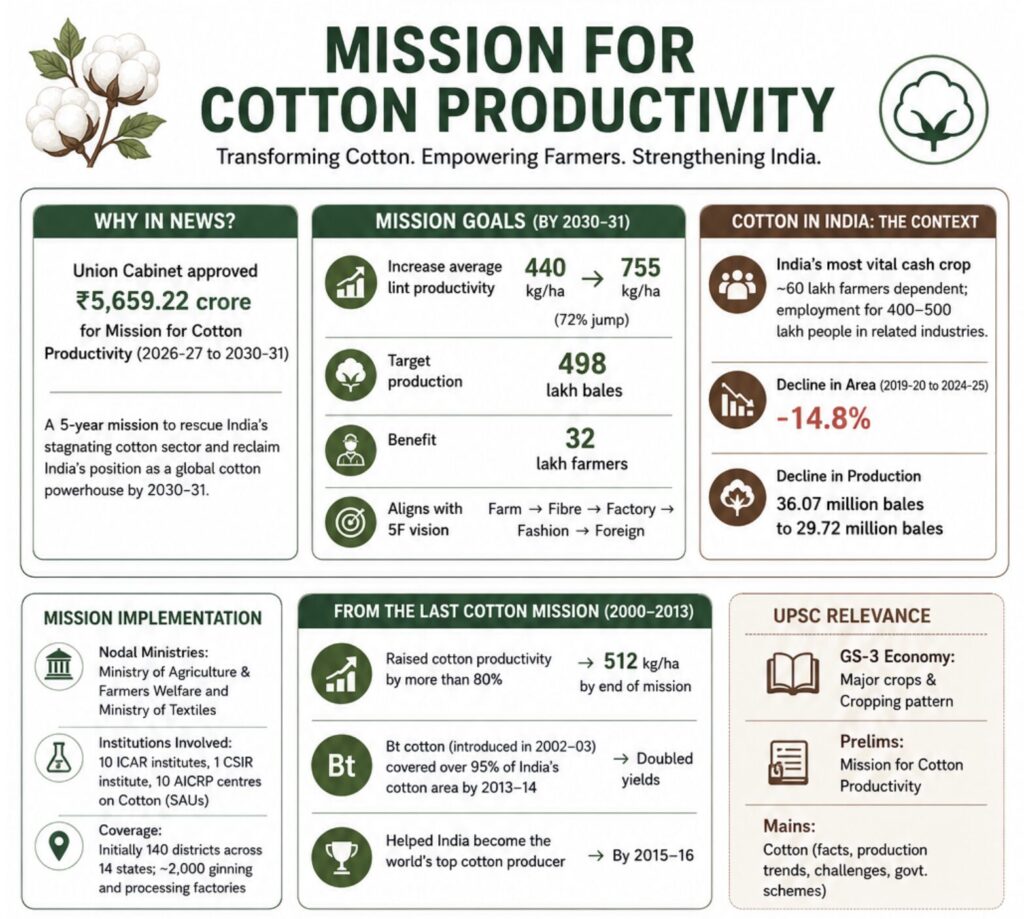
The Union Cabinet has approved Rs 5659.22 crore for the Mission for Cotton Productivity (2026-27 to 2030-31). The five-year mission aims to rescue India’s stagnating cotton sector — targeting a productivity leap from 440 to 755 kg/ha, benefiting 32 lakh farmers, and reclaiming India’s position as a global cotton powerhouse by 2030-31.
| UPSC Relevance: GS-3 Economy: Major crops & Cropping pattern Prelims: Mission for Cotton Productivity Mains: Cotton (facts, production trends, challenges, govt. schemes) |
Cotton is India’s most vital cash crop, serving as a primary source of income for approximately 60 lakh farmers and providing employment for 400-500 lakh people in related industries.
However, the area under cotton cultivation across India has decreased by over 14.8% between 2019-20 and 2024-25. The production is down from 36.07 million bales (170 kg in each bale) to 29.72 million bales.
Mission for Cotton Productivity:
- The Union Cabinet has approved ₹5,659.22 crore for the Mission for Cotton Productivity (2026-27 to 2030-31) to address bottlenecks, declining growth, and quality concerns in India’s cotton sector.
- The Mission envisages:
- To raise average lint productivity from 440 kg/ha to 755 kg/ha by 2031 (72% jump)
- To target production of 498 lakh bales.
- To benefit approximately 32 lakh farmers.
- The mission aligns with the 5F vision (Farm to Fibre to Factory to Fashion to Foreign) of the Government of India.

- The Mission will be implemented by the Ministry of Agriculture and Farmers Welfare and Ministry of Textiles, involving 10 institutes of ICAR, one institute of CSIR, and 10 centres of All India Coordinated Research Project (AICRPs) on Cotton operating in different State Agricultural Universities in major cotton-growing states.
Initially, 140 districts across 14 states will be targeted for technology upscaling and capacity building, covering around 2,000 ginning and processing factories.
| Cotton Mission (2000 to 2013): • The last cotton mission helped to raise cotton productivity by more than 80%, reaching 512 kg/ha by the end of the mission. • Bt cotton (introduced in 2002-03) covered over 95% of India’s cotton area by 2013-14, doubling yields and helping India become the world’s top cotton producer by 2015-16. |
Key Interventions in the Mission:
The Mission for Cotton Productivity will focus on the following major aspects:
- High-Yielding & Climate-Resilient Seeds: Development of HYV seeds resistant to pests, diseases, and climate stress. Special push for Extra Long Staple (ELS) cotton (fibre >34.925 mm) known for exceptional softness, strength, and premium pricing.
- Modern Production Technologies: Upscaling improved cotton production technologies like High Density Planting System (HDPS), Closer Spacing (CS), Integrated Cotton Management, and promotion of Extra Long Staple (ELS) Cotton
- Ginning & Processing Modernisation: Capacity building and adoption of best processing practices across 2,000 ginning and processing factories to ensure least-contaminant cotton supply to industry, targeting trash content below 2%.
- Cotton Testing Infrastructure: Strengthening testing facilities across the country with modern, standardised, and accredited labs for reliable quality assessment and global benchmarking aligned with BIS standards to compete with Supima (US) and Giza (Egypt) cotton brands.
- Kasturi Cotton Branding: Kasturi Cotton Bharat is a joint initiative of the Ministry of Textiles, Cotton Corporation of India, and trade bodies to own complete responsibility of branding, traceability, and certification of Indian cotton to enhance global competitiveness.
- Digital Market Integration: Digital integration of mandis (market yards) enabling transparent price discovery, direct market access, and improved farmer realisation through e-platforms.
- Circular Economy & Waste: Promotion of cotton waste recycling and circular economy practices to enhance resource efficiency, reduce environmental footprint, and generate additional value streams for the textile industry.
- Natural Fibre Diversification: Diversification of India’s fibre base by including flax, ramie, sisal, milkweed, bamboo, and banana.
Also Read: https://anantamias.com/current-affairs/indias-cotton-production-faces-prolonged-decline/
UPSC PYQ 2020:
Q. “The crop is subtropical in nature. A hard frost is injurious to it. It requires at least 210 frost-free days and 50 to 100 centimetres of rainfall for its growth. A light, well-drained soil capable of retaining moisture is ideally suited for the cultivation of the crop.” Which one of the following is that crop?
(a) Cotton
(b) Jute
(c) Sugarcane
(d) Tea
Answer: (a)
UPSC PYQ 2013:
Q. Consider the following crops:
1. Cotton
2. Groundnut
3. Rice
4. Wheat
Which of these are Kharif crops?
(a) 1 and 4
(b) 2 and 3 only
(c) 1, 2 and 3
(d) 2, 3 and 4
Answer: (c)
Tell Google you want more of this.
Add Anantam IAS as a preferred sourceOne tap, and this site shows up more often in your own Top Stories, AI Overviews and AI Mode. Remove it any time.