Why in News?
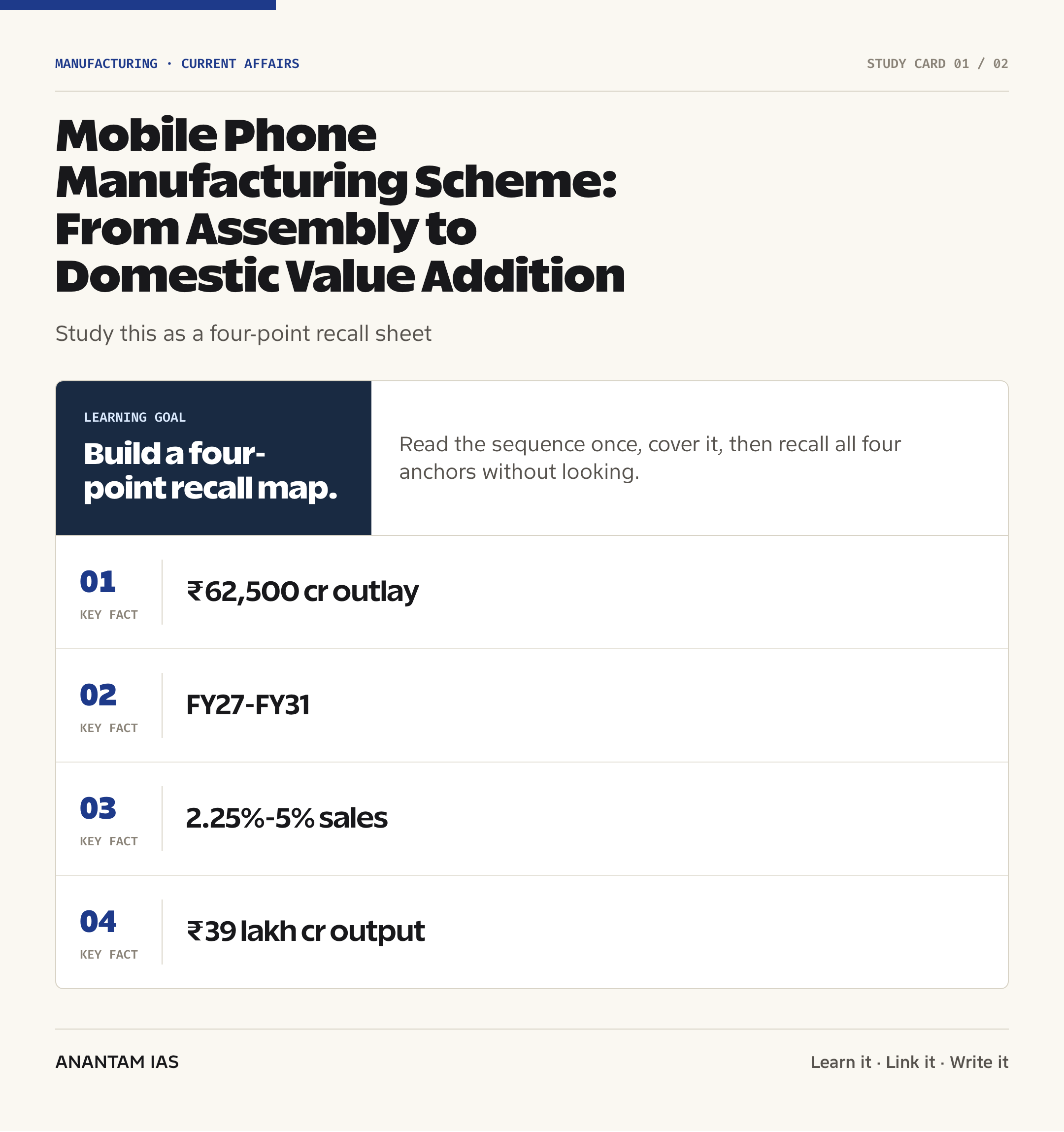
The Union Cabinet approved the Mobile Phone Manufacturing Scheme (MPMS) on 15 July 2026 with a budgetary outlay of ₹62,500 crore.
PIB said the five-year programme will reward eligible mobile-phone sales, deeper domestic sourcing, and Indian design and R&D. The policy shift matters because India has already built large assembly and export volumes; the next test is how much component value, intellectual property, and skilled work stays in the country.
- The scheme will run for five financial years, from FY 2026-27 to FY 2030-31.
- The basic incentive ranges from 2.25% to 5% of eligible sales at differentiated rates.
- Domestic sourcing of key components and sub-assemblies can earn an additional incentive of up to 1.5%.
- Building Indian brands through product design and R&D can earn an additional 3% on eligible sales.
- The official projection is about ₹39 lakh crore in cumulative mobile-phone production and around 60,000 direct jobs during the tenure.
The development matters in the context of:
- The earlier PLI for Large Scale Electronics Manufacturing ended on 31 March 2026 after helping India scale mobile-phone production and exports.
- India is the world’s second-largest mobile-phone manufacturer by volume, and 99.2% of phones used domestically are made in India, according to PIB.
- The policy question has moved from whether phones can be assembled in India to whether India can retain more value through components, industrial design, patents, tooling, and brands.
UPSC Relevance
Prelims Relevance
- MPMS is administered by the Ministry of Electronics and Information Technology (MeitY).
- Its tenure is FY 2026-27 to FY 2030-31, not an open-ended subsidy period.
- Its budgetary outlay is ₹62,500 crore.
- Its basic support is 2.25% to 5% on eligible sales of mobile phones manufactured in India.
- The domestic-sourcing add-on is up to 1.5% for key components and sub-assemblies.
- The Indian-brand add-on is 3% for product design and R&D.
- Domestic value addition means the share of a product’s value created inside India; it isn’t the same as final assembly inside India.
- The predecessor PLI-LSEM was notified in 2020, supported mobile phones and specified electronic components, and ended on 31 March 2026.
Mains Relevance
GS Paper 3
- Indian Economy: changes in industrial policy and their effects on industrial growth, employment, exports, and global value-chain participation.
- Science and Technology: indigenisation of technology, R&D, patents, component ecosystems, and technology sovereignty.
GS Paper 2
- Government policies and interventions: scheme design, fiscal accountability, implementation capacity, Centre-State coordination, and outcome monitoring.
- Governance: balancing performance-linked support with competition, MSME access, trade obligations, labour standards, and environmental responsibility.
Essay
- Technological sovereignty is built by owning knowledge and production capabilities, not only by producing large volumes.
- The movement from assembly to value addition shows how industrial policy can connect jobs, exports, resilience, and innovation.
Background and Context
How the incentive design works
MPMS uses three linked incentive layers to push scale, local sourcing, and Indian product ownership at the same time.
- The 2.25%-5% basic incentive rewards eligible sales from mobile phones made in India. It is performance-linked support, so production and sales must occur before a claim can qualify.
- The additional 1.5% sourcing incentive is the bridge from assembly to component depth. A domestically assembled phone can still carry imported displays, camera modules, printed circuit boards, cells, tooling, or other high-value inputs.
- The additional 3% design and R&D incentive targets Indian brands. Design ownership matters because product architecture, software integration, patents, and brand margins can retain value even when manufacturing spreads across countries.
- The ₹62,500 crore outlay is a public-expenditure ceiling for the scheme, while ₹39 lakh crore is the projected cumulative production value. The two figures measure different things and shouldn’t be compared as if both were government spending.
- The Cabinet release doesn’t specify applicant thresholds, annual ceilings, claim verification, rate slabs, or the exact rules for combining add-ons. Operational guidelines will have to settle those details before scheme performance can be judged.
What changed after PLI-LSEM
The predecessor scheme proved that incentives could build scale; MPMS now tries to attach that scale to deeper capabilities.
- The Production Linked Incentive model pays firms after measurable output rather than giving an unconditional upfront grant. The electronics PLI offered 4%-6% on incremental sales over a base year.
- PLI-LSEM, notified in 2020, covered mobile phones and specified electronic components. PIB records that its tenure ended on 31 March 2026.
- A separate MeitY release dated 15 July 2026 reported more than ₹20,600 crore in cumulative investment, over ₹11.62 lakh crore in production, and over ₹6.53 lakh crore in exports under PLI-LSEM by its close.
- Those outcomes established assembly scale and export credibility. But scale alone doesn’t prove that India owns the components, production machinery, product designs, standards, or brands that capture the largest margins.
- MPMS adds explicit rewards for domestic sourcing and design and R&D. That makes capability deepening a stated objective, not a hoped-for side effect of higher output.
Assembly is not the same as domestic value addition
This distinction is the core concept: the place where final assembly occurs doesn’t reveal where the product’s economic value was created.
- Domestic value addition (DVA) is the value generated in India through local materials, components, labour, design, engineering, software, logistics, testing, and profits, after imported inputs are accounted for.
- A phone may legally qualify as manufactured in India after substantial local assembly, yet imported components, foreign intellectual property, and overseas brand ownership can still capture much of its sale value.
- PIB said 99.2% of phones used in India are manufactured domestically. But a Lok Sabha reply released by MeitY in April 2026 placed overall electronics DVA at an industry-estimated 18%-20%. The second figure covers electronics, not mobile phones alone.
- The gap doesn’t cancel India’s manufacturing achievement. It shows the next policy frontier: move local firms from the lower-value assembly stage into components, product engineering, testing equipment, industrial tooling, and intellectual property.
- The global value-chain lens helps here. Countries gain more when their firms occupy several stages of production and knowledge creation, not one final stage.
Expected outcomes and their limits
The headline targets are large, but each one needs the right denominator and a clear measurement method.
- The projected ₹39 lakh crore is cumulative production across five years, not annual production and not a guaranteed outcome.
- The expected 60,000 direct jobs count should be read alongside job quality: wages, formal contracts, training, safety, career progression, and women’s continued participation in electronics factories.
- PIB says electronics manufacturing has grown seven times and exports eleven times since FY 2014-15. It also identifies smartphones as India’s largest exported product category in 2025.
- Higher exports can support foreign-exchange earnings and India’s position in global value chains. Net gains will be stronger when imported component content falls and Indian firms earn design, patent, and brand income.
- Supply-chain resilience doesn’t mean making every input domestically. It means avoiding single-point dependence through reliable domestic capacity, diversified imports, inventories for critical parts, and trusted production partners.
How MPMS fits the wider electronics ecosystem
A mobile-phone incentive can’t deepen the value chain by itself; it has to work with component, semiconductor, infrastructure, and skills policies.
- The Electronics Component Manufacturing Scheme targets sub-assemblies, bare components, supply-chain inputs, and capital equipment. Its outlay was raised to ₹40,000 crore in the Union Budget 2026-27.
- The India Semiconductor Mission addresses fabrication, packaging, chip design, materials, equipment, and workforce capability. Phone manufacturing creates demand that can help such upstream investments reach scale.
- Electronics Manufacturing Clusters, testing laboratories, logistics networks, reliable power, industrial water, and customs efficiency reduce the non-incentive costs that decide whether suppliers remain competitive after subsidies end.
- Domestic suppliers need certification, quality control, working capital, and long purchase commitments from anchor firms. Without supplier development, a sourcing bonus could raise costs without creating globally competitive capacity.
- States shape the final outcome through land, labour administration, power, training institutes, and cluster services, while MeitY sets national scheme rules and monitors claims.
Risks and the scorecard that matters
The scheme succeeds only if public incentives create capabilities that survive after the five-year support window closes.
- Additionality asks whether a subsidy caused production or R&D that wouldn’t otherwise occur. Paying for output a firm had already planned creates fiscal cost without an equal policy gain.
- A few large assemblers can meet export targets while domestic MSMEs remain outside vendor networks. The scorecard should track Indian suppliers, component-wise DVA, and domestic procurement, not only company sales.
- Patent counts can be gamed through low-value filings. Better measures include granted patents, standard-essential contributions, Indian-owned product designs, R&D payroll, prototypes commercialised, and licensing income.
- The final rules should protect competition, prevent duplicate claims across schemes, and align local-sourcing support with India’s trade obligations. Transparent audits can reduce both overpayment and policy uncertainty.
- Rapid output also raises material and waste costs. Compliance with the E-Waste (Management) Rules, 2022, repairability, recovery of critical materials, clean power, and safe recycling should sit inside the manufacturing scorecard.
Way Forward
Measure value addition precisely
- Publish a component-wise DVA methodology that separates assembly labour from local components, design, tooling, and intellectual property.
- Release annual dashboards for incentives claimed, audited eligible sales, exports, Indian procurement, jobs, R&D spending, and patents, while protecting genuine commercial secrets.
- Use independent technical and financial audits to verify additionality and prevent the same investment or sale from receiving overlapping support.
Build competitive supplier networks
- Coordinate MPMS and ECMS approvals so phone assemblers create predictable demand for domestic component projects.
- Help MSMEs meet global quality, traceability, cybersecurity, and delivery standards through shared testing facilities, vendor-development programmes, and patient working capital.
- Use time-bound incentives alongside logistics, power, customs, and cluster reforms so suppliers can compete without permanent fiscal support.
Turn R&D support into Indian ownership
- Tie the Indian-brand add-on to verified product engineering, Indian R&D teams, commercially useful patents, and products that reach domestic or export markets.
- Connect firms with IITs, IIITs, design institutes, and semiconductor programmes for radio design, power management, security, materials, software, and industrial design.
- Track design revenue and licensing income, not patent applications alone, because usable intellectual property is the capability the incentive seeks to build.
Make jobs resilient and production circular
- Link skill programmes to technician, tooling, automation, quality-control, chip-design, and product-engineering roles rather than counting only assembly-line hiring.
- Audit formal employment, wages, safety, apprenticeships, retention, and women’s advancement so the 60,000-job target reflects job quality as well as quantity.
- Enforce extended producer responsibility, design for repair, safe recycling, water efficiency, and clean-energy procurement as production expands.
Conclusion
MPMS marks a deliberate shift in India’s electronics policy. Output and exports remain important, but the scheme now rewards the harder capabilities behind lasting competitiveness: domestic components, resilient suppliers, Indian design, R&D, patents, and brands.
The final judgment should rest on how much value Indian firms and workers retain after incentives end. If component-wise DVA, productive R&D, supplier depth, and skilled employment rise with sales, India will have moved from being a major assembly location to becoming a broader electronics manufacturing and innovation base.
UPSC Practice Questions
Prelims MCQ 1
With reference to the Mobile Phone Manufacturing Scheme (MPMS), consider the following statements:
- It will operate from FY 2026-27 to FY 2030-31.
- It offers differentiated basic incentives ranging from 2.25% to 5% on eligible sales.
- It offers an additional domestic-sourcing incentive of up to 3%.
How many of the above statements are correct?
(a) Only one (b) Only two (c) All three (d) None
Answer: (b) Only two
Explanation:
Statements 1 and 2 are correct. The domestic-sourcing add-on is up to 1.5%; the separate 3% add-on supports design and R&D for building Indian brands.
Prelims MCQ 2
Which feature most directly distinguishes MPMS support for building Indian brands from a pure assembly incentive?
(a) A tariff exemption on all imported mobile-phone components (b) A 3% additional incentive on eligible sales for product design and R&D (c) Automatic patent grants for every approved manufacturer (d) A mandatory government equity stake in each beneficiary
Answer: (b) A 3% additional incentive on eligible sales for product design and R&D
Explanation:
The 3% design and R&D add-on seeks Indian product and brand ownership. The Cabinet release announces none of the other three measures.
UPSC Mains Questions
- India’s success in mobile-phone assembly has not automatically produced deep domestic value addition. Explain this distinction and critically examine whether the Mobile Phone Manufacturing Scheme’s sales, sourcing, and R&D incentives can move Indian firms into higher-value stages of global electronics value chains. (15 marks, 250 words)
- Performance-linked industrial policy can accelerate scale but may also create fiscal costs, concentration, and subsidy dependence. Discuss the safeguards and outcome metrics needed to ensure that the Mobile Phone Manufacturing Scheme creates additional production, competitive suppliers, useful intellectual property, and durable employment. (15 marks, 250 words)
- Mobile-phone manufacturing sits at the intersection of trade policy, technology sovereignty, employment, and supply-chain security. Analyse how MPMS should coordinate with component manufacturing, semiconductor, skill-development, logistics, and circular-economy policies to build a resilient electronics ecosystem in India. (15 marks, 250 words)
Source: PIB, Ministry of Electronics and IT.
Frequently Asked Questions
What is the Mobile Phone Manufacturing Scheme?
The Mobile Phone Manufacturing Scheme (MPMS) is a five-year MeitY incentive programme for phones made in India. It supports eligible sales at differentiated rates and adds incentives for domestic component sourcing and Indian design and R&D. The Cabinet approved it with a ₹62,500 crore budgetary outlay.
How long will MPMS operate?
MPMS will run for five financial years, from FY 2026-27 through FY 2030-31. A fixed sunset matters because the policy goal is to build firms and suppliers that remain competitive after support ends, not to make mobile-phone production permanently dependent on incentives.
What incentives does MPMS provide?
The basic incentive ranges from 2.25% to 5% on eligible sales. An additional incentive of up to 1.5% is linked to domestic sourcing of key components and sub-assemblies. Building Indian brands through product design and R&D can receive another 3% on eligible sales.
Why is domestic value addition important?
Final assembly shows where a phone was put together, but domestic value addition measures how much value India creates through components, labour, engineering, software, tooling, design, intellectual property, and profits. Higher DVA can deepen supplier networks, retain income, reduce vulnerable import dependence, and create more skilled work.
How is MPMS different from PLI-LSEM?
PLI-LSEM began in 2020 and focused on scaling mobile phones and specified electronic components through incentives on incremental sales. Its tenure ended on 31 March 2026. MPMS continues performance-linked support but explicitly adds rewards for domestic sourcing and design and R&D for Indian brands.
How should MPMS success be measured?
Sales and exports are only the first layer. A credible scorecard should track component-wise DVA, Indian suppliers, audited additional production, R&D payroll, commercially useful patents, design and licensing income, formal skilled jobs, MSME participation, incentive cost per outcome, and compliance with e-waste and labour rules.
Tell Google you want more of this.
Add Anantam IAS as a preferred sourceOne tap, and this site shows up more often in your own Top Stories, AI Overviews and AI Mode. Remove it any time.