Why in News?
The Union government placed the Prevention of Insults to National Honour (Amendment) Bill, 2026 in the Monsoon Session agenda. Parliament passed it in July, and the President’s office records assent on 6 August 2026; it is now the Prevention of Insults to National Honour (Amendment) Act, 2026.
The enacted amendment extends Section 3 of the 1971 Act to the National Song. It makes intentionally preventing the singing of Vande Mataram, or causing disturbance to an assembly engaged in its singing, punishable with imprisonment up to three years, fine, or both. The official PIB explainer sets out the provision.
- The measure moved from proposal to law: the Bill was passed by both Houses in July 2026 and received presidential assent on 6 August 2026.
- It amends the Prevention of Insults to National Honour Act, 1971, which protects the National Flag, the Constitution and the National Anthem through specified offences.
- The reported change concerns Vande Mataram, commonly described as India’s National Song, rather than Jana Gana Mana, the National Anthem.
- The enacted rule turns the earlier policy question into an implementation question: how will authorities apply the intentional prevention and disturbance thresholds while respecting constitutional safeguards?
- The January 2026 Union advisory on National Song protocol remains a separate administrative measure; the August 2026 Act is the later penal amendment.
The development matters in the context of:
- The issue tests how a democracy can protect national symbols without converting respectful disagreement or non-participation into a criminal offence.
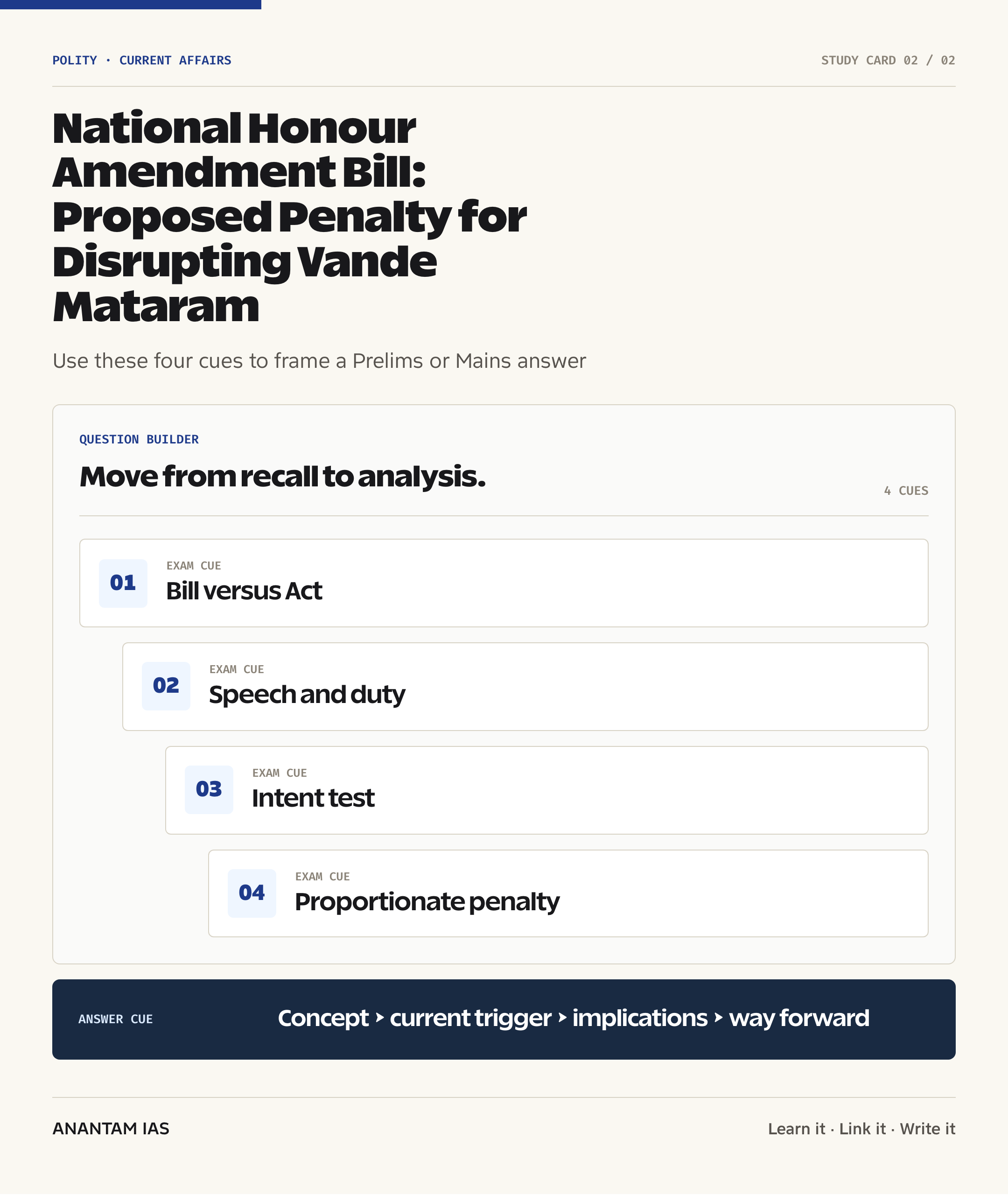
- For an exam answer, separate three layers: the 1971 Act, the January 2026 advisory, and the enacted 2026 amendment.
- The decisive policy question is not whether Vande Mataram deserves respect, but whether a penal rule is clear, proportionate and rights-compatible.
UPSC Relevance
Prelims Relevance
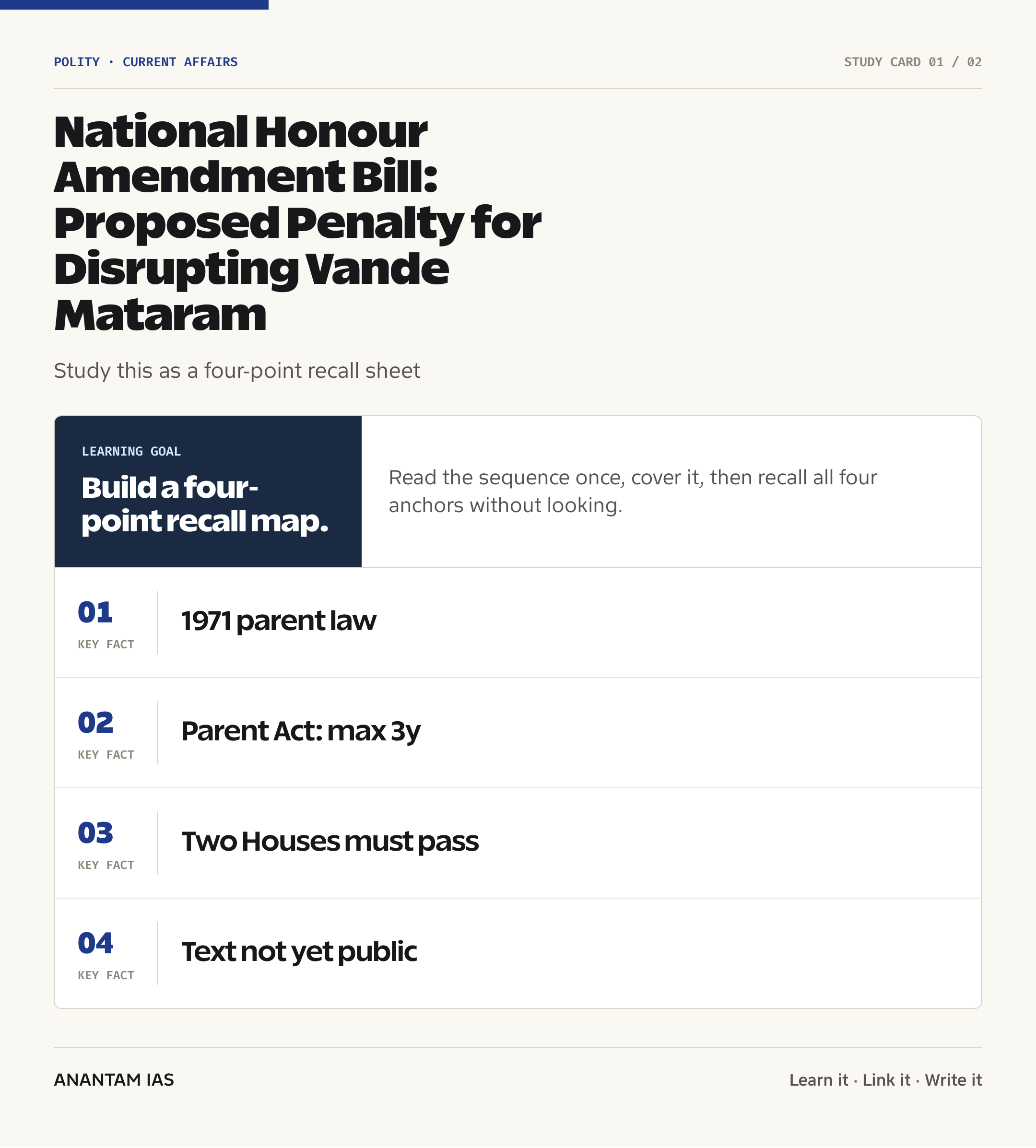
- The Prevention of Insults to National Honour Act, 1971 is a parliamentary law extending to the whole of India.
- Section 2 deals with insults to the Indian National Flag and the Constitution of India in public or within public view.
- Section 3 punishes intentional prevention of the singing of the Indian National Anthem or disturbance to an assembly engaged in such singing.
- Existing Sections 2 and 3 allow imprisonment up to three years, or fine, or both.
- Section 3A prescribes at least one year of imprisonment for a second or subsequent conviction under Section 2 or Section 3.
- Article 51A(a) asks citizens to respect the Constitution, its ideals and institutions, the National Flag and the National Anthem; it does not expressly name the National Song.
- Article 19(1)(a) guarantees freedom of speech and expression, subject to the grounds for reasonable restrictions in Article 19(2).
- A Bill becomes law after passage by both Houses in the same form and presidential assent. For this measure, the President’s office records assent on 6 August 2026.
Mains Relevance
GS Paper 2
- Legislative design at the intersection of fundamental rights, fundamental duties and protection of national symbols.
- Need for a narrow definition of the prohibited act, a clear mens rea requirement and proportionate punishment.
- Parliamentary scrutiny of a criminal-law amendment whose complete text and safeguards were not public at the agenda stage.
GS Paper 1
- Historical place of Vande Mataram in the freedom struggle and the Constituent Assembly’s statement of January 24, 1950.
- Difference between cultural recognition, executive protocol and enforceable statutory protection.
GS Paper 4
- Balancing constitutional patriotism, respect for shared symbols, liberty of conscience and restraint in the use of criminal law.
Essay
- Patriotism is strongest when civic respect and constitutional liberty reinforce each other.
- A shared national symbol can unite citizens only when the law distinguishes deliberate disruption from difference of conscience.
Background and Context
What Has Been Proposed and What Has Not
The first analytical task is to state the proposal at its correct legislative stage.
- The Lok Sabha Secretariat’s tentative agenda listed the Amendment Bill among five new measures for the Monsoon Session scheduled from July 20 to August 13, 2026.
- The reported object is to punish an intentional insult to Vande Mataram or a disruption during its singing.
- The Bill was only listed as of July 17. It had not yet been introduced, debated, referred to a committee, passed or assented to.
- The complete clause-by-clause text was not public in the cited agenda reports. Claims about the exact sentence, arrest powers, bail classification or exceptions would be premature.
- The tentative agenda can change. The title and stated purpose indicate legislative intent, but the introduced Bill and any later amendments will supply the enforceable wording.
- This distinction mirrors a wider UPSC rule: always separate a proposal, a Bill, an Act and a commenced provision.
- The session also includes pending legislation such as the FCRA Amendment Bill, 2026, showing why each measure’s stage must be tracked separately.
Architecture of the Existing 1971 Act
The parent law protects specified national symbols through narrowly described statutory offences.
- Parliament enacted the Prevention of Insults to National Honour Act, 1971 as Act No. 69 of 1971; it came into force on December 23, 1971.
- Section 2 criminalises public burning, mutilation, defacement, destruction, trampling, disrespect or contempt directed at the Indian National Flag or the Constitution of India.
- Section 2 carries imprisonment up to three years, or fine, or both. Its explanations specify forms of flag disrespect and define a public place.
- Explanation 1 to Section 2 expressly protects lawful criticism aimed at amending the Constitution or altering the Flag. This is an important internal safeguard for democratic dissent.
- Section 3 targets a different act: intentionally preventing the singing of the Indian National Anthem or disturbing an assembly engaged in such singing.
- Section 3 also allows imprisonment up to three years, or fine, or both. This is the current statutory model closest to the reported Vande Mataram proposal.
- Section 3A, inserted in 2003, requires imprisonment of at least one year for a second or subsequent conviction under Section 2 or Section 3.
- The current India Code text does not place Vande Mataram within Sections 2, 3 or 3A. Any extension of criminal liability needs an enacted amendment.
National Anthem, National Song and Constitutional Text
Cultural status and express constitutional wording are related but legally distinct.
- On January 24, 1950, Constituent Assembly President Rajendra Prasad declared Jana Gana Mana the National Anthem and said Vande Mataram, which played a historic role in the freedom struggle, should be honoured equally and have equal status.
- The Constitution itself does not contain a separate article declaring a National Song. In April 2026, the Karnataka High Court recorded that the National Song was not then covered by a statutory framework.
- Article 51A(a) expressly mentions respect for the Constitution, its ideals and institutions, the National Flag and the National Anthem. It does not expressly mention Vande Mataram.
- Fundamental duties guide civic conduct and may inform interpretation, but a penal consequence must rest on valid law with clear ingredients.
- The Union government’s 2017 parliamentary reply said Vande Mataram should receive due respect because of its freedom-struggle role and the Constituent Assembly President’s statement.
- The historical and legal baseline is covered in Vande Mataram’s protocol and legal-status explainer.
- For Prelims, remember the clean distinction: Jana Gana Mana is the National Anthem; Vande Mataram is recognised as the National Song in official practice and historical statements.
The 2026 Advisory and the Proposed Shift
The proposed Bill matters because it could move the subject from advisory protocol to statutory enforcement.
- The Ministry of Home Affairs issued Orders relating to the National Song in January 2026, setting out occasions and protocol for singing or playing Vande Mataram.
- The Supreme Court declined a premature challenge on March 25, 2026 after observing that the advisory created no mandatory legal burden, penalty or sanction.
- On April 9, 2026, the Karnataka High Court likewise noted that the order used the word ‘may’, performance was not mandatory, and the National Song lacked a statutory framework at that time.
- A later Act could create enforceable duties, but only within the precise conduct Parliament criminalises. A protocol and a penal offence are not interchangeable.
- If the Bill targets only intentional disruption, its scope may resemble Section 3’s conduct-based model. If it separately criminalises ‘insult’, Parliament must define that term with care.
- The introduced text should clarify whether respectful non-participation, academic criticism, artistic discussion or accidental interruption remains outside the offence.
- Answer-building cue: use a three-step timeline, advisory to Bill to possible Act, and attach the legal effect of each stage.
Fundamental Rights and Judicial Principles
Any penal extension will be tested against free expression, conscience, equality and fair criminal-law standards.
- Article 19(1)(a) protects speech and expression, including some forms of silence and non-participation. Restrictions must fit Article 19(2), have a legitimate aim and remain reasonable.
- Protection of public order and prevention of intentional disruption can support regulation, but the offence must maintain a close connection with the permitted Article 19(2) ground invoked.
- In Bijoe Emmanuel v. State of Kerala (1986), the Supreme Court protected students who stood respectfully but did not sing the National Anthem because of a sincere religious belief.
- Bijoe Emmanuel concerned the National Anthem, not Vande Mataram. Its durable principle is that respectful non-singing is different from intentionally preventing or disturbing others’ singing.
- Article 25 protects freedom of conscience and religion, subject to public order, morality, health and other fundamental-right provisions.
- Article 14 requires a non-arbitrary rule. Undefined terms such as ‘insult’ can invite selective enforcement unless objective ingredients and exceptions narrow discretion.
- Article 21 supports fair, just and non-arbitrary criminal procedure. Notice of prohibited conduct is especially important when imprisonment is possible.
- The Court’s insistence on narrow, context-sensitive speech restrictions can also be compared with the 2026 hate-speech ruling.
Legislative Design Questions Parliament Must Resolve
The quality of the amendment will depend on its definitions, safeguards and fit with the parent Act.
- Protected act: Parliament should specify whether the offence concerns only a formal rendition under notified protocol or any public, private or recorded performance.
- Mens rea: ‘Intentional’ should require proof of a deliberate purpose to insult or disrupt, not mere presence, silence, mistake, disability or inability to participate.
- Meaning of disruption: the law should distinguish material interference with an assembly from peaceful expression before or after the rendition.
- Meaning of insult: a closed or tightly bounded definition is preferable to a subjective test based only on offence felt by an observer.
- Safeguards: the Bill should state exceptions for bona fide scholarship, reporting, criticism and conduct protected by constitutional rights.
- Penalty: sentence design should be proportionate to harm and culpability. The current Act’s three-year ceiling must not be assumed to be the proposed punishment until the Bill is published.
- Procedure: Parliament should examine who may lodge a complaint, whether prior sanction is needed, and how police discretion can be checked.
- Evidence: proof of intention, context and actual interference should matter more than a clipped recording or a bare allegation.
How to Evaluate the Bill After Introduction
A disciplined UPSC analysis should move from text to process, rights and implementation.
- First, compare the introduced clause with existing Sections 2, 3 and 3A and mark every added definition, offence and penalty.
- Second, identify the stated constitutional objective and test whether the restriction falls within Article 19(2) rather than relying on an abstract appeal to national honour.
- Third, check whether respectful non-participation is expressly separated from insult or obstruction.
- Fourth, examine whether the Bill is sent to a Department-related Standing Committee or another parliamentary committee for stakeholder evidence.
- Fifth, track amendments in both Houses. An ordinary Bill must be passed in the same form before it can receive assent under Article 111.
- Sixth, verify commencement and any rules or executive orders. Even after assent, the final Act and its commencement clause remain the authoritative sources.
- A balanced conclusion should support protection from deliberate disruption while rejecting vague, symbolic over-criminalisation.
Way Forward
Publish the Text Before Rushed Debate
- Place the full Bill, statement of objects and reasons, offence ingredients and proposed sentence in the public domain with adequate time for scrutiny.
- Explain how the proposal interacts with the January 2026 advisory and the current Sections 2, 3 and 3A.
Use a Narrow Conduct-Based Offence
- Target deliberate, material prevention or disruption of a formal rendition rather than beliefs, silence or peaceful non-participation.
- Define insult, disruption, assembly and intent in objective terms.
Build Rights Safeguards Into the Clause
- Protect bona fide criticism, scholarship, journalism, disability-related conduct and conscientious non-singing that does not disturb others.
- Consider prior sanction or a screened complaint mechanism to reduce vexatious prosecution.
Prefer Civic Education Alongside Law
- Teach the freedom-struggle history and meaning of Vande Mataram rather than treating criminal punishment as the main source of respect.
- Use clear protocol, accessibility and public awareness to prevent accidental breaches.
Conclusion
The proposed amendment seeks to close a real statutory gap between the legal protection given to the National Anthem and the official respect accorded to Vande Mataram. But on July 17, 2026, it remained a listed Bill whose full text and punishment were not public.
Parliament can protect a shared national symbol without criminalising conscience. The sound route is a narrow offence against intentional, material disruption, backed by precise definitions, proportionate sanctions and explicit protection for respectful non-participation.
UPSC Practice Questions
Prelims MCQ 1
With reference to the Prevention of Insults to National Honour Act, 1971, consider the following statements:
- Section 2 concerns insults to the Indian National Flag and the Constitution of India.
- Section 3 concerns intentional prevention of National Anthem singing or disturbance to an assembly engaged in it.
- The current Act expressly criminalises refusal to sing Vande Mataram.
How many of the above statements are correct?
(a) Only one (b) Only two (c) All three (d) None
Answer: (b) Only two
Explanation:
Statements 1 and 2 reflect Sections 2 and 3. Statement 3 is incorrect: the current India Code text does not expressly cover Vande Mataram; the 2026 measure was only a proposed amendment as of July 17.
Prelims MCQ 2
Which one of the following is expressly mentioned in Article 51A(a) of the Constitution?
(a) National Song (b) National Emblem (c) National Anthem (d) National Calendar
Answer: (c) National Anthem
Explanation:
Article 51A(a) refers to respect for the Constitution, its ideals and institutions, the National Flag and the National Anthem. It does not expressly mention the National Song.
UPSC Mains Questions
- The proposed extension of penal protection to Vande Mataram sits at the intersection of fundamental rights, fundamental duties and constitutional patriotism. Discuss the safeguards Parliament should include to distinguish intentional disruption from respectful non-participation.
- A tentative legislative agenda, an introduced Bill, an enacted Act and a commenced provision have different legal effects. Explain these stages with reference to the Prevention of Insults to National Honour (Amendment) Bill, 2026.
- Criminal law can protect common civic symbols, but vague offences may enable selective enforcement. Examine the statement in the context of the proposed National Honour amendment.
Sources: The Hindu, citing the Lok Sabha Secretariat legislative agenda and India Code, Ministry of Law and Justice.
Frequently Asked Questions
Has the 2026 amendment become law?
No. As of July 17, 2026, the measure was listed in the Union government’s tentative Monsoon Session agenda. It had not been introduced, passed by both Houses or assented to by the President. The existing Prevention of Insults to National Honour Act, 1971 remained the governing statute.
What does the existing 1971 Act protect?
Section 2 protects the Indian National Flag and Constitution against specified public acts of insult or contempt. Section 3 punishes intentional prevention of National Anthem singing or disturbance to an assembly engaged in it. Section 3A sets a minimum sentence for repeat convictions under those sections.
What punishment does the proposed Bill prescribe?
The proposed punishment was not officially disclosed in the cited legislative agenda reports, and the full Bill text was not public on July 17. The current Act permits up to three years for Sections 2 and 3, but that existing ceiling should not be presented as the new proposal’s sentence.
Is singing Vande Mataram currently mandatory?
The January 2026 Union protocol was described by the Supreme Court and Karnataka High Court as advisory, using ‘may’ and imposing no legal penalty for non-participation. The reported Bill could change the statutory position for specified intentional insult or disruption only if Parliament enacts clear provisions.
Which rights are relevant to the proposal?
Article 19(1)(a) protects speech and expression, Article 25 protects conscience and religion, Article 14 guards against arbitrariness, and Article 21 supports fair legal procedure. Article 51A(a) supplies the civic-duty context but expressly names the National Anthem, not the National Song.
What is the key answer-writing distinction?
Separate deliberate obstruction from respectful non-participation. Bijoe Emmanuel protected students who stood respectfully without singing the National Anthem, while Section 3 targets intentional prevention or disturbance. A strong answer asks whether the new Bill preserves that line through clear intent, conduct and safeguard clauses.
Tell Google you want more of this.
Add Anantam IAS as a preferred sourceOne tap, and this site shows up more often in your own Top Stories, AI Overviews and AI Mode. Remove it any time.