Why in News?
In mid-July 2025 the National Council of Educational Research and Training (NCERT) rolled out a fresh set of Class 8 textbooks aligned with the National Education Policy (NEP) 2020 and the National Curriculum Framework for School Education (NCF-SE) 2023, marking the move of the new curriculum into the upper-primary classroom.
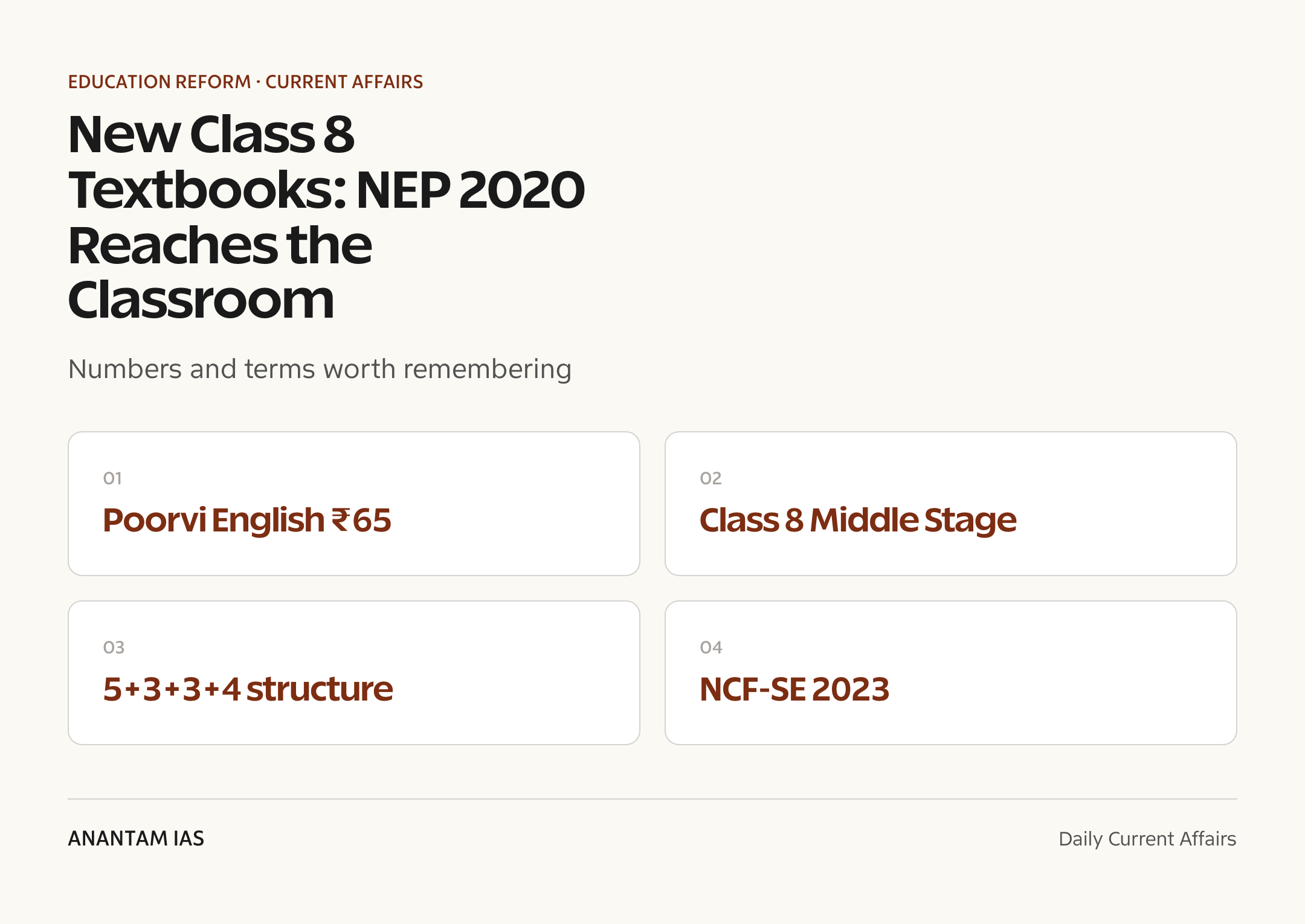
Global Education News reported the new titles went on sale around 10 July 2025, with the English reader Poorvi priced at ₹65 and free PDFs hosted on the NCERT portal — a tangible instance of NEP 2020 reaching students rather than staying on paper.
- New Class 8 titles: Poorvi (English), Malhar (Hindi), Curiosity (Science) and Kaushal Bodh (vocational education).
- Content shifts toward competency-based learning over rote recall, with thematic units blending prose, poetry and practical exercises.
- Greater stress on Indian heritage and lesser-known figures — physicist Bibha Chowdhuri, soldier Major Somnath Sharma and ‘milkman of India’ Verghese Kurien feature in the readers.
- New material on the Sindhu-Sarasvati Civilisation and on national missions such as Make in India and Beti Bachao, Beti Padhao.
- Aligned with the 5+3+3+4 structure under NEP 2020 — Class 8 sits in the Middle Stage (Classes 6-8).
The development matters in the context of:
- Comes amid a multi-year, class-by-class rollout of NCF-SE 2023 textbooks that began with Classes 1-2 and is moving up the grades.
- Lands in the broader debate over how heritage, history and competency framing are balanced in school content.

UPSC Relevance
Prelims Relevance
- NEP 2020 replaced the National Policy on Education, 1986 (modified 1992).
- 5+3+3+4 structure: Foundational (5 yrs), Preparatory (3), Middle (3), Secondary (4).
- NCF-SE 2023 is one of four frameworks under NEP; it guides school textbooks.
- NCERT is an autonomous body under the Ministry of Education, set up in 1961.
- New Class 8 books: Poorvi, Malhar, Curiosity, Kaushal Bodh.
- Bibha Chowdhuri (1913-1991) — cosmic-ray and particle physicist; worked on meson detection.
- Class 8 falls in the Middle Stage (Classes 6-8) of the 5+3+3+4 scheme.
- Vocational education from the Middle Stage is an NEP 2020 mandate.
Mains Relevance
GS Paper 2
- Implementation of NEP 2020 — design intent versus on-the-ground delivery in school education.
- Role of statutory and autonomous bodies (NCERT) in curriculum and textbook governance.
GS Paper 1
- How school curricula shape collective memory of Indian society and culture; the heritage-history balance.
Essay
- Education that liberates: from rote learning to competence and character.
- Whose past? The politics of what a nation teaches its children.
Background and Context
What NEP 2020 set out to do
The policy reimagines schooling around stages of child development rather than a flat 10+2 ladder.
- Replaced the 10+2 structure with 5+3+3+4 — mapping curriculum to cognitive stages from age 3 to 18.
- Pushes competency-based learning, conceptual understanding and reduced content load over memorisation.
- Mandates vocational exposure from the Middle Stage and stronger use of the mother tongue/regional language.
- Targets foundational literacy and numeracy, flexibility in subject choice, and ‘no hard separation’ between streams.
NCF-SE 2023 — the bridge to the classroom
A policy needs a framework to translate it into syllabi and textbooks; that job falls to NCF-SE.
- The National Curriculum Framework for School Education (NCF-SE) 2023 operationalises NEP for Classes 1-12.
- It is one of four NCFs envisaged under NEP — alongside frameworks for foundational stage, teacher education and adult education.
- NCERT writes new textbooks against the NCF-SE, rolling them out grade by grade.
- The Class 8 set continues a sequence that began with the Foundational and Preparatory stages.
The new Class 8 books, in brief
Four titles anchor the upper-primary refresh, each renamed and restructured.
- Poorvi — the English reader, priced around ₹65, organised into thematic units.
- Malhar — the Hindi textbook, named for the monsoon raga.
- Curiosity — the Science textbook, framed around inquiry and observation.
- Kaushal Bodh — a dedicated vocational education title, reflecting NEP’s skills focus.
- All available as free PDFs on the NCERT portal plus low-cost print copies.
Content shifts and new emphases
Beyond names, the readers change what students encounter.
- Heavier focus on Indian heritage, achievers and cultural narratives.
- Profiles of figures such as physicist Bibha Chowdhuri, Major Somnath Sharma (first Param Vir Chakra) and dairy pioneer Verghese Kurien.
- New treatment of the Sindhu-Sarasvati Civilisation and references to flagship missions like Make in India.
- Emphasis on the four language skills — reading, writing, listening, speaking — plus vocational competencies.
Why Bibha Chowdhuri matters
Her inclusion is a small signal of the heritage-and-achievers framing.
- Bibha Chowdhuri (1913-1991) was an Indian experimental physicist working on cosmic rays and meson detection with D. M. Bose.
- She studied under Nobel laureate Patrick Blackett at Manchester and worked at TIFR, PRL and the Saha Institute.
- Long described as a ‘forgotten legend’, her textbook profile aims to widen the roster of role models for students.
- A star observed by the IUCAA-led discovery team was later named Bibha in her honour.
The implementation challenge
Reaching the classroom is necessary but not sufficient.
- Class 8 books reportedly faced delays, with availability firming up only weeks before the rollout.
- Competency-based content demands matching teacher training and revised assessment, which lag textbook printing.
- States run their own boards; uptake of NCERT material varies widely across the country.
- Critics flag the need to keep curriculum revision evidence-led and transparent rather than contested.
Way Forward
Teacher capacity
- Pair every new textbook with structured teacher orientation on competency-based pedagogy.
- Build feedback loops so classroom experience informs the next revision cycle.
Assessment reform
- Shift board and school assessment toward application and understanding, in step with the new books.
- Use formative tools rather than high-stakes recall to track learning outcomes.
Keep curriculum design consultative and grounded in expert review, so content commands broad public confidence even as it modernises.
Conclusion
The Class 8 rollout is a modest but concrete sign that NEP 2020 is moving from policy document to printed page. New titles, a competency lens and a wider cast of Indian achievers signal the intended direction of travel.
The harder test now is delivery — trained teachers, aligned assessment and even uptake across states. Reform that stops at the textbook risks changing the cover without changing the classroom.
UPSC Practice Questions
Prelims MCQ 1
With reference to the 5+3+3+4 structure under NEP 2020, consider the following statements:
- It replaced the earlier 10+2 schooling structure.
- Class 8 falls in the Middle Stage of this structure.
- The structure maps curriculum to stages of child development from age 3 to 18.
How many of the above statements are correct?
(a) Only one (b) Only two (c) All three (d) None
Answer: (c) All three
Explanation:
NEP 2020 replaced 10+2 with 5+3+3+4 (Foundational, Preparatory, Middle, Secondary), spanning ages 3-18. Classes 6-8 form the Middle Stage, so Class 8 sits there. All three statements are correct.
Prelims MCQ 2
The new Class 8 textbooks introduced in 2025 are aligned primarily with which framework?
(a) National Policy on Education, 1986 (b) National Curriculum Framework for School Education (NCF-SE) 2023 (c) Right to Education Act, 2009 (d) National Curriculum Framework, 2005
Answer: (b) National Curriculum Framework for School Education (NCF-SE) 2023
Explanation:
NCERT writes the new textbooks against NCF-SE 2023, which operationalises NEP 2020 for Classes 1-12. The 1986 policy was superseded by NEP 2020.
UPSC Mains Questions
- NEP 2020 is often described as the gap between intent and implementation. Using the rollout of new NCERT textbooks, examine the challenges in translating curriculum policy into classroom outcomes.
- School curricula shape a society’s collective memory. Discuss the considerations that should guide curriculum revision so that it is both modern and broadly credible.
Sources: NCERT and Global Education News.
Frequently Asked Questions
What are the new Class 8 NCERT books for 2025?
The 2025 Class 8 set introduces renamed, restructured titles: Poorvi for English, Malhar for Hindi, Curiosity for Science and Kaushal Bodh for vocational education. They are aligned with NEP 2020 and NCF-SE 2023, and were rolled out in mid-July 2025 with free PDFs on the NCERT portal alongside low-cost print copies.
What is the 5+3+3+4 structure?
It is the schooling structure introduced by NEP 2020, replacing the older 10+2 ladder. It has four stages: Foundational (5 years), Preparatory (3), Middle (3) and Secondary (4), spanning ages 3 to 18. The stages map curriculum to a child’s cognitive development, with Classes 6-8 forming the Middle Stage where Class 8 sits.
What is NCF-SE 2023?
The National Curriculum Framework for School Education 2023 translates NEP 2020 into syllabi and textbooks for Classes 1-12. It is one of four frameworks envisaged under NEP. NCERT writes new textbooks against this framework and rolls them out grade by grade, which is why Class 8 books followed earlier sets for the lower classes.
Who was Bibha Chowdhuri?
Bibha Chowdhuri (1913-1991) was an Indian experimental physicist who worked on cosmic rays and meson detection, including early work with D. M. Bose. She studied under Nobel laureate Patrick Blackett and worked at TIFR, PRL and the Saha Institute. Long overlooked, she now features in the new Class 8 readers as a role model.
How does competency-based learning differ from rote learning?
Competency-based learning prioritises understanding, application and skills over memorising facts for exams. The new textbooks reflect this by using thematic units, inquiry-driven science and practical exercises. The aim is for students to grasp concepts and use them, rather than reproduce content, which also requires matching changes in teaching and assessment.
Are the new textbooks free to access?
Yes. NCERT hosts the new textbooks as free downloadable PDFs on its portal, ncert.nic.in, alongside affordable printed copies — the English reader Poorvi was priced around ₹65. This keeps the revised, NEP-aligned material accessible to students regardless of whether they buy print editions.
Tell Google you want more of this.
Add Anantam IAS as a preferred sourceOne tap, and this site shows up more often in your own Top Stories, AI Overviews and AI Mode. Remove it any time.