Why in News?
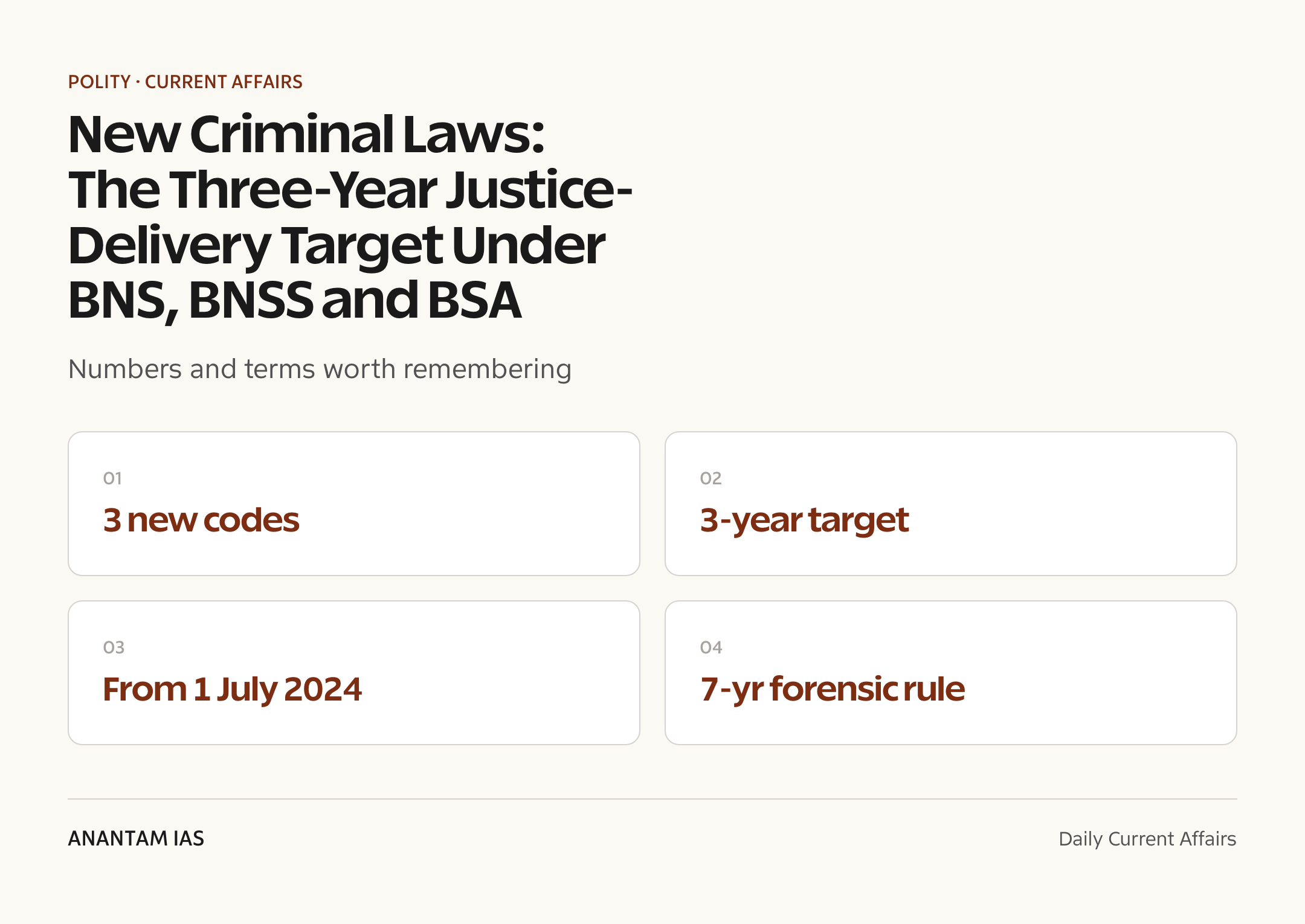
Marking the rollout of India’s three new criminal codes, the Home Minister reiterated the government’s stated goal of delivering justice within three years of an FIR once the system is fully implemented nationwide. The three codes — the Bharatiya Nyaya Sanhita (BNS), Bharatiya Nagarik Suraksha Sanhita (BNSS) and Bharatiya Sakshya Adhiniyam (BSA) — came into force on 1 July 2024, replacing colonial-era statutes that had governed crime, procedure and evidence for over a century and a half.
The renewed emphasis on a time-bound outcome shifts attention from the texts of the laws to their delivery. Early data on digital filing, online courts and prosecution records is being cited as evidence of momentum, even as questions remain on judicial capacity, forensic infrastructure and uniform implementation across States and Union Territories.
- Home Minister restated the target of justice within three years of an FIR after full rollout
- Full nationwide implementation projected to be achieved in a phased timeline of roughly two years
- Officials cited 22,000 courts online and over 1,361 jails on ePrison systems
- Nearly 193 million prosecution records reported as digitised under the new architecture
- Renewed focus on outcomes rather than statute text marks the second-year review of the codes
The development matters in the context of:
- The three codes replaced the IPC 1860, CrPC 1973 and Indian Evidence Act 1872 from 1 July 2024
- They retain large parts of the old law while adding digital procedure, victim rights and time limits
- Cases registered before 1 July 2024 continue under the old laws, creating a long transition phase

UPSC Relevance
Prelims Relevance
- Bharatiya Nyaya Sanhita (BNS), 2023 replaced the Indian Penal Code (IPC), 1860 — the substantive criminal law
- Bharatiya Nagarik Suraksha Sanhita (BNSS), 2023 replaced the Code of Criminal Procedure (CrPC), 1973 — procedural law
- Bharatiya Sakshya Adhiniyam (BSA), 2023 replaced the Indian Evidence Act, 1872 — law of evidence
- All three codes came into force on 1 July 2024
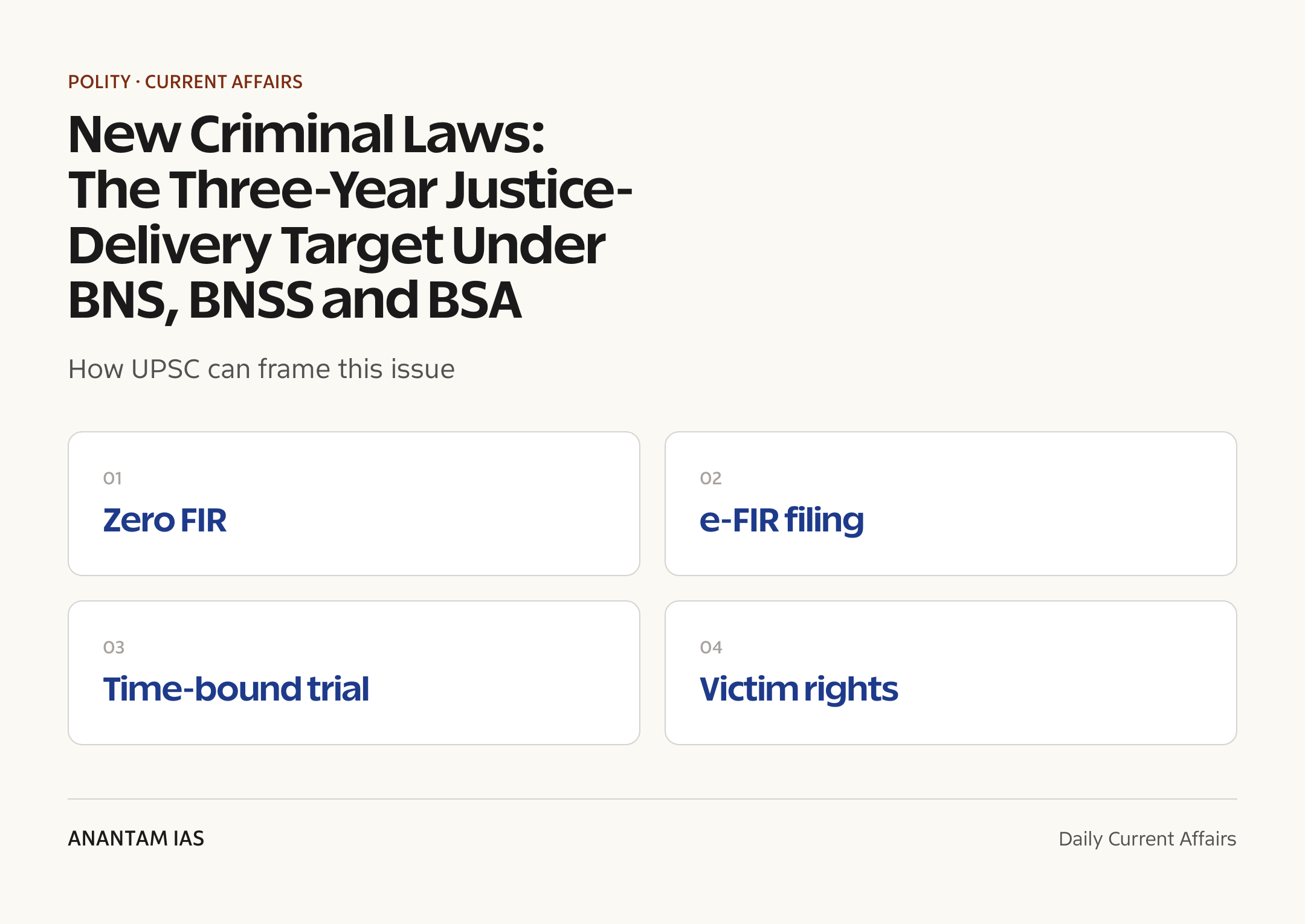
- Zero FIR allows an FIR to be registered at any police station regardless of jurisdiction; e-FIR permits electronic registration of complaints
- BNSS mandates forensic investigation for offences punishable by seven years or more
- BNS introduces community service as a form of punishment for petty offences
- BNS defines terrorism and mob lynching (murder by a group on grounds such as race, caste or community) as distinct offences
- Criminal law is in the Concurrent List of the Seventh Schedule, enabling a central overhaul
- Digital backbone draws on CCTNS, ICJS and the new eSakshya evidence app
Mains Relevance
GS Paper 2
- Reform of the criminal-justice system: shift from a punishment-centric to a justice- and victim-centric framework, and the role of time-bound procedure
- Implementation challenges — judicial vacancies and pendency, forensic and police capacity, digital divide across States, and the burden of running two legal regimes in parallel
Essay
- Justice delayed is justice denied: can statutory deadlines fix a system constrained by capacity rather than law?
Background and Context
Why the criminal codes were replaced
The overhaul aimed to shed colonial framing and modernise procedure.
- The IPC (1860), CrPC (1973) and Evidence Act (1872) carried colonial-era priorities centred on protecting the state and controlling subjects.
- The government framed the new codes as a move from ‘danda’ (punishment) to ‘nyaya’ (justice), with a stated emphasis on the victim and the citizen.
- Criminal law sits in the Concurrent List, allowing Parliament to enact a uniform overhaul applicable across States.
- The codes retain much of the earlier substantive law while renumbering sections and embedding digital and time-bound processes.
What the three-year target means
The headline promise is a defined timeline from complaint to verdict.
- The Home Minister’s stated goal is that, once the system is fully operational, a person can secure justice within three years of filing an FIR.
- BNSS sets internal deadlines feeding that outcome: time limits for completing investigation, framing charges, concluding trial and pronouncing judgment.
- Courts must now deliver judgment within 45 days of completing arguments in many cases, and frame charges within a fixed window.
- The target depends on every link — police, forensics, prosecution and judiciary — meeting its own timeline, not on the law alone.
Citizen-facing procedural reforms
Several provisions are designed to make the system more accessible.
- Zero FIR lets a complaint be lodged at any police station and transferred to the one with jurisdiction, removing a common barrier to registration.
- e-FIR and electronic filing allow complaints to be lodged online, with automatic receipts to the complainant.
- Mandatory video recording of searches, seizures and statements in serious cases aims to curb tampering and protect rights.
- Provisions on victim rights include the right to be informed of progress within a set period and to receive copies of key documents.
The digital and forensic backbone
Technology is meant to be the engine behind the timelines.
- eSakshya is an app for recording crime scenes and evidence, linked to the broader Inter-operable Criminal Justice System (ICJS).
- CCTNS (Crime and Criminal Tracking Network and Systems) connects police stations to a national database for case tracking.
- Forensic examination is mandatory for offences punishable by seven years or more, raising demand for forensic labs and trained personnel.
- Officials cited large-scale digitisation — thousands of online courts and crores of digitised prosecution and fingerprint records — as enabling infrastructure.
New offences and sentencing tools
BNS recasts parts of the substantive criminal law.
- Terrorism is defined within the general criminal code for the first time, alongside organised crime as a distinct offence.
- Mob lynching — murder by a group on grounds such as race, caste, sex, language or personal belief — is recognised as a specific offence.
- Community service is introduced as a sentencing option for petty offences, an alternative to imprisonment.
- Dedicated provisions strengthen protections in crimes against women and children, including stricter timelines for related investigations.
Implementation gaps and concerns
Capacity constraints, not statute, are the main risk to the target.
- Judicial vacancies and pendency mean courts may struggle to meet statutory judgment deadlines without more judges and staff.
- Forensic capacity is uneven; the seven-year forensic mandate requires far more labs, equipment and experts than currently exist.
- Running two legal regimes in parallel — old cases under IPC/CrPC and new ones under BNS/BNSS — burdens police, prosecutors and courts for years.
- Critics also flag concerns over expanded police powers, longer permissible police custody and the risk of a wider digital divide in access.
Way Forward
Build judicial and forensic capacity
- Fast-track filling of judicial vacancies and create dedicated benches so statutory judgment timelines are realistic, not aspirational.
- Expand the network of forensic science laboratories and trained examiners to meet the seven-year forensic mandate without new bottlenecks.
Make the digital backbone reliable and equitable
- Ensure CCTNS, ICJS and eSakshya are fully interoperable and resilient, with safeguards for data security and chain of custody.
- Bridge the digital divide so e-FIR and online services do not disadvantage rural and marginalised complainants.
Train, monitor and protect rights
- Sustained training for police, prosecutors and judicial officers on the renumbered provisions and new procedures.
- Independent monitoring of custody, video-recording compliance and victim-information timelines to guard against misuse of expanded powers.
Conclusion
The three new criminal codes represent the most sweeping recasting of India’s criminal-justice framework since independence, and the three-year justice target gives that ambition a measurable yardstick. The promise is meaningful precisely because delay has been the system’s defining failure.
Whether the target is met will turn less on the text of BNS, BNSS and BSA and more on capacity — enough judges, working forensic labs, a reliable digital backbone and protected rights. For the UPSC aspirant, the laws are best understood as a test case of how reform on paper translates into outcomes on the ground.
UPSC Practice Questions
Prelims MCQ 1
With reference to the new criminal laws that came into force in 2024, consider the following statements:
- The Bharatiya Nyaya Sanhita replaced the Indian Penal Code, 1860.
- The Bharatiya Sakshya Adhiniyam replaced the Code of Criminal Procedure, 1973.
- The forensic investigation is mandatory for offences punishable by seven years or more of imprisonment.
How many of the above statements are correct?
(a) Only one (b) Only two (c) All three (d) None
Answer: (b) Only two
Explanation:
Statements 1 and 3 are correct. Statement 2 is wrong — the Bharatiya Sakshya Adhiniyam replaced the Indian Evidence Act, 1872; the CrPC, 1973 was replaced by the Bharatiya Nagarik Suraksha Sanhita.
Prelims MCQ 2
Which one of the following correctly matches a new criminal code with the law it replaced?
(a) Bharatiya Nagarik Suraksha Sanhita — Indian Evidence Act, 1872 (b) Bharatiya Nyaya Sanhita — Code of Criminal Procedure, 1973 (c) Bharatiya Sakshya Adhiniyam — Indian Evidence Act, 1872 (d) Bharatiya Nagarik Suraksha Sanhita — Indian Penal Code, 1860
Answer: (c) Bharatiya Sakshya Adhiniyam — Indian Evidence Act, 1872
Explanation:
The Bharatiya Sakshya Adhiniyam replaced the Indian Evidence Act, 1872. BNS replaced the IPC, and BNSS replaced the CrPC.
UPSC Mains Questions
- The new criminal codes shift India’s criminal-justice system from a punishment-centric to a justice- and victim-centric model. Examine the key reforms and the challenges in achieving the stated three-year justice-delivery target. (GS Paper 2)
- Discuss how digital infrastructure and time-bound procedures under the BNSS aim to reduce delay in criminal justice, and assess the capacity constraints that could undermine these goals. (GS Paper 2)
Sources: PIB / Ministry of Home Affairs and Rising Kashmir.
Frequently Asked Questions
What are the three new criminal laws and when did they come into force?
They are the Bharatiya Nyaya Sanhita (BNS), Bharatiya Nagarik Suraksha Sanhita (BNSS) and Bharatiya Sakshya Adhiniyam (BSA). They came into force on 1 July 2024, replacing the Indian Penal Code 1860, the Code of Criminal Procedure 1973 and the Indian Evidence Act 1872 respectively.
What is the three-year justice-delivery target?
It is the government’s stated goal that, once the new system is fully operational nationwide, a person should be able to secure justice within three years of filing an FIR. BNSS supports this through statutory time limits for investigation, charge framing, trial and judgment.
What is a Zero FIR?
A Zero FIR allows a complaint to be registered at any police station regardless of where the offence occurred. It is then transferred to the station with jurisdiction. This removes a common barrier where victims were turned away over jurisdiction.
When is forensic investigation mandatory under the new laws?
Under the BNSS, forensic investigation of the crime scene is mandatory for offences punishable by seven years or more of imprisonment. This is intended to strengthen evidence quality, though it requires a large expansion of forensic laboratories and trained experts.
What new offences does the Bharatiya Nyaya Sanhita introduce?
The BNS defines terrorism and organised crime within the general criminal code and recognises mob lynching as a distinct offence. It also introduces community service as a punishment for petty offences and strengthens provisions on crimes against women and children.
What are the main challenges to implementing the new codes?
Key challenges include judicial vacancies and case pendency, limited forensic capacity, the digital divide affecting access, and the burden of running old and new legal regimes in parallel. Concerns over expanded police powers and longer custody have also been raised.
Tell Google you want more of this.
Add Anantam IAS as a preferred sourceOne tap, and this site shows up more often in your own Top Stories, AI Overviews and AI Mode. Remove it any time.