The NITI Aayog School Education Report released on May 5, 2026, takes stock of what changed in India’s classrooms between 2014-15 and 2024-25 and lays out where the system needs to reach by 2047. It’s the first single document that pulls together UDISE+ data, NAS scores, PGI rankings, and Samagra Shiksha outlays into one decade-long picture, and it does so with an honest mix of pride and discomfort.
Three numbers anchor the report. Gross enrolment ratio at the secondary level has climbed by roughly 12 percentage points. The pupil-teacher ratio at the elementary stage has improved across most states. And learning outcomes, as measured by the latest National Achievement Survey cycles, still trail the targets set under the National Education Policy 2020 by a wide margin. The NITI Aayog School Education Report frames this as a story of access mostly solved and quality still in motion.
For UPSC aspirants, this is a GS-II document worth reading carefully. It touches governance, federalism in education, social-sector spending, and the institutional architecture that NEP 2020 is rebuilding from the ground up.
Quick Facts
- Title: State of School Education in India: A Decade of Reforms (2014-15 to 2024-25)
- Released by: NITI Aayog, with the Ministry of Education
- Release date: May 5, 2026
- Coverage: All states and UTs, classes 1-12, public and private schools
- Anchor data source: UDISE+ 2024-25, NAS, PGI 2.0, PRABANDH
- Headline finding: GER at secondary level up ~12 pp; learning outcomes lagging
- Strategic horizon: Viksit Bharat @2047 with milestone years 2030, 2035, 2040
- Flagship schemes covered: Samagra Shiksha, PM SHRI, PM POSHAN, NIPUN Bharat, ULLAS
What Just Happened
NITI Aayog and the Ministry of Education jointly launched the NITI Aayog School Education Report on May 5, 2026, in New Delhi. The 400-page document is the first decadal stocktake of school education since the launch of NEP 2020 and serves two purposes at once. It audits the period between 2014-15 and 2024-25, and it sets out a forward roadmap aligned with the Viksit Bharat 2047 vision.
The report draws on UDISE+ (Unified District Information System for Education Plus), NAS (National Achievement Survey), PGI 2.0 (Performance Grading Index, version 2), and PRABANDH (Project Appraisal, Budgeting, Achievements and Data Handling System). It also factors in state-specific surveys and third-party assessments such as ASER. The headline framing is that India has largely closed the access gap at the elementary stage, narrowed it sharply at the secondary stage, and now faces a quality and learning-outcome challenge that will define the next decade.
Background and Historical Context
India’s modern school education architecture rests on three legal and constitutional pillars. Article 21A of the Constitution, inserted by the 86th Amendment in 2002, made free and compulsory education for children aged 6 to 14 a fundamental right. The Right of Children to Free and Compulsory Education Act 2009 operationalised that right. The National Education Policy 2020 then reframed the entire system, replacing the 10+2 structure with a 5+3+3+4 design and pushing for foundational literacy and numeracy as a non-negotiable.
Between 2014-15 and 2024-25, three flagship schemes carried the weight of implementation. Samagra Shiksha, launched in 2018, consolidated Sarva Shiksha Abhiyan, Rashtriya Madhyamik Shiksha Abhiyan, and Teacher Education into one umbrella programme. PM SHRI, announced in 2022, set out to upgrade 14,500 schools into model NEP-aligned institutions. NIPUN Bharat, launched in 2021, made foundational literacy and numeracy a national mission with a 2026-27 universalisation target.
The decade also saw structural shifts. The PM POSHAN scheme replaced the earlier mid-day meal programme in 2021. The Ministry of Human Resource Development was renamed the Ministry of Education in 2020. And the Apprenticeship Embedded Degree Programme and the National Credit Framework began linking school certificates to vocational pathways. The NITI Aayog School Education Report ties these threads together in one narrative.
Key Findings of the Decade Report
The report organises its findings under five domains: access, equity, infrastructure, teachers, and learning outcomes.
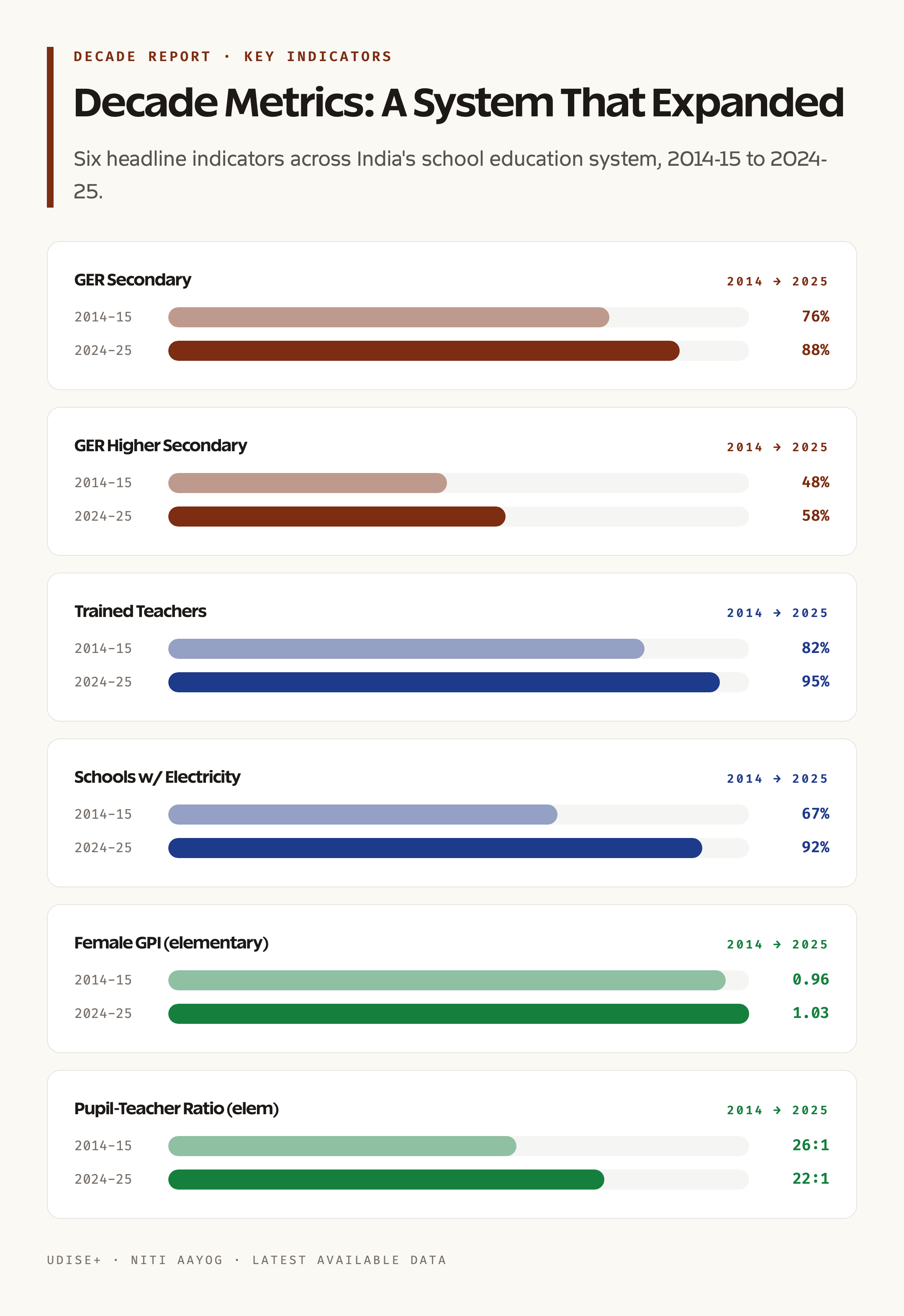
- Access: GER at the secondary level rose from around 76 percent in 2014-15 to nearly 88 percent in 2024-25 as per latest available data. Higher secondary GER also climbed, though it remains the weakest stage at roughly 58 percent.
- Equity: The gender parity index has crossed 1.0 at the elementary and secondary stages in most states. SC and ST enrolment gaps have narrowed, though dropout among adolescent girls remains a concern in five states.
- Infrastructure: Schools with functional electricity rose past 90 percent. Drinking water and toilets are near-universal. Internet connectivity is the new frontier, with roughly two-thirds of secondary schools connected.
- Teachers: Pupil-teacher ratios at the elementary stage have improved nationally. The share of trained teachers is now above 95 percent. Vacancy rates, however, remain high in tribal and aspirational districts.
- Learning outcomes: NAS cycles show modest improvement at the foundational stage but persistent weakness in mathematics at the upper-primary stage. Class 10 outcomes vary sharply across states.
Why It Matters
Education spending is the single largest social-sector commitment after food security, and the NITI Aayog School Education Report essentially asks whether that spending has bought the outcomes it promised. The political answer matters because Centre-state cost-sharing on Samagra Shiksha runs at a 60:40 ratio in most states and 90:10 in north-eastern and Himalayan states, which means the report’s verdict on each state’s grade flows back into budget conversations.
It matters at the policy level because NEP 2020 set ambitious targets, including 100 percent GER from pre-school to secondary level by 2030 and universal foundational literacy and numeracy by 2026-27. Mid-decade reviews like this report help decide whether timelines hold, whether targets need recalibration, and where new instruments such as the National Curriculum Framework for School Education 2023 should focus.
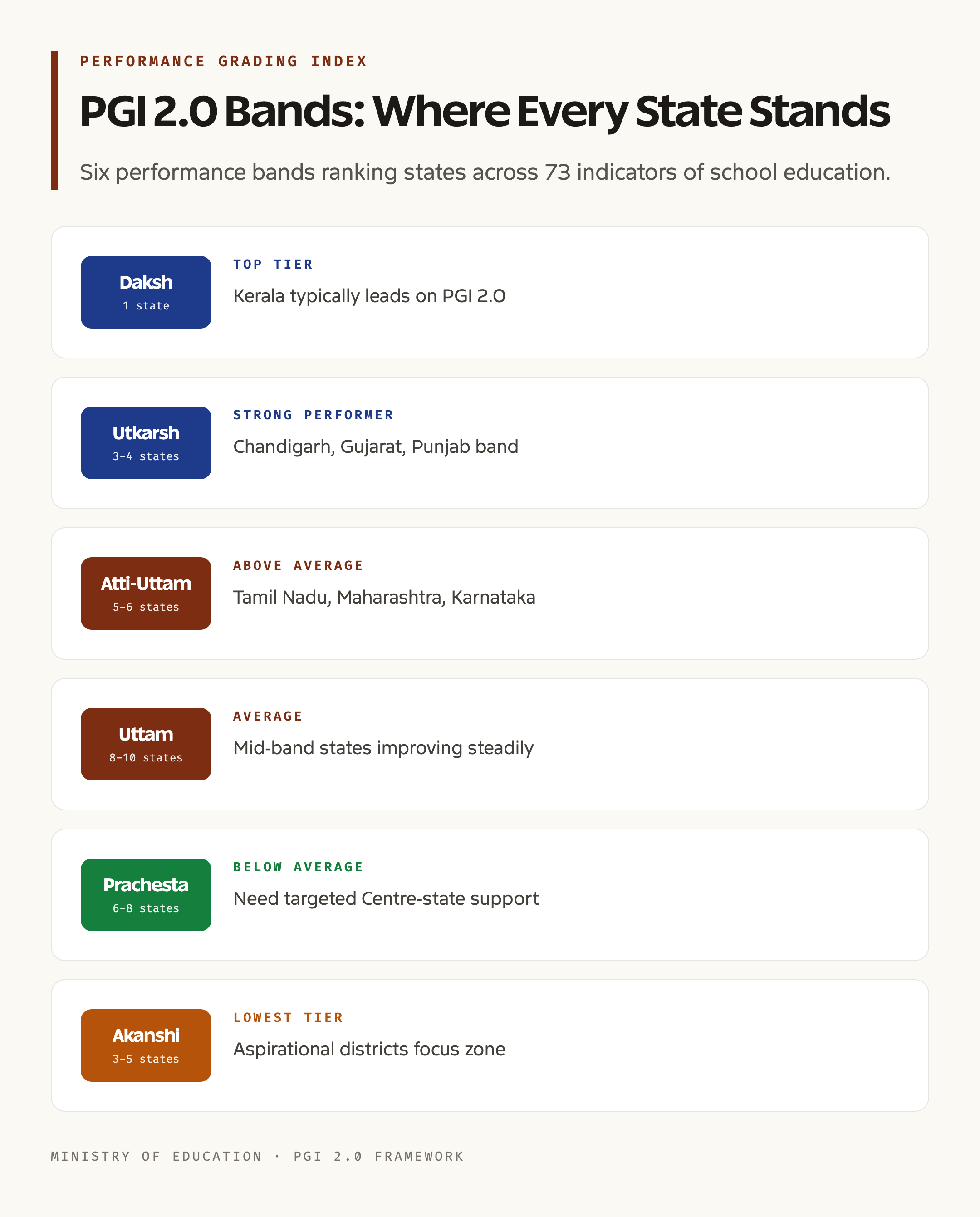
It matters at the federal level because education is on the Concurrent List under Schedule 7. The Centre frames policy and runs schemes, but states implement, recruit teachers, and hold examinations. The PGI 2.0 rankings, included in the report, sharpen that conversation by ranking each state on 73 indicators.
Detailed Analysis: Where India Stands
The decade report makes clear that India has solved the school access problem at the elementary stage, with GER comfortably above 100 percent in most states. The challenge has shifted upstream and downstream. Pre-primary access remains uneven, and higher secondary access is the weakest link. The report flags adolescent dropout as the single biggest equity risk for the next five years.
On learning outcomes, the picture is more sobering. NAS 2024 data referenced in the report shows that average performance in language at the foundational stage has improved, but gains in numeracy and grade-level mathematics are slower. The report calls for assessment-led reform, with the National Assessment Centre PARAKH playing a central role.
On teachers, the report acknowledges progress on training and certification but warns that contractual and para-teacher arrangements continue to dilute quality in several states. It backs the National Professional Standards for Teachers as a non-negotiable benchmark and pushes for digital teacher-management systems in every state.
On infrastructure, the decade has been transformative. The leap is visible in toilets, water, and electricity. The next leap, the report argues, is digital. PM SHRI schools are the testing ground for what a fully digital, NEP-aligned classroom looks like in practice.
Comparative View: India and Global Benchmarks
When placed alongside OECD and BRICS comparators, India’s secondary GER of 88 percent now matches the upper-middle-income average. Foundational learning, measured against PISA-equivalent benchmarks, still trails. The report uses the SDG-4 framework as its global yardstick.
| Indicator | India 2014-15 | India 2024-25 | OECD avg |
|---|---|---|---|
| GER Secondary | ~76% | ~88% | ~99% |
| GER Higher Secondary | ~48% | ~58% | ~92% |
| Trained teachers | ~82% | ~95% | ~98% |
| Schools with electricity | ~67% | ~92% | ~99% |
| Foundational literacy | NAS modest | NAS improving | high |
The report is careful to note that PISA participation by India remains limited and that NAS data, while richer, isn’t directly comparable across the two periods because the design changed.
Challenges and Gaps
Five structural challenges run through the report.
- Quality-access gap: Access has outpaced learning outcomes, especially in mathematics and science at the upper-primary stage.
- Teacher vacancies: Aspirational districts and tribal blocks still see vacancy rates above 20 percent in critical subjects.
- Adolescent dropout: Class 9-10 transition remains the weakest, especially for girls in select states.
- Digital divide: Internet connectivity in secondary schools is still uneven. Many PM SHRI ambitions depend on this gap closing.
- Implementation variance: State capacity differs sharply. PGI 2.0 ranges from band one to band six, showing the federal challenge.
The report also flags assessment integrity, the slow pace of board reform, and the absence of a unified teacher-management information system as outstanding issues.
Prelims Pointers
- Article 21A: Right to Education for children aged 6-14
- 86th Constitutional Amendment, 2002: Inserted Article 21A
- RTE Act, 2009: Operationalised the right
- NEP 2020 structure: 5+3+3+4 (Foundational, Preparatory, Middle, Secondary)
- UDISE+: Unified District Information System for Education Plus
- PGI 2.0: Performance Grading Index, version 2, by Ministry of Education
- PARAKH: National Assessment Centre under NCERT
- PM SHRI: PM Schools for Rising India, launched 2022
- NIPUN Bharat: National Initiative for Proficiency in Reading with Understanding and Numeracy, 2021
- PM POSHAN: PM Poshan Shakti Nirman, 2021 (replaced MDM)
- NCFSE 2023: National Curriculum Framework for School Education, 2023
- Education is on the Concurrent List: Schedule 7
Mains Questions
- The NITI Aayog School Education Report 2026 argues that access is largely solved and quality is the new frontier. Critically examine this proposition with reference to NAS data and PGI 2.0 outcomes. (GS Paper II, 15 marks)
- Discuss the role of cooperative federalism in implementing NEP 2020. Use the experience of Samagra Shiksha and PM SHRI to illustrate your answer. (GS Paper II, 15 marks)
- Adolescent dropout, especially among girls, remains the weakest link in India’s school education pipeline. Suggest a policy roadmap to close this gap by 2030. (GS Paper II, 10 marks)
- Examine the relationship between foundational literacy and numeracy and India’s demographic dividend goals. How does NIPUN Bharat fit within this larger objective? (GS Paper II, 10 marks)
Way Forward
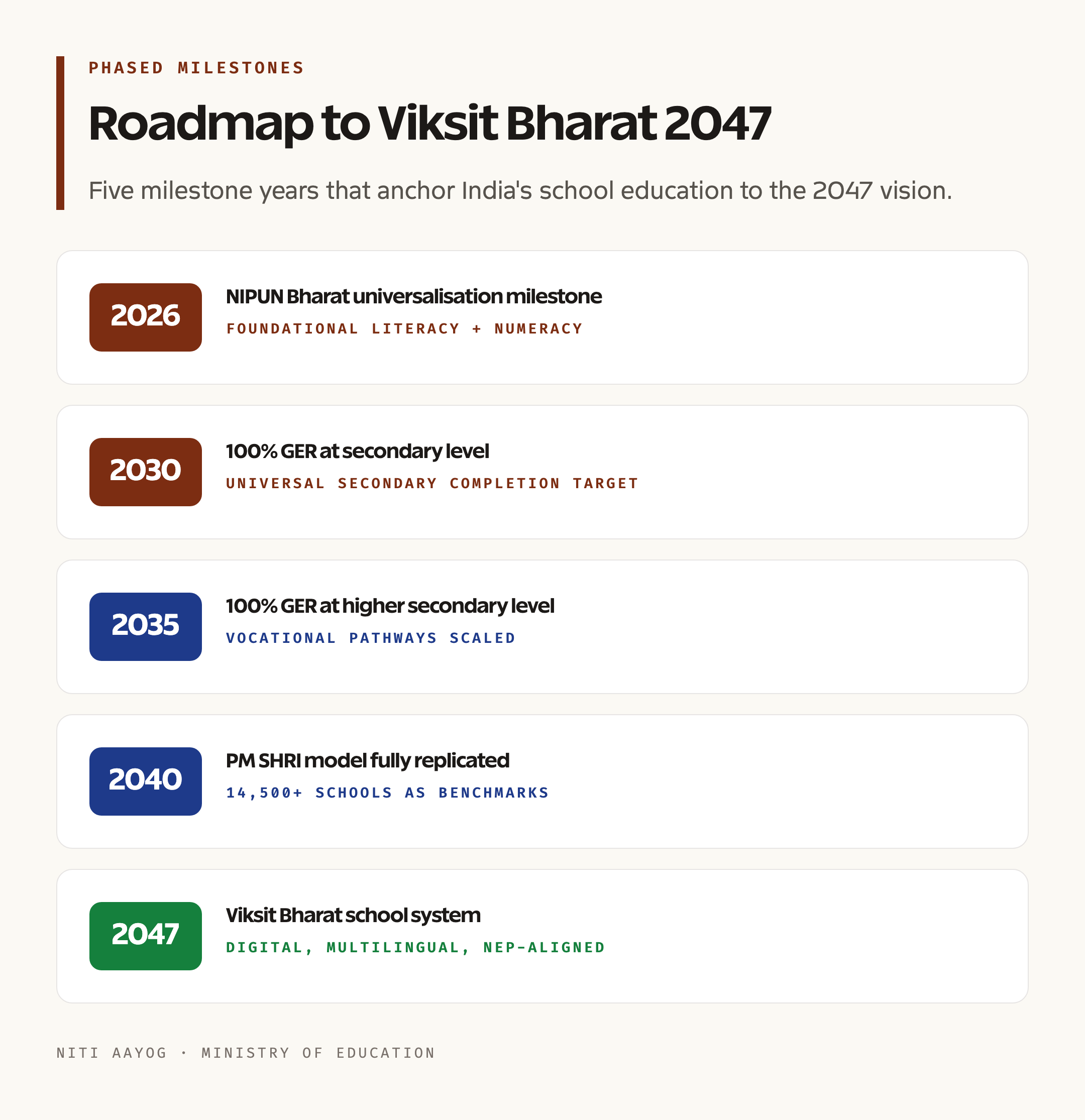
The road to 2047 in the NITI Aayog School Education Report runs through three pivots. The first is foundational learning, where NIPUN Bharat must hit its 2026-27 universalisation target. The second is secondary completion, where the report wants 100 percent GER at secondary level by 2030 and at higher secondary level by 2035. The third is teacher quality, where the National Professional Standards for Teachers and a unified MIS will set the floor.
For aspirants tracking the longer game, the report makes a strong case that school education and India’s demographic dividend are joined at the hip. A clear way to read this report is to see it as a checklist for the next 20 years.
You can connect this report with three related themes already covered on Anantamias. See our explainer on the NEP 2020 framework, the Samagra Shiksha scheme and the PM SHRI Schools initiative for the longer arc.
Frequently Asked Questions
What is the NITI Aayog School Education Report?
It is a decadal stocktake of India’s school education system between 2014-15 and 2024-25, released by NITI Aayog with the Ministry of Education on May 5, 2026. The report uses UDISE+, NAS, and PGI 2.0 data to audit access, equity, infrastructure, teachers, and learning outcomes, and lays out a roadmap to Viksit Bharat 2047.
Why is the NITI Aayog School Education Report important for UPSC?
The report sits squarely in GS Paper II, covering governance, federalism, social-sector spending, and human resource development. It also informs essay and ethics papers through the lens of equity and the right to education. Aspirants should treat it as a primary source for any question on NEP 2020 implementation or India’s progress on SDG-4.
What is the structure under NEP 2020?
NEP 2020 replaces the older 10+2 system with a 5+3+3+4 design. That means five years of foundational stage covering pre-school and classes 1-2, three years of preparatory stage for classes 3-5, three years of middle stage for classes 6-8, and four years of secondary stage covering classes 9-12.
What is PGI 2.0?
PGI 2.0 is the Performance Grading Index, version 2, used by the Ministry of Education to rank states and UTs on 73 indicators across school education. It replaces the earlier PGI framework and adds finer granularity on learning outcomes, equity, and infrastructure.
What does the report say on learning outcomes?
The report acknowledges modest gains in foundational language and persistent weakness in upper-primary mathematics. It recommends assessment-led reform with PARAKH at the centre and pushes for a sharper focus on NIPUN Bharat targets by 2026-27.
What is the Viksit Bharat 2047 vision in school education?
The report sets milestone years of 2030, 2035, 2040, and 2047. By 2030, GER should be 100 percent at the secondary level. By 2035, the same at the higher secondary level. By 2047, every learner should have access to a fully NEP-aligned, digitally enabled, multilingual school environment.
Is education a state subject or central?
Education sits on the Concurrent List under Schedule 7 of the Constitution. The Centre frames national policy and runs centrally sponsored schemes, while states implement, recruit teachers, and hold board examinations. The 42nd Constitutional Amendment in 1976 moved education from the State List to the Concurrent List.
What is PM SHRI and how many schools does it cover?
PM SHRI stands for PM Schools for Rising India, launched in 2022. It aims to upgrade 14,500 existing schools across states and UTs into model NEP-aligned institutions. These schools are meant to showcase what a fully reformed school looks like in terms of curriculum, pedagogy, and infrastructure.
What is the foundational learning crisis?
The foundational learning crisis refers to the gap between expected and actual learning levels for children in classes 1-3, especially in reading and arithmetic. NIPUN Bharat addresses this directly, and the NITI Aayog School Education Report flags it as the single most important early-decade priority.
What are the biggest gaps highlighted in the report?
The report flags five gaps: the quality-access gap, teacher vacancies in aspirational and tribal districts, adolescent dropout, the digital divide in secondary schools, and high state-to-state variance in implementation capacity. Each gap maps to a specific instrument in the way-forward section.
Tell Google you want more of this.
Add Anantam IAS as a preferred sourceOne tap, and this site shows up more often in your own Top Stories, AI Overviews and AI Mode. Remove it any time.