Why in News?
The Ministry of Housing and Urban Affairs approved the operational guidelines for the PARIVARTAN Scheme on 16 July 2026. The programme is now ready to replace older, highly polluting trucks and buses operating in the National Capital Region with eligible BS-VI-compliant or electric vehicles.
PIB confirmed that the Ministry of Road Transport and Highways will be the implementing ministry and that funding will flow through the National Capital Region Planning Board. The guidelines convert the Union Cabinet’s 3 June approval into an incentive and digital-delivery framework that requires coordination across Delhi, Haryana, Rajasthan and Uttar Pradesh.
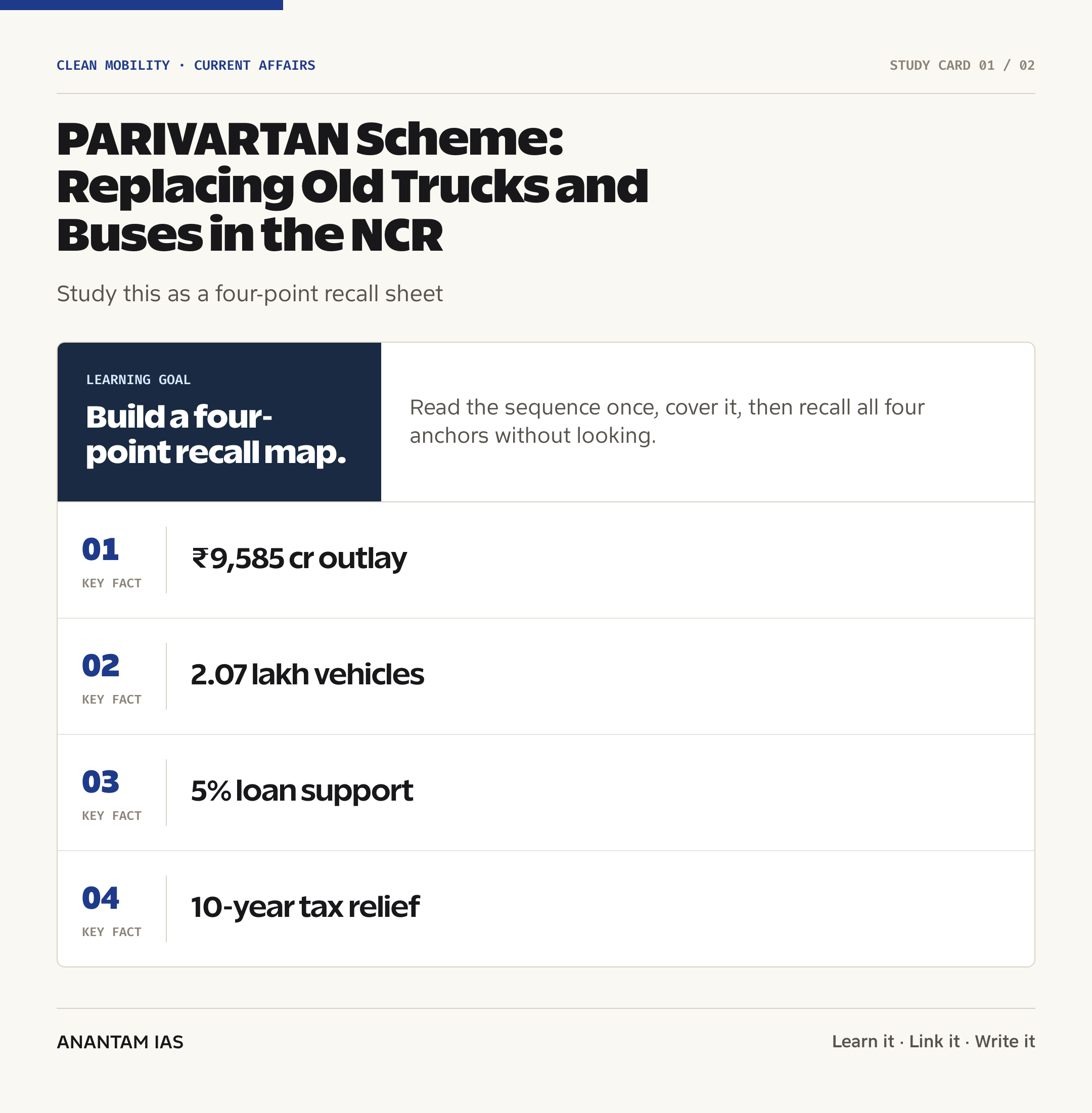
- The scheme carries a total outlay of ₹9,585 crore, including ₹5,041 crore in Central support.
- The four participating jurisdictions have notified a 10-year motor vehicle tax concession and registration-fee waiver for eligible new vehicles.
- Eleven original equipment manufacturers, representing more than 95% of the commercial-vehicle market, have agreed to extend the scheme discount.
- Benefits will be delivered through a platform connected to VAHAN, V-Scrap, DigiELV and PFMS.
The development matters in the context of:
- This is a fleet-renewal intervention, not a blanket subsidy for every commercial vehicle in the four participating states.
- Its policy logic combines a polluter-retirement condition with finance, tax and manufacturer incentives for a cleaner replacement.
- Its success must be judged by verified vehicle retirement and emission reduction, not only by registrations or subsidy disbursal.
UPSC Relevance
Prelims Relevance
- PARIVARTAN expands to Programme for Accelerated Renewal and Incentivization of Vehicle Assets for Reducing Transport Air Pollution and Network Emissions.
- Eligible old vehicles are trucks and buses registered in the Delhi-NCR region that meet BS-IV or earlier emission norms.
- BS-III or older vehicles must be scrapped at a Registered Vehicle Scrapping Facility; an eligible BS-IV vehicle may instead be sold outside NCR in a non-NCAP city or town.
- The replacement must be registered within the NCR and comply with BS-VI or stricter norms, or be electric.
- In Delhi, replacement light goods vehicles must be electric; replacement buses must be BS-VI CNG or electric.
- Government vehicles are excluded from the beneficiary pool.
- The scheme has a two-year enrolment window, while Central benefits continue for five years from registration of the replacement.
- The NCRPB is the funding channel, while MoRTH leads implementation and District Collectors or District Magistrates implement and monitor locally.
Mains Relevance
GS Paper 2
- Use the scheme to explain cooperative federalism in a functional region that crosses state borders.
- Assess whether an integrated portal, defined institutional roles and district monitoring can improve last-mile scheme delivery.
GS Paper 3
- Connect old commercial vehicles with urban air pollution, environmental health and clean-technology transition.
- Evaluate scrappage incentives against risks such as pollution displacement, weak charging networks and debt stress for small fleet owners.
Essay
- Clean air policy works best when regulation, finance and technology move together.
- A just green transition must make compliance affordable without weakening environmental outcomes.
- Administrative borders cannot contain regional environmental problems.
Background and Context
Who and What the Scheme Covers
Eligibility turns on the old vehicle’s type, registration location, emission standard and replacement pathway.
- The beneficiary must own a truck or bus registered in the Delhi-NCR area and compliant with BS-IV or an earlier standard.
- The geographic reference is the notified National Capital Region, which includes NCT Delhi and notified NCR areas in Haryana, Rajasthan and Uttar Pradesh; it does not automatically cover every district in those states.
- The regional design complements the planning logic discussed in the NCR Regional Plan 2041: transport and pollution flows cross administrative borders.
- The Cabinet release estimated coverage of about 2.07 lakh vehicle owners, comprising around 1.91 lakh truck owners and 16,329 bus owners.
- Government vehicles do not qualify. The programme is aimed at privately or commercially held legacy vehicles rather than routine public-fleet replacement.
- Owners must complete the approved retirement or exit route for the old vehicle and then purchase and register the qualifying replacement within the NCR.
Retirement Rules and Replacement Technologies
PARIVARTAN links each subsidy to removal or relocation of an older polluting asset and acquisition of a cleaner vehicle.
- A BS-III or older truck or bus must go to an authorised Registered Vehicle Scrapping Facility; continued operation or resale is not the approved exit route.
- A BS-IV vehicle may be scrapped or sold outside the NCR, but sale is restricted to a city or town that is not covered by the National Clean Air Programme.
- The standard replacement is a vehicle compliant with BS-VI or stricter emission norms, or an electric vehicle. Bharat Stage norms set progressively tighter limits on pollutants from vehicle exhaust.
- Delhi applies a narrower technology condition: a replacement light goods vehicle must be electric, while a bus must be BS-VI CNG or electric.
- An electric replacement can reduce tailpipe emissions, but its full value depends on charging availability, route suitability and electricity supply. The related PM E-DRIVE experience shows why vehicle support and enabling infrastructure must develop together.
- A Certificate of Deposit in the scrappage system records vehicle deposit at an authorised facility. PARIVARTAN includes a lump-sum benefit linked to eligible CoD trading, which can connect vehicle retirement with a replacement buyer.
How the Incentive Package Is Structured
The scheme distributes the transition cost across the Centre, participating states, lenders and vehicle manufacturers.
- The Centre provides a 5% interest subvention on eligible vehicle loans for five years, lowering the financing cost faced by an owner replacing an old asset.
- Eligible diesel and CNG replacements receive monthly fuel vouchers; the Cabinet release placed the maximum at ₹4,800 per month, depending on vehicle category.
- Electric replacements receive one-time financial assistance rather than a recurring fuel voucher, reflecting the different operating-cost structure.
- Participating states waive registration fees and can provide up to 100% motor vehicle tax concession for a new replacement and 50% for an eligible used replacement for ten years.
- The scheme also provides for waiver of eligible pending liabilities attached to participating old vehicles, reducing a barrier to formal scrappage.
- Participating manufacturers must offer at least an 8% discount on the ex-showroom price of an eligible vehicle. Eleven OEMs covering over 95% of the commercial market had signed agreements by 16 July.
- The two-year enrolment period creates a limited entry window, but Central benefits continue for five years from the new vehicle’s registration.
- For analysis, separate upfront relief such as discount and fee waiver from recurring relief such as loan subvention and fuel vouchers; each changes owner behaviour through a different channel.
Institutional and Digital Delivery Chain
Implementation is deliberately shared because finance, registration, fuel support and scrappage sit with different actors.
- MoHUA approved the guidelines and anchors the scheme through NCRPB, the statutory regional-planning institution under the ministry.
- MoRTH is the implementing ministry. The Cabinet approval also assigns an implementation role to the Ministry of Petroleum and Natural Gas for the fuel-linked component.
- The participating governments of Delhi, Haryana, Rajasthan and Uttar Pradesh issue tax and fee notifications, operate vehicle-registration systems and coordinate district execution in their NCR areas.
- An Empowered Committee chaired by the Cabinet Secretary monitors the scheme at the Centre; its membership brings together NITI Aayog, concerned Union ministries, state chief secretaries and NCRPB.
- District Collectors and District Magistrates are the local implementing and monitoring authorities, making district capacity central to beneficiary verification and grievance resolution.
- The digital platform connects VAHAN for vehicle records, V-Scrap and DigiELV for end-of-life vehicle workflows, and PFMS for public payments.
- Interfaces with lenders, OEMs and fuel-voucher systems should allow real-time eligibility checks, automated subvention claims and a traceable benefit trail.
- Interoperability can reduce duplicate or false claims, but the administration still needs data-quality checks, consent safeguards and an appeal process when records across systems do not match.
Why Heavy-Vehicle Renewal Matters for Air Quality
The policy targets a small fleet segment because its pollution burden is disproportionately high.
- PIB cited the 2018 ARAI-TERI source-apportionment study: transport contributes about 14% of PM2.5, 40% of carbon monoxide and 63% of nitrogen oxides in Delhi-NCR.
- Within transport, trucks and buses account for about 36% of PM2.5 emissions despite forming only 3% of the total fleet.
- The official estimate says one pre-BS heavy-duty vehicle can emit as much as 14 BS-VI-compliant vehicles, while a BS-IV vehicle emits about 2.7 times as much as a BS-VI counterpart.
- This makes targeted fleet renewal a potential high-impact intervention, especially when heavy vehicles cover long distances and operate for many hours.
- The scheme sits beside regulatory tools administered by the Commission for Air Quality Management, but incentives and restrictions serve different purposes.
- A credible impact assessment must compare baseline and post-replacement emissions, vehicle kilometres travelled and actual retirement records, rather than treating every subsidy claim as an equal air-quality gain.
Governance Risks and Policy Trade-offs
The scheme can accelerate compliance, but several design and implementation risks need close monitoring.
- Allowing a BS-IV vehicle to be sold outside NCR can create pollution displacement; the non-NCAP restriction reduces the immediate regulatory overlap but does not remove the vehicle’s emissions.
- Small truck and bus owners may still face a large upfront capital gap even after discounts and interest support, while a new loan can increase business risk.
- An 8% OEM discount is valuable only if the reference price is transparent and manufacturers do not offset it through accessories, finance charges or reduced dealer discounts.
- Electric adoption can stall without suitable depot charging, grid connections, maintenance skills and route planning, especially for high-use freight fleets.
- RVSF capacity and distance matter. A weak scrappage network can raise transaction costs, encourage informal dismantling or delay issue of a usable Certificate of Deposit.
- Digital integration can exclude owners when legacy registration, tax or identity records are incomplete. A human-assisted correction channel is needed alongside automation.
- The scheme’s stated 2.07 lakh pool is not the same as guaranteed replacement. Track applications, approved cases, completed scrappage, new registrations and measured emissions as separate outcomes.
Answer-Building Framework for UPSC
A strong answer should move from the regional pollution problem to design, delivery risks and measurable outcomes.
- Open with the core problem: a small share of old trucks and buses creates a disproportionate share of transport particulate emissions in the NCR.
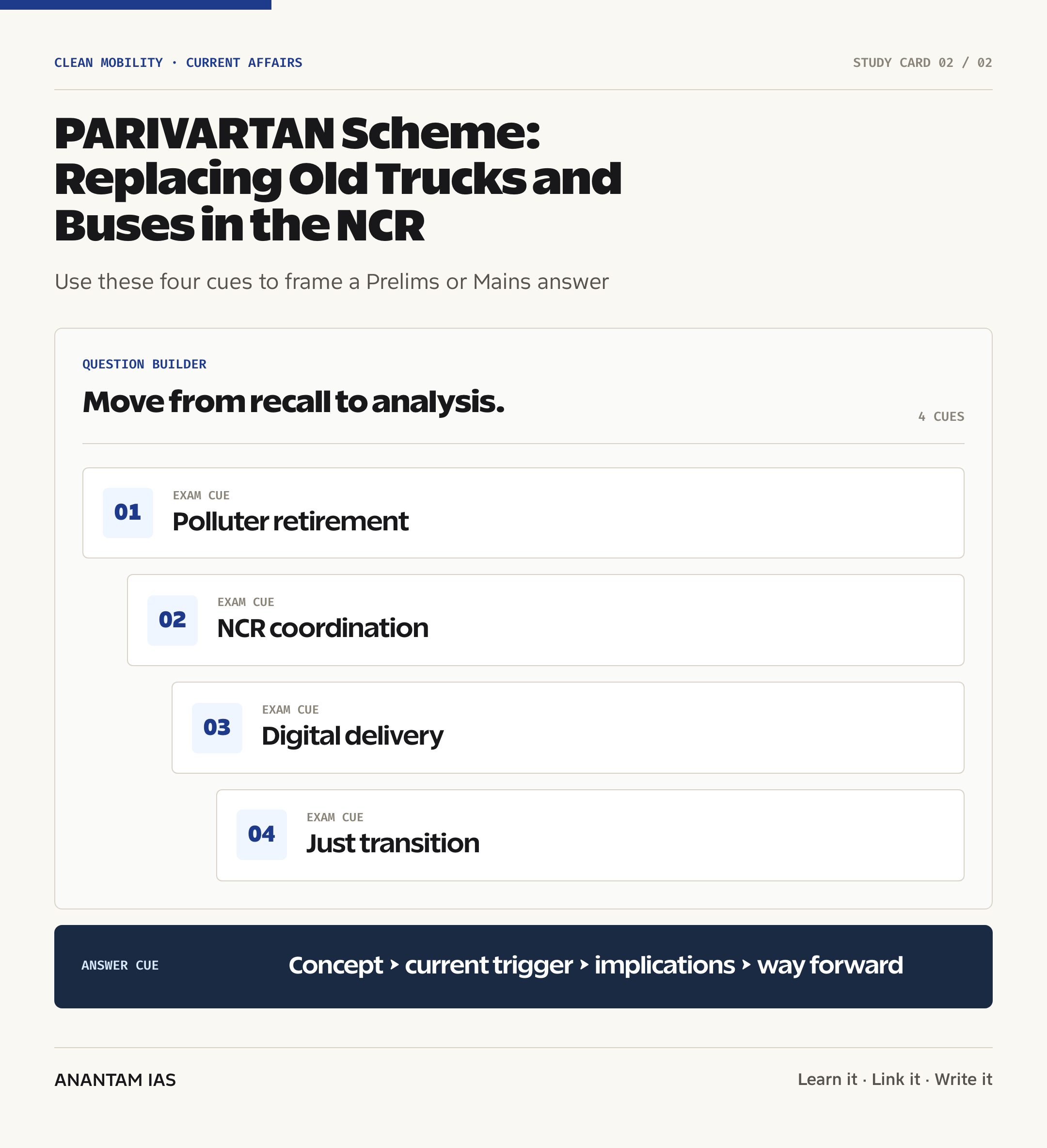
- Explain the policy chain as retire old vehicle → finance cleaner replacement → register within NCR → verify digitally.
- Organise the body under four headings: eligibility and technology, incentive sharing, cooperative-federal institutions, and environmental additionality.
- Add a balanced criticism: affordability for small operators, pollution relocation, charging gaps, digital exclusion and the need to audit OEM pricing.
- End with an outcome test: verified scrappage, lower fleet-average emissions and better air quality, supported by transparent district-wise data.
Way Forward
Protect Environmental Additionality
- Track the final status of every retired or transferred BS-IV vehicle and publish aggregate destination data.
- Link payments to verified scrappage or permitted transfer, replacement registration and continued compliance.
Make the Transition Affordable
- Provide assisted application desks and standard loan disclosures for small fleet owners.
- Audit ex-showroom reference prices so the OEM discount remains an additional, visible benefit.
Build the Supporting Ecosystem
- Expand RVSF access, depot charging, grid connections and trained maintenance networks across the NCR.
- Coordinate freight routes, charging plans and vehicle availability before pushing electric-only conditions.
Measure Results, Not Only Spending
- Publish district-wise dashboards for applications, scrappage, replacements, grievance disposal and fiscal support.
- Commission independent evaluation of PM2.5 and NOx reduction, fleet activity and distributional effects.
Conclusion
PARIVARTAN treats clean mobility as a coordinated replacement problem rather than a single purchase subsidy. Its combination of retirement rules, financing relief, manufacturer discounts and regional delivery gives the policy a credible implementation chain.
The decisive test is whether the programme permanently removes high-emitting vehicles without shifting the burden elsewhere or excluding small operators. Transparent records, accessible grievance handling and measured air-quality outcomes should define success.
UPSC Practice Questions
Prelims MCQ 1
With reference to the PARIVARTAN Scheme, consider the following statements:
- BS-III or older eligible trucks and buses must be scrapped at a Registered Vehicle Scrapping Facility.
- An eligible BS-IV vehicle may be sold outside NCR only in a non-NCAP city or town.
- Government trucks and buses are included in the beneficiary pool.
How many of the above statements are correct?
(a) Only one (b) Only two (c) All three (d) None
Answer: (b) Only two
Explanation:
Statements 1 and 2 are correct. Government vehicles are excluded. The replacement must be registered within NCR and comply with BS-VI or stricter norms, or be electric.
Prelims MCQ 2
Which institution serves as the funding channel for the PARIVARTAN Scheme?
(a) Commission for Air Quality Management (b) National Capital Region Planning Board (c) National Highways Authority of India (d) Central Pollution Control Board
Answer: (b) National Capital Region Planning Board
Explanation:
The scheme is funded through the NCRPB under MoHUA, while MoRTH leads implementation. The participating states, district administrations, lenders and OEMs handle defined delivery functions.
UPSC Mains Questions
- PARIVARTAN uses scrappage conditions, fiscal incentives and digital verification to modernise commercial fleets in Delhi-NCR. Examine how this design can reduce transport emissions while addressing affordability, pollution displacement and implementation risks for small truck and bus owners.
- Air pollution in the National Capital Region is a regional governance problem rather than a Delhi-only problem. Discuss the cooperative-federal architecture of the PARIVARTAN Scheme and suggest accountability mechanisms for converting vehicle replacement expenditure into measurable air-quality gains.
Sources: PIB, Ministry of Housing and Urban Affairs and PIB, Union Cabinet.
Frequently Asked Questions
What is the PARIVARTAN Scheme?
PARIVARTAN is a two-year enrolment programme for replacing eligible BS-IV or older trucks and buses registered in the Delhi-NCR region. It combines scrappage or approved transfer conditions with loan support, tax and fee concessions, manufacturer discounts, fuel vouchers or EV assistance, and digital verification.
Which old vehicles qualify?
The scheme covers eligible trucks and buses registered in the notified NCR area that comply with BS-IV or an earlier emission norm. Government vehicles are excluded. The owner must follow the prescribed retirement or transfer route and register a qualifying cleaner replacement within NCR.
Must every old vehicle be scrapped?
No. A BS-III or older eligible vehicle must be scrapped at an authorised RVSF. A BS-IV vehicle may be scrapped or sold outside NCR in a city or town not covered by the National Clean Air Programme. The second route can shift emissions, so destination tracking matters.
What replacement vehicles are allowed?
The general rule allows a BS-VI or stricter emission-compliant vehicle, or an electric vehicle. Delhi has tighter conditions: a replacement light goods vehicle must be electric, while a replacement bus must be BS-VI CNG or electric. The vehicle must be registered within NCR.
What financial benefits are available?
The package includes 5% interest subvention on eligible loans for five years, manufacturer discount of at least 8%, registration-fee waiver and motor vehicle tax relief. Eligible diesel and CNG vehicles receive monthly fuel vouchers, while electric replacements can receive one-time assistance.
Who implements and monitors the scheme?
MoRTH leads implementation, with funding routed through NCRPB under MoHUA and fuel-linked support involving MoPNG. Participating NCR governments issue tax and registration measures, District Collectors or District Magistrates manage local delivery, and a Cabinet Secretary-led Empowered Committee monitors the programme.
Tell Google you want more of this.
Add Anantam IAS as a preferred sourceOne tap, and this site shows up more often in your own Top Stories, AI Overviews and AI Mode. Remove it any time.