Why in News?
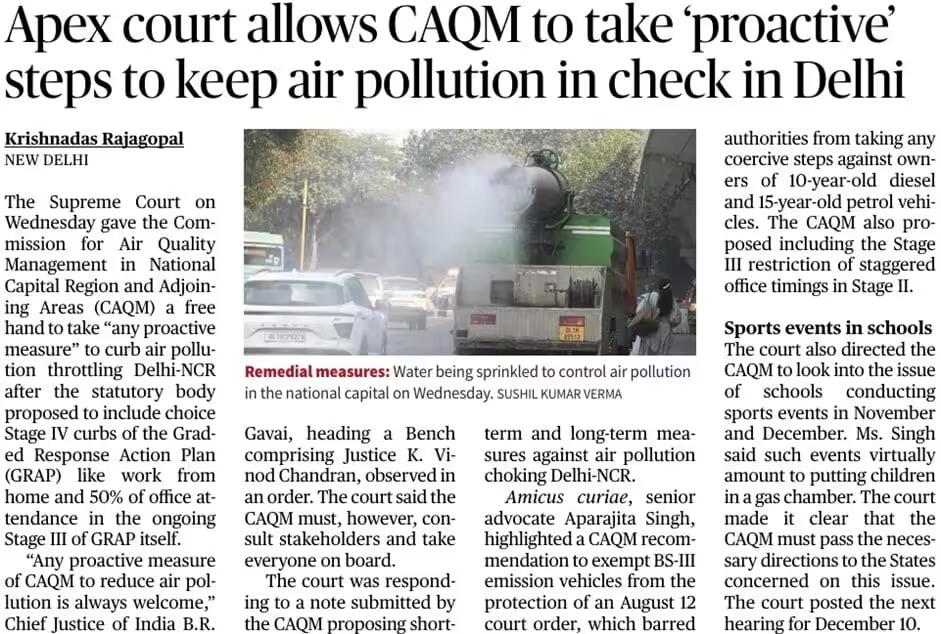
The Supreme Court has permitted the Commission for Air Quality Management (CAQM) to take any proactive measure – even beyond the prescribed GRAP stages – to control severe pollution in Delhi-NCR.
This is significant because:
- CAQM normally acts stage-wise under the Graded Response Action Plan (GRAP)
- Now it has a free hand to impose higher restrictions earlier
- The Supreme Court has emphasised regular monitoring, showing judicial seriousness
- The Court is prioritising health, especially of children
What Triggered the Supreme Court’s Intervention?
- Delhi-NCR pollution remains extremely high every winter
- CAQM submitted a note recommending extra restrictions
- These measures fall under higher GRAP stages, but CAQM wanted to apply them earlier
The Supreme Court responded by saying “Any proactive measure of CAQM to reduce air pollution is welcome”.
Thus, CAQM can now advance measures instead of waiting for pollution to worsen.
PYQ:
GS-III – 2021
Describe the key points of the revised Global Air Quality Guidelines (AQGs) recently released by the World Health Organisation (WHO). How are these different from its last update in 2005? What changes in India’s National Clean Air Programme are required to achieve these revised standards?
Practice Question
Q. Describe the major sources of air pollution in India. How can air quality be improved in urban areas?
What is GRAP?
- GRAP = Graded Response Action Plan
- Implemented by CAQM
- Provides stage-wise pollution control measures
- Triggered when AQI crosses certain levels
GRAP Stages
- Stage I – AQI 201–300 (Poor)
- Stage II – AQI 301–400 (Very Poor)
- Stage III – AQI 401–450 (Severe)
- Stage IV – AQI > 450 (Severe+)
Normally, measures cannot be taken out of turn, but now the SC has allowed flexibility.
What Did CAQM Propose?
Short-term Measures (Immediate Winter Measures)
- Advance Work-From-Home (WFH) and 50% attendance (GRAP-IV) → apply in GRAP-III
- Staggered office timings → apply in GRAP-II
- Improve public transport frequency (buses + metro)
- Intelligent traffic management + synchronised signals
- Fast notification of vehicle aggregator policy
- Better monitoring of cab aggregators (Uber/Ola)
- Restrict BS-III vehicles from exemptions (The Supreme Court gave an order in August protecting many older vehicles, including BS-III vehicles, from immediate penalties.)
CAQM also highlighted concerns about sports events in schools during peak pollution.
Supreme Court’s Directions
1) CAQM can take any proactive measure, but must consult stakeholders
2) Direct state governments to:
- Stop children’s outdoor sports during November–December
- Fill vacancies in Pollution Control Boards
- Provide subsistence allowance to daily-wage workers affected by GRAP restrictions
- Expedite aggregator policy implementation
3) SC will regularly monitor air pollution cases
Long-term Measures Proposed by CAQM
(1) Review of Electric Vehicle Policies
- Push for faster EV adoption.
(2) Higher Environmental Cess
- On luxury diesel SUVs (>2000 cc).
- Current cess = only 1% → too low.
- Funds to be used for air pollution abatement.
(3) No New Coal Power Plants Within 300 km of Delhi
- A crucial step because coal plants are major contributors to PM2.5.
(4) Waste Management Reforms
- Road redevelopment with green shoulders by Planting vegetation along roadsides to reduce dust and heat.
- Liquidation of legacy waste (old garbage dumped in landfills for 10–30+ years, example: Ghazipur, Bhalswa, Okhla).
- Strict processing of construction & demolition (C&D) waste (Collecting → Transporting → Sending it to C&D processing plants → Recycling into tiles, bricks, aggregates)
Tell Google you want more of this.
Add Anantam IAS as a preferred sourceOne tap, and this site shows up more often in your own Top Stories, AI Overviews and AI Mode. Remove it any time.