The Supreme Court’s April 2026 ruling on the RTE Act 25% quota has settled, at least at the level of doctrine, a fight that private schools have been running for fifteen years. The bench held that once a state government allots a child to a private unaided school under Section 12(1)(c) of the Right to Education Act, 2009, the school cannot delay the admission, cannot refuse the allotment, and cannot impose any condition that defeats the legislative scheme.
That ruling closes a loophole many private schools had been using to block disadvantaged-group admissions. Schools would accept the state allotment letter, then ask parents to “wait for the next cycle,” demand additional documents, or simply not respond until the academic year started. The 25% reservation under the RTE Act 25% quota became a paper entitlement. The Court has now told schools that the entitlement is legal, immediate and enforceable.
This explainer covers what the ruling actually says, how Section 12(1)(c) works, where the reimbursement system stands, what the implementation gaps look like across states, and where the policy goes from here.
Quick Facts at a Glance
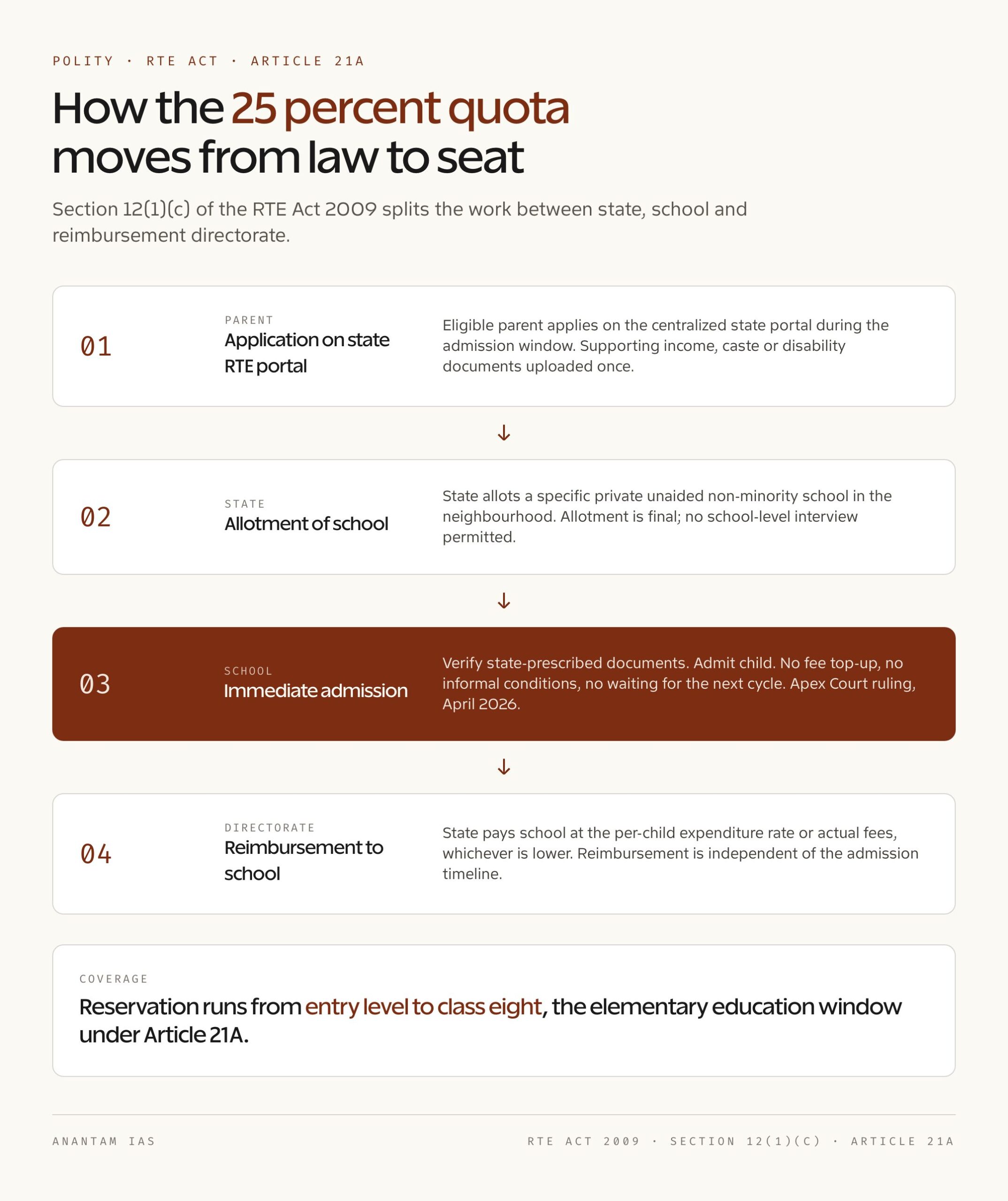
- Right of Children to Free and Compulsory Education Act, 2009 came into force on April 1, 2010.
- Section 12(1)(c) requires private unaided schools to reserve 25 percent of entry-level seats for children belonging to disadvantaged groups and weaker sections.
- Parents apply to the state under a centralized RTE portal in most states. The state allots specific schools to selected children.
- The state reimburses the school for fees up to the state’s per-child expenditure benchmark or the actual fees, whichever is lower.
- Supreme Court April 2026 ruling: state-allotted children must be admitted immediately. Delay or refusal is unlawful.
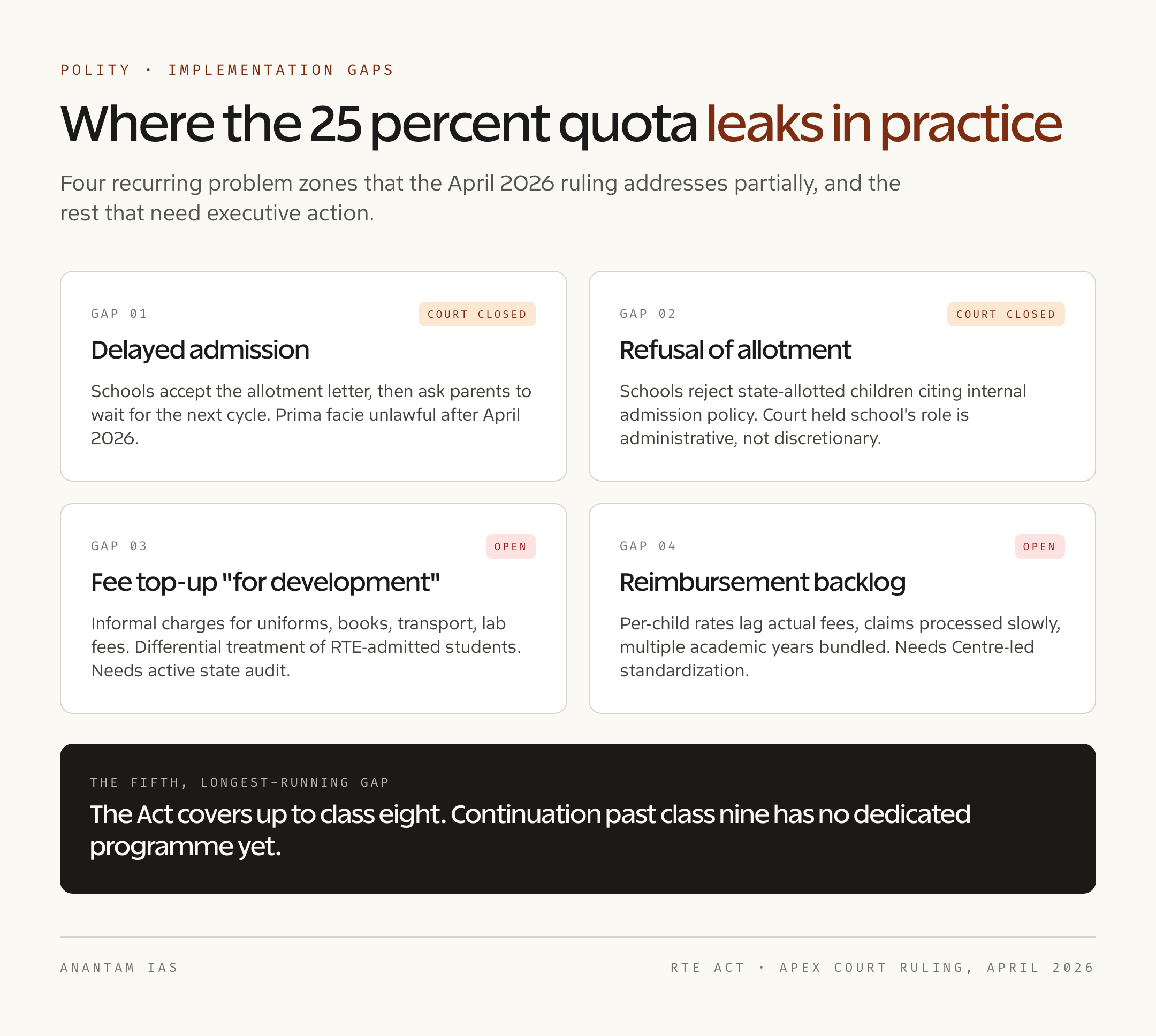
- Constitutional anchor: Article 21A, inserted by the 86th Constitutional Amendment, 2002.
- Foundational judgment: Society for Unaided Private Schools of Rajasthan v. Union of India, 2012, which upheld the validity of Section 12(1)(c) for private unaided non-minority schools.
What Just Happened
The April 2026 ruling came out of a clutch of writ petitions filed by parents whose children had been allotted seats in private schools but whose admissions had been blocked at the school gate. The petitioners argued that schools were using procedural delays and informal demands to defeat the RTE Act 25% quota.
The bench held that the statutory scheme leaves no room for such delays. Once the state’s centralized allotment is final, the school’s role is administrative, not discretionary. The school must verify the documents prescribed by the state, complete the admission, and submit the claim for reimbursement. Anything else, including a separate school-level interview, fee top-ups labelled as “development charges,” or insistence on additional documents not prescribed by the state, falls foul of Section 12(1)(c).
The Court also addressed the reimbursement question. Schools had argued in some petitions that reimbursement delays from state governments justified their reluctance to admit. The bench rejected this defense. Reimbursement is a state obligation. Admission is a school obligation. The two cannot be linked at the cost of the child.
Background and Historical Context
The Right to Education Act has a longer constitutional history than most people remember.
The original Constitution placed elementary education in the Directive Principles. Article 45, as it stood in 1950, asked the state to provide free and compulsory education for all children up to the age of fourteen within ten years. The deadline was missed. Repeatedly.
The Supreme Court’s 1992 judgment in Mohini Jain v. State of Karnataka, and the more refined 1993 ruling in Unni Krishnan v. State of Andhra Pradesh, held that the right to education flowed from Article 21. The Court located the right within the right to life and personal liberty, but limited it to the age fourteen mark consistent with Article 45.
The 86th Constitutional Amendment, 2002 made the right explicit. It inserted Article 21A: “The State shall provide free and compulsory education to all children of the age of six to fourteen years in such manner as the State may, by law, determine.” The amendment also moved Article 45 to cover early childhood care for under-six children, and added Article 51A(k), making it a fundamental duty of parents to provide educational opportunities to their children.
The Right to Education Act, 2009, gave statutory shape to Article 21A. Section 12(1)(c) of that Act extended the obligation to private unaided non-minority schools by reserving 25 percent of entry-level seats for children from disadvantaged groups and economically weaker sections.
The 2012 Supreme Court ruling in the Society for Unaided Private Schools of Rajasthan case upheld the constitutional validity of Section 12(1)(c) for non-minority private schools, while exempting minority institutions under Article 30. The 2014 Pramati Educational and Cultural Trust ruling extended the exemption to minority unaided schools more comprehensively.
Implementation has been uneven from the start. The 2026 ruling is the latest in a series of judicial interventions trying to close the gap between law and practice.
For broader context on educational rights, the explainer on cultural and educational rights covers Articles 29 and 30, and the analysis of the National Education Policy 2020 is useful for the policy environment in which the RTE Act now operates.
Key Provisions of Section 12(1)(c)
Section 12 of the RTE Act sets out the obligations of different categories of schools.
Government and aided schools must admit all children seeking admission. They are funded directly by the state.
Special category schools like Kendriya Vidyalayas, Navodaya Vidyalayas and Sainik Schools admit students under their own admission rules but extend at least 25 percent of seats to disadvantaged-group and EWS children.
Private unaided schools, non-minority are governed by Section 12(1)(c). They reserve 25 percent of seats at the entry-level class for children of disadvantaged groups and weaker sections living within the school’s neighbourhood. They are reimbursed for fees up to the state’s per-child expenditure benchmark or actual fees, whichever is lower.
Private unaided minority schools are exempt under the 2014 Pramati ruling.
Eligibility for the RTE Act 25% quota covers Scheduled Castes, Scheduled Tribes, socially and educationally backward classes, children with disabilities, orphans, and children from families with income below state-prescribed thresholds.
Entry level is typically pre-primary or class one, depending on the school’s structure. The reserved seats follow the child through to the completion of elementary education, defined as class eight.
Why the 2026 Ruling Matters
Three reasons.
The first is doctrinal clarity. By holding that state allotment is binding and immediate, the Court has removed the procedural toolkit schools were using to block admissions. Future writs do not need to argue principle. They can argue compliance.
The second is the equity message. The RTE Act 25% quota was designed to break the social segregation that private schooling produces. Children from disadvantaged backgrounds sit in classrooms with children from privileged backgrounds, build friendships across class lines, and access the same teachers, infrastructure and peer environment. When schools block admissions, they preserve segregation. The ruling restores the integration intent.
The third is the reimbursement backstop. By ruling that admission and reimbursement are independent obligations, the Court has separated the two timelines. States can no longer let reimbursement backlogs become indirect rationing tools. Schools can no longer use reimbursement delays as an excuse.
Detailed Analysis: Reimbursement Issues
The reimbursement system is where most of the friction sits.
Each state notifies a per-child expenditure rate, typically calculated annually. Schools claim reimbursement up to this rate or their actual fees, whichever is lower. Reimbursement happens through a state directorate, often with multiple verification layers and physical paperwork.
The problems are structural. State per-child rates have lagged actual private school fees by a wide margin in many cases. Schools end up cross-subsidising RTE seats from regular fee-paying students, which they resent. Reimbursement claims are processed slowly, with backlogs often running into multiple academic years. Some states issue partial payments. Others bundle multiple years into a single release.
The 2026 ruling does not solve these problems directly. It addresses only the admission side. The reimbursement side will need either a Centre-led standardization of rates, or a faster digital claim system that ties payments to verified attendance data.
Comparative Perspective
Few jurisdictions run a comparable model. The closest parallel is the United Kingdom’s Assisted Places Scheme, which operated from 1981 to 1997 and funded means-tested places at fee-charging schools. It was abolished by the Blair government on equity grounds. The American voucher and charter school models work differently, funding parents or alternative schools rather than mandating private school participation.
India’s RTE Act 25% quota is therefore distinctive. It is not a voucher. It is not a charter. It is a statutory obligation on private schools to participate in universal elementary education, anchored in a fundamental right and backed by reimbursement. The architecture is sound. The execution gaps are operational.
Challenges and Critiques
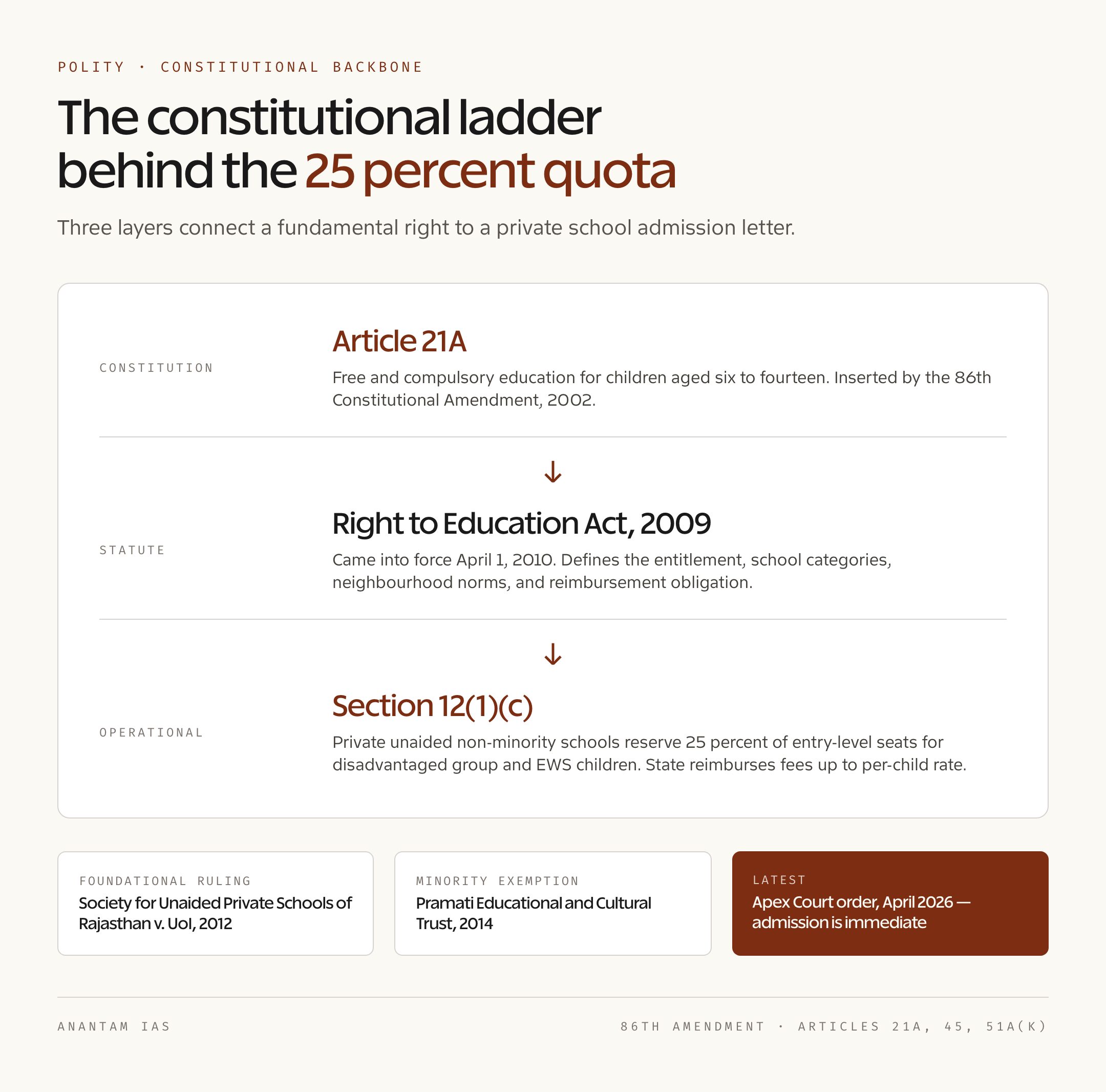
Implementation gaps come in four flavours.
State-level portal failures. Several states have struggled to maintain functioning RTE allotment portals. Glitches during application windows, opaque allotment criteria, and limited grievance redressal undermine the parent’s experience of the system.
School-level resistance. Beyond the procedural delays the Court addressed, schools sometimes segregate RTE-admitted students into separate sections, charge informal fees for uniforms, books or transport, or apply differential discipline. None of this is permitted by the Act, but it persists.
Reimbursement backlogs. As discussed, reimbursement is the system’s structural weak point.
Continuity beyond class eight. The Act covers elementary education only. RTE-admitted students reaching class nine often face the choice of staying at the same school by paying full fees or switching to a government school, which can disrupt their academic trajectory.
The 2026 ruling addresses only the first half of the first problem. The other gaps need executive action, not just judicial pronouncement.
UPSC Prelims Pointers
- Article 21A inserted by the 86th Constitutional Amendment Act, 2002.
- Right of Children to Free and Compulsory Education Act, 2009 came into force April 1, 2010.
- Section 12(1)(c) mandates 25 percent reservation for disadvantaged group and EWS children in private unaided non-minority schools at entry level.
- 2012 Society for Unaided Private Schools of Rajasthan judgment upheld Section 12(1)(c) for non-minority schools.
- 2014 Pramati Educational and Cultural Trust ruling exempted minority schools.
- Mohini Jain (1992) and Unni Krishnan (1993) established the right to education under Article 21 before the 86th Amendment.
- Article 45 (post-2002) covers early childhood care for under-six children.
- Article 51A(k) makes it a fundamental duty of parents to provide educational opportunities to children aged six to fourteen.
- Reimbursement: state per-child expenditure rate or actual fees, whichever is lower.
Mains Practice Questions
- The Right to Education Act 2009 was a landmark piece of social legislation. Critically evaluate its implementation, with particular reference to Section 12(1)(c). (GS Paper II, 15 marks)
- Discuss the role of the judiciary in giving effect to the right to education before and after the 86th Constitutional Amendment. (GS Paper II, 15 marks)
- The reimbursement system under the RTE Act 25 percent quota has structural weaknesses. Identify them and suggest reforms. (GS Paper II, 10 marks)
- Examine the tension between minority educational rights under Article 30 and the universal applicability of the RTE Act. How has the Supreme Court resolved this tension? (GS Paper II, 15 marks)
Way Forward
The Supreme Court has now done its part on the admission question. The remaining work is executive.
States need to standardize per-child reimbursement rates, ideally with Centre-led benchmarking. Reimbursement processing has to move to a fully digital, attendance-linked system that closes the backlog. School-level discrimination after admission needs an active complaint and audit mechanism, with consequences for repeated violations. And the post-class-eight transition for RTE-admitted students needs a dedicated continuation programme.
If these pieces are assembled, the RTE Act 25% quota will deliver what it was designed to deliver: a generation of Indian children educated together across class lines, with the most disadvantaged getting the fairest shot they have ever had at a private school education. If they are not, the law will continue to be only partly enforced, and another generation will lose the chance the statute promised them.
Article 21A is not aspirational. It is binding. The 2026 ruling is a reminder that the binding part has work left to do.
Frequently Asked Questions
What is the RTE Act 25% quota?
A statutory obligation on private unaided non-minority schools to reserve 25 percent of entry-level seats for children from disadvantaged groups and economically weaker sections, with the state reimbursing the fees.
What did the Supreme Court rule in April 2026?
The Court held that once a state allots a child to a private school under Section 12(1)(c), the school must admit the child immediately. Delay, refusal, or extra-procedural conditions are unlawful.
Which schools are exempt from Section 12(1)(c)?
Private unaided minority schools are exempt following the 2014 Pramati judgment. Government schools, aided schools and special category schools follow different rules under Section 12.
Who qualifies for admission under the quota?
Children of Scheduled Castes, Scheduled Tribes, socially and educationally backward classes, children with disabilities, orphans, and children from families with income below state-prescribed thresholds.
How does the reimbursement work?
The state reimburses schools at the per-child expenditure rate notified by the state or the actual fees, whichever is lower. Reimbursement is the state’s obligation; admission is the school’s.
Until what class does the RTE Act apply?
The Act covers elementary education up to class eight. Continuation beyond class eight depends on individual school policy and state schemes.
What is Article 21A?
A fundamental right inserted by the 86th Constitutional Amendment, 2002, which makes free and compulsory education for children aged six to fourteen a state obligation.
What if a school refuses admission despite state allotment?
After the April 2026 ruling, refusal is directly unlawful. Parents can approach the state RTE grievance cell, the State Commission for Protection of Child Rights, or move the High Court.
Tell Google you want more of this.
Add Anantam IAS as a preferred sourceOne tap, and this site shows up more often in your own Top Stories, AI Overviews and AI Mode. Remove it any time.