
Why in news?
Jan Aushadhi Kendras have crossed 20,500, but low awareness, stock-outs and doubts over quality still limit the scheme’s reach.
UPSC Relevance
Prelims – PMBJP, generic medicines, NPPA, NLEM, Jan Aushadhi Sugam app
Mains, GS2, Government Policies and Interventions; Issues relating to Development and Management of Health
Pradhan Mantri Bhartiya Janaushadhi Pariyojana (PMBJP)
PMBJP is a scheme to sell quality generic medicines at affordable prices through dedicated outlets called Jan Aushadhi Kendras (JAKs).
- Launch: Started in 2008 as the Jan Aushadhi Scheme; revamped in 2015 and renamed PMBJP in 2016.
- Ministry: Department of Pharmaceuticals, Ministry of Chemicals and Fertilizers (not the Health Ministry).
- Implementing agency: Pharmaceuticals and Medical Devices Bureau of India (PMBI), earlier called BPPI.
- Product basket: 2,110 medicines and 315 surgical items, covering major therapeutic groups like anti-diabetics, cardiovascular drugs, anti-cancers and antibiotics.
- Pricing: Medicines are priced at least 50% lower, and in many cases 80–90% lower, than branded medicines.
- Quality: Medicines are bought only from WHO-GMP certified suppliers, and every batch is tested in NABL-accredited labs before supply.
- Who can open a Kendra: Individual pharmacists, entrepreneurs, NGOs, hospitals and Primary Agricultural Credit Societies (PACS). An incentive of up to ₹5 lakh is given, with an extra one-time grant for women, SC/ST, Divyang owners and those in North-East, Himalayan, island and aspirational districts.
- Special products: Jan Aushadhi Suvidha oxo-biodegradable sanitary napkins at ₹1 per pad.
- Digital support: Jan Aushadhi Sugam app – store locator, Google Maps navigation and medicine-wise price comparison.
- Jan Aushadhi Diwas: Observed on 7 March every year.
Status
- Outlets: Kendras grew from just 80 in 2014-15 to 17,990 in December 2025 and 20,547 by July 2026. The target is 25,000 Kendras by March 2027.
- Sales: Sales at MRP rose from ₹7.29 crore in 2014-15 to ₹1,235.95 crore in 2022-23, ₹1,470 crore in 2023-24 and ₹2,252 crore in 2025-26.
- Savings: The government estimates savings of about ₹9,000 crore for citizens in 2025-26 and about ₹45,000 crore over 12 years – an average discount of around 80%.
The growth is steady, but the scale is still small. The 20,547 Kendras are only about 1.7% of the roughly 12 lakh chemists and druggists in the country.
Generic Medicines
| Type | Meaning |
|---|---|
| Branded (innovator) medicine | Developed and patented by a company; sold under its brand name at a high price during the patent period |
| Branded generic | Off-patent medicine sold by a company under its own brand name. Most medicines sold in Indian pharmacies fall here |
| Generic (unbranded) | Sold under the name of the salt or active ingredient (e.g., Paracetamol). Jan Aushadhi medicines fall here |
| Bioequivalence | The generic must release the same active ingredient into the blood at the same rate and extent as the original. This proves it works the same |
India supplies about one-fifth of the world’s generic medicines and is often called the “pharmacy of the world”. So manufacturing capacity is not the problem – reaching the patient is.
Why does it matter?
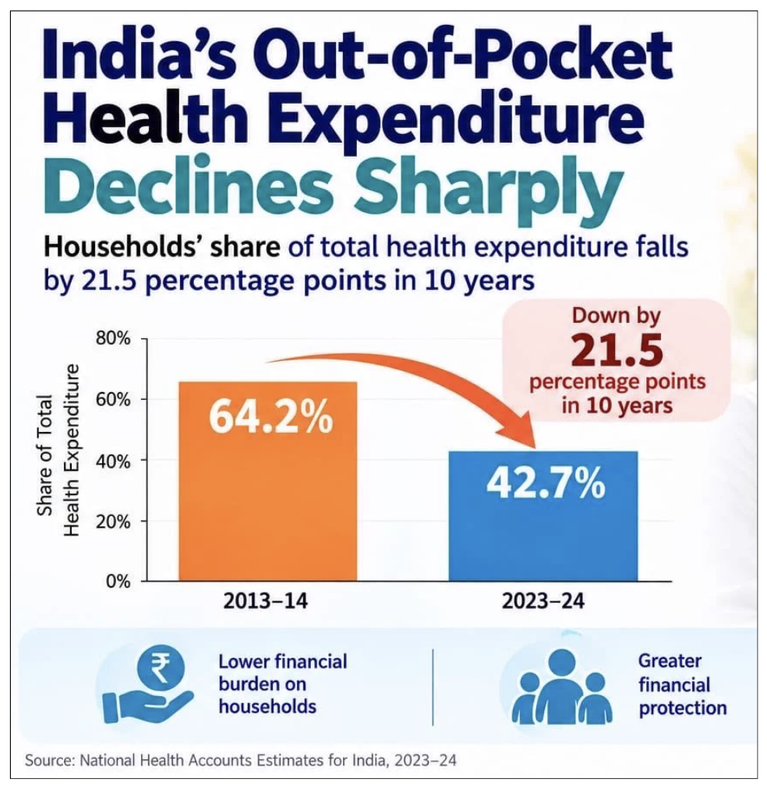
- Medicines drive out-of-pocket expenditure: Medicines make up roughly 60–70% of household out-of-pocket expenditure (OOPE) on health in India.
- Insurance gap: Schemes like Ayushman Bharat PM-JAY mainly cover hospitalisation. Outpatient drug costs, especially for chronic diseases like diabetes and hypertension, are largely not covered.
- Low public spending: Government health expenditure was 1.43% of GDP in 2023-24, while the National Health Policy, 2017 target was 2.5% of GDP by 2025.
- Rising NCDs: Lifelong medicines for non-communicable diseases make monthly drug bills a long-term burden. In the article, one family’s monthly bill fell from about ₹2,900 to ₹663 at a Kendra.
- Constitutional link: Right to health is part of Article 21 (as interpreted by the Supreme Court), and Article 47 directs the State to improve public health.
Challenges
- Low awareness: In a small study of 200 outpatients in Port Blair, only a third had heard of the scheme and more than half did not know what the outlets sell.
- “Shop for the poor” image: Many see Kendras as charity counters, which keeps away middle-class buyers and limits demand.
- Doctors’ prescriptions: Patients buy what doctors write. The National Medical Commission’s 2023 order to prescribe generic names was put on hold after doctors’ bodies objected over quality and autonomy. Only 6% of patients in the Port Blair study had ever asked for generics.
- Quality perception: The government reports 0.34% substandard medicines in Jan Aushadhi compared to 3.70% in the open market, but the period and testing method are not disclosed. A 2020 report counted 106 batch recalls in four years.
- Stock-outs: When medicines are not available, buyers lose trust and do not return. This leads to fewer customers and weaker stores.
- Location and viability: Kendras are often in less busy areas to save rent, and the low-margin model makes it hard for owners to survive.
- No data on users: There is no nationally representative survey on why people use or avoid Kendras.
- Supply chain: Most suppliers are MSMEs, which face raw-material price swings and procurement delays.
Way Forward
- Measure first: Department of Pharmaceuticals and Health Ministry should commission an independent national survey on awareness, prescriptions and stock availability.
- Transparent quality testing: Publish regular random-batch test results with the period, method and labs named, so that the 0.34% claim can be verified.
- Win doctors’ trust: Prove quality consistently, discuss with doctors’ bodies and then bring back the generic prescription mandate. Bioequivalence data on labels will help.
- No stock-outs: An online stock-tracking system that reorders automatically, and live stock positions on the Sugam app.
- Rebrand for all: Promote Kendras as shops for everyone through social media and targeted advertising.
- Better locations: Open Kendras inside government hospitals, railway stations and busy markets; use PACS and post offices in rural areas.
- Dedicated funding: As public health spending rises, a dedicated allocation for expanding and promoting Jan Aushadhi will directly cut household medical burden.
- Link with insurance: Cover outpatient medicines bought from Kendras under health insurance and Ayushman Arogya Mandirs.
A bill that fell by 77% in one visit shows what India has already built. The challenge now is to make that experience normal for every family, through evidence, trust and funding.
Practice MCQ
Q1. Consider the following statements regarding the Pradhan Mantri Bhartiya Janaushadhi Pariyojana (PMBJP):
- The scheme is administered by the Ministry of Health and Family Welfare.
- Medicines sold at Jan Aushadhi Kendras are procured only from WHO-GMP certified suppliers and tested at NABL-accredited laboratories.
- Under the “Janaushadhi Suvidha” initiative, oxo-biodegradable sanitary napkins are sold at ₹1 per pad.
- The product basket is limited to medicines; surgical items and medical consumables are outside its scope.
How many of the above statements are correct?
(a) Only one
(b) Only two
(c) Only three
(d) All four
Answer: (b)
Explanation
Statement 1 is incorrect. This is the trap, since aspirants often assume a health scheme sits with the Health Ministry. PMBJP is a flagship scheme administered by the Department of Pharmaceuticals under the Ministry of Chemicals and Fertilisers. The Pharmaceuticals & Medical Devices Bureau of India (PMBI) implements it.
Statement 2 is correct. Suppliers must be WHO-GMP certified, and each batch is tested at NABL-accredited labs before it is sold. This quality step is what separates the scheme from simply selling cheap generics.
Statement 3 is correct. The “Janaushadhi Suvidha” initiative sells oxo-biodegradable sanitary napkins for ₹1 per pad. By January 2026, over 100 crore pads were sold.
Statement 4 is incorrect. As of August 2026, the basket had 2,110 medicines and 315 surgicals, medical consumables and devices.
Q2. Given below are two statements, one labelled as Assertion (A) and the other as Reason (R):
- Assertion (A): The National Medical Commission’s direction making it mandatory for doctors to prescribe medicines by generic names is currently in force across India.
- Reason (R): Medicines account for the largest share of household out-of-pocket expenditure on health in India.
In the light of the above statements, choose the correct option:
(a) Both (A) and (R) are correct, and (R) is the correct explanation of (A).
(b) Both (A) and (R) are correct, but (R) is NOT the correct explanation of (A).
(c) (A) is correct, but (R) is incorrect.
(d) (A) is incorrect, but (R) is correct.
Answer: (d) The NMC’s generic prescription mandate was put on hold after objections from doctors’ bodies.
Practice Question
“Despite India being the pharmacy of the world, affordable generic medicines have not reached most Indian households.” In this context, examine the performance of the Pradhan Mantri Bhartiya Janaushadhi Pariyojana and suggest measures to expand its reach. (15 Marks, 250 words)
Tell Google you want more of this.
Add Anantam IAS as a preferred sourceOne tap, and this site shows up more often in your own Top Stories, AI Overviews and AI Mode. Remove it any time.