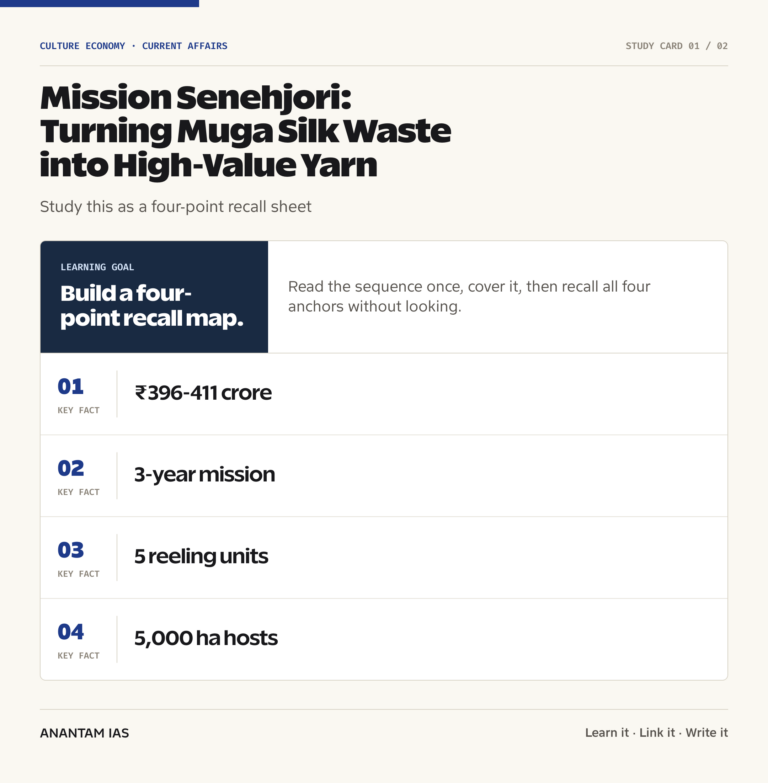
Why in News?
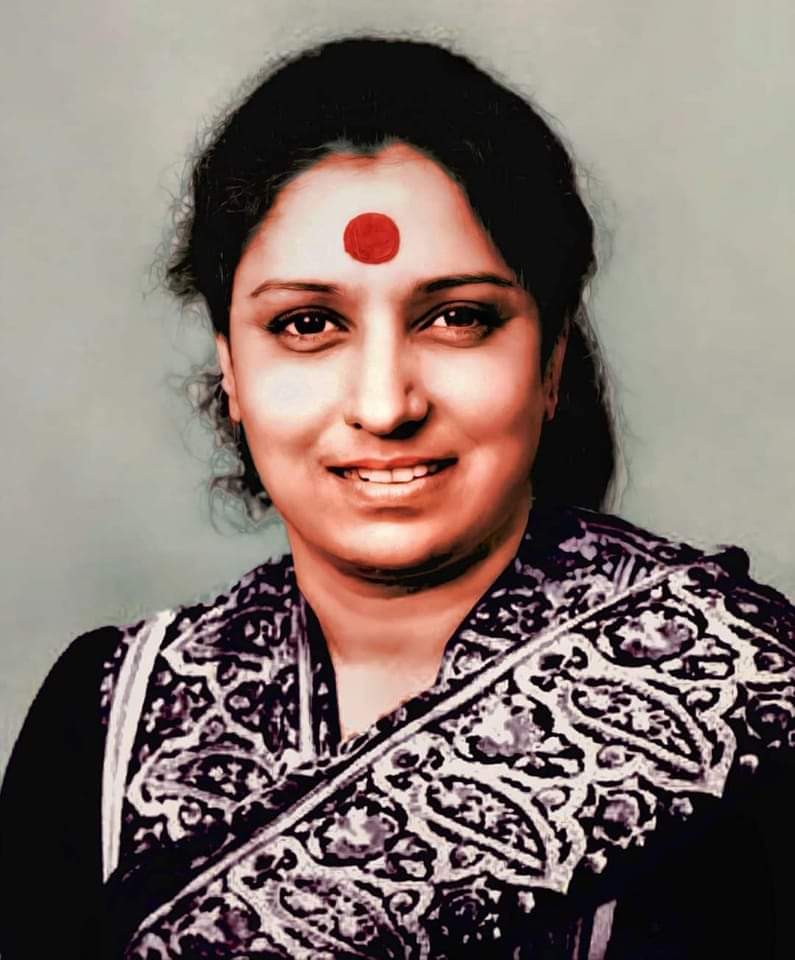
Veteran playback singer S. Janaki, revered across the south as the Isai Arasi (Tamil for ‘Queen of Music’) and the Nightingale of South India, died on 11 July 2026 in Mysuru, Karnataka, at the age of 88, after a heart attack and age-related illness. The Hindu and The Week reported the passing of one of Indian cinema’s most prolific voices, whose recordings spanned generations of composers and languages.
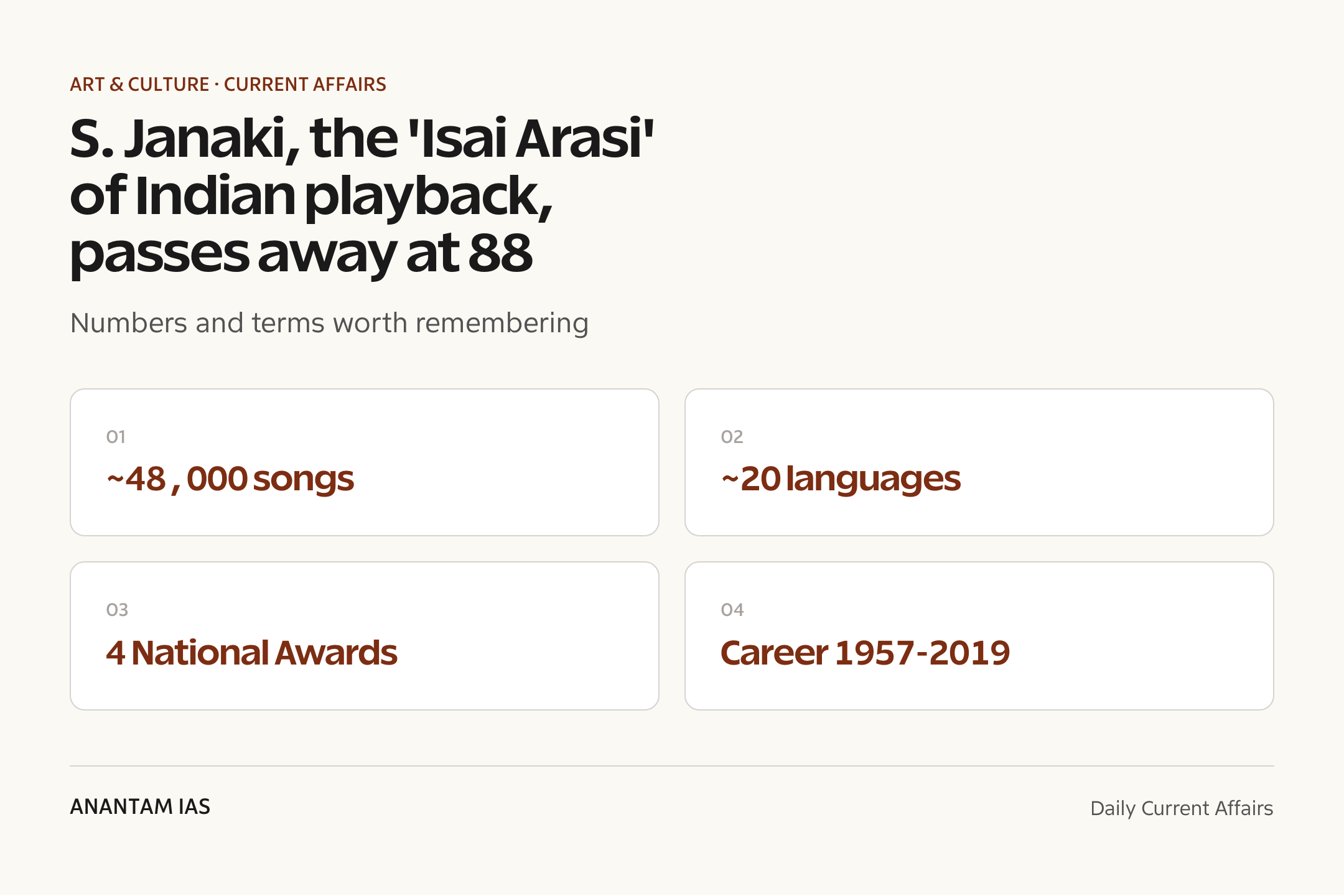
Over a career spanning close to six decades from 1957, Janaki recorded an estimated 48,000 songs across about 20 languages and won four National Film Awards, making her a high-value personality-in-news for UPSC art-and-culture and awards factsheets. Her death draws attention to the golden age of South Indian playback music and to the singers whose voices, more than the on-screen faces, carried the emotional life of regional cinema.
The obituary also revives an old debate she herself sharpened: in 2013 Janaki declined the Padma Bhushan, saying it had come too late and that South Indian artists were under-recognised in national honours — an episode that turns her passing into a case study on the fairness and timeliness of India’s civilian-award system.
- Born 23 April 1938 at Pallapatla (Guntur, then Madras Province, now Andhra Pradesh); spent much of her childhood in Sircilla.
- Playback debut in the Tamil film Vidhiyin Vilayattu (1957) at age 19; sang in six languages in her very first year, followed by the Telugu film M.L.A.
- Won four National Film Awards for Best Female Playback Singer and 33 State Film Awards across Tamil, Telugu, Kannada and Malayalam cinema.
- In 2013 she publicly declined the Padma Bhushan, saying the honour came ‘too late’ and that South Indian artists were under-recognised nationally.
- Announced retirement from film and stage singing in 2016; returned briefly in 2018 for the Tamil film Pannaadi.
The development matters in the context of:
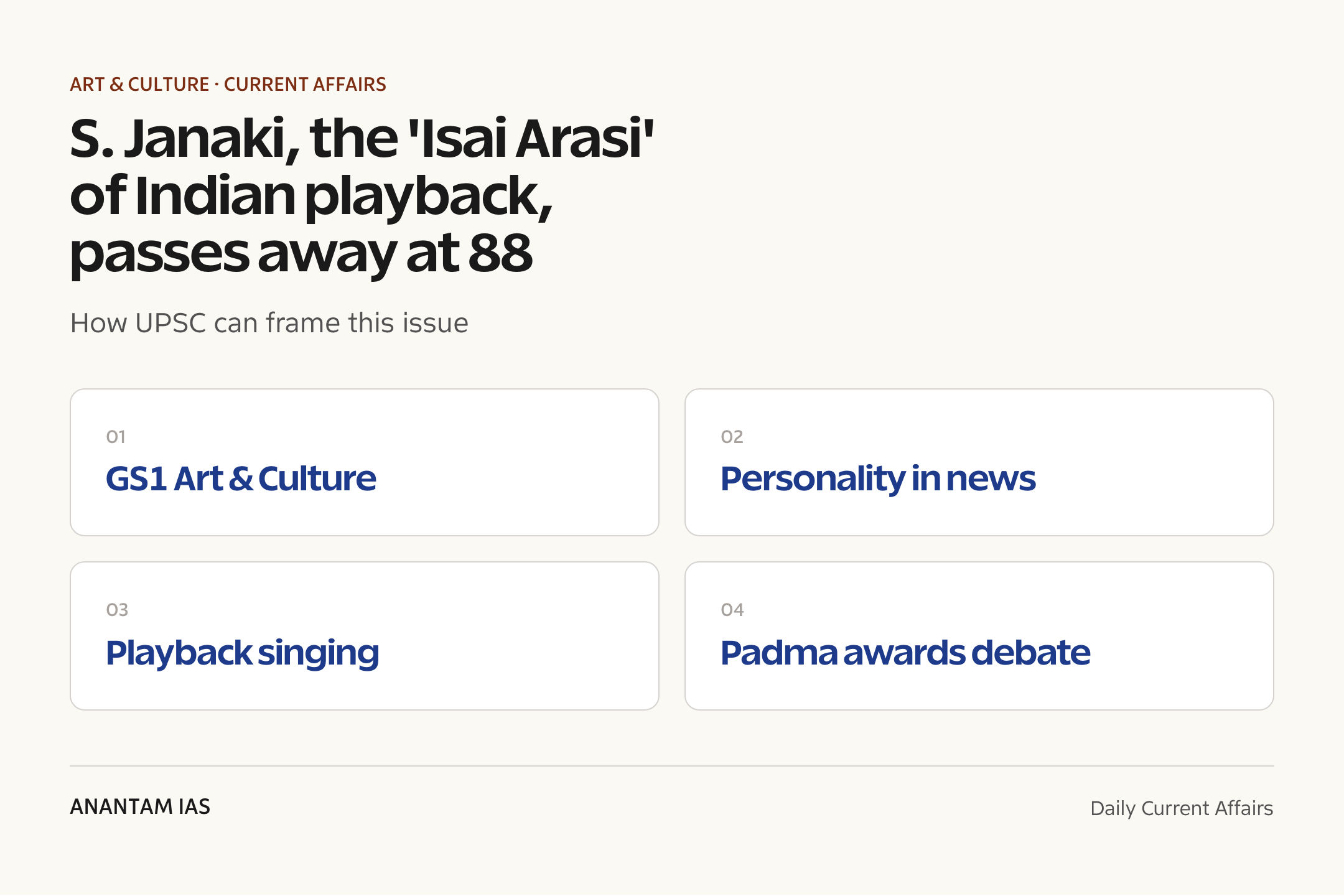
- Personality-in-news is a recurring Prelims and GS1 theme; obituaries of cultural figures feed the ‘Awards and Persons’ factsheet.
- Janaki’s life maps onto the playback singing tradition and the post-Independence growth of South Indian film music as a pillar of India’s cultural economy.
UPSC Relevance
Prelims Relevance
- S. Janaki — titles ‘Isai Arasi’, ‘Gana Kokila’, ‘Nightingale of South India / Deccan’.
- Debut film: Vidhiyin Vilayattu (Tamil, 1957).
- Four National Film Awards for Best Female Playback Singer (1976, 1980, 1984, 1992).
- First National Award: ‘Sindhoora Poove’ from 16 Vayathinile (1976, Tamil).
- National Award song ‘Inji Iduppazhaga’ from Thevar Magan (1992).
- Padma Bhushan — third-highest civilian award; Janaki declined it in 2013.
- Key collaborators: Ilaiyaraaja, M. S. Viswanathan, A. R. Rahman, G. K. Venkatesh.
- Concept: playback singing — pre-recorded vocals lip-synced by on-screen actors.
Mains Relevance
GS Paper 1
- Role of cinema and film music in shaping regional and national cultural identity in post-Independence India.
- Contribution of women artists to the performing-arts landscape and its social recognition.
GS Paper 2
- Civilian honours (Padma awards, Bharat Ratna): selection process, criticism of regional and sectoral under-representation.
Essay
- ‘A voice outlives the singer’ — art, memory and cultural continuity.
- Recognition and its discontents: when honours arrive late, do they still honour?
Background and Context
Who was S. Janaki
A defining voice of South Indian playback music for six decades, whose reach cut across languages, composers and generations.
- Sistla Janaki was born on 23 April 1938 at Pallapatla in Guntur district, in what was then the Madras Province and is today Andhra Pradesh; her father Sistla Sreeramamurthy was an Ayurvedic physician and teacher.
- She trained in Carnatic music from childhood and moved into films through the AVM Productions orbit in Madras, entering a studio system that was then building the modern playback tradition.
- Widely addressed as Janakiamma, Gana Kokila / Gana Kogile (Nightingale), and the Isai Arasi in Tamil, honorifics that reflected both her technical command and her emotional expressiveness.
- She was noted for voicing the rural female protagonist in South Indian cinema, lending a distinctive, earthy tenderness to heroines drawn from village life.
- Married V. Ramaprasad in 1959; she settled in Mysuru in her later years, where she remained a revered elder of the music world until her death.
A six-decade, multilingual career
Her range across languages and composers made her a pan-South-Indian institution rather than a singer confined to one film industry.
- Debuted with the Tamil film Vidhiyin Vilayattu (1957) at age 19 and recorded songs in six languages within that first year, followed quickly by the Telugu film M.L.A.
- Sang an estimated 48,000 songs across roughly 20 languages, including Tamil, Telugu, Kannada, Malayalam, Hindi and Odia, a body of work that few playback singers anywhere have matched in scale.
- Her collaboration with Ilaiyaraaja — beginning with Annakkili (1976) — defined an era of Tamil film music and produced some of its most enduring melodies.
- Also worked closely with M. S. Viswanathan, A. R. Rahman and G. K. Venkatesh, a span that carried her from the classic orchestral era into the synthesised, modern sound of the 1990s.
- She moved fluently between semi-classical, devotional and popular registers, adapting her voice to the demands of each composer and character.
- Announced retirement from film and stage in 2016, returned briefly in 2018 for Pannaadi, closing a career often cited as running 1957–2019.
Awards and honours
One of the most decorated playback singers in Indian cinema, honoured repeatedly at both national and state level.
- Four National Film Awards for Best Female Playback Singer — 1976 (16 Vayathinile), 1980 (Oppol), 1984 (Sitara) and 1992 (Thevar Magan) — spanning Tamil, Malayalam and Telugu cinema.
- Her first National Award came for ‘Sindhoora Poove’ from 16 Vayathinile, and among her celebrated award-winning numbers is ‘Inji Iduppazhaga’ from Thevar Magan.
- 33 State Film Awards from Tamil Nadu, Andhra Pradesh, Karnataka and Kerala combined, a tally that underlines her simultaneous standing across four language industries.
- Received the Kalaimamani (Tamil Nadu) and the Rajyotsava Prashasti (Karnataka), plus an honorary doctorate from the University of Mysore in recognition of her contribution to music.
The Padma Bhushan she declined
Her 2013 refusal put the spotlight on how, and how promptly, India recognises its artists.
- In 2013 the government named her for the Padma Bhushan, India’s third-highest civilian award; she declined it publicly.
- She said the honour had come ‘too late’ in a career then spanning over five decades, framing recognition delayed as recognition diminished.
- She voiced disappointment at the limited recognition for South Indian artists in national honours lists, giving voice to a wider grievance about regional representation.
- Padma awards are conferred by the President on the recommendation of the Padma Awards Committee; the debate she triggered concerns whom such lists tend to overlook.
- The episode is a ready case study on the perceived regional and linguistic imbalance in civilian awards, and on whether artists should be honoured while still at the height of their powers.
Playback singing as a cultural form
Understanding the craft that Janaki mastered anchors the news to the durable art-and-culture syllabus.
- Playback singing is the practice of pre-recording songs in a studio that on-screen actors then lip-sync during filming, a staple of Indian cinema since the 1930s.
- It made specialist singers — rather than actors — the true voices of film music, creating stars like Janaki, Lata Mangeshkar and S. P. Balasubrahmanyam whose fame rested on voice alone.
- South Indian film music built a distinct ecosystem of composers, lyricists and singers that shaped regional identity and a large cultural economy across Tamil, Telugu, Kannada and Malayalam industries.
- The singer’s craft demanded not just tunefulness but the ability to act through the voice — matching mood, dialect and character without appearing on screen.
- Janaki was noted for versatility across semi-classical, devotional and popular registers and for defining the voice of the rural female protagonist for a generation of filmgoers.
Way Forward
Preserving the archive
- Digitise and archive the recordings of playback legends through institutions such as the National Film Archive of India and All India Radio to prevent loss of cultural memory.
- Support oral-history and restoration projects that document composer-singer collaborations of the analogue era.
Recognising diversity
- Broaden civilian-honour deliberations to ensure fairer regional and linguistic representation among artists.
- Strengthen state and central patronage for performing artists in their lifetimes rather than largely posthumously.
Conclusion
S. Janaki’s passing closes a chapter in which a single voice could carry the emotional weight of an entire film industry across languages. Her nearly 48,000 songs, sung across roughly 20 languages and four decades of composers, are a living archive of South India’s musical imagination and of the golden age of film playback.
Her career also frames a quieter argument about cultural recognition. That one of India’s most awarded singers felt compelled to refuse the Padma Bhushan says as much about the honours system as about the artist, and keeps alive the question of regional and linguistic balance in national awards.
For the aspirant, her life is a compact study in India’s cultural history — the rise of playback singing, the reach of regional cinema as a pillar of the cultural economy, and the recurring debate over how, and how promptly, the nation honours its artists while they can still hear the applause.
UPSC Practice Questions
Prelims MCQ 1
With reference to the playback singer S. Janaki, consider the following statements:
- She made her playback debut in a Tamil film in 1957.
- She won four National Film Awards for Best Female Playback Singer.
- She accepted the Padma Bhushan awarded to her in 2013.
How many of the above statements are correct?
(a) Only one (b) Only two (c) All three (d) None
Answer: (b) Only two
Explanation:
Statements 1 and 2 are correct — she debuted with the Tamil film Vidhiyin Vilayattu (1957) and won four National Film Awards. Statement 3 is wrong: she declined the Padma Bhushan in 2013.
Prelims MCQ 2
The title ‘Isai Arasi’, associated with S. Janaki, translates most closely to:
(a) Queen of Dance (b) Queen of Music (c) Voice of the Nation (d) Empress of Cinema
Answer: (b) Queen of Music
Explanation:
‘Isai Arasi’ is a Tamil honorific meaning ‘Queen of Music’; she was also called the ‘Nightingale of South India’.
UPSC Mains Questions
- The life of a playback singer like S. Janaki mirrors the evolution of Indian cinema’s cultural and regional identity. Discuss the role of film music in shaping post-Independence popular culture in India. (250 words)
- India’s civilian honours have periodically faced criticism over regional and sectoral representation. Examine, with examples, the challenges of ensuring fairness and timeliness in recognising artistic contribution. (250 words)
Sources: The Hindu and The Week.
Frequently Asked Questions
Who was S. Janaki?
S. Janaki (1938–2026) was one of India’s most celebrated playback singers, revered as the ‘Isai Arasi’ and ‘Nightingale of South India’. Over nearly six decades she recorded an estimated 48,000 songs across about 20 languages and won four National Film Awards, singing chiefly for Tamil, Telugu, Kannada and Malayalam cinema.
When and where did she die?
She died on 11 July 2026 in Mysuru, Karnataka, at the age of 88, following a heart attack and age-related illness. She had lived in Mysuru in her later years and had largely retired from performing after 2016.
How many National Film Awards did she win?
She won four National Film Awards for Best Female Playback Singer — in 1976 for ’16 Vayathinile’, 1980 for ‘Oppol’, 1984 for ‘Sitara’ and 1992 for ‘Thevar Magan’. She also received 33 State Film Awards across the southern states.
Why did she decline the Padma Bhushan?
In 2013 S. Janaki declined the Padma Bhushan, India’s third-highest civilian award. She said the recognition had come too late in her long career and expressed disappointment at the limited representation of South Indian artists in national honours.
What is playback singing?
Playback singing is the practice of pre-recording songs in a studio that on-screen actors then lip-sync during filming. It has been central to Indian cinema since the 1930s and turned specialist singers such as S. Janaki into stars in their own right.
Which composers did she work with most?
She is closely associated with Ilaiyaraaja, whose partnership with her from ‘Annakkili’ (1976) defined an era of Tamil film music. She also worked extensively with M. S. Viswanathan, A. R. Rahman and G. K. Venkatesh across several decades.
Tell Google you want more of this.
Add Anantam IAS as a preferred sourceOne tap, and this site shows up more often in your own Top Stories, AI Overviews and AI Mode. Remove it any time.