Why in News?
The Ministry of Health and Family Welfare has released findings of the SAMPADA (Survey for Assessment of Markers of Population Health, Activity, Diet and Anthropometry) 2023-25, conducted by the Indian Council of Medical Research (ICMR) and the Department of Health Research (DHR).
| UPSC Relevance: GS-2 Social Justice: Health; GS-3 Science and Technology: Diseases Prelims: SAMPADA; Anaemia Mukt Bharat 7×7×7 matrix, Govt Schemes, Anaemia Burden, Double Fortified Salt |
About SAMPADA Survey:
- Conducted by: Indian Council of Medical Research (ICMR) and the Department of Health Research (DHR).
- Scale: Covered over 2 lakh individuals across 81,000 households in 183 districts across 35 States and Union Territories. More than 1.7 lakh blood samples were analysed.
- Significance: Provides nationally representative estimates of anaemia and micronutrient deficiencies across the life course, including older adults, pregnant women and lactating mothers.
- Evidence gap: It provides a more comprehensive national assessment following the withdrawal of routine anaemia estimates from the NFHS series to facilitate more robust measurement.
Key Highlights of SAMPADA Survey:
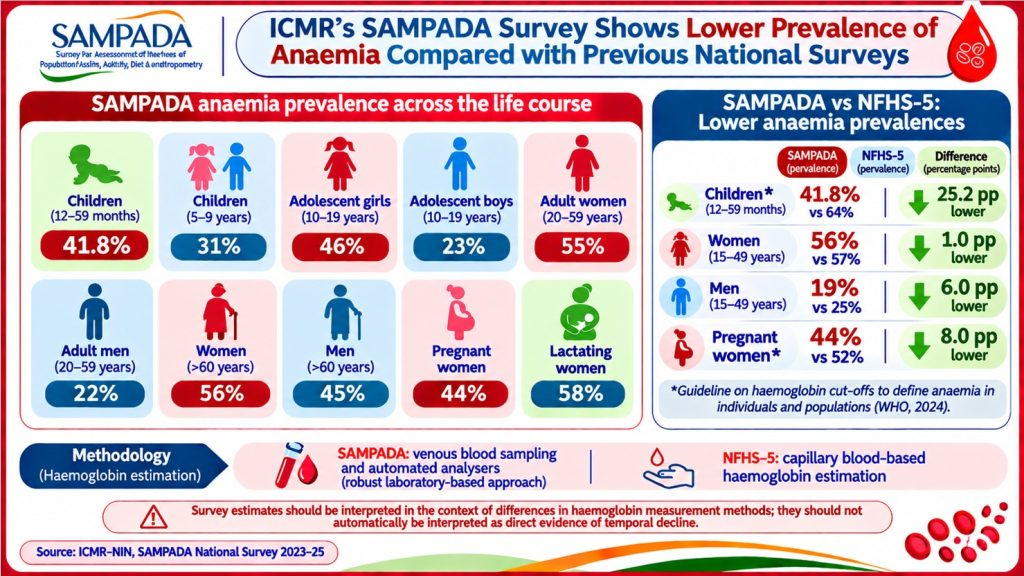
The survey indicates a broad decline in Anaemia prevalence across demographic groups, with nearly half of the reported cases falling in the “mild” category.
| Demographic Group | NFHS-5 (2019-21) | SAMPADA (2023-25) |
| Children (6-59 months) | 64.0% | 41.8% |
| Pregnant Women | 52.0% | 44% |
| All Women (Reproductive age) | 57.0% | 56% |
| Men | 25.0% | 19% |
Key observations:
- Gender disparity: Women experience a significantly higher burden than men, reflecting nutritional, reproductive and socio-economic vulnerabilities.
- Life-course vulnerability: Anaemia remains prevalent among adolescent girls, pregnant and lactating women, indicating the need for interventions beyond maternal healthcare.
- Severity: Severe anaemia is below 2% across most age groups, while a substantial proportion of cases are mild.
- Micronutrient deficiencies: Vitamin B12 deficiency is widespread, affecting around 65% of adolescent girls and 55-57% of women of reproductive age. Among adolescent girls, overall anaemia prevalence is 46.3%, whereas the coexistence of iron deficiency and anaemia is 26.9%.
Methodological Shift: From Finger-Prick to Venous Blood Testing
A major contribution of SAMPADA is its adoption of a more accurate diagnostic methodology.
- Earlier method (NFHS): Haemoglobin estimation relied on capillary blood collected through finger-prick testing and portable photometers.
- New method (SAMPADA): Uses venous blood sampling and automated haematology analysers, providing greater accuracy, reproducibility and laboratory quality control.
- Additional biomarkers: The new survey assessed iron status, folate, Vitamin B12 and inflammatory biomarkers such as C-reactive protein (CRP) and alpha-1-acid glycoprotein (AGP) in a subsample.
Significance: The shift enables better differentiation between anaemia and specific nutritional deficiencies. It also helps identify whether a person requires iron supplementation or investigation of other underlying causes.
Limitation: The change in methodology and diagnostic thresholds means that comparisons with earlier surveys should be interpreted cautiously rather than treating the decline as a direct measure of programme impact.
Why does Anaemia Persist?
Anaemia is a condition in which haemoglobin levels fall below normal, reducing the oxygen-carrying capacity of blood. Its causes extend beyond iron deficiency.
- Dietary inadequacy and poor absorption: Cereal-dominated diets, low consumption of bioavailable iron and inadequate Vitamin C intake can reduce iron absorption. Phytates in cereals and pulses inhibit the absorption of non-haem iron, while tea and coffee consumed with meals can further reduce absorption.
- Menstrual and reproductive health: Heavy menstrual bleeding (menorrhagia), often normalised rather than medically addressed, contributes to chronic iron loss among adolescent girls and women. Pregnancy and lactation further increase nutritional requirements.
- Infections and parasitic diseases: Hookworm infestation causes chronic intestinal blood loss, while malaria and recurrent infections contribute to anaemia through different mechanisms. Chronic inflammation can also restrict iron availability through increased hepcidin levels.
- Micronutrient deficiencies: Deficiencies of Vitamin B12 and folate can impair red blood cell production. SAMPADA highlights widespread Vitamin B12 deficiency, although its prevalence should not be equated with its contribution to anaemia.
- Genetic disorders: Sickle Cell Disease and Thalassaemia cause anaemia through inherited haemoglobin abnormalities and cannot be corrected through routine iron supplementation alone.
India’s Existing Strategy:
(i) Anaemia Mukt Bharat (AMB): launched in 2018, adopted a 6×6×6 strategy to address anaemia among vulnerable population groups through supplementation, testing and institutional convergence.
(ii) Revised Anaemia Mukt Bharat Abhiyaan Operational Guidelines (June 2026) expanded this into a 7×7×7 framework.
- Key features:
- Seven Beneficiary Groups: Children (6-59 months), children (5-9 years), adolescents (10-19 years), pregnant women, lactating mothers, women of reproductive age (20-49 years) and low-birth-weight infants (0-6 months).
- Seven Interventions: Prophylactic IFA supplementation, anaemia testing, therapeutic management, deworming and delayed cord clamping, Jan Bhagidari, addressing non-nutritional causes and the Eating Right approach.
- Seven Institutional Mechanisms: Inter-ministerial coordination, National Centre of Excellence and Advanced Research on Anaemia, National AMB Abhiyaan Unit, strengthened supply chains, convergence with other ministries, AMB portal and digital monitoring.
- T4 Approach:
- Test: Identify anaemia through haemoglobin testing.
- Treat: Provide appropriate therapeutic management based on diagnosis.
- Talk: Improve awareness and treatment compliance through community participation.
- Track: Digitally monitor beneficiaries, referrals and follow-up.
(iii) Other Supporting Initiatives:
- POSHAN Abhiyaan: Promotes nutrition awareness, community participation and behavioural change through initiatives such as Poshan Maah and Poshan Pakhwada.
- Mission Saksham Anganwadi and Poshan 2.0: Integrates supplementary nutrition, maternal and child health and early childhood care.
- Food Fortification: Fortified rice containing iron, folic acid and Vitamin B12 is distributed through welfare schemes such as PDS, PM POSHAN and ICDS.
- National Deworming Day: Addresses intestinal worm infestations that contribute to nutritional anaemia.
- National Sickle Cell Anaemia Elimination Mission: Addresses the genetic dimension of anaemia, particularly in tribal and high-prevalence regions.
Way Forward: Towards Evidence-Based Anaemia Control
- Targeted public health interventions: Use SAMPADA’s life-course data to prioritise high-burden groups, particularly lactating women, adolescent girls, pregnant women and elderly women, rather than adopting a uniform intervention.
- Precision diagnosis and treatment: Move beyond haemoglobin-only screening. Use ferritin and other relevant biomarkers, alongside clinical assessment, to distinguish iron-deficiency anaemia from other conditions.
- Improve dietary diversity and iron absorption: Promote locally available iron-rich foods such as millets, pulses and green leafy vegetables, along with Vitamin C-rich foods.
- Strengthen Behaviour Change Communication: Use ASHA and Anganwadi workers to address misconceptions about IFA supplementation, explain side effects and improve treatment adherence.
- Address non-nutritional causes: Integrate menstrual health management into school health programmes, strengthen deworming and malaria control, and improve WASH (Water, Sanitation and Hygiene) infrastructure.
- Strengthen surveillance and accountability: Integrate SAMPADA’s evidence with the Anaemia Mukt Bharat Abhiyaan’s digital tracking system to monitor treatment completion, referrals and recovery rather than merely counting beneficiaries screened.
- Evaluate fortification programmes: Assess the effectiveness and safety of fortified foods, including iron-fortified rice, while ensuring that fortification complements rather than replaces dietary diversification and clinical management.
SAMPADA marks an important shift in India’s nutrition policy from estimating anaemia prevalence through routine surveys to understanding its underlying causes through improved diagnostics. The challenge now is to translate better evidence into targeted treatment, stronger primary healthcare and sustained behavioural change.
Practice Prelims MCQ:
Q. Consider the following statements regarding the SAMPADA Survey (2023-25):
- It uses venous blood sampling and automated analysers for haemoglobin estimation.
- It was conducted by ICMR in collaboration with the Department of Health Research.
- It found that iron deficiency accounts for all cases of anaemia among women and children.
- It provides national-level estimates of anaemia among elderly populations.
Which of the statements given above are correct?
(a) 1 and 2 only
(b) 1, 2 and 4 only
(c) 2 and 3 only
(d) 1, 2, 3 and 4
Answer: (b) 1, 2 and 4 only. Statement 3 is incorrect: Anaemia is multifactorial. It is caused not only by iron deficiency, but also by deficiencies in other micronutrients (like Vitamin B12 and folate), parasitic worm infestations, chronic blood loss (menorrhagia), and genetic blood disorders (such as sickle cell anaemia and thalassemia).
Tell Google you want more of this.
Add Anantam IAS as a preferred sourceOne tap, and this site shows up more often in your own Top Stories, AI Overviews and AI Mode. Remove it any time.