Why in News?
On 18 November 2026, India called at COP31 in Antalya for an equitable, science-based second global stocktake covering climate action and implementation gaps.
- PIB reported India’s call for balanced treatment of mitigation, adaptation and implementation support.
- India highlighted national climate pledges, transparency reports and scientific assessments, including research from developing countries.
- This was a national negotiating position; the statement did not announce an adopted stocktake outcome.
- The second global stocktake connects evidence about collective progress with the next round of national action.
- Its analytical question concerns the combined result of implementation, including the support needed to close gaps.
UPSC Relevance
Prelims Relevance
- Article 14 of the Paris Agreement and the global stocktake
- Collective assessment and nationally determined contributions
- Information collection, technical assessment and consideration of outputs
- Mitigation, adaptation and means of implementation
Mains Relevance
GS Paper 3
- How climate evidence informs stronger implementation
- Assessing adaptation and support alongside emissions reductions
GS Paper 2
- National discretion within a multilateral assessment process
Essay
- Public reporting becomes useful when evidence changes implementation choices.
Background and Context
What the Global Stocktake Assesses
The assessment asks how the collective effort measures up against the Paris Agreement’s purpose and long-term goals.
- Article 14 establishes a collective review. Its subject is overall progress under the agreement, so it should not be read as a country-by-country compliance verdict assigning individual penalties.
- The treaty requires a comprehensive, facilitative approach, considering emissions reduction, adaptation and implementation support. Assessing only emissions would leave out resilience needs and the resources that enable countries to act.
- Equity and the best available science guide the exercise together. Scientific findings describe climate risks and pathways; equity keeps differences in responsibilities, capabilities and national circumstances within the assessment.
- The first stocktake took place in 2023, with a five-year cycle specified unless Parties decide otherwise. The second assessment is expected to conclude in 2028; a preparatory intervention is not its final result.
- An NDC describes a country’s contribution, while the stocktake examines the combined picture. This distinction prevents a national pledge, a global assessment and a negotiated response from being treated as interchangeable documents.

How Evidence Reaches National Decisions
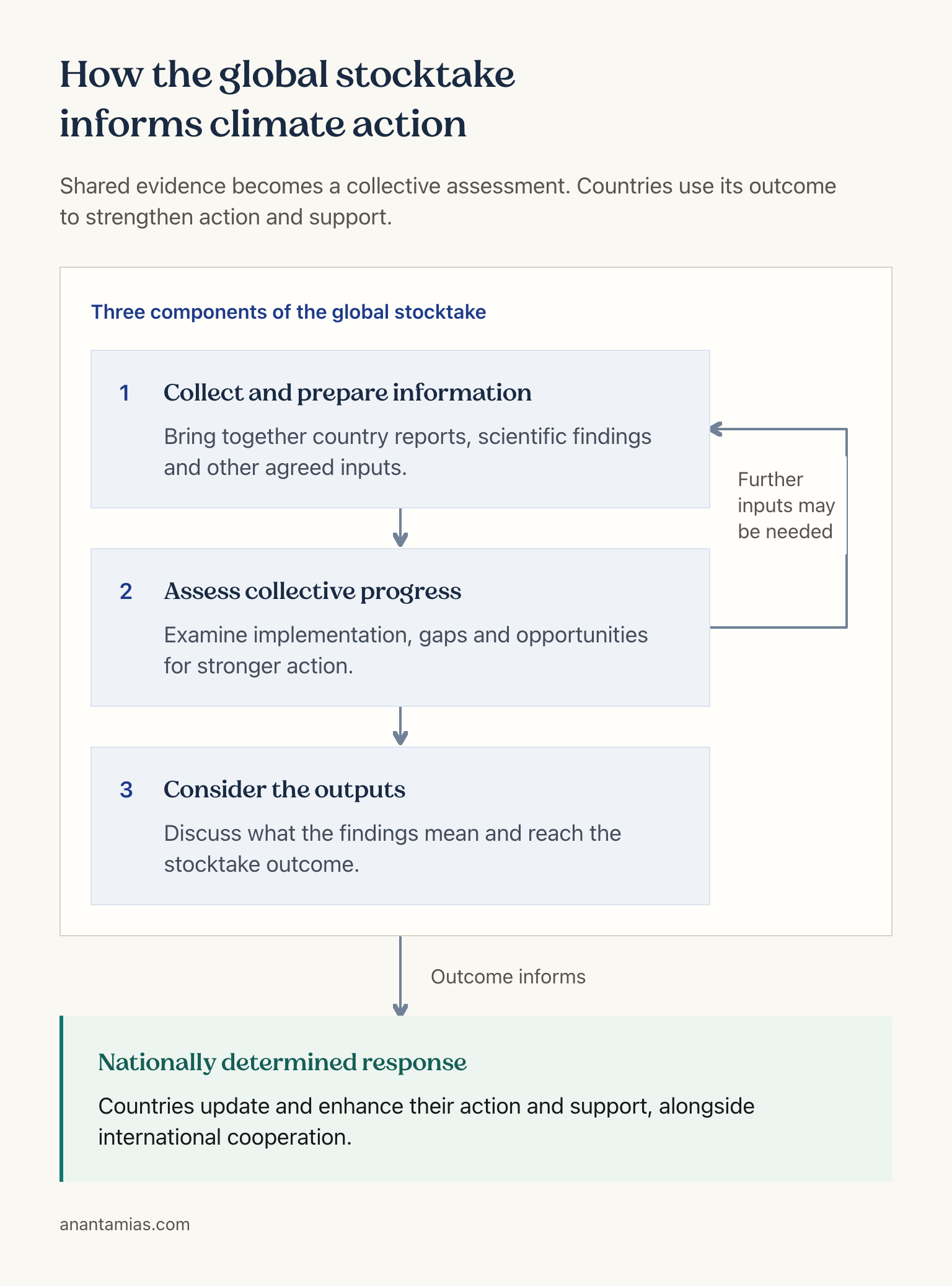
The process separates gathering evidence, assessing it and considering what the findings mean for subsequent action.
- Information collection and preparation gathers and synthesizes material for assessment. The UNFCCC GST2 outline places this work at the start of the process, before conclusions can be drawn from it.
- Technical assessment examines implementation and collective progress, including opportunities to improve action and support. It turns submitted material into an assessment of the overall situation rather than treating each announcement as a verified achievement.
- Consideration of outputs addresses the implications of technical findings. Parties discuss what the assessment means for the response; presenting evidence and agreeing on its political implications are related but distinct tasks.
- Nationally determined updates follow from the outcome informing countries’ actions and support. The stocktake provides common evidence and direction, while countries retain responsibility for shaping their own subsequent measures under the agreement.
- Feedback matters: information collection and technical work can interact, including requests for additional information. A simple flow describes their main relationship, but should not imply completely sealed stages with no exchange between them.
How to Read India's Intervention
India’s statement identifies priorities for the assessment; it does not establish that those priorities have already been accepted by all Parties.
- India sought recognition of implementation gaps alongside achievements. The useful question is whether reported action addresses identified needs, and what constraints remain, rather than whether the process produces another list of announcements.
- Transparency reports and NDCs serve different evidentiary roles: reported implementation helps assess progress, while pledges indicate intended action. Reading both can help expose a gap between plans and what has actually been delivered.
- India requested attention to developing-country science alongside IPCC assessments. Inclusion broadens the evidence considered; individual studies still need careful interpretation rather than being accepted solely because of where they originated.
- The earlier debate about delivery of climate commitments concerns performance. The stocktake’s distinctive role is organizing a collective assessment that can inform the next policy response.
- India’s separate just-transition proposal concerns an implementation arrangement. Keeping that proposal separate from the stocktake avoids confusing a suggested mechanism with the wider assessment of progress across the agreement.
Way Forward
Make Findings Usable
- Keep pledges, reported delivery and remaining needs distinguishable when preparing national submissions.
- Explain uncertainties and evidence gaps so technical findings remain traceable to their underlying material.
- Connect identified constraints with specific changes in action, support and international cooperation.
Conclusion
- The global stocktake links collective evidence with nationally determined improvement; its value depends on how countries use the findings.
- For GST2, distinguish India’s current negotiating priorities from the assessment process and from any eventual agreed outcome.
UPSC Practice Questions
Prelims MCQ 1
With reference to the global stocktake under the Paris Agreement, consider the following statements:
- It assesses collective progress towards the agreement’s purpose and long-term goals.
- Its scope includes adaptation and means of implementation and support.
- Its outcome informs Parties in updating actions in a nationally determined manner.
How many of the above statements are correct?
(a) Only one (b) Only two (c) All three (d) None
Answer: (c) All three
Explanation:
All three statements reflect Article 14. The stocktake is comprehensive and collective, and its outcome informs nationally determined updates.
Prelims MCQ 2
Which sequence best represents the main relationship among global stocktake components and their intended use?
(a) National penalties → individual compliance trials → replacement of all NDCs (b) Information preparation → technical assessment → consideration of outputs → informed national action (c) National target allocation → collection of fines → technical assessment (d) Political outcome → abolition of reporting → automatic emissions reductions
Answer: (b) Information preparation → technical assessment → consideration of outputs → informed national action
Explanation:
The three components organize evidence and findings to inform subsequent action. Collection and technical assessment can interact; the sequence does not imply perfectly isolated stages.
UPSC Mains Questions
- Explain how the global stocktake connects collective climate assessment with nationally determined action.
- Why should a global assessment of climate progress consider adaptation and implementation support alongside mitigation?
Sources: PIB, Ministry of Environment, Forest and Climate Change and UNFCCC.
Frequently Asked Questions
What is the second global stocktake?
It is the second collective assessment of progress under the Paris Agreement. The UNFCCC outlines a process beginning in November 2026 and concluding in November 2028, with findings intended to inform further action and support.
Does the stocktake assign a compulsory target to each country?
Its outcome informs Parties in updating and enhancing action and support in a nationally determined manner. It should not be described as an exercise that automatically allocates a new compulsory target to every country.
What are its main components?
They are information collection and preparation, technical assessment, and consideration of outputs. Together they connect evidence with discussion of its implications, which then informs national action and international cooperation.
Did India announce an agreed GST2 outcome at COP31?
No. The 18 November statement set out India’s priorities for an equitable, balanced and science-based assessment. It was a national intervention, not an announcement that the second stocktake had been completed.
Tell Google you want more of this.
Add Anantam IAS as a preferred sourceOne tap, and this site shows up more often in your own Top Stories, AI Overviews and AI Mode. Remove it any time.