Why in News?
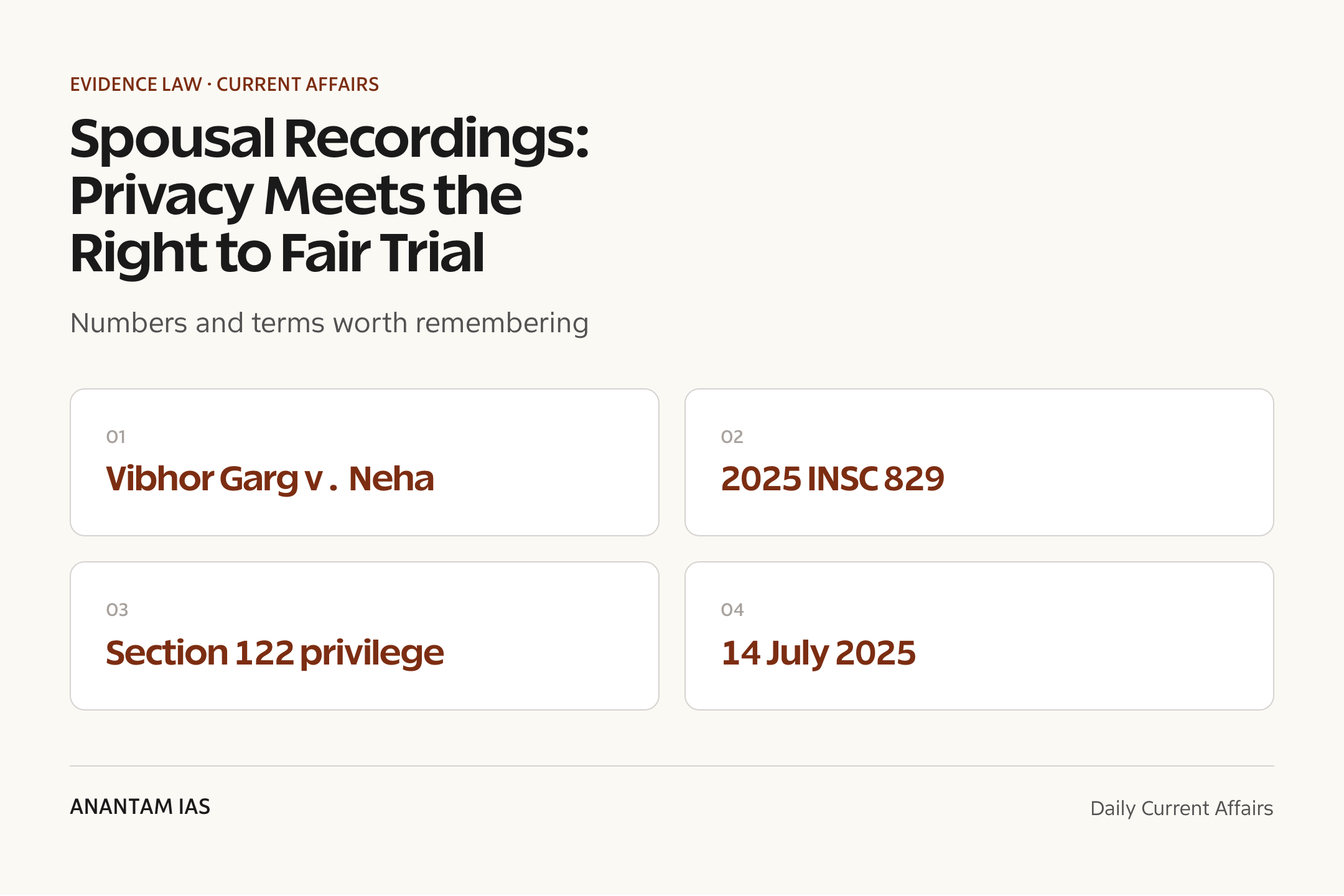
On 14 July 2025 the Supreme Court, in Vibhor Garg v. Neha, held that secretly recorded conversations between spouses are admissible as evidence in matrimonial proceedings, setting aside a Punjab & Haryana High Court order that had thrown out such recordings as a breach of the wife’s privacy.
The Bench of Justice B.V. Nagarathna (author) and Justice Satish Chandra Sharma read Section 122 of the Evidence Act as protecting the sanctity of marriage, not individual privacy, and ruled that the right to a fair trial allows a spouse to lead such evidence against the other.
- Citation 2025 INSC 829 (also reported as 2025 SCC OnLine SC 1421); appeal allowed, Family Court‘s order restored.
- The husband sought to file a supplementary affidavit with telephonic conversations stored on memory cards and a CD in a divorce petition under Section 13, Hindu Marriage Act, 1955.
- The High Court had held the recordings violated the wife’s right to privacy; the apex court disagreed.
- Court invoked the spouse-versus-spouse exception in Section 122 to lift the marital-communication bar.
- Held that evidence obtained unlawfully is not automatically inadmissible if relevant and authenticated under Section 65B.
The development matters in the context of:
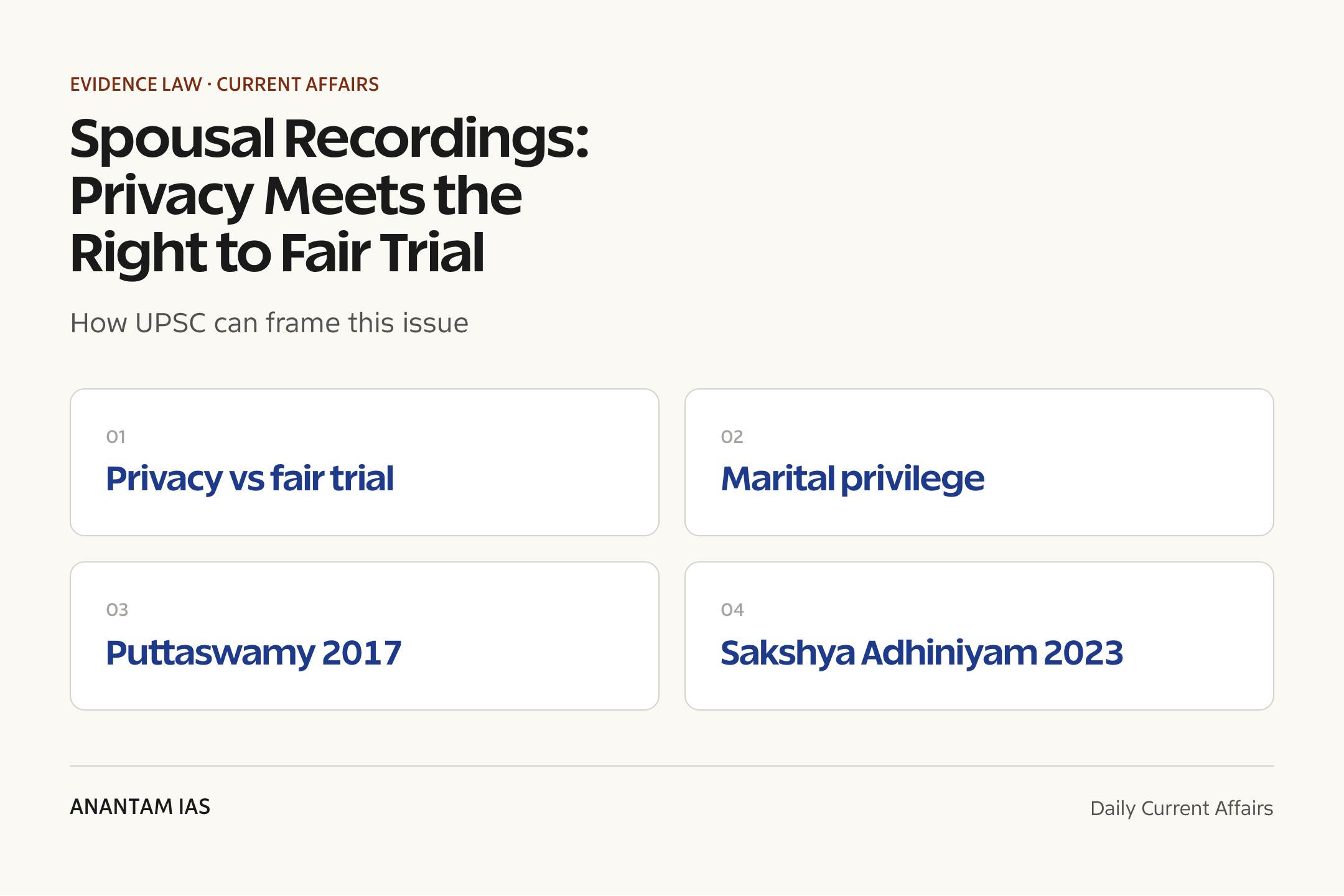
- Tests the reach of the privacy right recognised in K.S. Puttaswamy (2017) when it collides with a litigant’s fair-trial interest.
- Sharpens the older common-law rule that Indian evidence law cares about relevance, not the manner of collection.

UPSC Relevance
Prelims Relevance
- Section 122, Indian Evidence Act, 1872 — privilege over marital communications.
- Bharatiya Sakshya Adhiniyam, 2023 — successor to the Evidence Act; the privilege carries over as Section 128.
- Section 65B — admissibility and certification of electronic records.
- Section 13, Hindu Marriage Act, 1955 — grounds for divorce, including cruelty.
- K.S. Puttaswamy v. Union of India (2017) — right to privacy as a fundamental right under Article 21.
- Article 21 — life, personal liberty, and the implied right to a fair trial.
- Spouse-versus-spouse exception to marital privilege.
- Concept of illegally obtained evidence and its admissibility in Indian law.
- Author judge in this case — Justice B.V. Nagarathna.
Mains Relevance
GS Paper 2
- Balancing the fundamental right to privacy against the right to a fair trial in civil litigation.
- Judicial interpretation of statutory privilege and the transition from the Evidence Act to the Bharatiya Sakshya Adhiniyam.
GS Paper 1
- Privacy and autonomy within marriage as a social institution and its bearing on gender relations.
Essay
- Privacy is not a wall but a window the law decides when to open.
- Justice delayed by exclusion of truth versus justice corrupted by intrusion.
Background and Context
The dispute and the journey of the case
A contested divorce turned on whether covertly taped phone calls could be placed before the court.
- The couple married in 2009; a daughter was born in 2011; the husband filed for divorce in 2017 alleging cruelty.
- He sought to lead recordings of telephonic conversations spanning 2010 to 2016, stored on memory cards and a CD with transcripts.
- The Family Court, Bathinda allowed the supplementary affidavit; the Punjab & Haryana High Court reversed it on privacy grounds.
- The Supreme Court allowed the husband’s appeal and restored the Family Court’s order.
What Section 122 actually protects
The marital-communication privilege has two limbs, and a built-in exception that decided this case.
- Section 122 says a spouse cannot be compelled to disclose, and may not be permitted to disclose without consent, any communication made during marriage by the other spouse.
- First limb is compellability — no spouse can be forced to reveal such communication.
- Second limb is permissibility — voluntary disclosure normally needs the communicating spouse’s consent.
- The crucial exception: both bars fall away in litigation between the spouses themselves and in criminal cases of one spouse against the other.
- The Court read the section as guarding the sanctity of marriage, not creating a free-standing privacy right.
Privacy versus the right to a fair trial
The Bench framed the clash as statutory privilege against constitutional fair-trial interests.
- It held that Section 122 does not deal with privacy in the Article 21 sense; it is a rule of evidence about marital confidences.
- Once the spouse-versus-spouse exception applies, the privilege simply does not operate, so no privacy breach arises from admitting the material.
- The right to a fair trial — to lead relevant evidence and prove one’s case — was given weight against the privacy objection.
- The Court cautioned that unlawfully obtained evidence is treated with care, but is not barred merely because of how it was gathered.
Where this sits against Puttaswamy
The ruling narrows, but does not overrule, the privacy jurisprudence built since 2017.
- K.S. Puttaswamy (2017) made privacy a fundamental right, subject to reasonable restriction by a fair, just procedure.
- Here the restriction is the statutory exception in Section 122 read with the litigant’s fair-trial right.
- Critics worry the decision could normalise covert spousal surveillance and chill candid communication within marriage.
- Supporters argue matrimonial litigation is often a closed-door dispute where such evidence is the only proof of cruelty or conduct.
Electronic evidence and authentication
Even admissible recordings must clear the technical bar for electronic records.
- Audio recordings are electronic records; their admissibility runs through Section 65B of the Evidence Act.
- A valid Section 65B certificate and proof of integrity remain essential for the trial court to rely on the material.
- The Court flagged that relevance, reliability, and authentication — not the secret manner of capture — govern weight.
- Tampering, editing, or chain-of-custody gaps can still defeat such evidence at the trial stage.
The successor law — Bharatiya Sakshya Adhiniyam, 2023
The reasoning carries forward into the new evidence code that has replaced the 1872 Act.
- The Bharatiya Sakshya Adhiniyam, 2023 replaced the Indian Evidence Act, 1872 from 1 July 2024.
- The marital-communication privilege survives, substantially re-enacted as Section 128 of the new code.
- Electronic-record rules also continue, so the admissibility logic in this case applies under the new statute.
- The ruling so guides trial courts working with both the old Act (pending cases) and the new code.
Way Forward
Calibrate the privacy-evidence balance
- Trial courts should weigh relevance and reliability case by case, rather than auto-admit or auto-exclude covert recordings.
- Legislative or rule-making clarity on covert spousal recordings could reduce uncertainty across High Courts.
Tighten authentication safeguards
- Insist on strict Section 65B compliance and forensic verification to guard against doctored audio.
- Courts can use in-camera procedures to protect dignity while still examining the evidence.
Conclusion
The decision treats the marital-communication privilege as a shield for the institution of marriage, not a veto a spouse can use to hide relevant truth in a dispute against the other. Within the statutory exception, the fair-trial interest prevails.
The harder question lingers: how far covert recording can spread before it erodes trust within marriage. The ruling answers the narrow legal point and leaves the wider ethical and privacy debate, anchored in Puttaswamy, for another day.
UPSC Practice Questions
Prelims MCQ 1
With reference to Section 122 of the Indian Evidence Act, 1872, consider the following statements:
- It protects communications made between spouses during a valid marriage.
- The privilege applies even in litigation between the spouses themselves.
- It has been carried forward in substance into the Bharatiya Sakshya Adhiniyam, 2023.
How many of the above statements are correct?
(a) Only one (b) Only two (c) All three (d) None
Answer: (b) Only two
Explanation:
Statements 1 and 3 are correct. Statement 2 is wrong: the privilege does NOT apply in suits between the spouses themselves — that exception is exactly what the Supreme Court relied on in Vibhor Garg v. Neha (2025).
Prelims MCQ 2
The right to privacy was recognised as a fundamental right flowing primarily from which Article of the Constitution?
(a) Article 14 (b) Article 19 (c) Article 21 (d) Article 32
Answer: (c) Article 21
Explanation:
K.S. Puttaswamy v. Union of India (2017) located the right to privacy chiefly in Article 21 (life and personal liberty), read with other freedoms.
UPSC Mains Questions
- The decision in Vibhor Garg v. Neha (2025) admitting secretly recorded spousal conversations is said to subordinate the right to privacy to the right to a fair trial. Critically examine this balance in matrimonial litigation.
- Discuss how the transition from the Indian Evidence Act, 1872 to the Bharatiya Sakshya Adhiniyam, 2023 affects the law on marital-communication privilege and the admissibility of electronic evidence.
Sources: Supreme Court of India and SCC Online / Verdictum.
Frequently Asked Questions
What did the Supreme Court decide in July 2025?
In Vibhor Garg v. Neha (14 July 2025), the Supreme Court held that secretly recorded conversations between spouses are admissible in matrimonial proceedings. It set aside a Punjab & Haryana High Court order that had excluded such recordings as a breach of the wife’s privacy and restored the Family Court’s order.
What is Section 122 of the Evidence Act?
Section 122 is the marital-communication privilege. It bars a spouse from being compelled to disclose, or from voluntarily disclosing without consent, communications made by the other spouse during marriage. The privilege protects the sanctity of marriage and does not apply in disputes between the spouses themselves.
Does this ruling overturn the right to privacy?
No. The Court did not overrule the privacy right recognised in K.S. Puttaswamy (2017). It held that Section 122 is about marital confidences, not Article 21 privacy, and that in a spouse-versus-spouse case the fair-trial interest in leading relevant evidence prevails over the privacy objection.
Are such recordings automatically reliable in court?
No. Admissibility is only the first step. As electronic records, the recordings must satisfy Section 65B authentication, and the trial court still tests their relevance, integrity, and reliability. Tampered or unverifiable audio can be rejected on weight.
Does the Bharatiya Sakshya Adhiniyam change this?
Not in substance. The Bharatiya Sakshya Adhiniyam, 2023 replaced the 1872 Act from 1 July 2024 and re-enacts the marital-communication privilege as Section 128, along with the electronic-record rules. The reasoning in this case carries forward under the new code.
Why does this matter for UPSC?
It is a live constitutional-law issue balancing privacy, fair trial, and evidence law — relevant to GS-II (rights, judiciary), GS-I (society and marriage), and ethics. It also tests awareness of the new Bharatiya Sakshya Adhiniyam, 2023 and the Puttaswamy privacy framework.
Tell Google you want more of this.
Add Anantam IAS as a preferred sourceOne tap, and this site shows up more often in your own Top Stories, AI Overviews and AI Mode. Remove it any time.