Why in News?
China issued rules for the national nature reserve it created around Scarborough Shoal , known as Huangyan Dao in China and Bajo de Masinloc or Panatag Shoal in the Philippines.
- China approved the Huangyan Island National Nature Reserve in September 2025 and later published its area and functional zoning.
- China’s National Forestry and Grassland Administration listed a total reserve area of 3,523.67 hectares, comprising a core zone and an experimental zone, with the coral-reef ecosystem as the principal object of protection.
- The latest rules add an operational layer by identifying prohibited or permission-based activities inside the reserve framework.
- The Philippines contests China’s authority at the shoal and continues to rely on UNCLOS and the 2016 arbitral award.
- The development came alongside Chinese military drills near the shoal, making the combination of civil regulation and coercive presence especially significant.
- The dispute shows how a state can use domestic law, environmental administration and coast-guard enforcement to consolidate a claim without a formal change in internationally recognized title.
- It tests the practical value of UNCLOS dispute settlement when one party rejects an award but retains stronger operational control at sea.
- Restrictions on access directly affect traditional fishing communities, which the 2016 tribunal treated as having long-established fishing rights at the shoal.
UPSC Relevance
Prelims Relevance
- Scarborough Shoal is a contested coral atoll in the South China Sea, called Huangyan Dao by China and Bajo de Masinloc or Panatag Shoal by the Philippines.
- The dispute principally involves China and the Philippines; it is distinct from the separate but connected contests over features in the Spratly and Paracel groups.
- The United Nations Convention on the Law of the Sea entered into force in 1994 and provides the legal framework for maritime zones and dispute settlement.
- Under UNCLOS Article 57, an exclusive economic zone may extend up to 200 nautical miles from the relevant baselines.
- Under UNCLOS Article 121(3), rocks that cannot sustain human habitation or economic life of their own generate no EEZ or continental shelf.
- The 2016 tribunal held that Scarborough Shoal is a rock for Article 121(3), so the feature itself cannot generate an EEZ or continental shelf.
Mains Relevance
GS Paper 2
- The tension between rules-based maritime order and unilateral administrative action in a contested space.
- Limits of international adjudication when an award is legally authoritative but lacks direct enforcement machinery.
GS Paper 3
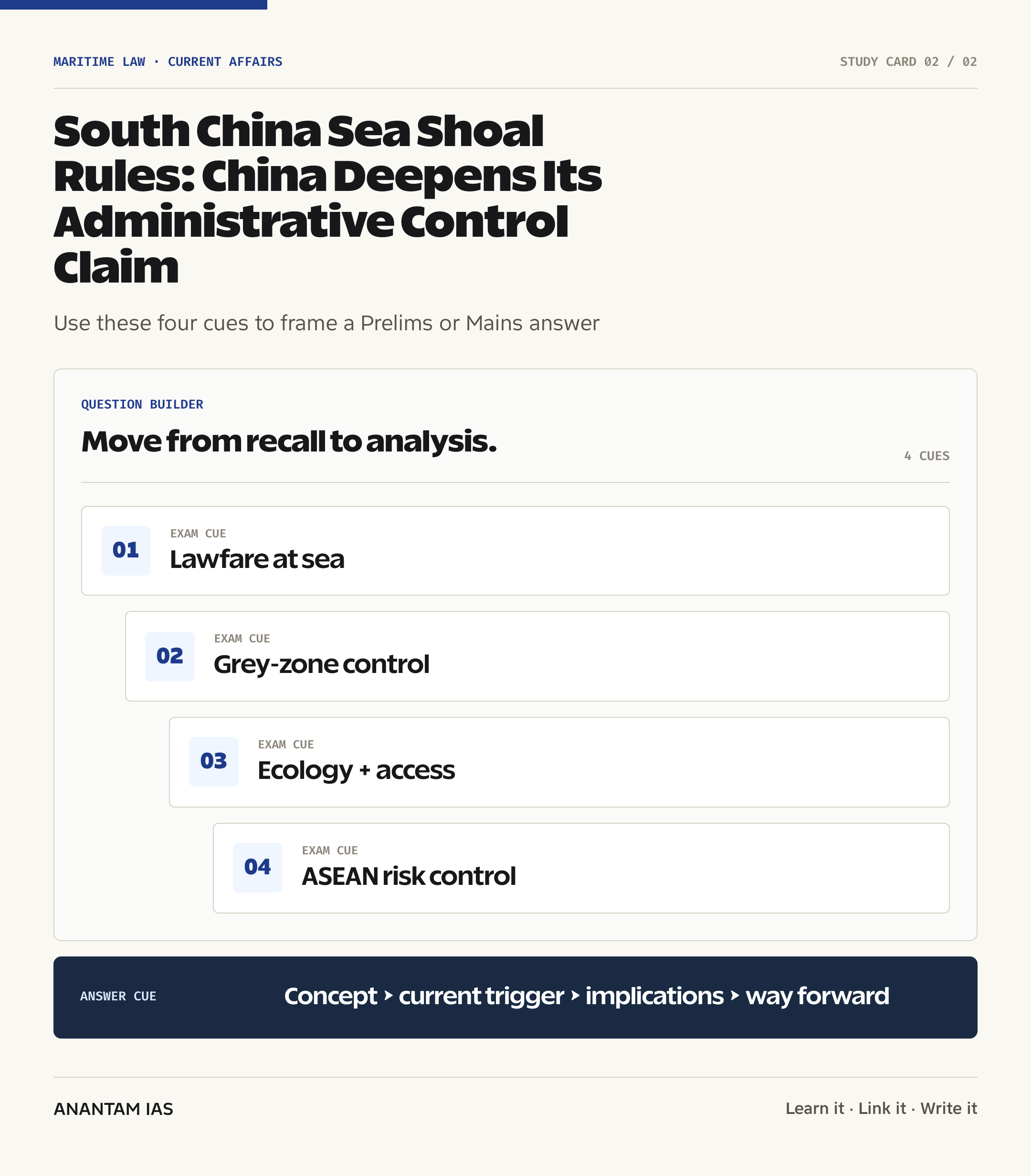
- Use of coast guards, fishing regulations and environmental rules as instruments of grey-zone strategy below the threshold of open war.
- Links among marine conservation, fisher livelihoods, maritime-domain awareness and regional security.
Essay
- Law without compliance: why legitimacy and enforcement capacity must reinforce each other.
Background and Context
Why Scarborough Shoal Matters
The shoal matters because geography, fisheries access and strategic position converge in one small maritime feature.
- Scarborough Shoal is a ring of reefs and rocks enclosing a lagoon in the South China Sea, west of the Philippine island of Luzon.
- It is a rich traditional fishing ground used over long periods by fishers from more than one nationality.
- Control of access allows a state to regulate fishing, scientific activity and navigation around the lagoon, converting physical presence into day-to-day authority.
- The shoal sits within a wider theatre that carries major commercial traffic and is central to the security calculations of China, ASEAN states and the United States.
- A 2012 standoff ended with China maintaining a persistent operational presence, while the Philippines continued to assert its claim through diplomacy, patrols and international law.
What the Reserve Framework Does
A conservation designation can perform ecological and strategic functions at the same time.
- China says the reserve protects the shoal’s coral-reef ecosystem and maintains ecological diversity, stability and sustainability.
- The published zoning identifies a core zone and an experimental zone, creating an administrative geography for differentiated control.
- Rules against unauthorized fishing, mining and coral harvesting can support genuine ecosystem protection, especially where destructive extraction has damaged reefs.
- But the authority to issue permits, inspect vessels and penalize violations presupposes a claim to jurisdiction. The Philippines rejects that presupposition.
- The key analytical point is not that conservation is illegitimate, but that a unilateral reserve cannot by itself resolve the prior question of sovereign title.
UNCLOS: Maritime Zones and Feature Status
UNCLOS separates sovereignty over land features from the maritime zones those features may generate.
- A coastal state may claim a territorial sea up to 12 nautical miles from lawful baselines and an EEZ up to 200 nautical miles, subject to UNCLOS rules.
- In an exclusive economic zone, the coastal state has sovereign rights over natural resources and jurisdiction over specified matters such as marine environmental protection; it does not possess full territorial sovereignty over the water column.
- Article 121 distinguishes islands capable of generating full maritime zones from rocks that cannot sustain human habitation or economic life of their own.
- The tribunal found that Scarborough Shoal’s high-tide features fall within Article 121(3). They can generate at most a territorial sea, not an EEZ or continental shelf of their own.
- That classification narrows possible maritime entitlements, but it does not answer which state owns the feature. Feature status and sovereignty are separate legal questions.
What the 2016 Arbitral Award Decided
The award is often described too broadly, so its actual holdings must be stated carefully.
- The Philippines initiated proceedings in 2013 under UNCLOS Annex VII; China’s decision not to participate did not stop the tribunal from examining jurisdiction and the merits.
- The tribunal held that UNCLOS left no legal basis for Chinese historic rights to resources beyond the maritime entitlements permitted by the Convention within the nine-dash line.
- It found that Filipino and Chinese fishermen, and potentially fishermen of other nationalities, had long exercised traditional fishing rights at Scarborough Shoal.
- The tribunal found that China unlawfully prevented Filipino fishermen from engaging in traditional fishing at the shoal after May 2012.
- It also addressed failures to protect the marine environment from destructive harvesting, linking ecological obligations with state responsibility for conduct at sea.
Way Forward
Protect Traditional Fishing Access
- China and the Philippines should adopt a practical arrangement that guarantees safe artisanal fishing access while prohibiting destructive methods.
- Patrol agencies should publish clear, multilingual rules and use graduated enforcement before detention or force, with special protection for small fishing vessels.
- Any interim arrangement should be expressly without prejudice to the competing sovereignty claims.
Conclusion
- China’s Scarborough Shoal rules show how administrative regulation can shape a maritime dispute as powerfully as a naval deployment.
- The durable answer is not to choose between ecology and law.
- For India and ASEAN, the lesson is clear: a rules-based Indo-Pacific needs both sound legal principles and practical mechanisms that reduce incidents, preserve access and make coercive faits accomplis harder to normalize.
UPSC Practice Questions
Prelims MCQ 1
With reference to Scarborough Shoal and the 2016 South China Sea arbitral award, consider the following statements:
- The tribunal held that Scarborough Shoal is a rock under Article 121(3) of UNCLOS.
- The tribunal awarded sovereignty over Scarborough Shoal to the Philippines.
- The tribunal recognized traditional fishing rights at the shoal.
How many of the above statements are correct?
(a) Only one (b) Only two (c) All three (d) None
Answer: (b) Only two
Explanation:
Statements 1 and 3 are correct. The tribunal classified the feature under UNCLOS Article 121(3) and recognized traditional fishing rights. It did not decide territorial sovereignty over the shoal.
Prelims MCQ 2
Which one of the following best describes a coastal state’s exclusive economic zone under UNCLOS?
(a) An area of complete territorial sovereignty extending 200 nautical miles (b) An area where no other state enjoys freedom of navigation (c) A maritime zone of sovereign rights over resources and specified jurisdiction, extending up to 200 nautical miles (d) A zone generated by every low-tide elevation regardless of location
Answer: (c) A maritime zone of sovereign rights over resources and specified jurisdiction, extending up to 200 nautical miles
Explanation:
Under UNCLOS Articles 55-57, the EEZ is a specific legal regime. It grants resource-related sovereign rights and specified jurisdiction, while preserving relevant rights of other states, including navigation and overflight.
UPSC Mains Questions
- China’s Scarborough Shoal nature-reserve rules illustrate how environmental administration can become an instrument of grey-zone strategy. Examine the interaction among domestic regulation, coast-guard enforcement, traditional fishing rights and UNCLOS in this dispute.
- The 2016 South China Sea arbitral award clarified maritime entitlements but did not settle sovereignty or ensure compliance. Discuss the legal significance and practical limitations of international adjudication in managing the China-Philippines dispute.
Sources: Permanent Court of Arbitration, South China Sea Arbitration Award and The Hindu.
Frequently Asked Questions
Where is Scarborough Shoal?
Scarborough Shoal is a coral atoll in the South China Sea, west of Luzon in the Philippines. China calls it Huangyan Dao, while the Philippines calls it Bajo de Masinloc or Panatag Shoal. Both countries claim the feature, and.
What do China’s new shoal rules restrict?
The rules reported in August 2026 restrict activities including unauthorized fishing, mining and coral harvesting within China’s nature-reserve framework. The measures are presented as ecological protection, but their enforcement also asserts China’s claimed authority to regulate access and conduct.
Did the tribunal award the shoal to the Philippines?
No. The 2016 arbitral tribunal decided issues concerning maritime entitlements, traditional fishing and the lawfulness of certain conduct under UNCLOS. It did not determine territorial sovereignty over Scarborough Shoal and did not delimit a maritime boundary between China and the.
Can Scarborough Shoal generate an EEZ?
No. The tribunal classified Scarborough Shoal’s high-tide features as rocks under Article 121(3) of UNCLOS. Such rocks may generate a territorial sea, but they cannot generate an exclusive economic zone or continental shelf of their own.
What are traditional fishing rights there?
The tribunal found that fishermen from the Philippines, China and potentially other states had long used the shoal as a traditional fishing ground. It held that China unlawfully prevented Filipino fishermen from exercising those rights after May 2012, while.
Tell Google you want more of this.
Add Anantam IAS as a preferred sourceOne tap, and this site shows up more often in your own Top Stories, AI Overviews and AI Mode. Remove it any time.