Why in News?
Defence Research and Development Organisation (DRDO) and the Indian Air Force (IAF) successfully conducted the maiden flight-trial of Tactical Advanced Range Augmentation (TARA) weapon off the coast of Odisha.
| UPSC Relevance: GS-3 Science and Technology: Defence Technology Prelims: Tactical Advanced Range Augmentation (TARA) weapon |
Tactical Advanced Range Augmentation (TARA):
- TARA is India’s first indigenous glide weapon system that converts ordinary unguided air-dropped bombs into precision-guided weapons.
- Aim: To enhance the lethality and accuracy of a low-cost weapon to neutralise ground-based targets.
- It has been designed and developed by the Research Centre Imarat, Hyderabad, along with other DRDO laboratories.
How does TARA work?
- Once an aircraft releases a TARA-fitted munition, the system deploys folding wings and aerodynamic surfaces to generate lift, enabling the weapon to glide well beyond normal free-fall range.
- Onboard GPS/INS-based guidance steers it precisely to a ground-based target. Thus, instead of falling directly like a conventional bomb, it can:
- Travel much farther and strike with greater precision.
- Allow aircraft to attack targets from safer stand-off distances.
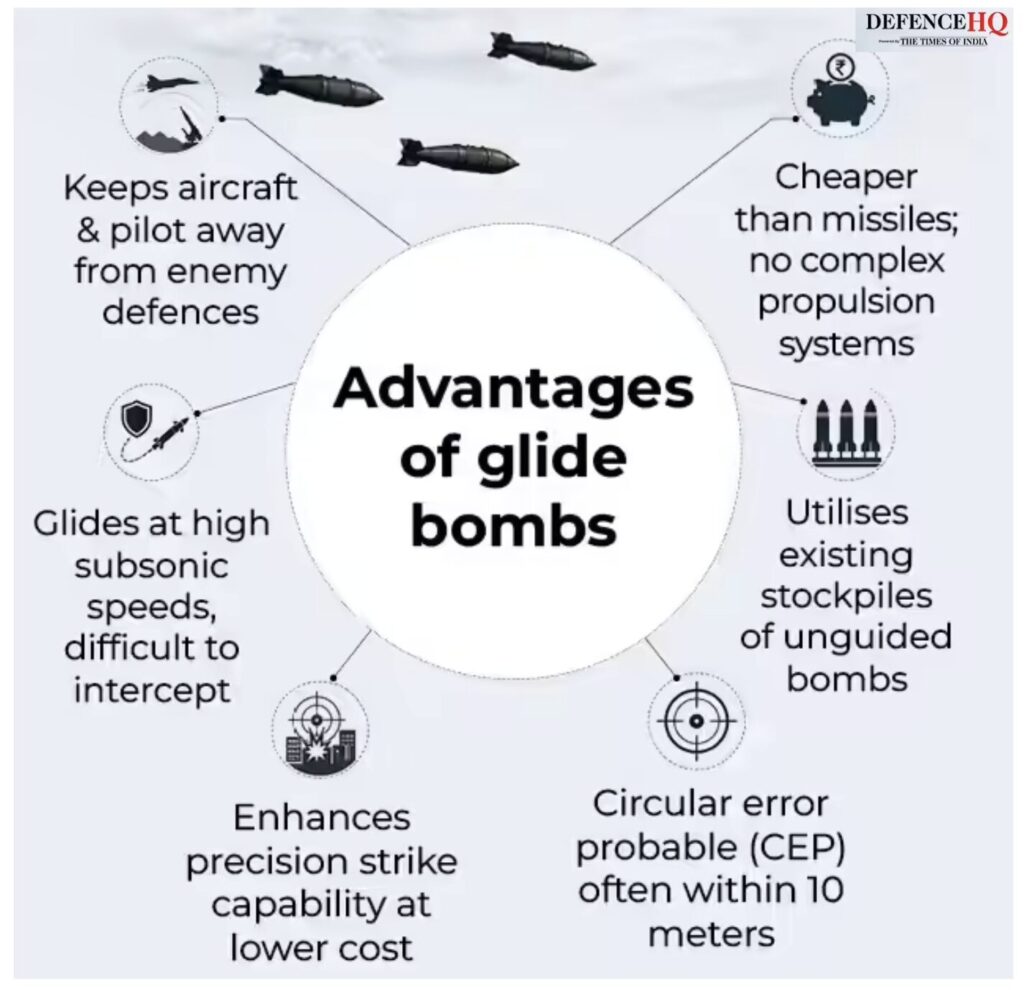
| What are Glide Weapons? Glide weapons are air-launched munitions fitted with guidance systems, folding wings/fins, and navigation kits. Unlike traditional bombs, they glide toward targets after release instead of falling vertically. Advantages: Stand-off attack capability Reduced the exposure of aircraft to enemy air defence Improved accuracy Lower cost compared to missiles. |
Why is TARA significant for India?
- Boosts Indigenous defence capability: TARA represents a major step toward defence self-reliance and Indigenous military modernisation.
- Cost-Effective Precision Warfare: Instead of manufacturing expensive missiles, India can upgrade existing ordinary unguided bombs into smart weapons. This improves strike accuracy at a lower cost.
- Enhanced Stand-Off Capability: Aircraft can release the weapon from safer distances, reducing vulnerability to Surface-to-air missiles and enemy interception.
Practice MCQ:
Q. With reference to Tactical Advanced Range Augmentation (TARA), consider the following statements:
1. TARA is India’s first indigenous glide weapon system.
2. It converts unguided bombs into precision-guided weapons.
3. It is developed by the Research Centre Imarat under DRDO.
Which of the statements given above are correct?
(a) 1 and 2 only
(b) 2 and 3 only
(c) 1 and 3 only
(d) 1, 2 and 3
Answer: (d)
UPSC PYQ 2022:
Q. Which one of the following statements best reflects the idea behind the “Fractional Orbital Bombardment System” often talked about in the media?
(a) A hypersonic missile is launched into space to counter the asteroid approaching the Earth and explode it in space
(b) A spacecraft lands on another planet after making several orbital motions
(c) A missile is put into a stable orbit around the Earth and de-orbits over a target on the Earth
(d) A spacecraft moves along a comet with the same speed and places a probe on its surface
Answer: (c)
Tell Google you want more of this.
Add Anantam IAS as a preferred sourceOne tap, and this site shows up more often in your own Top Stories, AI Overviews and AI Mode. Remove it any time.