

The Ministry of Coal in late April 2026 signed contracts for four coal blocks with explicit Underground Coal Gasification provisions, opening up a route to extract energy from coal seams that conventional mining can’t reach. The decision matters because it bets on technology, not just geology, and it could shrink India’s import bill for fertilizer feedstock and natural gas if the pilots scale.
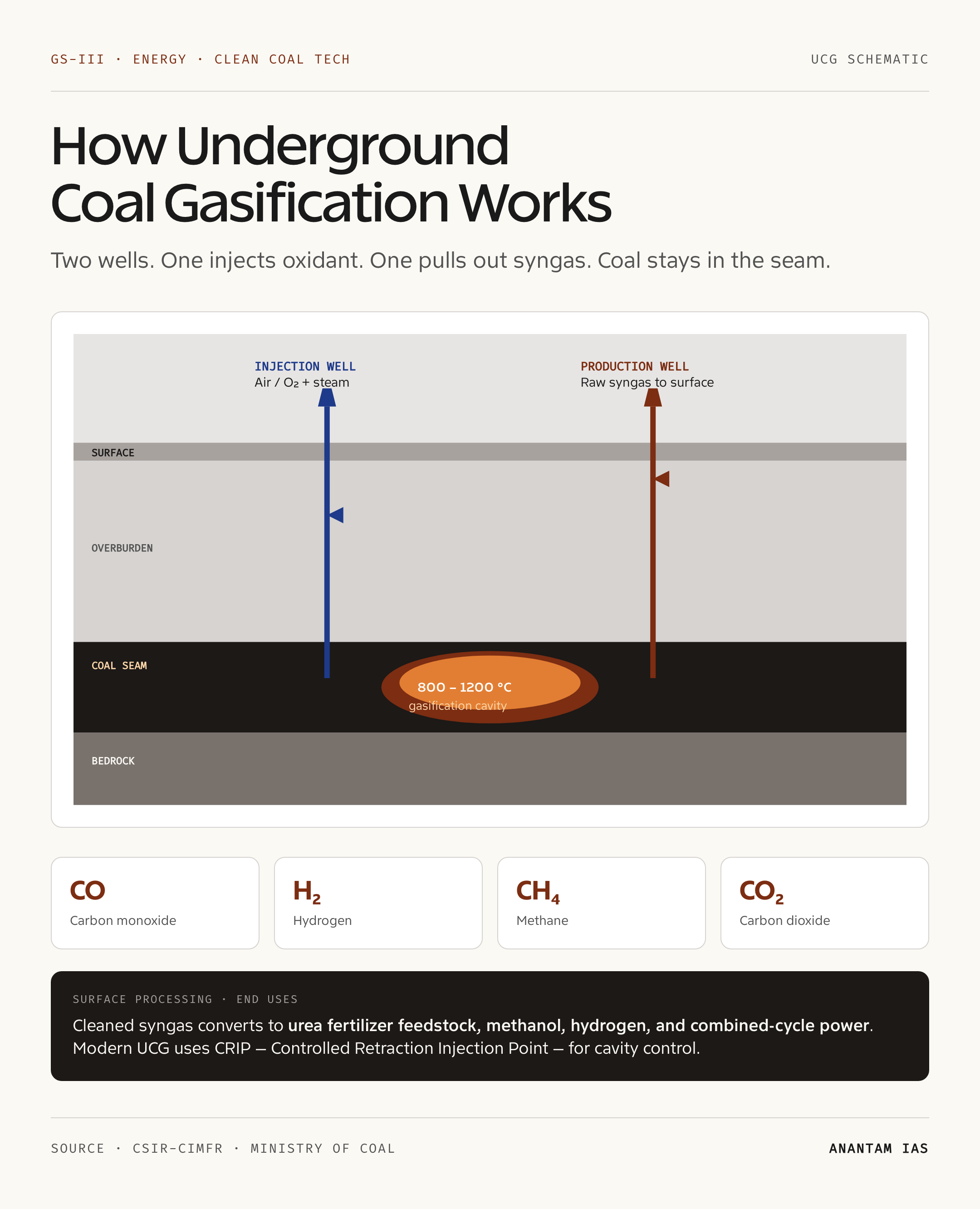
Underground Coal Gasification, or UCG, converts coal into syngas while the coal is still in the ground. No open-cast pit, no underground galleries, no coal handling on the surface. Two wells go down, one to inject air or oxygen and steam, another to pull out the resulting syngas, a mix of hydrogen, carbon monoxide, methane, and CO2. Surface plants then clean and convert the syngas into fertilizer feedstock, methanol, hydrogen, or power.
For UPSC, Underground Coal Gasification touches at least four GS-III strands: energy security, coal sector reforms, clean energy transition, and the environmental tradeoff debate around fossil fuels.
Quick Facts at a Glance
- Announcement window: April 24-26, 2026
- Ministry: Ministry of Coal
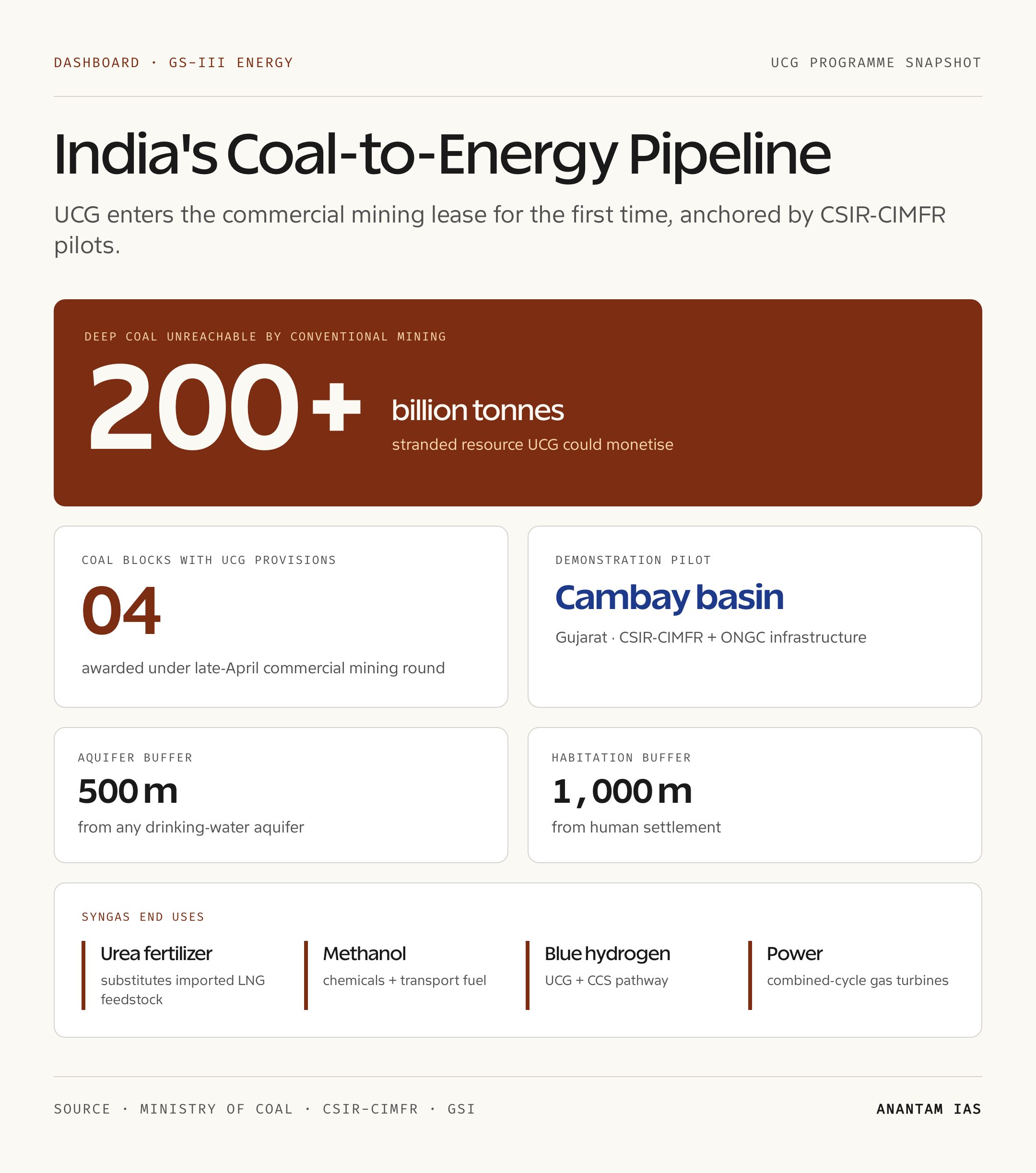
- Coal blocks signed: 4 (with embedded UCG provisions in the mining lease)
- Pilot research lead: CSIR-Central Institute of Mining and Fuel Research (CIMFR), Dhanbad
- Pilot site under study: Cambay basin (Gujarat) and select blocks in Eastern Coalfields
- Indian deep coal reserves estimated unsuitable for conventional mining: roughly 200+ billion tonnes
- Syngas end uses: fertilizer urea feedstock, methanol, hydrogen, combined-cycle power
- Global pioneers: Soviet Union (1930s), Australia (Linc Energy, 2000s), USA (1970s)
- Lead nodal R&D: Department of Scientific and Industrial Research and Coal Ministry’s UCG division
What Just Happened
Coal India and the Coal Ministry awarded four coal blocks under the commercial coal mining round with mining lease conditions that permit and encourage UCG, not just conventional extraction. The four blocks include deep-seated seams where conventional underground mining is uneconomical because of depth (more than 600 metres) or because the coal is interbedded with too much non-coal rock to mine cleanly.
The lease language is the new bit. Earlier rounds treated UCG as a separate licensing track. The April 2026 round merges UCG rights into the standard commercial mining lease, so the licensee can pick the extraction technology that fits each seam. That’s a meaningful policy unlock.
Alongside, the Coal Ministry indicated it would expand CSIR-CIMFR’s pilot programme. CIMFR has been working on Indian coal-specific gasification chemistry since the 2000s and ran a small-scale pilot with Reliance in the Cambay basin. The new push allocates dedicated central funds for a 1-2 MW equivalent demonstration plant.
Background and Historical Context
UCG is one of the oldest “future” technologies. Sir William Siemens proposed the underground gasification of coal in 1868. The Soviet Union ran the first commercial-scale UCG facility at Lisichansk in the 1930s. The technology has worked in pockets ever since. It hasn’t scaled because every coal seam behaves differently, the chemistry is sensitive, and the environmental risks (groundwater contamination, surface subsidence) demand careful site selection.
India’s interest in Underground Coal Gasification has tracked its energy anxiety. The first serious push came in the late 1980s under the Department of Coal, then went quiet through the 1990s. Interest revived around 2007 when ONGC and GAIL studied UCG potential at Vastan in Gujarat. Reliance, working with CIMFR, ran lab and field trials in the Cambay basin between 2010 and 2014 with mixed results. The economics were unfavourable when imported LNG was cheap, and UCG slipped into the long-tail R&D bucket.
The April 2026 push reflects a changed cost environment. LNG prices have stayed structurally elevated since 2022. India imports almost half its natural gas, much of which feeds the urea fertilizer cycle. Domestic coal-based syngas, if produced cleanly, becomes attractive again. The Coal Ministry has been signalling for two years that UCG is a strategic option for energy security alongside conventional coal sector reforms.
The bigger context is India’s deep coal problem. The Geological Survey of India estimates roughly 200 billion tonnes of Indian coal sit at depths or in geological conditions where current mining cannot extract them economically. That stranded resource, mostly in eastern peninsular India and parts of Gujarat and Rajasthan, is the prize Underground Coal Gasification is trying to unlock.
Key Provisions and Features of the New UCG Push
The new framework has five operative features.
- Unified mining lease. A single lease can authorise both conventional mining and UCG on the same block, with the licensee choosing per seam.
- Royalty parity. UCG syngas royalty is benchmarked against equivalent thermal coal royalty, calculated on energy content (GCV-based).
- CSIR-CIMFR concurrent oversight. All pilots must share environmental monitoring data, including groundwater quality, with CIMFR for a national database.
- Buffer zones. Mandatory 500-metre safety buffer from any aquifer used for drinking water and a 1,000-metre buffer from human habitation.
- Carbon capture readiness. New pilots must include design space for future post-combustion or pre-combustion CO2 capture, even if capture isn’t installed at day one.
The lease also includes a use-it-or-lose-it clause: if UCG provisions are not actioned within five years, they revert to conventional mining only.
Why It Matters: Energy Security and the Fertilizer Link
The blunt reason Underground Coal Gasification matters for India is fertilizer.
Roughly 75% of India’s nitrogenous fertilizer (mainly urea) is made from natural gas. Domestic gas covers part of the demand; the rest is imported as LNG, which is volatile and dollar-denominated. Coal-derived syngas can substitute gas as urea feedstock through a methanation pathway. CIL has already moved one fertilizer revival project (Talcher Fertilizers) to surface coal gasification feedstock. UCG is a step beyond surface gasification, because it doesn’t require mining the coal first.
The second reason is power. India’s strategic petroleum reserves protect against oil shocks but do nothing for gas. UCG-derived syngas can run combined-cycle gas turbines as a peak-load source, although the economics here depend heavily on carbon pricing.
The third reason is hydrogen. UCG with carbon capture is one of the cheaper “blue hydrogen” pathways, in principle competitive with natural gas reforming if CO2 capture costs come down. India’s green hydrogen mission currently focuses on electrolysis, but blue hydrogen from UCG could be a transitional bridge.
Detailed Analysis
The Chemistry, Briefly
A UCG well injects oxidant (air, oxygen, or oxygen-steam) into the coal seam. Combustion at the cavity face raises temperatures to 800-1,200°C. At those temperatures, coal pyrolyses and reacts with steam and CO2 to release a syngas mix dominated by CO, H2, CH4, and CO2. A second well some tens of metres away pulls the syngas to surface, where it is cleaned of tar, sulphur, and particulate, and then converted.
The cavity grows as coal is consumed. Managing cavity growth is the engineering hard part. If the cavity grows uncontrollably, surface subsidence rises and groundwater can intrude. The Linc Energy Australia case and the Soviet Lisichansk site both struggled with cavity control over decades.
The Cambay Basin Pilot
The Cambay basin in Gujarat hosts coal at depths beyond conventional mining economics, with relatively favourable hydrogeology. CIMFR’s earlier work there established baseline data on coal rank, ash content, and overburden permeability. The new pilot is expected to use a controlled retraction injection point (CRIP) configuration, which is the modern UCG method, and operate for a 6-12 month campaign before scaling.
Cambay also has existing oil and gas infrastructure, which means syngas can plug into surface processing more cheaply than greenfield sites in eastern coalfields.
Environmental Tradeoffs
UCG is not a free lunch.
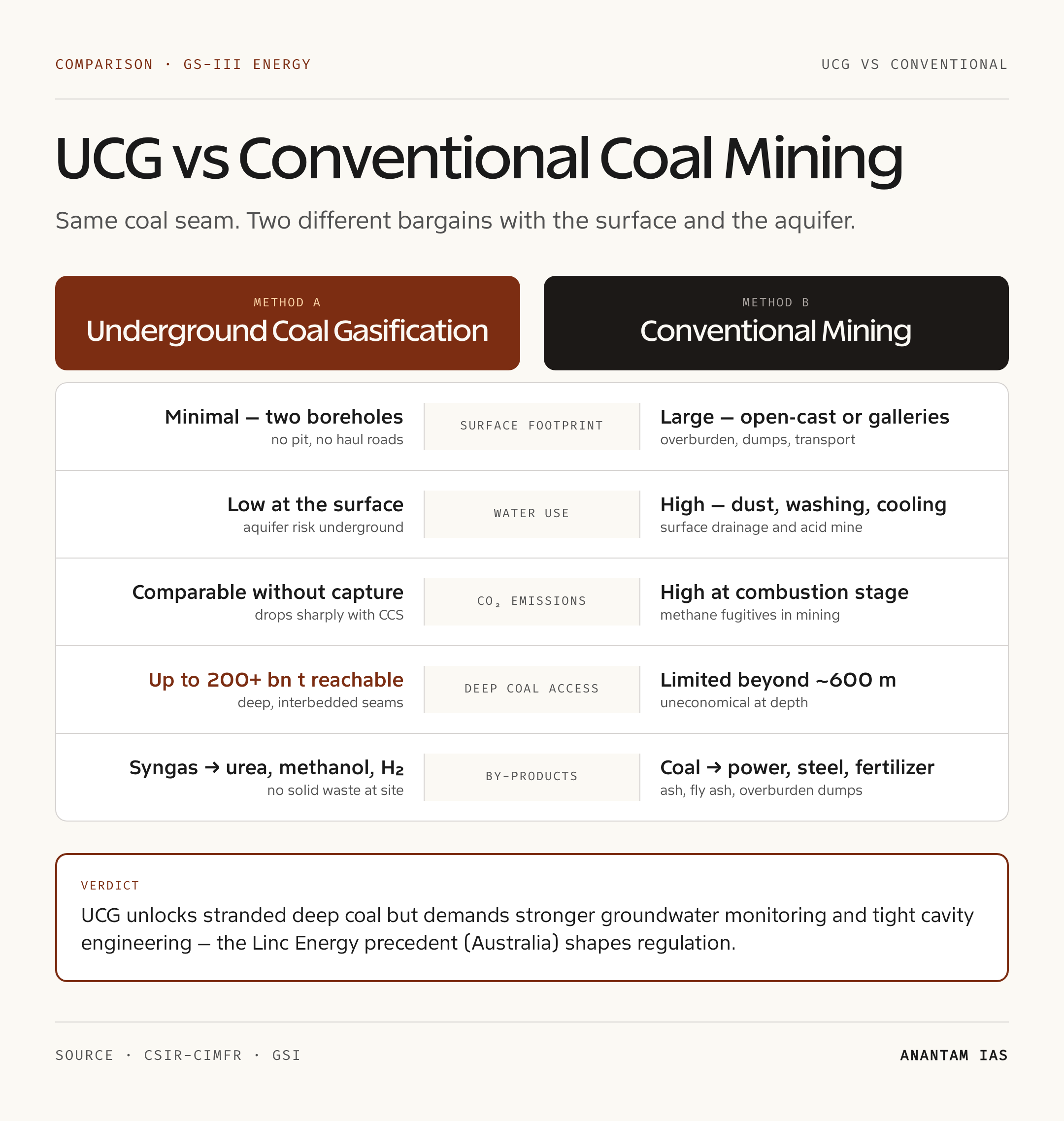
Groundwater risk. Combustion produces phenols, benzenes, polycyclic aromatic hydrocarbons, and other organics that can leach through fractured rock if cavity pressure isn’t carefully managed. The Linc Energy case in Queensland led to soil and groundwater contamination charges and shaped global UCG regulation thereafter.
Surface subsidence. Cavity collapse can cause measurable subsidence above the seam, problematic in agricultural land or near infrastructure.
Carbon footprint. Without carbon capture, UCG-derived energy emits roughly the same CO2 as conventional coal use, sometimes a touch less because of higher conversion efficiency. With carbon capture, emissions can drop sharply, but capture is expensive.
Air quality. Surface processing of raw syngas involves volatile organics. Plant design must account for emissions far stricter than typical coal handling.
These risks are why the buffer zones and CIMFR oversight are non-negotiable in the new framework.
Comparing UCG with Surface Gasification
Surface coal gasification (SCG) requires mining coal first, which means surface footprint, transport, and waste disposal. UCG eliminates those. But SCG is engineering-mature, with hundreds of working units globally. UCG has a much smaller operational base. India is likely to run both pathways in parallel through 2030, with SCG carrying the bulk of fertilizer feedstock load and UCG operating as deep-resource demonstration.
Comparative Perspective
China runs the world’s largest UCG demonstration programme. Multiple commercial-scale UCG plants operate in Inner Mongolia and Xinjiang, primarily for syngas to fuel chemical complexes. The Chinese model is state-led and relatively willing to absorb environmental compliance costs.
Australia’s UCG history is cautionary. Linc Energy’s Chinchilla project ran for over a decade and produced significant data, but environmental violations led to court action and the closure of UCG in Queensland. Western Australia and other states have taken a more permissive view, but commercial scale-up has been slow.
The United States has run UCG trials since the 1970s under the Department of Energy. Nothing reached commercial scale, but the engineering literature from Hoe Creek, Rocky Mountain, and other pilots underpins much of modern CRIP design.
South Africa’s Eskom ran a UCG pilot at Majuba power station to feed an existing coal plant with low-cost syngas, with mixed results.
Challenges and Critiques
The UCG critique falls into three buckets.
One, climate locking. Critics argue UCG entrenches fossil-fuel infrastructure for decades and risks crowding out genuine renewable investment. The counter is that India’s industrial heat and fertilizer feedstock demand cannot be electrified at scale before 2040, and UCG with capture is cleaner than imported LNG with leaked methane.
Two, technology risk. Each seam is bespoke. Cavity dynamics, water inflow, and gas quality vary by metres of strata. Scaling from pilot to commercial-scale, like 100 MW equivalent, has tripped up almost every UCG programme worldwide.
Three, regulatory capacity. UCG environmental monitoring requires combined groundwater, soil, and air expertise across district, state, and central regulators. India’s environmental regulatory architecture is stretched. Without strong enforcement, the Linc Energy outcome is plausible at scale.
UPSC Prelims Pointers
- UCG converts coal to syngas in situ, without mining the coal.
- Syngas is mainly CO, H2, CH4, CO2.
- Modern UCG uses CRIP (Controlled Retraction Injection Point) wells.
- India’s lead R&D body for UCG: CSIR-CIMFR, Dhanbad.
- Cambay basin (Gujarat) is a leading pilot site.
- Syngas can substitute natural gas in urea fertilizer manufacture (methanation pathway).
- Mandatory buffers under April 2026 framework: 500 m from drinking aquifer, 1,000 m from habitation.
- Royalty under new framework is GCV-based, parity with thermal coal.
- Linc Energy (Queensland, Australia) is the cautionary international case.
- China is the largest commercial UCG operator globally.
Mains Practice Questions
- “Underground Coal Gasification offers India a route to monetise stranded coal reserves while reducing fertilizer import dependence.” Critically examine the techno-economic and environmental tradeoffs. (GS-III, 250 words)
- Discuss the role of CSIR-CIMFR and other research institutions in indigenising clean coal technologies. (GS-III, 150 words)
- Compare Underground Coal Gasification and surface coal gasification as pathways to syngas-based industry in India. (GS-III, 150 words)
- Evaluate the regulatory architecture required to govern UCG safely in India, drawing lessons from international experience. (GS-II / GS-III, 250 words)
Way Forward
Three steps would let India’s UCG bet pay off.
One, run the Cambay pilot transparently with public data on groundwater and emissions. The legitimacy of the entire programme depends on that single demonstration.
Two, build a UCG-specific environmental clearance track at the central level, separate from generic mining EIA, with mandatory third-party audits.
Three, link UCG to fertilizer feedstock demand explicitly. Without an off-take certainty, no licensee will sink the capex.
Underground Coal Gasification is not the silver bullet of India’s energy transition. But for stranded deep coal, it is the only credible large-scale option short of leaving the resource buried. The April 2026 contracts have started the clock. The next 24 months of pilot data will decide whether UCG becomes a genuine pillar or stays a 60-year-old promise.
Frequently Asked Questions
What is Underground Coal Gasification?
Underground Coal Gasification is a process that converts coal into syngas in situ, without mining. Two wells (an injection well and a production well) are drilled into the coal seam. Oxidant injected into one well combusts and pyrolyses the coal, producing syngas that is collected from the second well.
What are the main components of UCG syngas?
Carbon monoxide (CO), hydrogen (H2), methane (CH4), and carbon dioxide (CO2), plus minor amounts of nitrogen and water vapour. The exact mix depends on coal rank, oxidant ratio, and operating temperature.
Why is Underground Coal Gasification relevant to India now?
India has an estimated 200+ billion tonnes of coal that conventional mining cannot reach economically. UCG can monetise that stranded resource. It also offers an alternative to imported LNG as a feedstock for urea fertilizer manufacture.
Which institution leads UCG research in India?
CSIR-Central Institute of Mining and Fuel Research (CIMFR), Dhanbad. CIMFR has run laboratory studies and limited field pilots, including in the Cambay basin in Gujarat.
What environmental risks does UCG pose?
Groundwater contamination from organic compounds (phenols, PAHs), surface subsidence over the gasification cavity, and CO2 emissions if not paired with carbon capture. Strict buffer zones from aquifers and habitation are mandatory under the April 2026 framework.
How does Underground Coal Gasification differ from surface coal gasification?
Surface gasification requires mining and transporting coal first, then gasifying it in a surface reactor. UCG eliminates the mining step but requires careful subsurface engineering and is harder to control. Surface gasification is engineering-mature; UCG is still mostly demonstration-scale globally.
What is CRIP in UCG?
CRIP stands for Controlled Retraction Injection Point. It is a modern UCG method where the injection point is moved backward along a horizontal well as coal is consumed, giving better cavity control and gas quality.
Can UCG produce hydrogen for India’s clean energy mission?
Yes. UCG syngas, when combined with carbon capture and a water-gas shift reaction, can yield “blue hydrogen” with significantly lower lifecycle emissions than uncaptured pathways. This positions UCG as a transitional bridge alongside green electrolysis hydrogen.
Tell Google you want more of this.
Add Anantam IAS as a preferred sourceOne tap, and this site shows up more often in your own Top Stories, AI Overviews and AI Mode. Remove it any time.
