India is making rapid strides in renewable energy, its progress is heavily constrained by lack of climate finance. The government and private sector must expand financing mechanisms like green bonds, carbon markets, and institutional investments to ensure India meets its 2030 climate targets.
UPSC Relevance:
Climate change, Climate Finance, Carbon Market, Renewable energy etc.
UPSC PYQ:
Q.1 In the context of India’s preparation for Climate-Smart Agriculture, consider the following statements: (2021)
The ‘Climate-Smart Village’ approach in India is a part of a project led by the Climate Change, Agriculture and Food Security (CCAFS), an international research programme.
The project of CCAFS is carried out under Consultative Group on International Agricultural Research (CGIAR) headquartered in France.
The International Crops Research Institute for the Semi-Arid Tropics (ICRISAT) in India is one of the CGIAR’s research centres.
Which of the statements given above are correct?
(a) 1 and 2 only
(b) 2 and 3 only
(c) 1 and 3 only
(d) 1, 2 and 3
Q.1 Describe the major outcomes of the 26th session of the Conference of the Parties (COP) to the United Nations Framework Convention on Climate Change (UNFCCC). What are the commitments made by India in this conference? (2021)
Q.2 ‘Climate Change’ is a global problem. How will India be affected by climate change? How Himalayan and coastal states of India be affected by climate change? (2017)
Major highlights of the editorial:
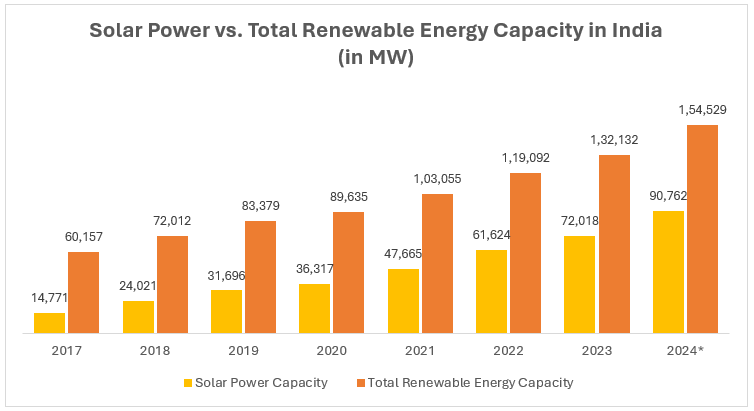
India’s clean energy transition is gaining momentum. In 2024, India added 24.5 gigawatts (GW) of solar energy capacity, making it the third largest contributor globally after China and the United States, making it a key player in the global shift towards renewables.
India has officially surpassed Japan to become the world’s third-largest solar power producer. According to the International Renewable Energy Agency (IRENA), India generated an impressive 1,08,494 GWh of solar energy, leaving Japan behind at 96,459 GWh.
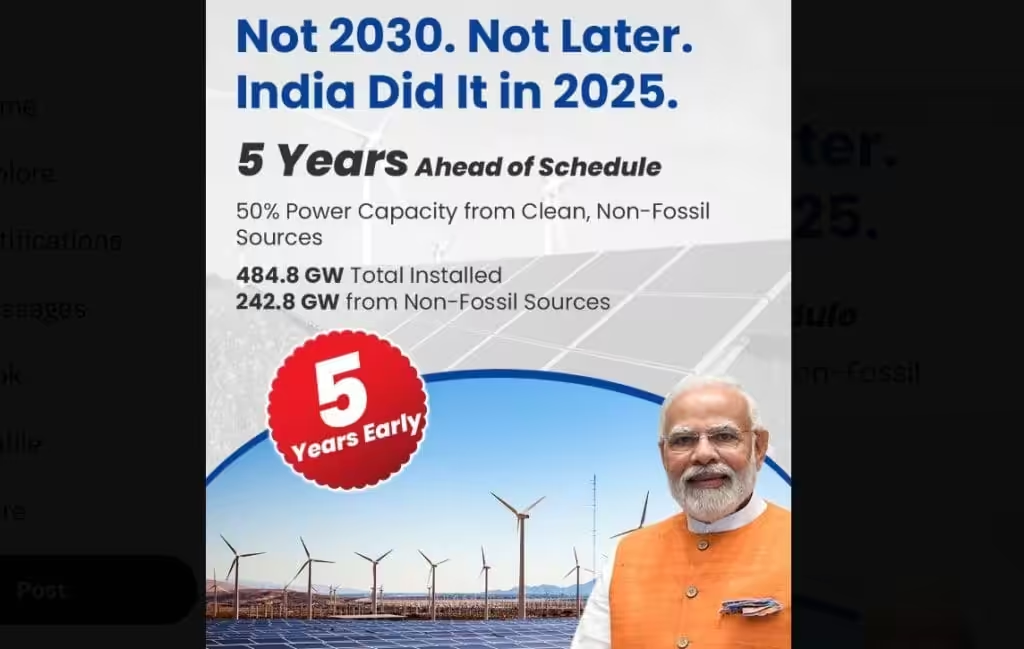
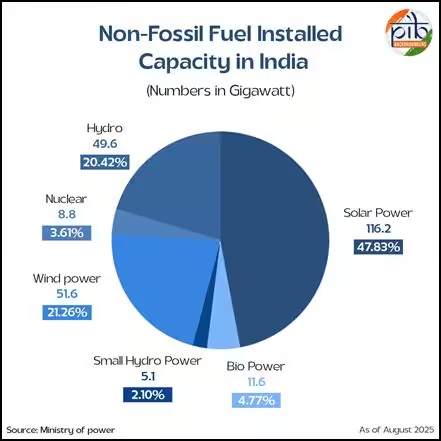
India has achieved its target of meeting 50 per cent of total installed energy capacity through renewable sources well ahead of the 2030 deadline.
PM JANMAN: Empowering PVTG Communities through Solar Electrification
Floating Solar Projects: The Omkareshwar Floating Solar Park in Madhya Pradesh is one of Asia’s largest floating solar parks, with a planned capacity of 600 MW.
Agrivoltaics: Agrivoltaics use solar panels and allow farming underneath, increasing land use and farmer income.
India stands 4th globally in Renewable Energy Installed Capacity, 4th in Wind Power capacity and 3rd in Solar Power capacity (as per IRENA RE Statistics 2025).
The Paris Agreement was adopted under United Nations Framework Convention on Climate Change (UNFCCC) in 2015. Under its Paris Agreement Nationally Determined Contributions (NDCs), India committed to reducing carbon intensity of the economy by 45% by 2030, over 2005 levels and the target of achieving 50% of cumulative electric power installed capacity from non-fossil fuel-based energy resources by 2030is now being met ahead of schedule.
Achievements:
Global leadership: Founding role in the International Solar Alliance (ISA).
Large-scale solar and wind growth: India is at the forefront of renewable expansion.
Employment generation: Renewables provided more than 1 million jobs (2023), plus 80,000 jobs in off-grid solar (2021).
Critical Gap – Climate Finance
Without large-scale finance, India will struggle to meet its climate targets.
Despite progress, the biggest challenge is finance to sustain and scale renewable growth.
Estimates suggest $1.5 trillion by 2030 will be needed; some projections even higher ($2.5 trillion).
Key Insights from the Report:
Green Bond Market:
India issued $55.9 billion in sustainability-linked bonds since 2021, but it’s still short of the needed scale.
Private finance covers 84% of total green investment, but public sector involvement is limited.
Scaling Clean Energy:
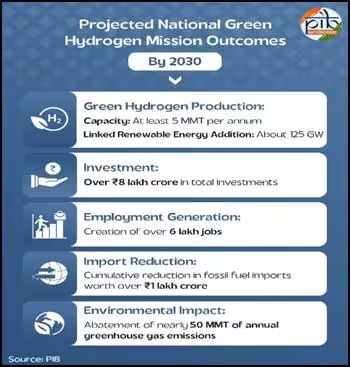
Investment needed in battery storage, hydrogen fuel, smart grids, decentralised energy, and green transport.
Mid-sized clean energy infrastructure (esp. Tier II & III cities) faces risks due to weak governance and delivery mechanisms.
Policy & Institutional Support:
Unlocking domestic pools like pension funds, sovereign wealth funds, insurance companies can expand financing.
Regulatory reforms, risk mitigation, and long-term project financing are required.
Carbon Markets:
India’s Carbon Credit Trading Scheme could mobilize finance if implemented transparently.
Potential to fund adaptation, innovation, and loss & damage measures.
UPSC Content Team Head · Web Developer & Designer · AnantamIAS
Recognized as one of India’s best content marketers, Gaurav Tiwari is an SEO strategist, WordPress developer, and founder of Gatilab. He builds websites that load in under a second, creates content that ranks on Google’s first page, and develops WordPress plugins and tools used on thousands of live sites.
Specialises in · Writing, web development, design — UPSC prep toolingExperience · 16+ yearsVisit website ↗