
Why in News
Assam Chief Minister Himanta Biswa Sarma left for London (November 15, 2025) to initiate the process of bringing back the historic Vrindavani Vastra, currently housed in the British Museum.
Return of Vrindavani Vastra
- An agreement is expected to be signed for the return (loan) of the textile to Assam by 2027.
- This is one of India’s most significant art repatriation efforts, involving a revered artefact linked to Srimanta Sankaradeva, the 15th–16th century saint-reformer.
- The textile is not being permanently returned. British Museum agreed to lend the Vrindavani Vastra to India for 18 months.
- The loan is conditional on Assam constructing a climate-controlled, museum-standard facility.
What is Vrindavani Vastra?
- Vrindavani Vastra = “Cloth of Vrindavan”
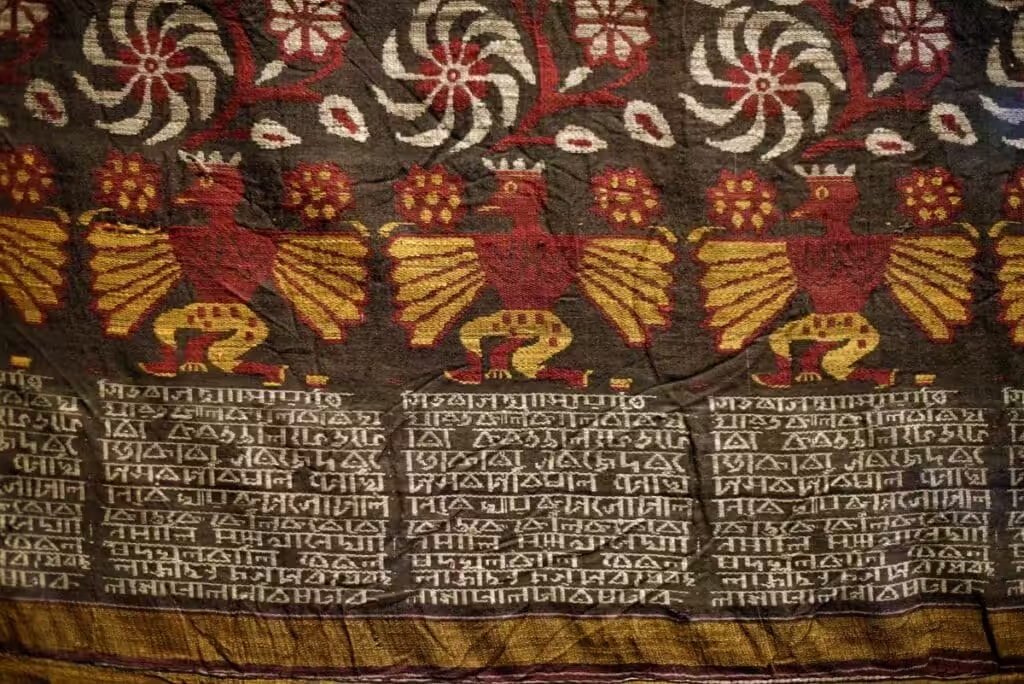
- A sacred, richly woven silk textile depicting scenes from Lord Krishna’s life, especially his Vrindavan episodes.
- Created in Assam under the guidance of Vaishnavite saint Srimanta Sankaradeva, a key figure in the Bhakti Movement and founder of Neo-Vaishnavism (Ekasarana Dharma) in Assam.
- Made using the Assamese mulberry silk (Muga/Eri).
- Contains intricate woven motifs, not painted (unique Assamese weaving tradition).
- Depicts: Krishna’s childhood acts, Rasleela, Vrindavan landscapes, Cowherds and animals
- Represents:
- Assamese weaving excellence
- Bhakti art tradition
- Sankaradeva’s cultural revolution (Sattriya culture, Bhakti movement revival)
Who Was Srimanta Sankaradeva?
- 15th–16th century Saint, Composer, poet, dramatist, scholar, painter, and reformer from Assam.
- Founded Ekasarana Dharma (Neo-Vaishnavism).
- Established Satras and Namghars (community prayer halls).
- Created Ankiya Naat, Borgeet, and influenced Sattriya Dance (now a classical dance of India).
- Guided artisans to create devotional art — including the Vrindavani Vastra.
How Did the Vrindavani Vastra Reach the British Museum?
- Originally created in Assam in the 16th century.
- Later pieces believed to have travelled to Tibet in the 17th–18th century (via monks, traders, or collectors).
- British explorers collected these pieces in the 19th century from Tibet.
- Eventually acquired and preserved by:
- British Museum, London
- Musee Guimet, Paris (other fragments)
Practice Question
1. With reference to the Vrindavani Vastra, consider the following statements:
- It is a woven silk textile depicting episodes from the life of Lord Krishna.
- It was created under the guidance of a prominent 15th–16th century Shaivite Bhakti saint from Assam.
- All surviving pieces of the Vrindavani Vastra are currently preserved in India.
- It represents the Neo-Vaishnavite cultural tradition known for Satras and community prayer halls.
Which of the statements given above are correct?
(a) 1 and 2 only
(b) 1 and 4 only
(c) 2 and 3 only
(d) 1, 3 and 4 only
Correct Answer: (b)
2. Consider the following pairs regarding Indian cultural artefacts and their associated traditions:
| Artefact / Tradition | Associated Region |
| 1. Patola Weaving | Gujarat |
| 2. Vrindavani Vastra | Assam |
| 3. Kalamkari Painting | Andhra Pradesh |
| 4. Mayurbhanj Chhau | West Bengal |
How many of the above pairs are correctly matched?
(a) Only one
(b) Only two
(c) Only three
(d) All four
Correct Answer: (c) Only three
Tell Google you want more of this.
Add Anantam IAS as a preferred sourceOne tap, and this site shows up more often in your own Top Stories, AI Overviews and AI Mode. Remove it any time.