Why in News?
The Delhi High Court said that it will pass an interim order protecting the personality rights of Congress MP Shashi Tharoor. The move comes in response to a suit against AI-generated deepfake videos that falsely portrayed him as praising Pakistan.
| UPSC Relevance: GS-2 Polity and Governance: Fundamental Rights; GS-3 Science and Technology: New Emerging Technology (Artificial Intelligence) Prelims & Mains: Personality Rights; Deepfakes. |
What are Personality Rights?
- Personality rights refer to an individual’s legal right to protect their identity from unauthorised use or commercial exploitation.
- Protected attributes include name, image, voice, signature, mannerisms, gestures, catchphrases or dialogues, digital avatars and AI-generated replicas, and other defining personal attributes.
- They combine two distinct but complementary doctrines: the Right to Privacy (personal autonomy and dignity) and the Right to Publicity (control over commercial use of one’s persona).
Two core dimensions of Personality Rights:
1. Right to Privacy:
- Protects individuals from unauthorised public exposure or misuse of personal identity. It originates primarily from Article 21 of the Indian Constitution (Right to Life and Personal Liberty). The Supreme Court judgment in Justice K.S. Puttaswamy v. Union of India recognised privacy as a fundamental right.
2. Right to Publicity:
- Protects the commercial and economic value attached to a person’s identity. It prevents false endorsements, commercial exploitation without consent, misleading advertisements and unauthorised merchandising.
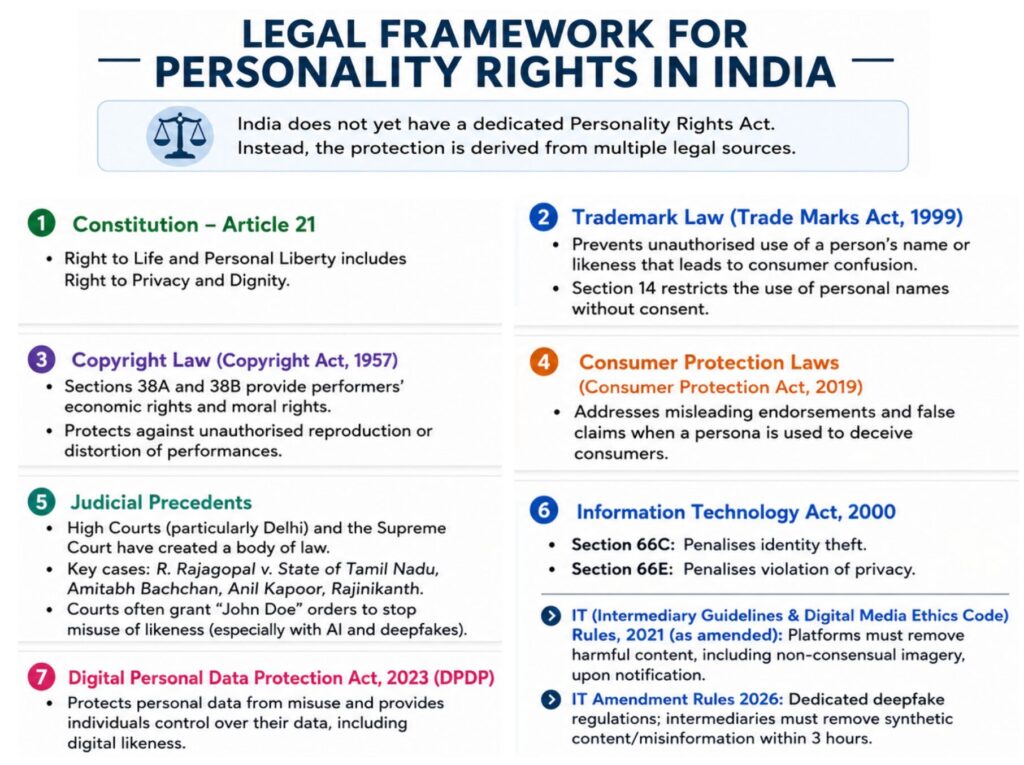
Legal Framework for Personality Rights in India:
India does not yet have a dedicated Personality Rights Act. Instead, the protection is derived from multiple legal sources.
- Right to Life and Personal Liberty under Article 21 includes the Right to Privacy and Dignity.
- Trademark Law (Trade Marks Act, 1999): Prevents unauthorised use of a person’s name or likeness that leads to consumer confusion. Section 14 restricts the use of personal names without consent.
- Copyright Law (Copyright Act, 1957): Sections 38A and 38B provide performers’ economic rights and moral rights, protecting against unauthorised reproduction or distortion of performances.
- Consumer Protection Laws: The Consumer Protection Act, 2019, addresses misleading endorsements and false claims, which can be applied when a persona is used to deceive consumers.
- Judicial Precedents: High Courts (particularly Delhi) and the Supreme Court have created a body of law through cases like R. Rajagopal v. State of Tamil Nadu and modern decisions for celebrities like Amitabh Bachchan, Anil Kapoor, and Rajinikanth, often granting “John Doe” orders to stop the misuse of likeness (especially with AI and deepfakes).
- Information Technology Act, 2000:
- Section 66C: Penalises identity theft.
- Section 66E: Penalises violation of privacy.
- Information Technology (Intermediary Guidelines and Digital Media Ethics Code) Rules, 2021 (as amended): Mandates social media platforms to remove harmful content, including non-consensual imagery, upon notification.
- IT Amendment Rules 2026: Introduces dedicated deepfake regulations, requiring intermediaries to remove synthetic content/misinformation within 3 hours.
- Digital Personal Data Protection Act, 2023 (DPDP): Protects personal data from misuse and provides individuals control over their data, including digital likeness.
Key Cases regarding Personality Rights:
- Anil Kapoor Case (Delhi High Court, 2023): The High Court restrained the unauthorised use of his name, voice, image, catchphrase “Jhakaas”, AI-generated representations and deepfakes. The court recognised that personality rights extend to digital and AI misuse.
- Shashi Tharoor Case (Delhi High Court, 2026): First case to explicitly protect “oratorial cadence” vocabulary, mannerisms and intellectual style as a protectable personality attribute.
In the context of AI and deepfakes, both dimensions are violated simultaneously. The deepfake video harms dignity and reputation (privacy), and also misappropriates the individual’s commercially valuable voice and image (publicity) without consent.
These rights are essential to maintaining personal dignity and controlling one’s public commercial reputation.
UPSC Mains PYQ 2024:
Q. Describe the context and salient features of the Digital Personal Data Protection Act 2023.
UPSC Mains PYQ 2023:
Q. Introduce the concept of Artificial Intelligence (AI). How does Al help clinical diagnosis? Do you perceive any threat to the privacy of the individual in the use of AI in healthcare? (10)
Tell Google you want more of this.
Add Anantam IAS as a preferred sourceOne tap, and this site shows up more often in your own Top Stories, AI Overviews and AI Mode. Remove it any time.