
Why in News?
A day after the Trinamool Congress (TMC) lost in the West Bengal Assembly Elections (2026), Chief Minister Mamata Banerjee declared she would not resign, alleging the elections were “not fair.”
Her refusal to resign raises foundational questions about the limits of executive power, the Governor’s role, and constitutional safeguards against political obstruction.
| UPSC Relevance: GS-2 Polity and Governance: Executive Prelims: Constitutional Framework (Article 164, Article 172); Legal Remedy for the outgoing Chief Minister. |
Constitutional Framework:
Article 164: Office of the Chief Minister:
- Article 164 states: “The Chief Minister shall be appointed by the Governor and the other Ministers shall be appointed by the Governor on the advice of the Chief Minister, and the Ministers shall hold office during the pleasure of the Governor.”
- The “pleasure of the Governor” clause is not absolute. A line of Supreme Court rulings has interpreted that the power of the Governor primarily flows from the “aid and advice” of the Council of Ministers.
- However, the Governor retains the constitutional authority to dismiss a Chief Minister who has demonstrably lost majority support in the Assembly and refuses to resign.
Article 172: Tenure of the State Assembly:
- Article 172 states: “Every State Legislative Assembly, unless sooner dissolved, shall continue for five years from the date appointed for its first meeting. At the expiry of five years, the Assembly stands automatically dissolved.”
The current Bengal Assembly’s tenure began on May 8, 2021, and will expire on May 7, 2026. Upon Expiry, the Assembly itself ceases to exist, making the position of all sitting MLAs (including the Chief Minister) lapse automatically.
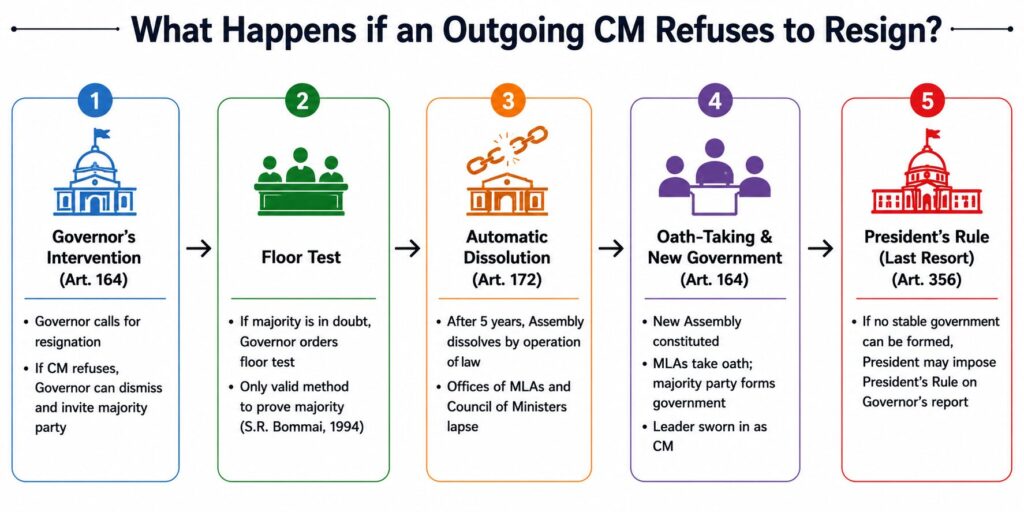
What Happens if an Outgoing CM Refuses to Resign?
- Step 1: Governor’s Intervention (Article 164): The Governor can formally call for the outgoing CM’s resignation. If the CM refuses, the Governor holds constitutional authority to dismiss him/her and invite the majority party to form the government.
- Step 2: Floor Test: If any ambiguity over the majority exists, the Governor can call a special session and order a floor test. This is the only constitutionally valid method to determine majority, as per the SR Bommai case (1994).
- Step 3: Automatic Dissolution (Article 172): No special notification is needed to dissolve the House after the tenure of 5 years; it dissolves by operation of law. This renders the position of all MLAs and the Council of Ministers constitutionally untenable.
- Step 4: Oath-Taking and New Government (Article 164): The Governor then initiates the process of constituting a new Assembly. The newly elected MLAs take the oath, and the majority party is invited to form the government, with its leader being sworn in as the new Chief Minister.
- Step 5: President’s Rule as Last Resort (Article 356): If no stable government can be formed, the President, on the Governor’s report, may impose President’s Rule.
| S.R. Bommai v. Union of India case (1994): • Floor Test as gold standard: The majority must be tested on the floor of the Assembly, rather than by the Governor’s subjective opinion. • Judicial Review: The Presidential Proclamation under Article 356 is subject to judicial review. The court can examine if the material used to base the decision was relevant and bona fide. If the proclamation is found unconstitutional, the court can restore the dismissed government. • Automatic Lapse: The Proclamation must be approved by Parliament within 2 months, else it lapses. • Limitations on Article 356: It is a power to be used only in extreme situations, not to solve political issues or satisfy central leadership. |
Legal Remedy for the outgoing Chief Minister:
The outgoing CM can challenge election results through an election petition in the High Court.
- Under the Representation of the People Act, 1951 (Section 80A), election petitions for state legislative assemblies are filed in the state’s High Court.
- Any candidate or voter can file a petition challenging the result on grounds of malpractice, improper counting, or violations.
- Such a petition must be filed within 45 days of the declaration of the election results.
- The High Court can declare the election void or order a re-election if malpractices are proven.
Practice MCQ:
Q. Consider the following statements:
1. The Governor can dismiss a Chief Minister who has lost majority support and refuses to resign.
2. The Governor can determine the majority of a state government based on his subjective assessment.
3. The State Legislative Assembly stands dissolved automatically after the expiry of its five-year term.
Which of the statements given above is/are correct?
(a) 1 and 2 only
(b) 2 only
(c) 1 and 3 only
(d) 2 and 3 only
Answer: (c)
UPSC PYQ 2014:
Q. Which of the following are the discretionary powers given to the Governor of a State?
1. Sending a report to the President of India for imposing the President’s rule.
2. Appointing the Ministers.
3. Reserving certain bills passed by the State Legislature for consideration of the President of India.
4. Making the rules to conduct the business of the State Government.
Select the correct answer using the code given below:
(a) 1 and 2 only
(b) 1 and 3 only
(c) 2, 3 and 4 only
(d) 1, 2, 3 and 4
Answer: (b)
Tell Google you want more of this.
Add Anantam IAS as a preferred sourceOne tap, and this site shows up more often in your own Top Stories, AI Overviews and AI Mode. Remove it any time.