Why in news?
Justice B.V. Nagarathna said that women in high office do not prove equality across society; substantive equality is still missing.
UPSC Relevance
Prelims – constitutional provisions, 106th Amendment
Mains, GS1, Role of women and women’s organisations; Social empowerment
GS2, Indian Constitution – significant provisions; Structure and functioning of the Judiciary; Mechanisms, laws and institutions for the protection of vulnerable sections
What did the judge say?
Justice Nagarathna, who is in line to become India’s first woman Chief Justice, delivered the inaugural Cornelia Sorabji Memorial Lecture at Somerville College, Oxford. Cornelia Sorabji was the first woman to study law at Oxford and later India’s first woman advocate. Key points from the lecture:
- Token presence is not equality: One woman in a senior post does not mean other women have access to education, jobs, property or legal remedies.
- Limits of judgments and laws: A judgment cannot by itself make every workplace safe or ensure every woman gets her inheritance. Laws fail if remedies are inaccessible, officials do not act or social attitudes stop women from asserting rights.
- Reservation in legislatures: The one-third reservation for women in Parliament and State legislatures shows that women must take part in decision-making and not remain content with a formal right to vote.
- Wrong yardstick: Progress cannot be measured by the number of discriminatory provisions struck down or a few beneficial laws passed.
Formal Equality vs Substantive Equality
| Basis | Formal Equality | Substantive Equality |
|---|---|---|
| Meaning | Treat everyone alike; same rules for all | Equal outcomes and real opportunities, considering existing disadvantages |
| View of difference | Ignores social and historical differences | Recognises structural disadvantage, care burden, caste, class, religion |
| Tool | Removing discriminatory provisions | Affirmative action, reasonable accommodation, changing institutions |
| Constitutional basis | Article 14 (equality before law), 15(1) | Article 14 (equal protection of laws), 15(3), 16(4), 39, 42, 243D, 243T, 330A, 332A |
| Example | Same entrance test for men and women | Maternity benefits, crèches, reservation in local bodies and legislatures |
Indian courts have slowly moved from a “protective” approach (treating women as weak and needing protection) to a “rights-based” and substantive approach (removing stereotypes and structural barriers).
Constitutional Framework for Gender Equality
- Article 14: Equality before law and equal protection of laws.
- Article 15(1) and 15(3): No discrimination on grounds of sex; State can make special provisions for women and children.
- Article 16(2): No discrimination in public employment on grounds of sex.
- Article 21: Right to life with dignity, including bodily autonomy, privacy and reproductive choice.
- DPSPs: Article 39(a) equal right to livelihood, 39(d) equal pay for equal work, 42 maternity relief.
- Article 51A(e): Fundamental duty to renounce practices derogatory to the dignity of women.
- Articles 243D and 243T: One-third reservation in Panchayats and Municipalities (73rd and 74th Amendments).
- Articles 330A and 332A: One-third reservation in Lok Sabha and State Assemblies (106th Amendment, 2023), to be operational after delimitation following the next census.
Judicial Evolution in Ensuring Gender Equality
Phase 1: Early years – formal equality and protective approach (1950s–1970s)
- Yusuf Abdul Aziz v State of Bombay (1954): Upheld a law that punished only men for adultery, treating it as a special provision for women under Article 15(3). This reflected the paternalistic view of women as victims, not as equal agents.
- C.B. Muthamma v Union of India (1979): Struck down IFS rules that required women officers to seek permission to marry and allowed their removal after marriage. Justice Krishna Iyer called it a hangover of “masculine” culture in services.
Phase 2: Rights in workplace and family (1980s–1990s)
- Air India v Nargesh Meerza (1981): Termination of air hostesses on first pregnancy was held arbitrary and an insult to womanhood.
- Mohd. Ahmed Khan v Shah Bano Begum (1985): Divorced Muslim women entitled to maintenance under Section 125 CrPC. Later upheld in spirit in Danial Latifi (2001).
- Mary Roy v State of Kerala (1986): Syrian Christian women got equal share in father’s property under the Indian Succession Act.
- Vishaka v State of Rajasthan (1997): Laid down guidelines on sexual harassment at the workplace using CEDAW, in the absence of a law. Led to the POSH Act, 2013.
- Githa Hariharan v RBI (1999): The word “after” in the Hindu Minority and Guardianship Act was read to allow the mother to be a natural guardian even when the father is alive.
Phase 3: Rejecting stereotypes and paternalism (2000s–2010s)
- Laxmi v Union of India (2015): Regulated the sale of acid and ordered compensation for acid-attack survivors.
- Shayara Bano v Union of India (2017): Instant triple talaq declared unconstitutional. Later criminalised by the Muslim Women (Protection of Rights on Marriage) Act, 2019.
- Joseph Shine v Union of India (2018): Section 497 IPC (adultery) struck down. It treated the wife as the husband’s property. This overruled the logic of Yusuf Abdul Aziz.
- Indian Young Lawyers Association (Sabarimala, 2018): Exclusion of women aged 10–50 from the temple held unconstitutional. The matter has been referred to a larger bench on wider questions of essential religious practices.
Phase 4: Substantive equality as a constitutional standard (2020 onwards)
- Secretary, Ministry of Defence v Babita Puniya (2020): Women officers to get Permanent Commission in the Army. The Court rejected arguments based on “physiological limitations” as sex stereotypes.
- Vineeta Sharma v Rakesh Sharma (2020): Daughters are coparceners by birth under the Hindu Succession (Amendment) Act, 2005, whether or not the father was alive on that date.
- Kush Kalra v Union of India (2021): Women allowed to appear for the NDA examination.
- X v Principal Secretary, Health, Govt. of NCT of Delhi (2022): Unmarried women equally entitled to safe abortion up to 24 weeks. For the MTP Act, “rape” includes marital rape.
- Handbook on Combating Gender Stereotypes (2023): Released by the Supreme Court to replace stereotypical words like “eve-teasing” and “housewife” in legal writing.
- Mohd. Abdul Samad v State of Telangana (2024): Justice Nagarathna’s bench held that Muslim women can claim maintenance under Section 125 CrPC. She stressed the value of the homemaker’s work and advised joint bank accounts for financial security of wives.
Why judgments alone are not enough
| Gap | Example |
|---|---|
| Weak implementation | Many workplaces still lack Internal Committees under the POSH Act |
| Inaccessible remedies | Cost, delay and distance of courts; low legal awareness in rural areas |
| Social attitudes | Daughters often give up property rights under family pressure despite Vineeta Sharma |
| Under-representation | Women remain a small share of judges in higher judiciary and of MPs |
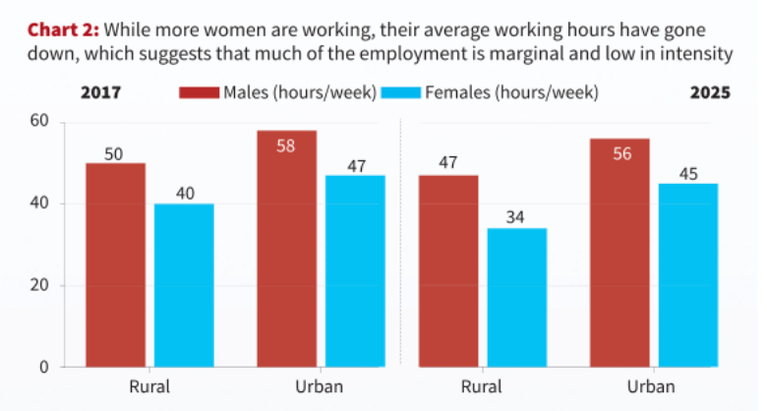
| Economic exclusion | Low female labour force participation; unpaid care work |
Way Forward
- Implementation focus: Fix accountability of public authorities in laws like POSH Act, PWDV Act, 2005 and Maternity Benefit Act.
- Access to justice: Strengthen legal aid under NALSA, fast-track courts and One Stop Centres.
- Gender diversity in judiciary: More women judges in High Courts and the Supreme Court bring wider perspectives.
- Early operation of the 106th Amendment: Timely census and delimitation so that the reservation becomes real.
- Change social norms: Gender sensitisation in schools, police and judiciary; equal sharing of care work.
- Economic empowerment: Women’s ownership of land and assets, credit through SHGs, workplace crèches.
Courts have moved from protecting women to empowering them. As Justice Nagarathna points out, the real test is whether rights reach every woman in daily life, not just the number of laws and judgments.
Practice MCQ
Q1. With reference to the Constitution (106th Amendment) Act, 2023, consider the following statements:
1. It reserves one-third of seats for women in the Lok Sabha, State Legislative Assemblies and the Legislative Assembly of the NCT of Delhi.
2. The reservation will come into effect after delimitation is done on the basis of the first census taken after its commencement.
3. It also provides reservation for women in the Rajya Sabha and State Legislative Councils.
Which of the statements given above are correct?
(a) 1 and 2 only
(b) 2 and 3 only
(c) 1 and 3 only
(d) 1, 2 and 3
Answer: (a)
Explanation: Statement 3 is incorrect. The Amendment does not cover the Rajya Sabha or Legislative Councils, which are indirectly elected.
Practice Question
“Formal equality alone may not be sufficient to secure meaningful representation of women.” Trace the evolution of the Supreme Court’s approach from protective discrimination to substantive equality with the help of landmark judgments. Also discuss why judicial pronouncements alone cannot ensure gender justice. (15 Marks)
Tell Google you want more of this.
Add Anantam IAS as a preferred sourceOne tap, and this site shows up more often in your own Top Stories, AI Overviews and AI Mode. Remove it any time.