Why in News?
A 2026 ICRIER report, The Participation Paradox, highlights the growing participation of women in India’s workforce but raises concerns about the quality, security and remuneration of their employment.
Despite a near doubling of working women between 2017-18 and 2025, much of the increase has been concentrated in agriculture, informal employment and unpaid family work.
| UPSC Relevance: GS-1 Indian Society: Role of Women; GS-2 Social Justice: Human Resources, Vulnerable Sections; GS-3 Economy: Employment; Inclusive Growth Mains: Women’s Employment Paradox |
Key Findings: India’s Women’s Employment Paradox:
1. Rising employment, but limited structural transformation:
- The number of working women nearly doubled from 104 million in 2017-18 to 201 million in 2025, while the female Worker Population Ratio (WPR) increased from 22% to 38%.
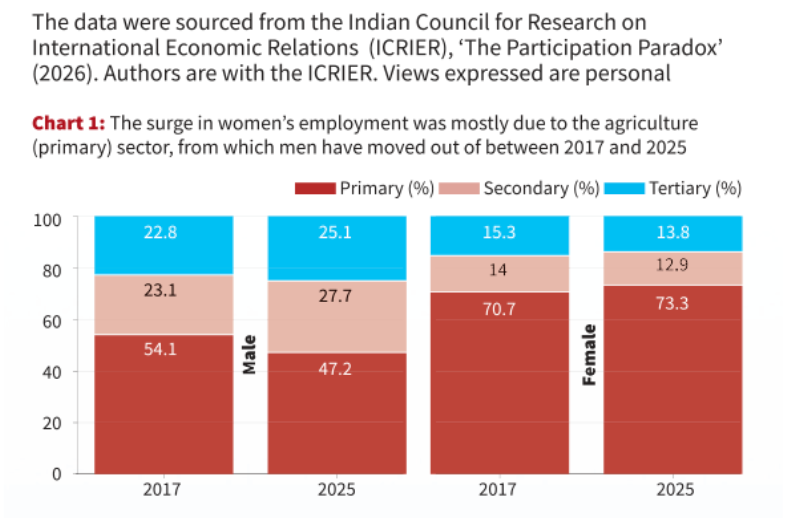
- Women’s employment remains concentrated in agriculture. The share of women employed in the primary sector increased from 70.7% to 73.3% between 2017 and 2025.
- In contrast, men’s dependence on agriculture declined from 54.1% to 47.2%, indicating gender differences in the pace of structural transformation.
2. Increasing informal and marginal employment:
- Outside agriculture, women’s employment gains have largely occurred in garments, retail and construction, where informal and own-account work is prevalent.
- Rural women’s participation in own-account work increased substantially, while the share of regular salaried employment declined from 10.5% to 9.3%.
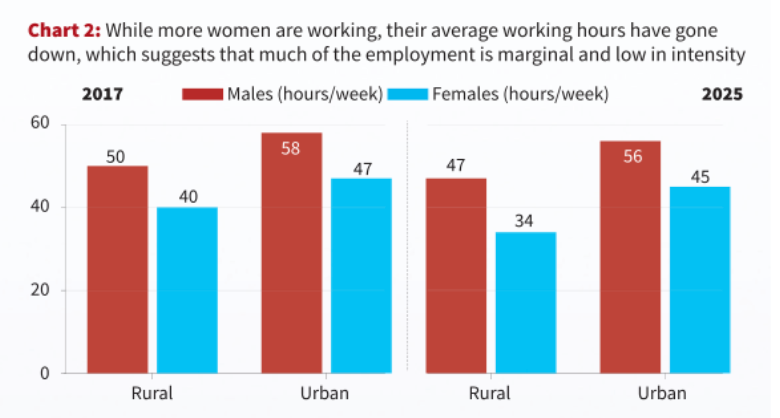
- Despite rising workforce participation, average weekly working hours declined between 2017 and 2025. Rural women’s working hours fell from 40 to 34 hours, suggesting an increase in marginal or low-intensity employment.
- In textiles and garments, widening gender gaps in working hours indicate the persistence of home-based, piece-rate and informal work rather than regular factory employment.
3. Persistent gender wage gap:
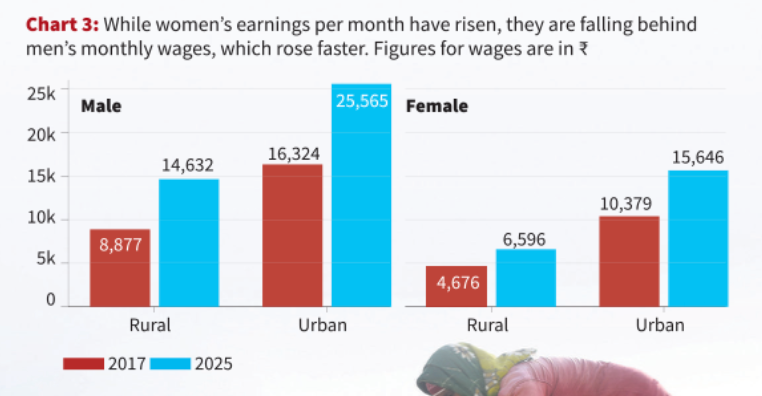
- Women’s earnings have increased, but men’s wages have grown faster. In rural India, women earned approximately 45% of men’s monthly earnings in 2025, compared with 53% in 2017.
- Significant hourly wage disparities persist in sectors employing large numbers of women, including tobacco manufacturing, education, textiles and crop production.
4. Disproportionate burden of unpaid care work:
- According to the Time Use Survey 2024, women spend approximately 3.7 hours more per day on domestic work than men and nearly one additional hour on caregiving.
- Even employed women continue to spend around four hours daily on domestic work and nearly two hours on care activities.
- Around 60% of women citing reasons for not participating in the labour force identify childcare and household responsibilities, compared with less than 1% of men.
Major Challenges:
- Occupational segregation: Women remain concentrated in low-productivity sectors and occupations with limited opportunities for career progression.
- Informal Employment: Home-based work, unpaid family labour and self-employment often lack social security, stable incomes and employment protection.
- Unpaid care economy: Unequal domestic responsibilities restrict women’s time, mobility and ability to undertake full-time paid employment.
- Wage inequality: Gender-based wage disparities reflect occupational segregation, differences in working hours and unequal access to better-paying jobs.
- Limited workplace infrastructure: Inadequate childcare facilities, safe transport, hostels and workplace flexibility constrain women’s access to formal employment.
Way Forward:
- Strengthen care infrastructure: Expand affordable childcare facilities, crèches and elderly-care services. Promote paid paternity and shared parental leave to redistribute care responsibilities.
- Promote formal employment: Encourage women’s recruitment in MSMEs and labour-intensive manufacturing through targeted incentives, better working conditions and access to social security.
- Improve workplace infrastructure: Develop safe transport, working women’s hostels and childcare facilities in industrial clusters and textile parks.
- Enhance rural livelihoods: Strengthen women’s self-help groups, producer organisations and rural enterprise clusters to create productive, remunerative employment closer to home.
- Improve economic opportunities: Expand women’s access to credit, technology, market linkages, vocational training and digital skills.
- Recognise unpaid work: Improve measurement and recognition of unpaid domestic and care work in economic policymaking.
India’s challenge is no longer merely to increase women’s workforce participation but to ensure that participation translates into productive, remunerative and secure employment.
The focus must shift from counting women at work to improving the quality of their work while addressing the unequal distribution of unpaid care responsibilities.
Mains Practice Question:
Q. Despite rising women’s workforce participation in India, concerns regarding informalisation, wage inequality and unpaid care work persist. Examine the challenges and suggest measures to improve the quality of women’s employment.
Tell Google you want more of this.
Add Anantam IAS as a preferred sourceOne tap, and this site shows up more often in your own Top Stories, AI Overviews and AI Mode. Remove it any time.