Political participation refers to the involvement of citizens in political processes such as voting, contesting elections, joining political parties, influencing public policy, and participating in governance. In a democracy like India, equal political participation of women is essential for inclusive governance and gender equality.
Why in News?
Women’s political participation in India has recently come into focus due to debates on low representation of women in legislative bodies despite high voter participation. Reports and discussions around International Women’s Day and political reforms have highlighted that women constitute only around 10% of MPs and MLAs in India, indicating a major gender gap in political representation.
UPSC Relevance:
GS I: Indian Society, GS II: Social Justice, Women Empowerment, Governance
Current Status of women in political participation:
The Paradox of Progress: India presents a striking paradox — it is the world’s largest democracy and has had women in the highest offices (President, Prime Minister, Chief Ministers), yet it ranks poorly on gender representation.
Women constitute nearly half of India’s population, yet their representation in political institutions remains limited. For example:
- Women constitute around 14% of Members of Parliament in Lok Sabha.
- The average representation in State Legislative Assemblies is around 9%.
- Overall, only about 10% of MPs and MLAs are women in India.
- Reservation in Panchayati Raj institutions has significantly increased women’s participation, with many states providing 33–50% reservation.
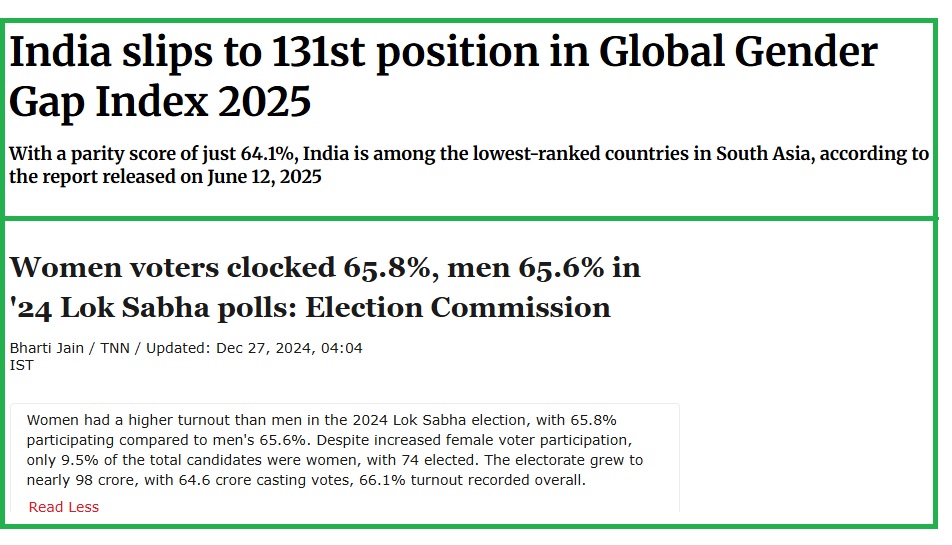
However, in terms of voter participation, women have made significant progress. In the 2024 Lok Sabha elections, women voter turnout slightly exceeded men, indicating growing political awareness and engagement.
Thus, while women participate actively as voters, they remain underrepresented in political leadership and decision-making positions.
Global Context India slipped to 131st position in the Global Gender Gap Index 2025, with a parity score of just 64.1%, making it among the lowest-ranked countries even within South Asia. Bangladesh, by contrast, jumped 75 ranks to rank 24 globally
What are the Reasons for Low Representation?
1. Patriarchal Social Structure
Traditional gender norms restrict women’s participation in leadership roles.
2. Political Party Bias
Political parties often field fewer women candidates, limiting their opportunities.
3. Economic Constraints
Campaigning requires significant financial resources, which many women lack.
4. Lack of Political Networks
Women often have limited access to political mentorship and networks.
5. Violence and Safety Concerns
Harassment and violence in politics discourage women from contesting elections. Cyber-harassment and political violence deter women from public life.
6. Criminalization of Politics:
The prevalence of muscle and money power in elections discourages women from contesting.
Although women’s voter participation is rising, structural barriers still limit their representation in decision-making institutions. Comprehensive reforms are needed to achieve gender-balanced governance.
What are the Measures to Improve Participation?
1. Constitutional and Legal Measures
- The Constitution guarantees equality and non-discrimination on the basis of sex.
- The 73rd and 74th Constitutional Amendments introduced 33% reservation for women in Panchayats and Municipalities, which has significantly increased grassroots political participation.
2. Women’s Reservation in Parliament
The 106th Constitutional Amendment (2023) provides 33% reservation for women in the Lok Sabha and State Legislative Assemblies. This is expected to increase women’s representation in higher political institutions.
3. Capacity Building
- Training programmes for women leaders
- Support for women’s political wings in parties
- Greater media visibility
Why Women’s Political Participation is important?
Greater representation of women can:
1. Democratic Equality
Women constitute nearly half of India’s population; their representation is necessary for a truly representative democracy.
2. Better Policy Outcomes
Studies show that women leaders prioritize issues such as healthcare, education, and social welfare.
3. Gender-sensitive Governance
Women representatives are more likely to address gender-based discrimination and social issues.
4. Socio-economic Empowerment
Political participation enhances women’s status and decision-making power in society.
Way forward:
1. Implement 106th Constitutional Amendment:
Expedite implementation of the 106th Constitutional Amendment (Nari Shakti Vandan Adhiniyam, 2023) for 33% reservation in Parliament. Aligns with India’s international commitments under CEDAW (Convention on the Elimination of All Forms of Discrimination against Women) and the Beijing Declaration (1995), and with SDG 5 on gender equality.
- Limitations: Implementation is deferred until after the next census and delimitation exercise, effectively pushing it to 2029 or later.
2. Strenghten Women Leadership initiatives:
Strengthen the National Commission for Women (NCW) and leverage Self-Help Groups (SHGs) as leadership pipelines.
3. Election Commission Role:
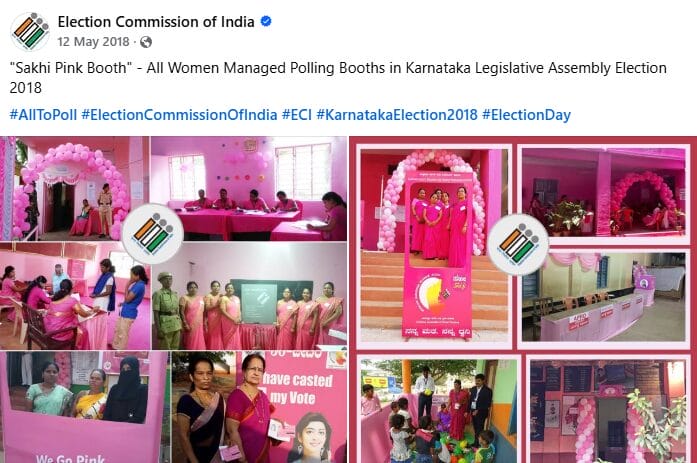
Expand Election Commission initiatives like SVEEP (Systematic Voters’ Education and Electoral Participation) and Pink Booths (also known as Sakhi Polling Booths)to create safer electoral environments.
4. Political Party Reforms
Parties should allocate a minimum percentage of tickets to women candidates. Mandate political parties to field women in at least 33% of tickets through law.
5. Financial Support
Public funding mechanisms to support women candidates.
6. Social Awareness
Campaigns to challenge patriarchal attitudes and promote gender equality.
Conclusion
Despite constitutional guarantees and increasing voter participation, women remain significantly underrepresented in Indian politics. Effective implementation of reservation policies, political party reforms, and social transformation are necessary to ensure substantive political empowerment of women in India.
Practice Mains Questions
- Despite increasing voter turnout among women in India, their representation in political institutions remains low. Examine the reasons and suggest measures to improve women’s political participation.
- Women’s political participation is essential for inclusive and representative democracy. Discuss the importance of women’s representation in politics in the Indian context.
- Evaluate the role of constitutional provisions and reservation policies in promoting women’s political participation in India.
Tell Google you want more of this.
Add Anantam IAS as a preferred sourceOne tap, and this site shows up more often in your own Top Stories, AI Overviews and AI Mode. Remove it any time.