Context:
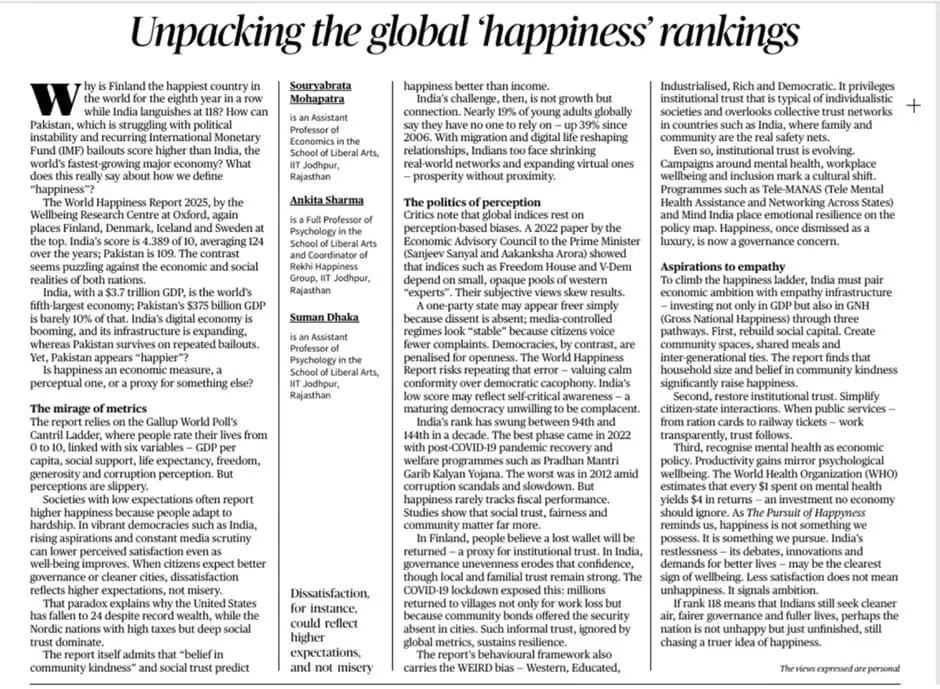
The World Happiness Report 2025 demonstrates that Finland successively holds the position as the world’s happiest country for multiple years.
UPSC Relevance:
Important Rankings.
PYQ:
Q. Which of the following is/are the indicator/ indicators used by IFPRI to compute the Global Hunger Index Report? (2016)
Undernourishment
Child stunting
Child mortality
Select the correct answer using the code given below:
(a) 1 only
(b) 2 and 3 only
(c) 1, 2 and 3
(d) 1 and 3 only
World Happiness Report:
- The World Happiness Report is an annual study that ranks countries based on subjective well-being and objective social and economic indicators. First published in 2012, It aims to measure the overall happiness of people worldwide and highlight areas where improvements are needed.
- Published by the Wellbeing Research Centre at the University of Oxford in collaboration with Gallup and the United Nations Sustainable Development Solutions Network (UNSDSN).
Feature of the World Happiness Report 2025:
- The World Happiness Report 2025 highlights fundamental aspects of worldwide happiness evolution by exposing the elements which enhance social well-being status.
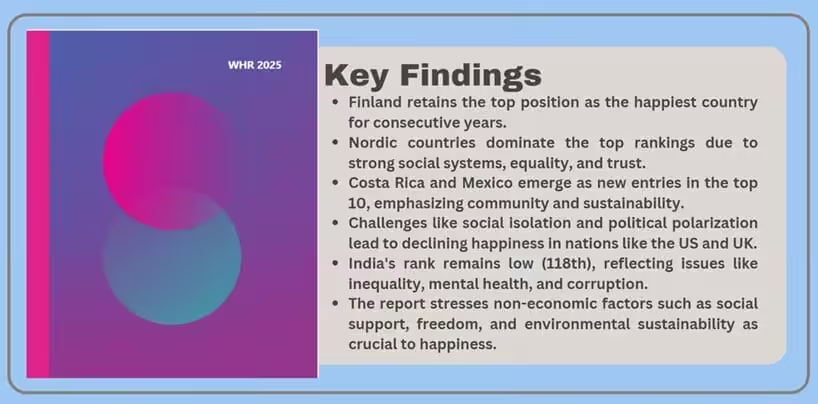
- The rank of being the happiest nation once again goes to Finland which demonstrates how social trust and healthcare quality and community strength create ideal happiness conditions.
- The Scandinavian countries Denmark, Iceland and Sweden maintain leadership positions as they demonstrate that equality and sustainability and cultural integration create pleased citizens.
- The new report introduces two new entries to the top 10 list which includes Costa Rica and Mexico.
- National success depends on social cohesion along with culture and environmental conservation which creates happiness for citizens.
- America and the United Kingdom experience decreased happiness rankings according to the research which signals the existence of social fragmentation along with political conflicts in those countries.
Finland’s Success Story:
The world recognizes Finland as the happiest country because of its extraordinary methods for building well-being within society. The basis of Finland’s success emerges from its robust welfare system because this system provides citizens with excellent health services and comprehensive education and stark social prevention. The basic foundation of these services creates a stress-free environment and equality which enables people to find happiness through secure stability and fulfilment.
The Nordic Dominance:
- The social welfare systems of Nordic countries establish universal access to Healthcare, Education and Social Security as their primary advantage for domination. Real security alongside ample support for citizens exists through widespread policies which serve to decrease anxiety levels while developing a protective environment.
- Work-life balance as a concept represents another major contributor to Nordic public happiness.
- The nature-based lifestyle together with environmental protection activities help people maintains their mental health.
- These nations value the promotion of equal rights for women and men together with communal participation while providing resident’s freedom in the decisions they make about their lives.
How It Is Calculated?
- Public data used to create World Happiness Report rankings originates mainly from Gallup surveys that utilize Cantril Ladder assessments for participant life evaluation.
- The system requires respondents to evaluate their life satisfaction at present by selecting numbers between 0 and 10 with 0 representing the worst possible life experience and 10 representing the best possible life experience.
- The starting point of happiness rankings depends exclusively on self-evaluation results.
- Subjective well-being scores serve as the base for this study which combines them with six fundamental elements that drive happiness levels.
GDP Report as per Capita: The economic value of each person’s consumption or income works as a happiness factor because it enables access to resources along with opportunities.
Social Support: Individuals can measure their sense of having trustworthy and purposeful social relationships through Social Support assessments.
Healthy Life Expectancy: People commonly assume that their ability to enjoy long lives without illness stands as a crucial element which determines how happy they become.
Freedom to Make Life Choices: When people possess life decision freedom combined with communal independence it increases their well-being scores.
Generosity: Elaborate gestures of providing support to others create joy and community bonds through positive emotional responses and communal connections.
Perception of Corruption: The reduction of corruption allows people to establish trust toward institutions thus leading to happier societies.
Each country receives a happiness score from the combination of weighted elements included in the assessment method.
India and World Happiness Report:
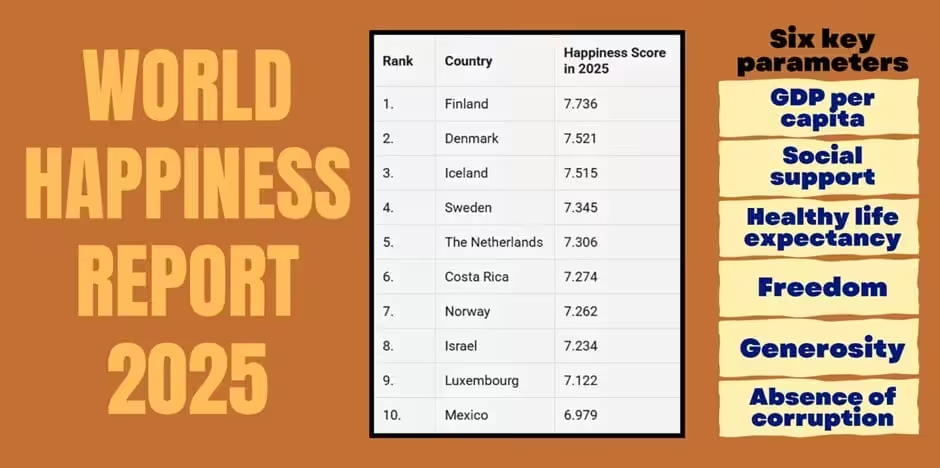
India stands at position 118 in the World Happiness Report 2025 because it faces difficulties enhancing its overall happiness although it shows significant economic development together with its cultural depth. India has made strides which show progress through its ranking but continues to face on-going obstacles which impact the welfare of its numerous citizens.
India’s Ranking and Context:
The World Happiness Report shows India holds a position that falls behind multiple neighbouring nations especially Nepal together with Bangladesh regarding various happiness standards. The meaningful gap between Global Happiness ratings and India’s development attracts attention related to its advantageous resources and cultural diversity. Although India has improved its infrastructure technology and urbanization capabilities the population disparities hinder consistent happiness benefits across all groups.
Challenges behind India’s Lag:
- The fifth biggest economy in the world currently maintains substantial economic imbalances that impact a large part of its population. Many residents in India cannot obtain vital needs which include high-quality medical care and proper educational services with clean water access. Overall happiness suffers due to this inequality which produces discontent among the groups who are marginalized.
- India faces significant challenges regarding mental health because the nation maintains poor funding rates for mental services along with social stigmas regarding psychological conditions. People suffer from more mental health problems because stress levels rise alongside urbanization as well as socio-economic pressures. The shortage of mental health services creates more difficulties in the situation.
- Public institutions along with transparent government operations serve as essential factors that impact the level of happiness within a society. Indian citizens feel discouraged about their capacity to develop meaningful improvements within their neighbourhoods because they see corruption as an on-going problem throughout the country.
- Social support as well as freedom to make choices is perceived less favourably in India compared to other high-ranking nations. People within traditional social systems must follow restrictions limiting their personal choices yet rural and urban assistance networks do not offer reliable support.
- The quality of life in India suffers because of massive pollution together with environmental deterioration. It deals with significant air and water pollution issues whereas rural territories experience deforestation and diminishing natural resources problems.
The steps India must take in order to improve its situation:
- Strengthening Social Support Systems
- India requires the implementation of strong social networks which provide citizens support and social connections. Community well-being will improve when India funds mental health services as well as develops local community facilities to strengthen interpersonal relationships through neighbourhood-led programs. Dismissive barriers to affordable healthcare services must be eliminated across urban and rural settings to found societal happiness.
- Tackling Inequality and Poverty
- The level of economic inequality stands as the main obstacle which prevents Indians from finding happiness. Strategic policy measures focusing on inclusive development together with unemployment generation and poverty reduction programs should work to narrow the wealth disparity between wealthy and poor population segments. Social welfare programs need expansion to offer housing subsidies as well as health care subsidies and educational support which will benefit vulnerable populations and elevate general societal quality of life.
- Prioritizing Mental Health Awareness
- Health issues related to mental difficulties still carry heavy stigma throughout Indian society. National awareness campaigns led by the government must happen simultaneously with efforts to decrease the stigma along with support for people who need help. Providing young people and working professionals with expanded access to mental healthcare through professionals and counselling centres and helplines serves to address their increasing mental health needs.
- Combatting Corruption
- When corruption occurs in society it drives trust away from institutional bodies and simultaneously reduces the general happiness of citizens. When combined with mandated anti-corruption rules and stronger oversight of public servants the public will regain trust in their government leadership. Transparent and efficient systems create an environment where people gain power over their circumstances and demonstrate increased engagement.
- Enhancing Environmental Quality
- The current state of environmental degradation heavily affects the overall life quality standards. India needs to make sustainable development its top priority through efforts against pollution sources and the protection of natural resources and the implementation of environmentally conscious urban development plans. Healthy living environments will emerge from reforestation drives combined with clean energy projects alongside tighter pollution control regulations.
- Promoting Freedom and Personal Choice
- The improvement of happiness depends heavily on fostering personal choices along with individual expression. Through gender equal, free speech and cultural diversity-supporting policies citizens can live better fulfilling lives and feel included.
- Community and cultural initiatives
- The multiple elements of Indian cultural heritage represent an opportunity to develop stronger neighbourhoods among residents. Through cultural festivals and artistic events alongside exchange opportunities India can develop stronger relationships between citizens which fosters a unified sense of community.
Tell Google you want more of this.
Add Anantam IAS as a preferred sourceOne tap, and this site shows up more often in your own Top Stories, AI Overviews and AI Mode. Remove it any time.