UPSC CSE 2026 Essay Paper Discussion

Daily Digest · Thursday

2 April 2026 Current Affairs for UPSC

4 current affairs published on Thursday, 2 April 2026

2 April 2026 Current Affairs for UPSC — every Why-in-News article AnantamIAS published on Thursday, 2 April 2026, broken down with Why in News?, the exact GS paper it feeds, sub-topic mapping, MCQ-ready facts and a UPSC-style practice question. 4 articles in total, covering Polity, Economy, Environment, S&T, IR, Geography, History, Society and Internal Security — the same Why-in-News + GS-paper-mapping + practice-question format the Compass uses across every daily digest on the site.

Daily current affairs for UPSC is where new material enters your prep stream. Read this 2 April 2026 digest end-to-end in 25–35 minutes, attempt the practice question at the foot of each article (it's MCQ for some, 10/15-marker for others), then bookmark the entries that fall inside your active revision window. Everything stays cross-linked: tap any subject pill to jump to that subject's hub, or use the table of contents above to skip straight to a specific story.

Use this page three ways. Read sequentially for a one-sitting scan of everything that mattered on 2 April 2026. Download the 2 April 2026 PDF below for offline study or print revision. Or use the April 2026 Current Affairs compilation to see this day in the month's full context. For the previous day's reading, see 1 April 2026 Current Affairs; the next day's is 3 April 2026 Current Affairs.

Why we publish daily current affairs separately from the monthly compilation: daily is learning, monthly is revision. Use the daily page to add fresh material to your notes the day it breaks; come back to the April 2026 compilation 60 days before Prelims when the noise has settled and only the lasting takeaway is worth re-reading.

Quantum Entanglement in Helium Atoms

Open article →Download PDF

Why in News?

  • Recently, scientists successfully demonstrated quantum entanglement in Helium atoms.
UPSC Relevance: GS-3 Science and Technology: Quantum Technology

Prelims: Basics of Quantum Computing; Quantum Entanglement & its Applications.  

What is Quantum Entanglement?

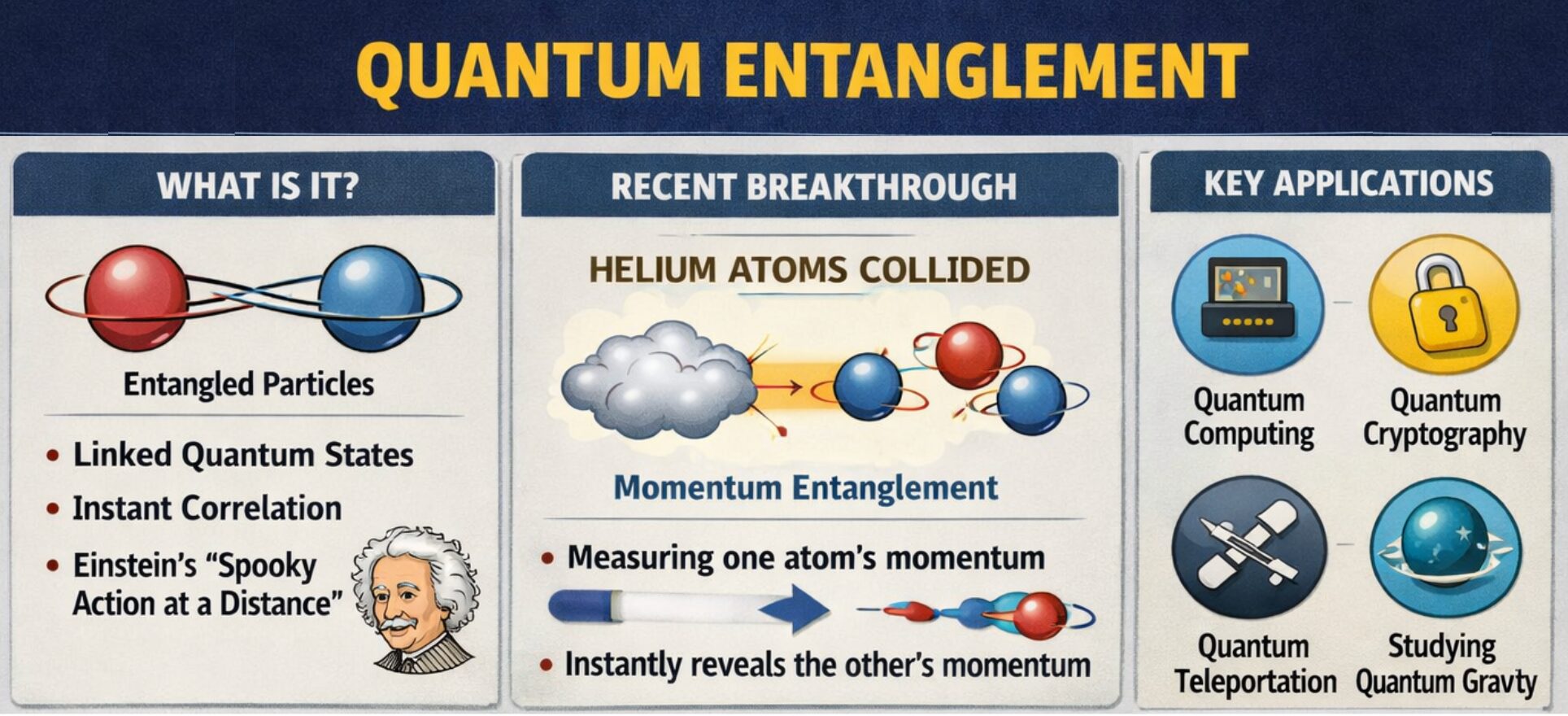
  • Quantum entanglement occurs when two particles become so deeply linked that they share a single existence.
    • When two or more particles become entangled, the state of one particle becomes linked with the state of the other(s), regardless of the distance between them. Thus, changes to the state of one particle instantaneously affect the state of the other. 
  • Albert Einstein famously called entanglement “spooky action at a distance” because it defies everyday logic. In classical physics, objects usually only affect things directly next to them. 

Quantum Entanglement in Helium Atoms:

  • Researchers collided clouds of Helium atoms. The collisions produced pairs of atoms whose momenta were entangled (momentum entanglement).
    • Neither atom had a definite direction until a detector measured it. However, once the momentum of one atom was measured, it instantly determined the momentum of the other atom (of its partner), no matter how far apart they had travelled.
  • The experiment shows that even relatively heavy particles can share a single quantum state. Their properties (momentum, in this case) remained interconnected even when separated. 

Significance:

  • Moving closer to Unified Theory of Everything: So far, quantum entanglement has been observed in much lighter particles like electrons, photons, etc. The recent discovery of quantum entanglement in heavy particles (matter) opens ways for researchers to study the link between quantum physics and gravity — a famous unsolved problem in physics. 
Applications of Quantum Entanglement:

  • Quantum Computing: Entangled qubits in a quantum computer can be manipulated collectively, allowing for the parallel processing of information in a way that classical bits (classical computers) cannot achieve. 
  • Quantum Cryptography: Used in Quantum Key Distribution (QKD). Provides ultra-secure communication because any interference can be detected.
  • Quantum Teleportation: Transfer of quantum state information across distances. Useful in future communication networks.
  • Precision Measurement: Improves accuracy in sensors and atomic clocks.
  • Understanding Quantum Gravity: Helps explore the connection between the General Theory of Relativity (gravity) and Quantum Mechanics. 

UPSC PYQ 2025

Q. Consider the following statements:

I. It is expected that Majorana 1 chip will enable quantum computing.

II. Majorana 1 chip has been introduced by Amazon Web Services (AWS).

III. Deep learning is a subset of machine learning.

Which of the statements given above are correct?

(a) I and II only

(b) II and III only

(c) I and III only

(d) I, II and III

Answer: (c)

UPSC PYQ 2022

  Which one of the following is the context in which the term “qubit” is mentioned?

(a)     Cloud Services

(b)    Quantum Computing

(c)     Visible Light Communication Technologies

(d)     Wireless Communication Technologies

Answer: (b)

PM inaugurates Samrat Samprati Museum at Koba: Grandson of Ashoka, Champion of Jainism

Open article →Download PDF

Why in News?

  • On the occasion of Mahavir Jayanti, the Prime Minister inaugurated the Samrat Samprati Museum in Gandhinagar.
  • The museum highlights the role of Samrat Samprati in spreading Jainism, similar to how Ashoka spread Buddhism.

UPSC Relevance:

GS-I: History & Culture, Jainism

Background: Mauryan Religious Landscape

Role of Ashoka

  • Ashoka (269–232 BCE) promoted Buddhism after the Kalinga War.
  • He propagated Dhamma, which emphasized ethical governance, non-violence, and tolerance.
  • He sent missionaries to Sri Lanka, Central Asia, and Southeast Asia, aiding the global spread of Buddhism.

Co-existence of Religions

  • Despite Ashoka’s patronage of Buddhism, Jainism remained influential in the Mauryan Empire.
  • His first wife, Padmavati, is believed to have been associated with Jainism, indicating religious diversity.

Who was Samprati?

  • Samprati was the grandson of Ashoka and the son of Kunala. He ruled parts of the Mauryan Empire after Ashoka.
  • Samprati’s reign (approx. 224–215 BCE) was marked by a shift in state patronage from Buddhism to Jainism. Influenced by the Jain monk Suhastisuri, he dedicated his imperial resources to the propagation of the Shvetambara tradition, mirroring the administrative and missionary methods his grandfather used for Buddhism.
  • He is considered one of the greatest patrons of Jainism, comparable to Ashoka’s role in Buddhism.

Contribution of Samprati in Spreading Jainism

1. State Patronage to Jainism

  • Samprati actively supported Jain monks and institutions.
  • He provided royal patronage, which helped Jainism gain legitimacy and wider acceptance.

2. Construction of Jain Temples

  • He is believed to have built thousands of Jain temples (basadis) across India.
  • These temples became centers for religious learning and propagation.

3. Missionary Activities

  • Samprati sent Jain monks to regions beyond the Mauryan Empire, including:
    • South India
    • Western India
    • Possibly Central Asia
  • This helped in expanding Jainism geographically.

4. Promotion of Non-Violence (Ahimsa)

  • Like Jain teachings, he emphasized ahimsa (non-violence) in governance.
  • This strengthened the ethical and philosophical base of Jainism.

5. Support to Jain Literature and Scholars

  • He encouraged the preservation and spread of Jain scriptures.
  • His patronage contributed to the institutionalization of Jain traditions.

6. Restoration:

  • He is credited with the renovation of ancient Jain pilgrimage sites, including Shatrunjaya and Girnar in Gujarat.

Comparison: Ashoka vs Samprati

AspectAshokaSamprati
ReligionBuddhismJainism
MethodEdicts, missions, DhammaTemples, monks, patronage
SpreadInternational (Sri Lanka, SE Asia)Subcontinental expansion
IdeologyMoral governance (Dhamma)Ahimsa and Jain ethics

Historical Significance

  • Samprati is often called the “Jain Ashoka” due to his role in spreading Jainism.
  • His reign ensured that Jainism remained a major religious force despite the dominance of Buddhism.
  • He contributed to religious pluralism in ancient India.
  • His efforts strengthened Jainism particularly in Western and Southern India, where it still has a strong presence.

Limitations / Historical Debate

  • Much of Samprati’s life is based on Jain textual traditions, which may contain exaggerations.
  • There is limited archaeological evidence compared to Ashoka’s inscriptions.
  • His exact territorial control and political achievements remain less documented.

Relevance for Today

  • The study of Samprati highlights India’s long tradition of religious tolerance and coexistence.
  • It reinforces the importance of state support in cultural and ethical propagation.
  • His model of governance rooted in non-violence and ethics remains relevant in modern policymaking.

Practice Questions

Consider the following statements about Samprati:

  1. He was the grandson of Ashoka.
  2. He promoted Buddhism through inscriptions.
  3. He is associated with the spread of Jainism.

Which of the above are correct?
(a) 1 and 2
(b) 1 and 3
(c) 2 and 3
(d) 1, 2 and 3

Answer: (b)

Mains Question

Q. “Samprati played a role in Jainism similar to Ashoka’s role in Buddhism.” Discuss.

Exclusion from rolls doesn’t repeal voting rights forever: SC

Open article →Download PDF

Why in News?

UPSC Relevance:

GS-II: Election Commission of India, Polity & Governance, Special Intensive Revision,

GS-IV: Ethical governance

Background: Electoral Rolls & SIR

What is an Electoral Roll?

  • An electoral roll is the official list of eligible voters in a constituency.
  • Only those whose names are included can exercise the right to vote.

What is Special Intensive Revision (SIR)?

  • SIR is a comprehensive revision exercise conducted by the Election Commission of India.
  • It aims to:
    • Remove ineligible or duplicate voters.
    • Include eligible but left-out voters.
  • It involves claims and objections, adjudication, and publication of revised lists.

Key Observations of the Court

  1. Voting Right is Not Permanently Lost: The Court held that exclusion from voter rolls cannot “wash away” voting rights forever. Even if a person is excluded temporarily, they retain the right to seek inclusion.
  2. Need for Fair Adjudication: The Court stressed that SIR processes must reach a logical conclusion. Incomplete adjudication would create an “extremely oppressive situation”.
  3. Role of Appellate Tribunals
    • 19 tribunals were set up by the Election Commission of India.
    • These are headed by retired High Court judges, ensuring fairness and credibility.
    • The Court emphasized that such tribunals would help correct wrongful exclusions.
  4. Transparency in Decision-Making
    • The Court directed the EC to provide tribunals:
      • Reasons for deletion of names.
      • Remarks of adjudicating officers.
    • This ensures accountability and transparency.

    Constitutional & Legal Framework

    Right to Vote

    • The right to vote is a statutory right, not a fundamental right.
    • It is derived from:
      • Representation of the People Act, 1950 & 1951
      • Article 326 (Universal Adult Franchise)

    Role of Election Commission

    • Under Article 324, the EC supervises:
      • Preparation of electoral rolls
      • Conduct of elections

    Due Process Principle

    • Even though voting is a statutory right, procedural fairness (natural justice) must be ensured.
    • Arbitrary exclusion violates democratic principles.

    Representation of the People Act, 1950:

    • Governs the preparation and revision of electoral rolls (specifically Sections 21-24)

    Key Data

    • Around 60 lakh claims were under adjudication.
    • Nearly 47 lakh claims were disposed of.
    • There was a high exclusion rate (~45%), raising concerns.
    • Supplementary electoral rolls were allowed even after final publication.

    Issues & Challenges

    Risk of Disenfranchisement: Large-scale deletion can lead to genuine voters losing their rights.

    Administrative Burden: Handling millions of claims in a short time may lead to errors and wrongful exclusions.

    Timing Constraints: Electoral roll freezing before elections may leave many claims unresolved.

    Trust Deficit: High exclusion rates can erode public trust in electoral processes.

    Significance of the Judgment

    • Reinforces the principle of inclusive democracy.
    • Ensures that technical or procedural lapses do not deny voting rights permanently.
    • Strengthens judicial oversight over electoral processes.
    • Promotes transparency and accountability in voter list preparation.

    Way Forward

    • The EC should ensure continuous updating of electoral rolls, not just periodic revisions.
    • Use of technology (Aadhaar linkage, digital verification) can reduce duplication and errors.
    • Strengthening grievance redressal mechanisms for faster resolution of claims.
    • Increasing voter awareness so citizens regularly verify their names.
    • Ensuring coordination between judiciary and EC for timely disposal of disputes.

    Practice Questions

    Q. Consider the following statements:

    1. Right to vote is a fundamental right under the Constitution.
    2. Article 324 deals with the powers of the Election Commission.
    3. Electoral rolls can be revised even after their final publication.

    Which of the above are correct?
    (a) 1 and 2
    (b) 1 and 3
    (c) 2 and 3
    (d) 1, 2 and 3

    Answer: (c)

    Mains Questions

    1. “Free and fair elections require not just conduct of polls but also accurate electoral rolls.” Discuss in the light of recent Supreme Court observations.
    2. Examine the challenges associated with electoral roll revision in India. Suggest reforms to ensure inclusiveness and transparency.

    Space Debris & Orbital Governance 

    Open article →Download PDF

    Why in News?

    Earth’s orbital environment has become crowded, fragile, and vulnerable, threatened by the huge scale of space debris. The orbital environment is actively used, commercially exploited, and strategically warranted but ethically under-governed. 

    UPSC Relevance: GS-3 Science and Technology: Space Technology
    Prelims: Kessler Syndrome; Project NETRA
    Mains: Space Sustainability and Orbital Governance 

    What is Space Debris?

    • Space debris, or space junk, is any piece of machinery or debris left by humans in space. It consists of defunct satellites, discarded rocket stages, and small fragments like paint flecks, metal shards, etc.
    • Currently, 30,000+ trackable debris objects orbit Earth at very high speeds (~28,000 km/ h). Even debris smaller than a coin carries enough energy to disable or destroy an active satellite. 

    Why is Space Debris a serious concern?

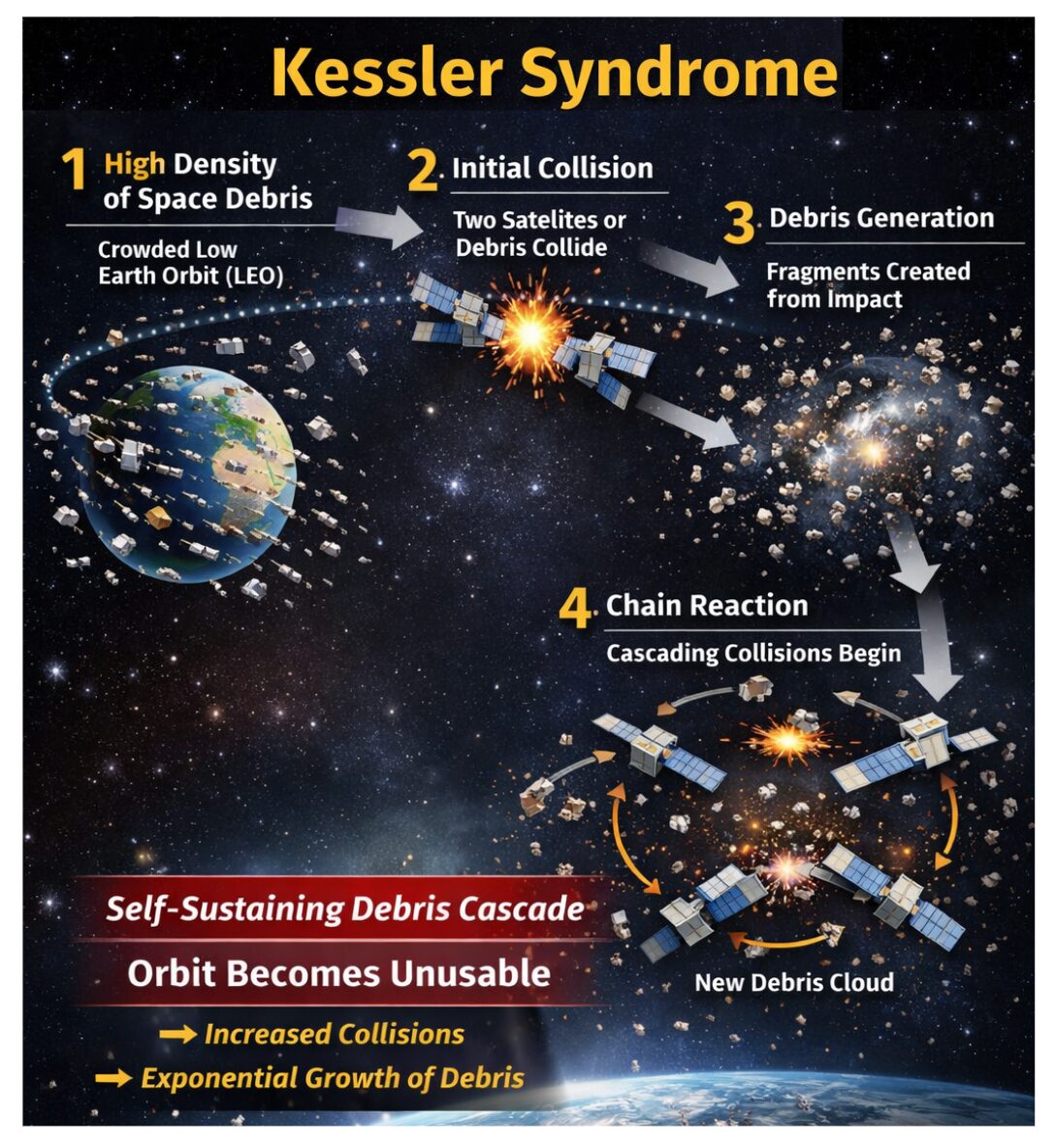
    • Floating space debris is a potential hazard for operational satellites. Any collision can leave the satellites dysfunctional and further risk a chain of collisions (Kessler Syndrome).
    • High concentration of debris in specific orbital regions (E.g., Low Earth Orbit) can limit the availability of desirable orbital slots for future missions.
    • Unprecedented rate of creation of space debris due to increasing satellite launches (communication, navigation, earth observation) and growth of private players (SpaceX, OneWeb, etc.)
    • Rising amounts of space debris severely complicate space situational awareness (SSA), making it difficult for operators to track objects and predict potential collisions with accuracy. 

    Kessler Syndrome: If the density of debris in orbit becomes too high, collisions can trigger a chain reaction, creating more fragments and further collisions, eventually making certain orbits unusable.

    Challenges associated in removal of Space Debris: 

    • Difficulty in tracking space debris: Much of the debris capable of causing damage is impossible to track consistently. A fragment can only be tracked to its source after it has caused some damage. There exists no single global authority to regulate satellite movement and collision avoidance. 
    • Lack of Legal Definition: Space debris lacks a universally accepted legal definition in international treaties.
      • No Binding Definition: The core pillars of international space law- the 1967 Outer Space Treaty, the 1972 Liability Convention- define space objects, but never specifically define “space debris”.
      • The Inter-Agency Space Debris Coordination Committee (IADC) and the UN Committee on the Peaceful Uses of Outer Space (COPUOS) have working definitions. COPUOS refers to space debris: “Space debris is all man-made objects, including fragments and elements thereof, in Earth orbit or re-entering the atmosphere, that are non-functional.” However, these are voluntary, non-binding guidelines.
    • Legal Constraints in Debris Removal: Given the lack of definition, legal disputes often hinge on whether a piece of debris qualifies as a “space object” under the Liability Convention 1972. This means one nation cannot legally remove another’s debris without permission, which complicates active debris removal efforts.
    • Regulatory Vacuum: 
      • No binding rules to penalise uncontrolled re-entries of rockets until damage occurs.
      • No regulations to check the accountability of satellite operators if they track and manage the debris of their own satellites, once the mission ends. 
    • Lack of an international body to set rules on space traffic and debris. Thus far, space missions have been supervised at the national level only, and states have been encouraged to translate non-binding space debris guidelines into national regulations.

    Existing guidelines to mitigate debris in orbit rely largely on voluntary compliance and lack uniform monitoring or sanctions for non-compliance.

    What is PROJECT NETRA?
    NETRA stands for Network for Space Object Tracking and Analysis. 
    Initiative of: Indian Space Research Organisation (ISRO)
    An early warning system in space to detect debris and hazards to Indian satellites for space situational awareness (SSA).
    NETRA uses telescopes, radars, and data processing units to track small debris (≥10 cm) up to a range of 3400 kms, covering major satellite orbits (~2,000 km altitude). 

    Way Forward:

    • Formulate an international binding agreement for the management of debris and space traffic. International harmonisation of space traffic for an efficient and interference-free use of space.
    • Standard National license for law enforcement: Licensing conditions need to be standardised. Launch operators should be mandated to use measurable debris-mitigation thresholds, compulsorily share data to improve space situational awareness, and use verifiable end-of-life disposal strategies.
    • R&D: Develop high-accuracy assessment and prediction tools to reduce risk to current systems and future launches.
      • Active debris removal technologies (robotic capture, laser nudging)
      • AI-based collision avoidance systems.
    • Transparency and data sharing: Mandatory sharing of orbital data, an open global catalogue of space objects and collaborative debris monitoring mechanisms. 

    Ethical orbital governance means recognising that shared environments demand shared restraint and that access to orbit carries obligations beyond national interest or commerce. 

    Since space is a global common, all stakeholders must move towards codifying the best principles of orbital governance, which are binding and enforceable. 

    Practice Mains Question: 

    Q. Growing congestion and space debris have raised concerns about Space Sustainability. Identify the key challenges in maintaining the sustainability of outer space and evaluate the steps taken at the national and global levels to address these concerns.