Why in News?
Earth’s orbital environment has become crowded, fragile, and vulnerable, threatened by the huge scale of space debris. The orbital environment is actively used, commercially exploited, and strategically warranted but ethically under-governed.

| UPSC Relevance: GS-3 Science and Technology: Space Technology Prelims: Kessler Syndrome; Project NETRA Mains: Space Sustainability and Orbital Governance |
What is Space Debris?
- Space debris, or space junk, is any piece of machinery or debris left by humans in space. It consists of defunct satellites, discarded rocket stages, and small fragments like paint flecks, metal shards, etc.
- Currently, 30,000+ trackable debris objects orbit Earth at very high speeds (~28,000 km/ h). Even debris smaller than a coin carries enough energy to disable or destroy an active satellite.
Why is Space Debris a serious concern?
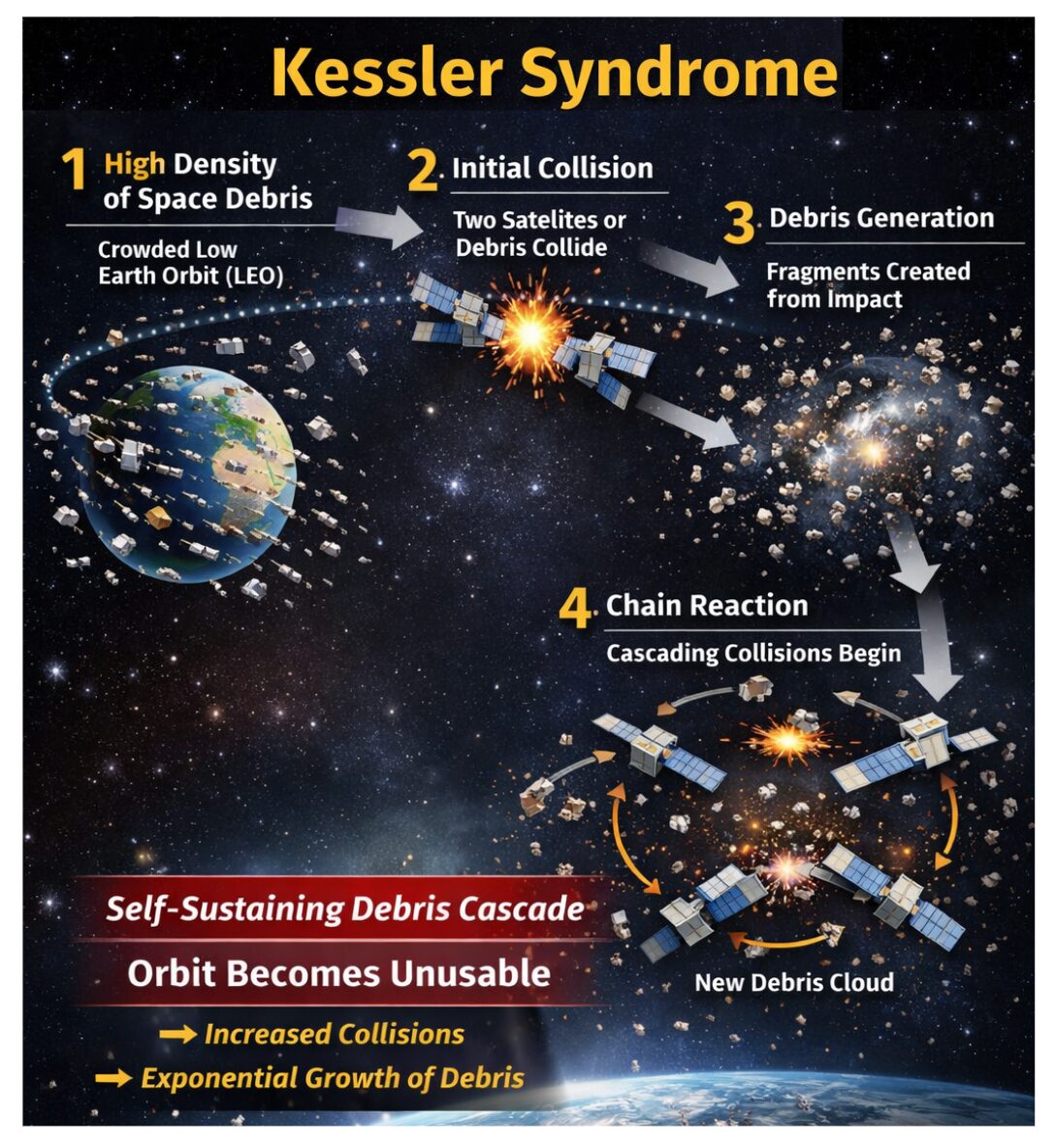
- Floating space debris is a potential hazard for operational satellites. Any collision can leave the satellites dysfunctional and further risk a chain of collisions (Kessler Syndrome).
- High concentration of debris in specific orbital regions (E.g., Low Earth Orbit) can limit the availability of desirable orbital slots for future missions.
- Unprecedented rate of creation of space debris due to increasing satellite launches (communication, navigation, earth observation) and growth of private players (SpaceX, OneWeb, etc.)
- Rising amounts of space debris severely complicate space situational awareness (SSA), making it difficult for operators to track objects and predict potential collisions with accuracy.
Kessler Syndrome: If the density of debris in orbit becomes too high, collisions can trigger a chain reaction, creating more fragments and further collisions, eventually making certain orbits unusable.
Challenges associated in removal of Space Debris:
- Difficulty in tracking space debris: Much of the debris capable of causing damage is impossible to track consistently. A fragment can only be tracked to its source after it has caused some damage. There exists no single global authority to regulate satellite movement and collision avoidance.
- Lack of Legal Definition: Space debris lacks a universally accepted legal definition in international treaties.
- No Binding Definition: The core pillars of international space law- the 1967 Outer Space Treaty, the 1972 Liability Convention- define space objects, but never specifically define “space debris”.
- The Inter-Agency Space Debris Coordination Committee (IADC) and the UN Committee on the Peaceful Uses of Outer Space (COPUOS) have working definitions. COPUOS refers to space debris: “Space debris is all man-made objects, including fragments and elements thereof, in Earth orbit or re-entering the atmosphere, that are non-functional.” However, these are voluntary, non-binding guidelines.
- Legal Constraints in Debris Removal: Given the lack of definition, legal disputes often hinge on whether a piece of debris qualifies as a “space object” under the Liability Convention 1972. This means one nation cannot legally remove another’s debris without permission, which complicates active debris removal efforts.
- Regulatory Vacuum:
- No binding rules to penalise uncontrolled re-entries of rockets until damage occurs.
- No regulations to check the accountability of satellite operators if they track and manage the debris of their own satellites, once the mission ends.
- Lack of an international body to set rules on space traffic and debris. Thus far, space missions have been supervised at the national level only, and states have been encouraged to translate non-binding space debris guidelines into national regulations.
Existing guidelines to mitigate debris in orbit rely largely on voluntary compliance and lack uniform monitoring or sanctions for non-compliance.
| What is PROJECT NETRA? NETRA stands for Network for Space Object Tracking and Analysis. Initiative of: Indian Space Research Organisation (ISRO) An early warning system in space to detect debris and hazards to Indian satellites for space situational awareness (SSA). NETRA uses telescopes, radars, and data processing units to track small debris (≥10 cm) up to a range of 3400 kms, covering major satellite orbits (~2,000 km altitude). |
Way Forward:
- Formulate an international binding agreement for the management of debris and space traffic. International harmonisation of space traffic for an efficient and interference-free use of space.
- Standard National license for law enforcement: Licensing conditions need to be standardised. Launch operators should be mandated to use measurable debris-mitigation thresholds, compulsorily share data to improve space situational awareness, and use verifiable end-of-life disposal strategies.
- R&D: Develop high-accuracy assessment and prediction tools to reduce risk to current systems and future launches.
- Active debris removal technologies (robotic capture, laser nudging)
- AI-based collision avoidance systems.
- Transparency and data sharing: Mandatory sharing of orbital data, an open global catalogue of space objects and collaborative debris monitoring mechanisms.
Ethical orbital governance means recognising that shared environments demand shared restraint and that access to orbit carries obligations beyond national interest or commerce.
Since space is a global common, all stakeholders must move towards codifying the best principles of orbital governance, which are binding and enforceable.
Practice Mains Question:
Q. Growing congestion and space debris have raised concerns about Space Sustainability. Identify the key challenges in maintaining the sustainability of outer space and evaluate the steps taken at the national and global levels to address these concerns.
Tell Google you want more of this.
Add Anantam IAS as a preferred sourceOne tap, and this site shows up more often in your own Top Stories, AI Overviews and AI Mode. Remove it any time.