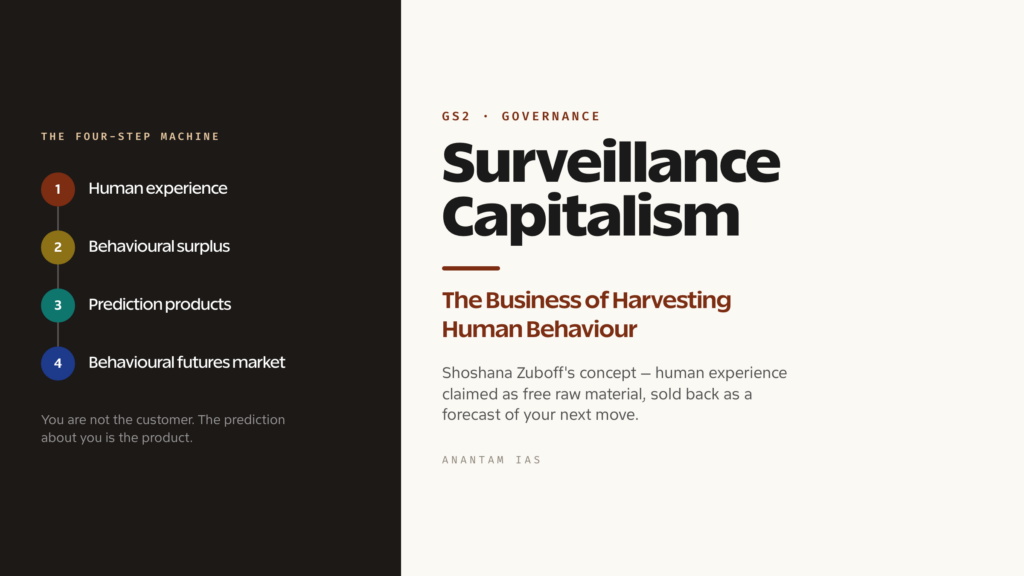
Open almost any app today and a quiet trade begins before you’ve typed a word. The thing being bought and sold isn’t the app, and it isn’t even your attention — it’s a prediction about what you’ll do next. That trade is the engine of what the Harvard scholar Shoshana Zuboff named, in her 2019 book, surveillance capitalism: an economic order that quietly claims your private experience as free raw material, refines it into forecasts of your behaviour, and sells those forecasts to whoever wants to bet on your next move. Zuboff’s phrase has since travelled far beyond academia, because it gave a name to a discomfort millions already felt — that the free internet was never really free, and that the price was something more intimate than money.
For an Indian aspirant, this is not a foreign debate to admire from a distance. It sits squarely inside the syllabus. It is a governance and rights question for GS Paper 2 — the right to privacy the Supreme Court read into the Constitution in 2017, and the data-protection law India finally passed in 2023 and operationalised in 2025. It is a science-and-technology and security question for GS Paper 3 — artificial intelligence, the data economy, and the surveillance state. And it is a ready-made ethics case on autonomy, consent and manipulation. Get the concept clear, attach the Indian law to it, and you have one of the most flexible answers in the modern syllabus.
What Surveillance Capitalism Actually Is
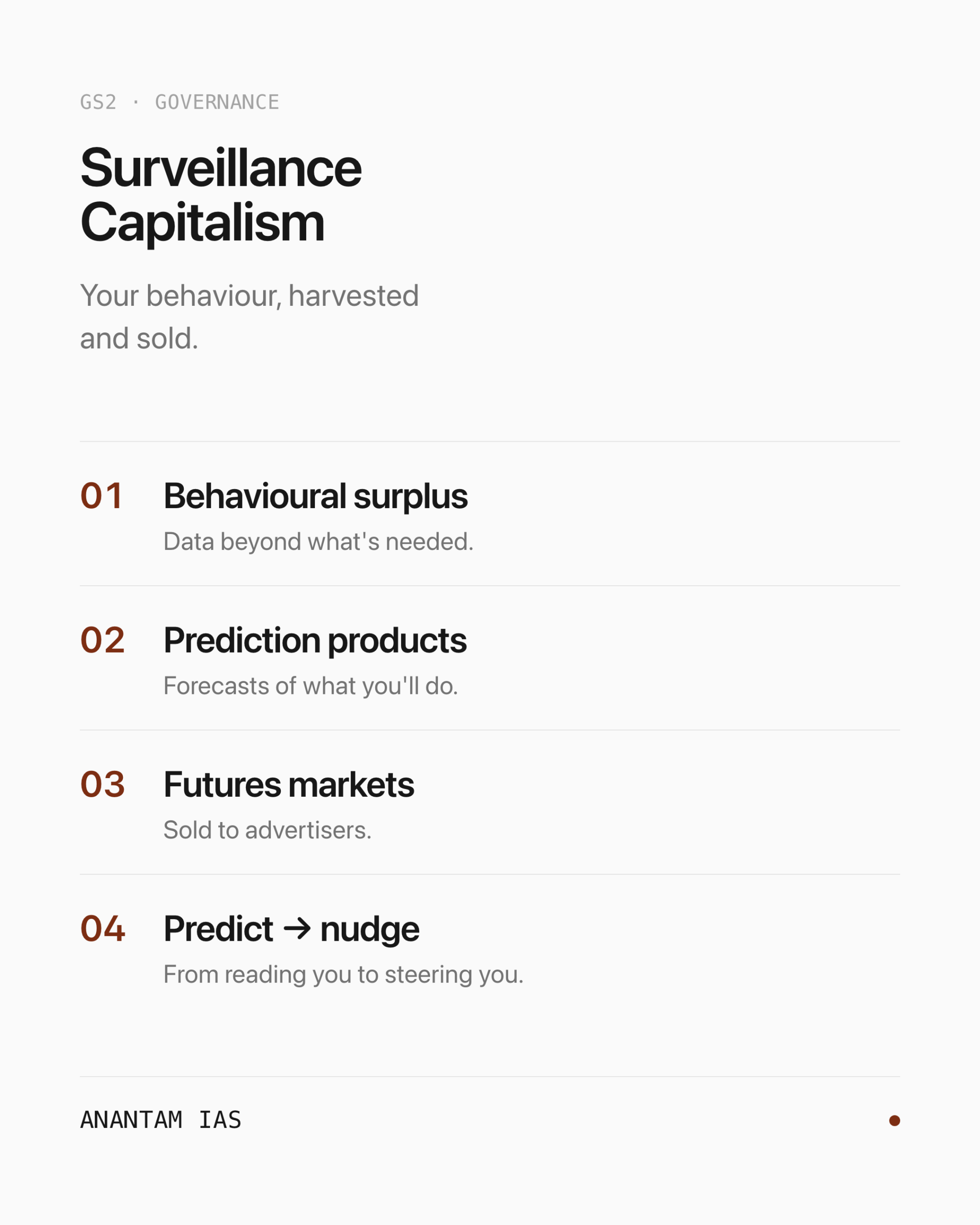
Start with Zuboff’s own definition, because the precision is the point. Surveillance capitalism, she writes, is the unilateral claiming of private human experience as free raw material for translation into behavioural data. The word unilateral does the heavy lifting: nobody asked you, and you were never meant to notice. The data is taken, not traded for. And the word surplus is the second key. When you use a search engine or a map, some of the data you generate is fed back to improve the service — better results, a faster route. But a great deal more is left over, a residue Zuboff calls the behavioural surplus: the extra signals about how you scrolled, where you paused, what you ignored, who you know, how you feel. That surplus is the raw ore of the whole industry.
The discovery that this leftover could be money is usually dated to Google in the early 2000s. Faced with the dot-com crash and the need to make search pay, a small team built the system that became AdWords and found that the behavioural exhaust of search — patterns nobody had thought worth keeping — could predict which advertisement a person was most likely to click. That was the founding insight of the model: not “what is the user searching for” but “what will this user do.” Once it worked at Google, it spread. Social networks, app stores, smart speakers, connected cars, fitness trackers and a thousand free services adopted the same logic, because the same logic prints money.
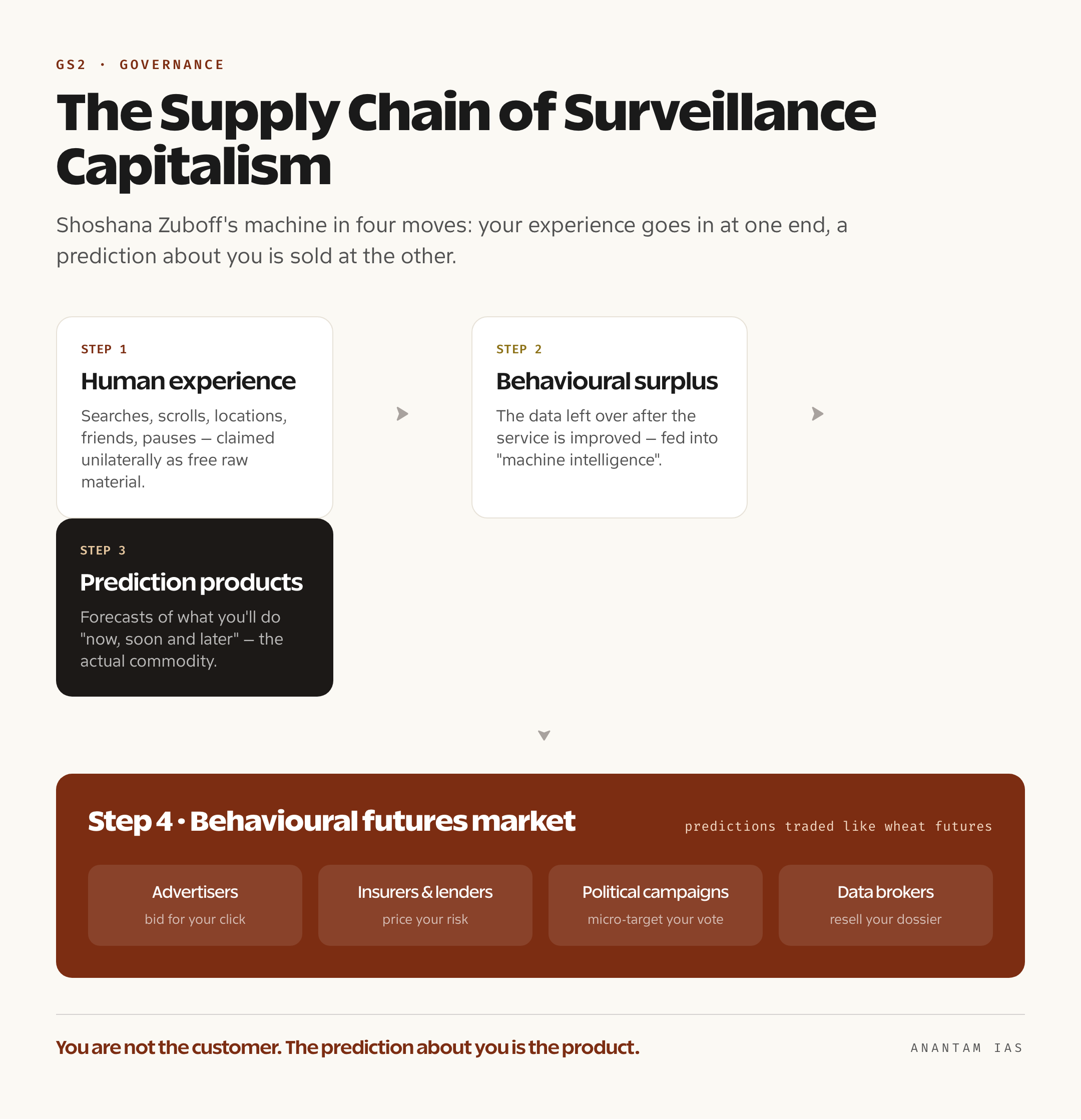
From there the chain is mechanical, and it’s worth memorising as a four-step pipeline. Human experience is claimed as free raw material. The behavioural surplus is fed into what the industry calls machine intelligence — the large-scale computation and machine-learning systems that find patterns in oceans of data. Out of that come prediction products: calculations that anticipate, in Zuboff’s words, what you will do “now, soon, and later.” And those predictions are sold in what she names behavioural futures markets — marketplaces where companies place bets on your future conduct exactly as traders bet on the future price of wheat. The advertiser buying a targeted slot, the insurer pricing a policy, the lender scoring a borrower, the political campaign micro-targeting a swing voter: all are customers in a market for predictions about human beings. The user is not the customer. The user is the source of the raw material, and the prediction about the user is the product.

From Predicting You to Shaping You
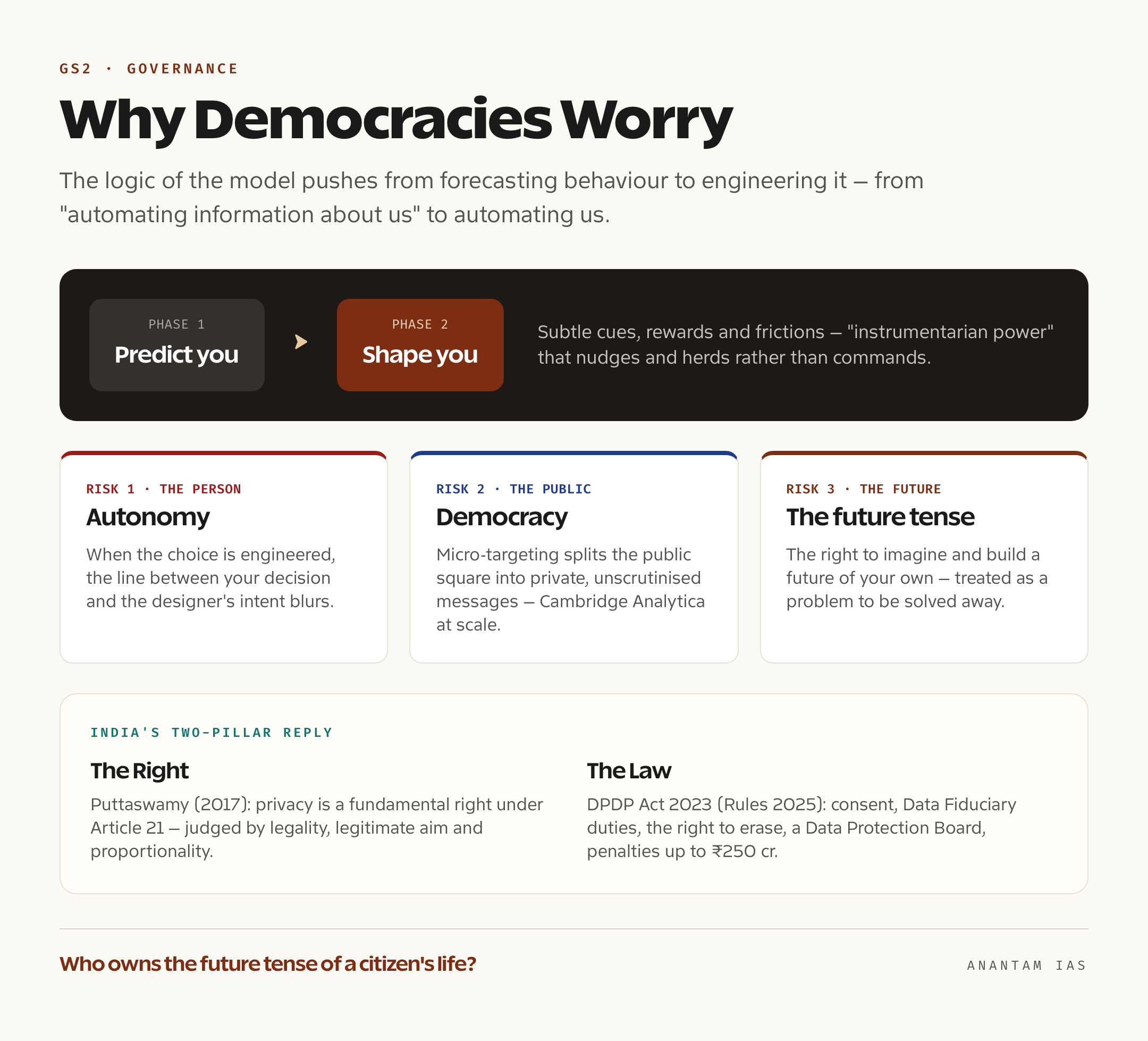
If the story stopped at prediction, it would be unsettling but familiar — advertising has always tried to read us. Zuboff’s sharper warning is about what comes after. The most valuable prediction is a certain one, and the surest way to know what someone will do is to make them do it. So the logic of the model pushes from forecasting behaviour toward modifying it. She captures the shift in a single line that’s worth quoting in an answer: the project has moved from “automating information flows about us” to “automating us.” The first phase watched. The second phase nudges, herds and tunes.
The instruments are subtle by design. Zuboff describes “economies of action” — the engineering of small cues, rewards and frictions that steer conduct without the person feeling steered. An infinite scroll that never lets you reach a stopping point. A notification timed to the moment your resolve is weakest. A feed ordered to hold your gaze a few seconds longer. None of this announces itself as control, which is what makes it powerful. This is the attention economy and surveillance capitalism fused: attention is harvested to generate the surplus, and the surplus is used to capture more attention, in a loop that tightens with every cycle.
To name the new kind of power this creates, Zuboff coins instrumentarianism. It is not the old totalitarian power that breaks bodies and demands belief; it doesn’t care what you think. It works through instruments — the ubiquitous, networked devices around us — to instrument and instrumentalise behaviour for prediction, modification and control. Its ambition, she argues, is a kind of frictionless social order in which computational certainty and quiet behavioural tuning replace the messy business of persuasion, argument and politics. You’re not commanded; you’re conditioned. That is a different and, in her telling, more insidious threat, because it can feel like nothing at all.
The Real Episodes: Cambridge Analytica and the Ad-Tech Machine
Concepts land harder with cases, and the canonical one is Cambridge Analytica. Between roughly 2014 and 2018 the political-consulting firm obtained the behavioural profiles of tens of millions of Facebook users — reporting at the time put the figure around 87 million — harvested largely without their knowledge through a personality-quiz app that also scraped data from the quiz-takers’ friends. The firm claimed it could build psychographic profiles and target voters with tailored political messages calibrated to their personalities, and it worked for campaigns including the 2016 cycle in the United States. The scandal that broke in 2018 became the public’s crash course in what behavioural data could do. Zuboff’s point, though, is that Cambridge Analytica was not an aberration in an otherwise clean system — it was the ordinary machinery of surveillance capitalism turned to an election rather than a shopping cart. The same profiling that sells you shoes can be aimed at your vote.
Behind the headline cases sits the everyday plumbing: ad-tech, the vast and largely invisible advertising-technology industry. In the fraction of a second it takes a webpage to load, an automated auction — real-time bidding — broadcasts a packet of information about you to hundreds of potential advertisers, who bid for the chance to show you an ad, and the highest bidder wins, all before the page finishes rendering. Layered on top is a network of data brokers, companies most people have never heard of, that assemble, buy and sell dossiers on individuals drawn from purchases, locations, app activity and public records. This is the routine, lawful, day-in-day-out face of the model. The scandals are simply the moments when the lights flicker on.
It’s worth distinguishing surveillance capitalism from a rival diagnosis it’s often confused with: the economist Yanis Varoufakis’s idea of techno-feudalism. Both look at the same digital giants and see something disturbing, but they name different beasts. Zuboff says capitalism is still capitalism — markets, competition, profit — only now the commodity is predictions about human behaviour and the raw material is human experience itself. Varoufakis argues the platforms have stopped behaving like capitalists at all: they own the digital “land” we all must live on and extract rent from everyone who uses it, more like feudal lords than market competitors. For an answer, the contrast is useful shorthand — surveillance capitalism is about extracting behaviour to sell predictions, techno-feudalism is about owning the platform to collect rent. They can both be partly true at once.
Why It Threatens Autonomy and Democracy
Pull the threads together and the stakes become clear, and they map onto exactly the values a civil servant is sworn to protect. The first casualty is individual autonomy. If your environment is quietly engineered to make some choices easy and others hard, the line between your decision and the designer’s intention blurs. Zuboff frames the deepest loss as the erosion of what she calls the right to the future tense — the elemental human capacity to imagine, intend and build a future of your own. A system optimised to make your behaviour predictable, and then to make it happen on schedule, treats that open future as a problem to be solved. Autonomy, in her account, isn’t just inconvenienced by surveillance capitalism; it’s the thing the model is built to overcome.
The second casualty is democracy itself. A democracy assumes citizens who can form views through open argument and a shared, broadly truthful information space. Micro-targeting fractures that: instead of a public conversation, each voter receives a private, tailored message tuned to their psychological pressure points, invisible to everyone else and to scrutiny. The result is a politics that can be segmented, manipulated and inflamed at the level of the individual nervous system. Zuboff has argued bluntly that surveillance capitalism, left unchecked, undermines democracy — concentrating in a few private firms a knowledge about populations, and a power to shape them, that no electorate has authorised and no parliament has fully seen. When a handful of companies know more about citizens than the state does, and can act on that knowledge at scale, the balance of power between people and institutions quietly tilts.
The third casualty is the information ecosystem that everything else depends on. Engagement-maximising systems learn that outrage, fear and novelty hold attention best, so the surplus-harvesting machine has a structural bias toward the inflammatory. Misinformation spreads not despite the business model but partly because of it. For a governance answer, this is the bridge to debates on platform regulation, fact-checking and intermediary liability — the same machinery that monetises attention also degrades the public square it depends on.
India’s Answer: Privacy as a Right and the DPDP Act
Here is where the global concept becomes an Indian governance question, and the connective tissue is two pillars an aspirant should always pair. The first is constitutional. In Justice K.S. Puttaswamy v. Union of India (2017), a nine-judge bench of the Supreme Court held unanimously that the right to privacy is a fundamental right, intrinsic to the right to life and personal liberty under Article 21 and to the freedoms in Part III. The Court overruled older judgments that had denied it, and — crucially for the data age — it laid down a test for when the state may intrude: any infringement must satisfy legality (backed by law), legitimate aim, and proportionality (no more intrusive than necessary). The case had begun as a challenge to the mandatory biometric Aadhaar scheme, which is why informational privacy — control over your own data — sits at the heart of the verdict. Puttaswamy is the constitutional anchor for every Indian conversation about surveillance, public or private.
The second pillar is statutory: the Digital Personal Data Protection (DPDP) Act, 2023, whose operational rules were notified in 2025, putting the law into motion with a phased compliance window. The Act builds its scheme around a few ideas that translate the surveillance-capitalism critique into enforceable duties. It calls the person whose data is being processed the Data Principal, and the entity that decides why and how to process it the Data Fiduciary — and the word fiduciary is deliberate, casting the data-handler as a trustee who owes duties, not a free owner of your information. Its core engine is consent: a Data Fiduciary must generally obtain free, informed, specific consent through a clear notice stating exactly what is collected and why, and the Data Principal can withdraw that consent. It grants rights to access, correct and erase your data, demands stronger safeguards for children’s data, and creates a Data Protection Board of India to adjudicate breaches, with penalties running up to ₹250 crore for serious failures such as inadequate security safeguards.
But the Indian debate is genuinely two-sided, and a strong answer holds both ends. The hardest tension is surveillance versus privacy when the surveiller is the state. Critics worry that the DPDP Act grants the government broad exemptions — letting state agencies process personal data for purposes such as national security or public order outside several of the law’s protections — which, paired with expanding facial-recognition systems and CCTV networks deployed by police and agencies, risks legitimising state surveillance even as it disciplines private firms. The private-sector harvesting Zuboff describes and the public-sector watching that worries civil-liberties advocates are two faces of the same data economy, and India is building law for both at once. The way to judge any rule — a data law, a facial-recognition rollout, a fact-check mandate — is the test Puttaswamy already gave us: is it lawful, does it serve a legitimate aim, and is it proportionate.
For Your Mains Answer
This topic is unusually portable. It is a GS Paper 2 answer on governance, the right to privacy and data-protection law; a GS Paper 3 answer on the digital economy, artificial intelligence and internal security; and a clean GS Paper 4 ethics case on autonomy, consent and manipulation. It also gives the Essay paper a sharp lens on technology, freedom and democracy. The examiner’s reward is always the same: define the concept precisely, anchor it to the Indian constitutional-and-legal frame, and then judge it with both edges of the argument.
How to Build the Answer
Move in a clean chain. Define surveillance capitalism in Zuboff’s terms (human experience as free raw material). Lay out the pipeline (behavioural surplus → machine intelligence → prediction products → behavioural futures markets). Show the shift from predicting to shaping behaviour, naming instrumentarian power and the right to the future tense. Ground it in a case (Cambridge Analytica) and the everyday machine (ad-tech). Spell out the threats to autonomy and democracy. Then pivot hard to India — Puttaswamy as the right, the DPDP Act 2023 as the law — and close with the two-sided surveillance-versus-privacy tension, using the proportionality test as your yardstick. Concept, then country, then verdict.
Common Mistakes to Avoid
Don’t reduce surveillance capitalism to “companies collect your data” — the marks are in the surplus and the behavioural futures market, the selling of predictions. Don’t confuse it with techno-feudalism; keep predictions-versus-rent straight. Don’t treat privacy and the DPDP Act as the same thing — privacy is the Puttaswamy fundamental right, the DPDP Act is the statute that operationalises a slice of it. And don’t write a one-sided rant: a balanced answer notes that data also powers welfare delivery and innovation, and that the real question is proportionate regulation, not abolition.
A Compact Answer Spine
Zuboff (2019): human experience claimed as free raw material → behavioural surplus → machine intelligence → prediction products sold in behavioural futures markets → shift from “automating information about us” to “automating us” (instrumentarian power) → threatens autonomy (right to the future tense) and democracy (micro-targeting, Cambridge Analytica) → India: privacy a fundamental right (Puttaswamy 2017, Art. 21, proportionality test) + DPDP Act 2023 / Rules 2025 (Data Principal, Data Fiduciary, consent, Data Protection Board, ₹250 cr penalty) → live tension: state surveillance and facial recognition vs privacy → verdict: legality + legitimate aim + proportionality.
Diagram or Flowchart Idea
Draw the four-box horizontal pipeline — Human experience → Behavioural surplus → Prediction products → Behavioural futures market — with a feedback arrow looping back from the market to “shaping behaviour.” Beside it, a small two-column box: India’s two pillars, “Right (Puttaswamy 2017)” and “Law (DPDP Act 2023).” That single visual carries the whole answer.
A Balanced-Conclusion Line
A line that lands the marks: “Surveillance capitalism asks who owns the future tense of a citizen’s life — and India’s reply, in Puttaswamy and the DPDP Act, is that the answer must be the citizen, provided the same proportionality we demand of companies is also demanded of the state.”
How to Use Data Without Cramming
You need only a handful of anchors: the year of the book (2019) and of Puttaswamy (2017); the DPDP Act year (2023) and its Rules (2025); the Cambridge Analytica scale (about 87 million profiles); and the DPDP ceiling penalty (₹250 crore). Attribute them plainly — “as Zuboff argued,” “the nine-judge bench in Puttaswamy held,” “the DPDP Rules notified in 2025” — rather than scattering figures.
Frequently Asked Questions
What is surveillance capitalism in simple terms?
It is the business model, named by Shoshana Zuboff in 2019, in which companies claim your private experience as free raw material, extract a “behavioural surplus” from the data you generate, use machine intelligence to turn it into predictions about your future behaviour, and sell those predictions to advertisers, insurers, lenders and political campaigns in what Zuboff calls behavioural futures markets. You are not the customer; the prediction about you is the product.
How is surveillance capitalism different from techno-feudalism?
Both describe the power of digital giants but diagnose it differently. Zuboff’s surveillance capitalism is still capitalism — markets and competition — where the commodity is predictions about human behaviour. Yanis Varoufakis’s techno-feudalism argues the platforms have stopped being capitalist and instead own the digital “land” everyone must use, extracting rent like feudal lords. In short: extracting behaviour to sell predictions versus owning the platform to collect rent.
How does India’s law respond to surveillance capitalism?
Through two pillars. The Supreme Court’s 2017 Puttaswamy judgment made the right to privacy a fundamental right under Article 21, with a proportionality test for any intrusion. The Digital Personal Data Protection Act, 2023 (rules notified in 2025) then built an enforceable regime around consent, casts data-handlers as “Data Fiduciaries” who owe duties to “Data Principals,” grants rights to access, correct and erase data, and sets up a Data Protection Board with penalties up to ₹250 crore.
Why is surveillance capitalism seen as a threat to democracy?
Because the same machinery that predicts behaviour can be used to shape it. Micro-targeting lets campaigns send each voter a private, tailored message tuned to their psychological triggers, invisible to public scrutiny — the Cambridge Analytica episode showed this at scale. It also concentrates in a few private firms a knowledge about populations, and a power to nudge them, that no electorate has authorised, tilting the balance between citizens and institutions.
Practice Questions
Prelims MCQs
- The term “behavioural surplus,” central to the concept of surveillance capitalism, refers to which of the following?
(a) The profit left after a company pays for its data centres
(b) Behavioural data left over after service improvement, used to predict and modify behaviour
(c) The surplus of consumers over producers in a digital market
(d) The unused storage capacity on a cloud server
Answer: (b) Shoshana Zuboff defines behavioural surplus as the residual behavioural data, beyond what improves the service, that is mined to forecast and influence future behaviour. - The concept of “surveillance capitalism” was developed and popularised by which scholar?
(a) Yanis Varoufakis
(b) Shoshana Zuboff
(c) Cathy O’Neil
(d) Evgeny Morozov
Answer: (b) Shoshana Zuboff introduced and elaborated the concept, most fully in her 2019 book on the subject. Varoufakis is associated with the rival idea of techno-feudalism. - In Justice K.S. Puttaswamy v. Union of India (2017), the Supreme Court held that the right to privacy is:
(a) A statutory right created by Parliament
(b) A fundamental right intrinsic to Article 21 and Part III of the Constitution
(c) A directive principle, not enforceable in court
(d) Available only against private parties, not the state
Answer: (b) A nine-judge bench unanimously held privacy to be a fundamental right intrinsic to the right to life and personal liberty under Article 21 and the freedoms in Part III. - Under the Digital Personal Data Protection Act, 2023, the entity that determines the purpose and means of processing personal data is called the:
(a) Data Principal
(b) Data Fiduciary
(c) Consent Manager
(d) Data Protection Board
Answer: (b) The Data Fiduciary decides why and how personal data is processed; the individual whose data it is, is the Data Principal. - Which test did the Supreme Court lay down in Puttaswamy for a valid intrusion into the right to privacy by the state?
(a) Reasonableness and public interest alone
(b) Legality, legitimate aim and proportionality
(c) Necessity and majority approval
(d) National interest and executive discretion
Answer: (b) Any infringement must satisfy legality (backed by law), a legitimate state aim, and proportionality between the means and the object.
Mains Practice Questions
- “Surveillance capitalism claims human experience as free raw material and sells predictions about our future behaviour.” Explain this concept and examine its implications for individual autonomy. (15 marks, 250 words)
- Discuss how the business model of large digital platforms can undermine democratic processes. What safeguards can a democracy adopt without stifling innovation? (15 marks, 250 words)
- The right to privacy in India rests on Puttaswamy (2017) and is operationalised by the Digital Personal Data Protection Act, 2023. Critically evaluate how far this framework addresses the harms of a data-driven economy. (15 marks, 250 words)
- Distinguish between “surveillance capitalism” and “techno-feudalism” as competing accounts of the power of digital giants. Which framing is more useful for a policymaker, and why? (10 marks, 150 words)
- State surveillance and the protection of personal privacy are often in tension. Using the proportionality standard, suggest how India can balance security needs with the fundamental right to privacy in the age of facial recognition and big data. (15 marks, 250 words)
Tell Google you want more of this.
Add Anantam IAS as a preferred sourceOne tap, and this site shows up more often in your own Top Stories, AI Overviews and AI Mode. Remove it any time.