
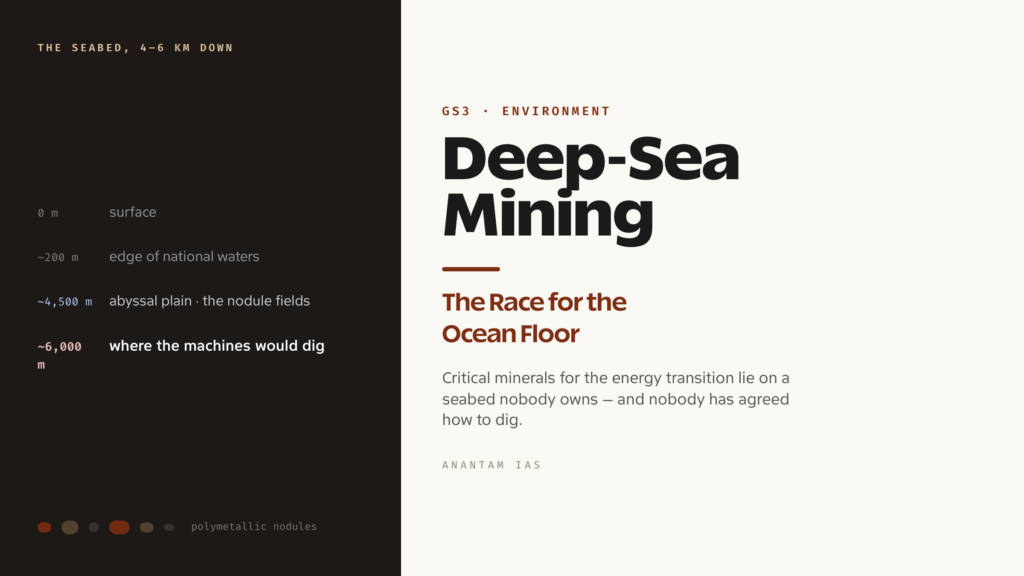
Three or four kilometres beneath the surface of the Pacific, in cold and total darkness, the seabed is littered with what look like blackened potatoes. They are polymetallic nodules — lumps of rock that grew over millions of years, one atom-thin layer at a time, around a shark’s tooth or a fragment of bone. And they are packed with exactly the metals the world now says it cannot live without: nickel, cobalt, copper and manganese, the raw stuff of electric-car batteries, wind turbines and the whole clean-energy build-out. For decades they sat there as a geological curiosity. Now they sit at the centre of one of the tensest standoffs in global environmental politics, because a handful of companies and governments want to start scooping them up at industrial scale, and a growing bloc of countries and scientists wants the whole idea paused before it begins.
That standoff is what deep-sea mining is really about — not just engineering, but who owns the bottom of the ocean and what we are willing to risk to get at it. The legal answer is that the international seabed belongs to no one and everyone; the law calls it the “common heritage of mankind.” The practical answer is that nobody has yet agreed on the rulebook for digging it up, and in 2025 the United States decided it would stop waiting and write its own. For a UPSC aspirant this topic is a gift, because it stitches together environment, the Law of the Sea, the critical-minerals scramble and India’s own quiet ambitions in the Indian Ocean into a single, examinable knot.
What Lies on the Deep Seabed and Why Everyone Suddenly Wants It
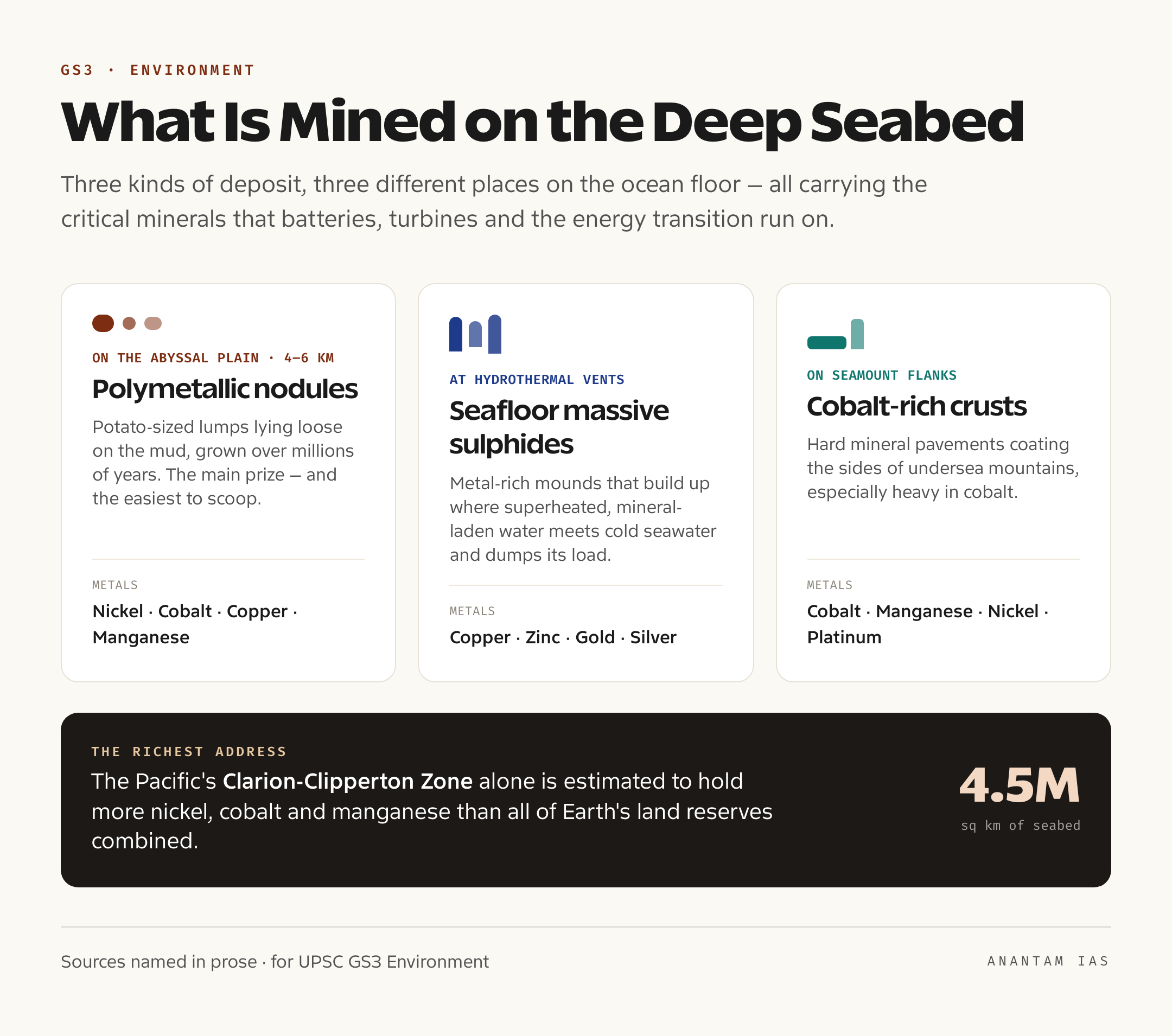
Start with the deposits, because the whole debate rests on three kinds of rock. The first and most famous are the polymetallic nodules — those potato-sized lumps lying loose on the abyssal plains, four to six kilometres down, rich in manganese, nickel, copper and cobalt. They are not buried; they sit on the surface of the mud like scattered marbles, which is precisely what makes them temptingly easy to harvest with a seabed collector. The second are seafloor massive sulphides, metal-rich mounds that build up around hydrothermal vents where superheated, mineral-laden water meets cold seawater and dumps its load of copper, zinc, gold and silver. The third are cobalt-rich ferromanganese crusts, hard pavements that coat the flanks of undersea mountains, or seamounts, and are especially loaded with cobalt. Each sits in a different place and needs a different machine, but all three carry metals the modern economy is desperate for.
The single most important address in this story is the Clarion-Clipperton Zone, a stretch of Pacific abyss the size of a continent — about 4.5 million square kilometres — running between Hawaii and Mexico. The US Geological Survey has estimated that this one zone holds more nickel, cobalt and manganese than all the proven reserves on dry land combined. That is the sentence that turned a scientific backwater into a gold rush. The International Seabed Authority has already handed out 31 exploration contracts there and across other seabed areas, the largest single bloc of them — five — held by China.
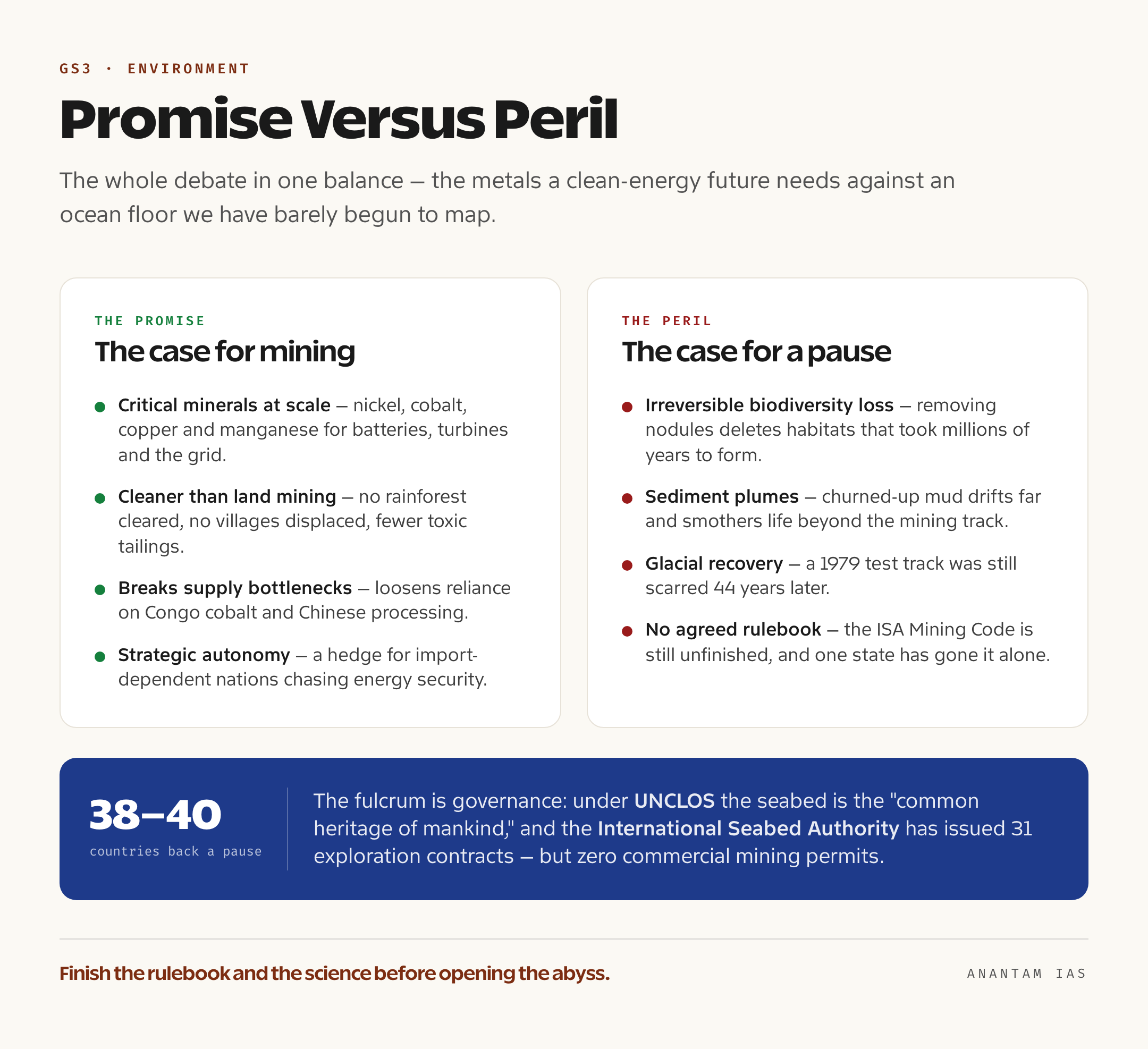
So why now? Because the clean-energy transition runs on metal. A single electric-vehicle battery can need tens of kilograms of nickel and several of cobalt; grid-scale storage and wind turbines pull on the same shopping list. Demand for these critical minerals is projected to multiply several times over the coming decades, and the land-based supply is awkward in two ways. It is concentrated — most of the world’s cobalt comes from the Democratic Republic of Congo, much of its processing from China — and it is often dirty, tangled with child labour, deforestation and toxic tailings. Backers of deep-sea mining argue that the seabed offers a way to break that bottleneck: vast tonnages of the right metals, no rainforest to clear, no villages to displace. The metals you can read about in the critical-minerals story are the same ones driving every ship out to the Clarion-Clipperton Zone. The promise, in one line, is a cleaner battery supply chain dug from a place where nobody lives.
Who Governs the Ocean Floor: The ISA and the “Common Heritage of Mankind”
This is where the Law of the Sea walks on, and it is the part examiners love. The seabed beyond any country’s national waters — beyond the 200-nautical-mile exclusive economic zone and the legally recognised continental shelf — is governed by the 1982 United Nations Convention on the Law of the Sea, which most aspirants meet through topics like the High Seas Treaty and BBNJ negotiations. UNCLOS calls this international seabed, in capital letters, “the Area,” and it makes a bold declaration: the Area and its mineral resources are the “common heritage of mankind.” No state can claim sovereignty over it; its riches belong to humanity as a whole, present and future, and any benefits from mining it are meant to be shared, with particular care for developing countries.
To put that principle into practice, UNCLOS created the International Seabed Authority, or ISA, headquartered in Kingston, Jamaica. Every country that has ratified the convention is a member, and the ISA’s job is to organise and control all mineral activity in the Area on humanity’s behalf. It does two things. It grants exploration contracts — permission to survey and study a patch of seabed, which is what the 31 existing licences cover. And it is supposed to write the “Mining Code,” the set of exploitation regulations that would actually allow commercial digging to begin, with environmental rules, royalty rates and benefit-sharing built in. The catch is the second half. After more than a decade of drafting, the Mining Code still does not exist. The ISA has issued plenty of permission to look, but none to mine.
The pressure to finish it came from an unexpected quarter. In June 2021 the tiny Pacific island state of Nauru, sponsoring a subsidiary of a mining company, formally told the ISA it intended to apply to mine — and in doing so it pulled a legal trigger buried in the rules. This is the notorious “two-year rule”: once a member gives notice, the ISA is obliged to finish its regulations within two years, and if it fails, it must consider and provisionally approve a mining application anyway, under whatever rules exist at the time. The two years lapsed in 2023 with no code agreed, leaving the Authority in an awkward legal limbo — theoretically open to applications it had no finished rulebook to judge. Through its 2025 sessions in Kingston, the ISA’s member states again ended their talks in deadlock: no Mining Code, no commercial permits, and no firm deadline to break the impasse. The deep sea stayed officially closed — but only just.
The Big Rupture: When One Country Decides Not to Wait
Into that legal vacuum stepped the United States, and this is the development that has made deep-sea mining a live geopolitical flashpoint rather than a slow regulatory saga. The crucial back-story is that the US has never ratified UNCLOS. It signed but never joined the convention, which means it has never been a member of the ISA and does not recognise the Authority’s exclusive right to license seabed mining in international waters. Instead it has its own decades-old domestic law, the Deep Seabed Hard Mineral Resources Act of 1980, that claims a unilateral right to license American companies to mine the deep seabed.
In April 2025 President Donald Trump signed an executive order, “Unleashing America’s Offshore Critical Minerals and Resources,” directing the Department of Commerce to fast-track exploration and recovery permits under that 1980 act — including for areas beyond US national waters. The National Oceanic and Atmospheric Administration, or NOAA, was tasked with reviewing licences for mining the international seabed directly, outside the ISA system entirely. Within days, The Metals Company — a firm that already holds ISA exploration contracts through Pacific sponsors but had grown impatient with the deadlock — filed for a commercial recovery permit under the American framework. The message was blunt: if the ISA will not open the door, we will use a different one.
The reaction was sharp and near-universal. The ISA’s Secretary-General stated that any country applying its own domestic law to mine the international seabed violates international law and the spirit of UNCLOS, because it treats the common heritage of mankind as if it were one nation’s to license. China and the European Union condemned the move on the same grounds. Critics warn it could shatter four decades of patiently built ocean governance and trigger a free-for-all, with each capable nation simply asserting its own right to dig. Defenders in Washington counter that since the US never joined UNCLOS, it is bound by its own law and is merely securing critical minerals against Chinese dominance. Whichever way it resolves, the episode has exposed how fragile the “common heritage” idea is once a powerful state decides the rules do not apply to it.
The Environmental Case for Slamming the Brakes
Running underneath the legal fight is a scientific one, and here the alarm is loud. The deep seabed is among the least-explored environments on Earth — we have better maps of the surface of Mars than of large parts of the abyssal plain — and it turns out to be far from the lifeless desert it was once assumed to be. The mud and nodules host strange, slow, ancient communities: sea cucumbers, brittle stars, sponges, worms and microbes, many of them found nowhere else and many living on the very nodules a mining machine would scoop away. Because the nodules themselves took millions of years to form and serve as the only hard surface for some creatures to live on, removing them does not just disturb a habitat — it deletes one that cannot grow back on any human timescale.
The damage comes in layers. The seabed collectors crush and strip the top layer of sediment directly, killing what lives there. Then there are sediment plumes — clouds of churned-up mud, some kicked up at the seafloor and some discharged from the ship after the nodules are separated, which can drift for long distances and smother filter-feeding life far from the actual mining track. There is noise, light and possible toxic-metal release into a world that has never known any of them. And recovery is glacial. The single most quoted piece of evidence is a test mining track gouged into the Pacific seabed back in 1979: when scientists returned more than four decades later, biodiversity along the track was still measurably lower than in the untouched seabed beside it. Forty-four years on, the scar had not healed.
This is why a precautionary-pause coalition has grown so fast. By 2025 around 38 to 40 countries — including France, Germany, Chile, Brazil and many Pacific island states — were backing a moratorium, a precautionary pause, or an outright ban on deep-sea mining until the science is far better understood. Hundreds of marine scientists have signed statements warning that we cannot responsibly mine an ecosystem we have barely begun to describe, and that the harm is likely to be irreversible and large-scale. Even some of the carmakers and tech firms that need the metals — the supposed customers — have pledged not to use seabed minerals for now. The conservation argument is not that these metals do not matter; it is that we should not trade a barely-known living world for them before we know what we are destroying, especially when battery recycling and better land-based practice could ease the crunch instead.
India in the Race: Two Contracts, the Deep Ocean Mission and a Careful Balance
India sits in this story with a foot on both sides of the line, and that balance is the heart of any India-focused answer. On the ambition side, India has been a pioneer-investor in seabed exploration for years. It holds an ISA exploration contract for polymetallic nodules in the Central Indian Ocean Basin, a roughly 75,000-square-kilometre patch estimated to hold around 380 million tonnes of nodules — carrying millions of tonnes of nickel, copper and manganese and substantial cobalt. Then in 2025 India went further: the Ministry of Earth Sciences signed a fresh 15-year contract with the ISA for exclusive rights to explore polymetallic sulphides across a 10,000-square-kilometre stretch of the Carlsberg Ridge in the Indian Ocean, with the work to be led by the National Centre for Polar and Ocean Research. That second contract made India the first country in the world to hold two separate ISA exploration contracts — a marker of serious intent.
This sits inside the wider Deep Ocean Mission, the multi-ministry, multi-thousand-crore programme run by the Ministry of Earth Sciences to build India’s capacity to explore and use the deep ocean. Its most eye-catching component is Samudrayaan, an indigenous crewed submersible designed to carry three people to a depth of about 6,000 metres in the Indian Ocean — India’s bid to physically reach the seabed it has been studying from the surface. The strategic logic is straightforward. India imports almost all of the critical minerals its energy transition and defence sector need, much of it from or through China; a domestic seabed source, even years away, is a hedge against that dependence and a step toward strategic autonomy. The technology spillovers — submersibles, sensors, marine robotics — matter on their own terms too.
But India has been careful, and that nuance is worth carrying into an answer. New Delhi is exploring, not exploiting. It is working entirely inside the ISA framework, has not joined the American end-run around it, and has generally supported the idea that the Mining Code must be finished — with real environmental safeguards — before any commercial mining begins. India’s position reflects a genuine tension that mirrors the global one: it wants the minerals and the prestige of leading-edge ocean science, but it also has a long coastline, a huge fishing economy and a stated commitment to a healthy ocean and the blue economy. The honest summary is that India is buying itself a seat at the table and the option to mine later, while letting the governance and the science mature first — a middle path between the rush and the moratorium.
For Your Mains Answer
This is a high-value topic for GS Paper 3, which covers environment and conservation, science and technology, and the mobilisation of resources — and it spills cleanly into GS Paper 2 on international institutions and groupings, since UNCLOS and the ISA are the spine of the story. A question can come at you from the environment side (the precautionary principle, irreversible biodiversity loss), the IR side (the common heritage of mankind, the US bypass of multilateral rules) or the resource-security side (critical minerals and strategic autonomy). It is also a ready-made Essay example on themes of technology versus nature, the global commons, and sustainable development. The skill that scores is the one this article uses: hold the promise and the peril in the same hand, anchor each with a fact, and place India precisely within the global debate.
How to Build the Answer
Move in a clean chain. Open with what deep-sea mining is and the three deposit types, lead with the nodules of the Clarion-Clipperton Zone. Explain why demand is rising — critical minerals for the energy transition. Then the governance: UNCLOS, the common heritage of mankind, the ISA and its stalled Mining Code, the two-year rule. Then the rupture — the US executive order and the bypass debate. Then the environmental case and the moratorium coalition. Close with India’s two contracts and the Deep Ocean Mission, and a balanced verdict. That arc — define, demand, govern, disrupt, conserve, locate India, judge — fits almost any framing of the question.
Common Mistakes to Avoid
Don’t confuse the ISA’s exploration contracts with permission to mine — there are 31 exploration licences but, as of now, zero exploitation permits, because the Mining Code is unfinished. Don’t say the US is “breaking ISA rules”; it never ratified UNCLOS, so the precise charge is that it is acting outside the multilateral framework the rest of the world accepts. Don’t treat the moratorium camp as anti-development; frame it as the precautionary principle applied to an irreversible risk. And don’t forget that India is exploring, not exploiting — getting that one word wrong flips the whole India paragraph.
A Compact Answer Spine
Deep-sea mining = extracting nodules, sulphides and crusts from the deep ocean floor for nickel, cobalt, copper, manganese → driven by critical-minerals demand for batteries and clean energy → richest site is the Clarion-Clipperton Zone (more nickel/cobalt/manganese than all land reserves) → the international seabed is the “common heritage of mankind” under UNCLOS, regulated by the ISA → ISA has 31 exploration contracts but no Mining Code; Nauru’s 2021 “two-year rule” trigger lapsed without one → in April 2025 the US bypassed the ISA via a domestic law and an executive order, drawing global condemnation → ~38-40 countries and many scientists back a precautionary pause over irreversible biodiversity loss (a 1979 test track is still scarred) → India holds two ISA exploration contracts (Central Indian Ocean Basin nodules + Carlsberg Ridge sulphides) under its Deep Ocean Mission and Samudrayaan, exploring inside the framework → verdict: balance critical-mineral security against an ocean we barely understand.
Diagram or Flowchart Idea
Draw a simple two-column balance: on the left, “The Promise” (critical minerals, cleaner than land mining, energy security); on the right, “The Peril” (irreversible biodiversity loss, sediment plumes, no rulebook, common-heritage conflict). Put the ISA and UNCLOS as the fulcrum in the middle. A balance like this signals at a glance that you understand the trade-off, and it is quick to sketch.
A Balanced-Conclusion Line
A line that lands the marks: “Deep-sea mining forces a hard choice between the metals a clean-energy future needs and the integrity of an ecosystem we have barely begun to map — and the wiser course is to finish the rulebook and the science before we open the abyss, not after.”
How to Use Data Without Cramming
You need only a handful of anchors: the Clarion-Clipperton Zone holds more nickel, cobalt and manganese than all land reserves; the ISA has issued 31 exploration contracts but no Mining Code; about 38-40 countries back a precautionary pause; a 1979 test track was still scarred 44 years later; and India holds two ISA exploration contracts (about 75,000 sq km in the Central Indian Ocean Basin, 10,000 sq km on the Carlsberg Ridge). Drop those into the right sentences and attribute them plainly — “as the ISA’s own figures show” — rather than scattering numbers.
Frequently Asked Questions
What is deep-sea mining and what is actually mined?
Deep-sea mining is the extraction of metal-rich mineral deposits from the deep ocean floor, usually three to six kilometres down. There are three main targets: polymetallic nodules (potato-sized lumps lying on the abyssal plains, rich in nickel, cobalt, copper and manganese), seafloor massive sulphides (mounds around hydrothermal vents holding copper, zinc, gold and silver), and cobalt-rich crusts on undersea mountains. Demand is rising because these are the critical minerals needed for electric-vehicle batteries, wind turbines and the wider clean-energy transition.
Who regulates the international seabed, and why is no mining happening yet?
The international seabed beyond national waters is governed by the 1982 UN Convention on the Law of the Sea, which declares it the “common heritage of mankind.” The International Seabed Authority (ISA), based in Kingston, organises all mineral activity there. It has granted 31 exploration contracts but has not finished its “Mining Code” — the regulations needed for commercial mining to begin. So while companies can survey the seabed, no one has yet been licensed by the ISA to mine it commercially.
Why did the United States bypass the ISA in 2025?
The US never ratified UNCLOS, so it is not an ISA member and does not accept the Authority’s exclusive right to license seabed mining. In April 2025 President Trump signed an executive order directing NOAA to fast-track mining permits under a 1980 US domestic law, and The Metals Company applied for a commercial recovery permit. The ISA Secretary-General, China and the EU condemned this as a violation of international law and the common-heritage principle, warning it could unravel decades of ocean governance.
What is India’s role in deep-sea mining?
India is a leading explorer working inside the ISA framework. It holds two ISA exploration contracts — one for polymetallic nodules in the roughly 75,000-square-kilometre Central Indian Ocean Basin, and a 15-year contract signed in 2025 for polymetallic sulphides across a 10,000-square-kilometre area of the Carlsberg Ridge — making it the first country with two such contracts. This sits within India’s Deep Ocean Mission, which includes the Samudrayaan crewed submersible designed to reach about 6,000 metres. India is exploring, not yet mining, and balances critical-mineral security against ocean conservation.
Practice Questions
Prelims MCQs
- With reference to the international seabed, the phrase “common heritage of mankind” is associated with which of the following?
(a) The Convention on Biological Diversity
(b) The 1982 UN Convention on the Law of the Sea
(c) The Antarctic Treaty System
(d) The Ramsar Convention
Answer: (b) UNCLOS, 1982, declares the international seabed (“the Area”) and its mineral resources the common heritage of mankind, to be administered by the International Seabed Authority. - The International Seabed Authority (ISA) is headquartered in which city?
(a) Geneva
(b) Nairobi
(c) Kingston, Jamaica
(d) London
Answer: (c) The ISA, created under UNCLOS, is based in Kingston, Jamaica, and regulates all mineral-related activity in the international seabed. - Polymetallic nodules found on the deep ocean floor are valued mainly for which of the following metals?
(a) Iron, aluminium, lead and zinc
(b) Nickel, cobalt, copper and manganese
(c) Gold, silver, platinum and tin
(d) Uranium, thorium, lithium and beryllium
Answer: (b) Polymetallic nodules are rich in nickel, cobalt, copper and manganese — critical minerals for batteries and clean-energy technology. - Consider the following about the Clarion-Clipperton Zone:
1. It lies in the Pacific Ocean between Hawaii and Mexico.
2. It is estimated to hold more nickel, cobalt and manganese than all land-based reserves combined.
3. It is governed by India’s Deep Ocean Mission. Which statements are correct?
(a) 1 and 2 only
(b) 2 and 3 only
(c) 1 and 3 only
(d) 1, 2 and 3
Answer: (a) The Clarion-Clipperton Zone is in the Pacific and holds vast metal reserves, but it falls under the ISA, not India’s Deep Ocean Mission; India’s contracts are in the Indian Ocean. - With reference to India’s deep-sea exploration, which statement is correct?
(a) India has begun commercial mining of polymetallic nodules in the Pacific
(b) India holds two ISA exploration contracts, in the Central Indian Ocean Basin and the Carlsberg Ridge
(c) India has joined the US framework to bypass the ISA
(d) India has called for an outright ban on all seabed exploration
Answer: (b) India holds ISA exploration contracts for nodules in the Central Indian Ocean Basin and, since 2025, for polymetallic sulphides on the Carlsberg Ridge — the first nation with two such contracts. It is exploring, not exploiting, and works within the ISA.
Mains Practice Questions
- What is deep-sea mining, and why has demand for deep-seabed minerals risen sharply in recent years? Discuss the environmental concerns that have led many countries to call for a moratorium. (15 marks, 250 words)
- Explain the principle of the “common heritage of mankind” under UNCLOS and the role of the International Seabed Authority. How has the 2025 US decision to license seabed mining outside this framework challenged global ocean governance? (15 marks, 250 words)
- “Deep-sea mining pits the critical-minerals demands of the clean-energy transition against the integrity of a barely-understood ecosystem.” Critically examine this trade-off. (15 marks, 250 words)
- Discuss India’s strategy in deep-sea exploration, including its ISA contracts and the Deep Ocean Mission. How does it balance resource security with ocean conservation? (10 marks, 150 words)
- Examine the relevance of the precautionary principle to deep-sea mining, drawing on the slow recovery of deep-sea ecosystems and the gaps in scientific knowledge. (15 marks, 250 words)
Tell Google you want more of this.
Add Anantam IAS as a preferred sourceOne tap, and this site shows up more often in your own Top Stories, AI Overviews and AI Mode. Remove it any time.