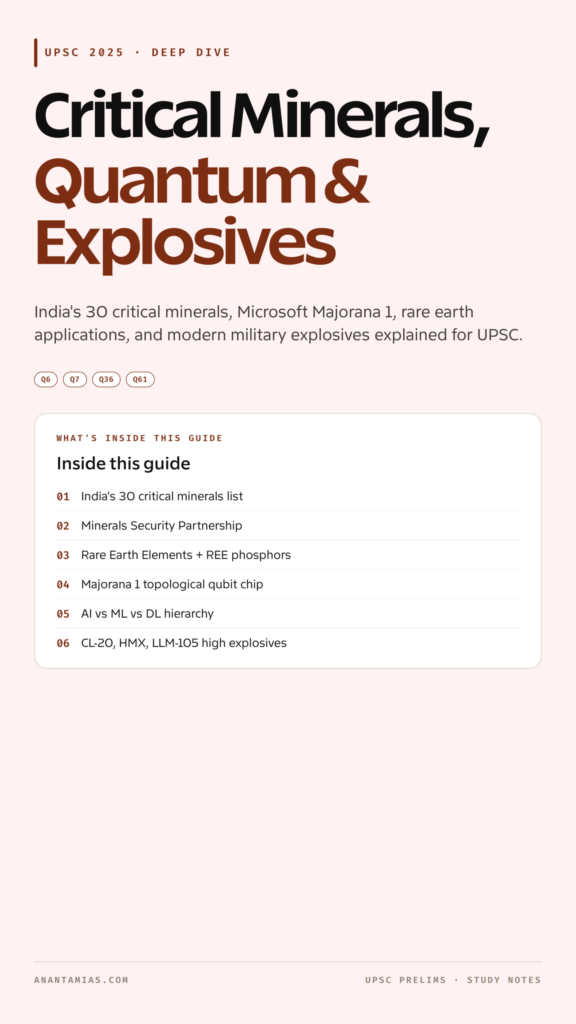
UPSC Prelims 2025 GS Paper-I included four questions that together cover the frontier of India’s resource security, deep-tech ambition and defence modernisation — Q6 on the explosives CL-20, HMX and LLM-105, Q7 on the Majorana 1 quantum chip and the AI hierarchy, Q36 on the Minerals Security Partnership, and Q61 on rare earth elements in displays. These are not isolated trivia. They map directly onto India’s National Critical Minerals Mission, the National Quantum Mission, the Semicon India programme and the DRDO’s high-energy materials roadmap. This note treats them as one syllabus block.
Part 1: Critical Minerals and the Minerals Security Partnership
A critical mineral is one whose supply disruption would inflict significant economic or national-security damage on the importing country. The label is therefore both technical and political — copper is critical for an electrifying grid, lithium for storage, niobium for steel alloys, gallium for semiconductors, and so on. Every major economy now maintains its own list. The United States Geological Survey lists 50 critical minerals (2022 revision). The European Union lists 34 critical and 17 strategic raw materials under the Critical Raw Materials Act of 2024. Japan, Australia and the United Kingdom maintain parallel lists. India entered this conversation formally in 2023.
India’s 30 Critical Minerals — the Veena Kumari Dermal list
The Ministry of Mines constituted an expert committee under Joint Secretary Veena Kumari Dermal in November 2022. The committee benchmarked itself against the EU, US, Australian, Japanese, UK and Canadian methodologies, then applied a two-stage filter based on economic importance and supply risk for the Indian context. Its report, released on 28 June 2023, identified 30 minerals as critical for India.
| # | Mineral | Primary use | India’s status |
|---|---|---|---|
| 1 | Antimony | Flame retardants, lead-acid batteries, ammunition | ~90% imported |
| 2 | Beryllium | Aerospace alloys, nuclear reactors, X-ray windows | Limited domestic |
| 3 | Bismuth | Pharmaceuticals, low-melting alloys, cosmetics | Fully imported |
| 4 | Cobalt | EV batteries (cathode), superalloys, catalysts | 100% imported |
| 5 | Copper | Electrical wiring, EV motors, grid infrastructure | ~93% imported (concentrate) |
| 6 | Gallium | GaN power semiconductors, LEDs, 5G base stations | Fully imported |
| 7 | Germanium | Fibre optics, infra-red optics, solar cells | Fully imported |
| 8 | Graphite (natural) | Li-ion battery anodes, refractories, lubricants | ~60% imported |
| 9 | Hafnium | Nuclear control rods, plasma cutting, super alloys | Fully imported |
| 10 | Indium | ITO touchscreens, solar PV, LCD displays | Fully imported |
| 11 | Lithium | EV batteries, grid storage, ceramics | 100% imported (5.9 MT inferred in J&K) |
| 12 | Molybdenum | Steel alloys, catalysts, lubricants | Largely imported |
| 13 | Niobium | HSLA steel, superconductors, capacitors | ~100% imported (Brazil) |
| 14 | Nickel | Stainless steel, EV battery cathodes | 100% imported |
| 15 | PGEs (Pt, Pd, Rh, Ir, Os, Ru) | Catalytic converters, hydrogen electrolysers | Fully imported |
| 16 | Phosphorus | Fertilisers, lithium-iron-phosphate batteries | ~90% imported (rock phosphate) |
| 17 | Potash | Fertilisers | 100% imported |
| 18 | REEs (17 elements) | Magnets, phosphors, lasers, defence | ~7% reserves, ~1% production |
| 19 | Rhenium | Jet-engine superalloys, catalysts | Fully imported |
| 20 | Silicon (high-purity) | Semiconductors, solar PV | Largely imported |
| 21 | Strontium | Ferrite magnets, pyrotechnics, ceramics | Fully imported |
| 22 | Tantalum | Capacitors in electronics, surgical implants | Fully imported |
| 23 | Tellurium | CdTe thin-film solar, thermo-electrics | Fully imported |
| 24 | Tin | Solder, tin-plate, chemicals | Mostly imported |
| 25 | Titanium | Aerospace alloys, pigment, implants | Mineral rich (ilmenite), low metal capacity |
| 26 | Tungsten | Cutting tools, ammunition, filaments | ~100% imported (Salem-Erode reserves untapped) |
| 27 | Vanadium | Steel alloys, redox-flow batteries | Largely imported |
| 28 | Zirconium | Nuclear cladding, ceramics, foundry | Beach-sand resource, limited refining |
| 29 | Selenium | Glass, solar cells, animal feed | Fully imported |
| 30 | Cadmium | NiCd batteries, CdTe solar, pigments | By-product of zinc smelting |
This is the single most important table for the UPSC critical minerals topic. Note the import-dependence column: it explains why Statement II of Q36 (“India is resource-rich in all 30 critical minerals”) is patently false. India is import-dependent for the overwhelming majority, with proven resources only in a few — ilmenite and rutile for titanium, beach-sand zircon, and the recently inferred lithium block in Salal-Haimana, Reasi district, Jammu and Kashmir, estimated at 5.9 million tonnes by the Geological Survey of India in February 2023.
The Minerals Security Partnership
The Minerals Security Partnership was announced on 14 June 2022 by the US State Department’s Bureau of Energy Resources. The original eleven members were the United States, Australia, Canada, Finland, France, Germany, Japan, South Korea, Sweden, United Kingdom and the European Commission. Italy and Norway joined later, then Estonia. India became a member on 22 June 2023 during Prime Minister Modi’s state visit to Washington, taking the count to fifteen including the EU. The Czech Republic joined subsequently. Headquartered through the US State Department, MSP has no permanent secretariat — it is a coordination forum, not an organisation.
The mandate has three operational pillars: catalysing public and private investment in responsible critical-mineral supply chains; sharing information on offtake, geological mapping and ESG standards; and engaging with resource-rich emerging economies. The partnership has identified specific projects — a graphite mine in Tanzania, a rare earth processing plant in Estonia, a nickel-cobalt operation in Brazil — for joint financing under the MSP Forum, which was launched in February 2024 at the Indaba mining conference in Cape Town.
India’s institutional architecture
India is not approaching critical minerals through MSP alone. A four-layer domestic architecture has emerged since 2022.
| Layer | Instrument | Function |
|---|---|---|
| Legislative | MMDR Amendment Act 2023 | Created a “critical and strategic minerals” category of 24 minerals reserved for central-government auction. Allowed private exploration of atomic minerals. |
| Mission | National Critical Mineral Mission (Jan 2025, Rs 16,300 crore) | Whole-of-government framework covering domestic exploration, recycling, overseas acquisition, R&D and trade. |
| Overseas | KABIL (NALCO + HCL + MECL) | Acquires foreign mineral assets. Signed Catamarca lithium block deal with Argentina’s CAMYEN in January 2024. |
| Auctions | Ministry of Mines, tranches since November 2023 | Four tranches auctioned by mid-2025 covering lithium, REE, graphite, nickel, copper and vanadium blocks. |
The first auction tranche in November 2023 received tepid response — only a handful of blocks were sold out of twenty offered, partly because exploration data was at G4 reconnaissance level, too early for serious commercial commitment. Subsequent tranches improved geological certainty and added a 50% royalty rebate for early producers. The Salal-Haimana lithium block had to be re-auctioned twice after the first round failed.
The National Critical Mineral Mission, approved by the Union Cabinet on 29 January 2025, brings a sharper edge. Its seven-year outlay of Rs 16,300 crore is supplemented by an expected Rs 18,000 crore of public sector investment. The Mission sets quantitative targets: 1,200 exploration projects to be launched by the Geological Survey of India and Mineral Exploration Corporation Limited by 2031, twenty critical-mineral blocks to be operational, four centres of excellence for processing technologies, an indigenous recycling industry capable of handling 400,000 tonnes a year of secondary feedstock, and a Critical Mineral Stockpile holding strategic reserves for a six-month buffer in lithium, cobalt and rare earth oxides. Customs duty on twenty-five critical minerals was abolished in the Union Budget 2024-25 to reduce input costs for the downstream processing industry.
The Offshore Areas Mineral (Development and Regulation) Amendment Act of 2023 opened seabed exploration. The first tranche of offshore blocks — polymetallic nodules and crusts containing manganese, cobalt, copper and nickel — was notified in November 2024 along India’s western continental shelf. India also holds two contracts with the International Seabed Authority for polymetallic nodule exploration in the Central Indian Ocean Basin and polymetallic sulphides in the Central Indian Ridge, giving it long-standing standing in the deep-sea minerals debate.
The China factor and global counter-architecture
| Country/Bloc | Policy instrument | Year | Key feature |
|---|---|---|---|
| United States | Inflation Reduction Act (IRA), Defense Production Act Title III | 2022 | $369 bn for clean-energy, EV tax credits contingent on non-FEOC mineral sourcing |
| European Union | Critical Raw Materials Act | 2024 | 2030 benchmarks: 10% domestic extraction, 40% processing, 25% recycling, max 65% from one third country |
| Australia | Critical Minerals Strategy 2023-30 | 2023 | A$4 bn Critical Minerals Facility for project finance |
| Japan | JOGMEC offtake support | Ongoing | Equity and loan guarantees for Japanese firms acquiring overseas mineral stakes |
| India | National Critical Mineral Mission | 2025 | Rs 16,300 crore over seven years, 1,200 exploration projects |
| China | REE export controls, gallium-germanium quotas | 2023 onwards | Weaponising downstream dominance — 60% mining, 87% processing |
China’s August 2023 export controls on gallium and germanium, followed by graphite restrictions in December 2023 and antimony controls in 2024, gave the MSP its real political momentum. India’s joining was as much a hedge against China as a bid for capital. The Galwan stand-off and the subsequent supply-chain shocks from semiconductor shortages convinced South Block that critical minerals were no longer a Mines Ministry file.
India has parallel bilateral tracks. The India-Australia Critical Minerals Investment Partnership signed in March 2022 commits AUD 5.8 million for joint due diligence on lithium, cobalt, vanadium, nickel and REE projects, with KABIL holding offtake rights in several Australian operations. The India-United States initiative on Critical and Emerging Technologies (iCET), launched in January 2023, includes a critical minerals workstream. The Quad’s Critical Minerals Working Group, launched in 2024, brings India, the US, Japan and Australia into a coordinated investment screening forum. A separate India-United Kingdom Technology Security Initiative agreed in July 2024 added critical minerals as a workstream alongside semiconductors and AI.
Q36 decoded
The question asked about MSP. Statement I — “India has joined” — is correct (June 2023). Statement II — “India is resource-rich in all 30 critical minerals” — is wrong, as the dependence table above demonstrates. The correct answer is (a) I only. UPSC’s framing rewards aspirants who track both the diplomatic event and the underlying resource reality, not just the press release.
Part 2: Rare Earth Elements and the Display Connection
The rare earth elements are seventeen chemically similar metals — the fifteen lanthanides (atomic numbers 57 to 71), plus scandium (21) and yttrium (39). The name is a historical accident. They are not particularly rare in crustal abundance — cerium is more common than copper — but they almost never occur in concentrated, mineable deposits. They co-occur with each other, making separation chemically demanding and environmentally messy.
The two REE families
| Group | Elements | Defining property | Headline use |
|---|---|---|---|
| Light REE (LREE) | La, Ce, Pr, Nd, Pm, Sm, Eu, Gd | Lower atomic number, more abundant, easier to extract | Catalysts (Ce), NdFeB magnets (Nd, Pr), red phosphors (Eu) |
| Heavy REE (HREE) | Tb, Dy, Ho, Er, Tm, Yb, Lu, Sc, Y | Higher atomic number, scarcer, harder to separate | High-temperature magnet additives (Dy, Tb), display phosphors (Y, Tb), fibre-optic amplifiers (Er) |
The HREEs command higher prices and carry higher strategic risk because their geological occurrence is more concentrated. Dysprosium and terbium, vital for high-temperature neodymium magnets used in EV traction motors and wind turbines, are dominated by southern China’s ionic-clay deposits.
Phosphors, displays and the Q61 logic
A phosphor is a substance that emits visible light when excited by an external energy source — ultra-violet light, an electron beam, or another photon. In a flat-panel LCD-LED television, white LED backlights pass through colour filters; in a quantum-dot or older CRT display, phosphors directly convert excitation into red, green and blue light. REEs are uniquely suited because the 4f electrons of lanthanides are shielded from the surrounding crystal lattice, producing sharp, narrow-band emission lines — exactly what colour-accurate displays need.
| Colour | Phosphor | Active REE | Application |
|---|---|---|---|
| Red | Y2O3:Eu3+, Y2O2S:Eu3+ | Europium (dopant), Yttrium (host) | CRT, LED, fluorescent lamps |
| Green | LaPO4:Tb3+, GdMgB5O10:Tb3+ | Terbium | Trichromatic fluorescent tubes, LEDs |
| Blue | BaMgAl10O17:Eu2+, (Sr,Ce)PO4 | Europium (II), Cerium | Compact fluorescent lamps, LEDs |
| White (broad) | YAG:Ce3+ (yttrium aluminium garnet) | Cerium | White LED conversion (Nichia patent) |
| Near-IR | Er-doped silica | Erbium | Fibre-optic amplifiers (EDFA) |
The phosphorescence in REE phosphors is a quantum-mechanical transition between specific energy levels of the lanthanide ion. Unlike fluorescence, which decays within nanoseconds, phosphorescence involves a forbidden transition with a longer lifetime, producing the characteristic afterglow in some materials. Q61 therefore tested two factually correct statements — REEs are used in flat TVs and computer monitors, and they have phosphorescent properties — making (c) both are correct the right answer.
Other strategic uses of REEs
| Application | REE used | Strategic sector | Substitute availability |
|---|---|---|---|
| NdFeB permanent magnets | Nd, Pr, Dy, Tb | EVs, wind turbines, MRI, robotics | Ferrite magnets exist but are 5-10x weaker |
| Samarium-cobalt magnets | Sm | Missile guidance, jet-engine actuators | Limited; chosen for high-temperature performance |
| Auto catalytic converters | Ce, La | Emission control | Partial — Pt/Pd substitution costly |
| Fluid catalytic cracking | La, Ce | Petroleum refining | Cerium-zeolite essential |
| Nd-glass lasers | Nd | Inertial confinement fusion, materials processing | None for high-energy applications |
| NiMH batteries | La, Ce mischmetal | Hybrid vehicles, stationary storage | Li-ion has displaced most uses |
| Polishing powders | Ce | Glass, semiconductor wafers | Silica/alumina inferior for precision optics |
India’s REE position
India holds an estimated 6.9 million tonnes of REE oxides — about 7% of the world total — placing it third behind China (44 MT) and Brazil (21 MT). Production is barely 2,900 tonnes a year, less than 1% of global output. The mismatch reflects decades of restrictive licensing under the Atomic Energy Act 1962, because India’s main REE source is monazite, a thorium-bearing beach sand mineral classed as a “prescribed substance” reserved for Department of Atomic Energy entities.
| Facility | Operator | Location | Output |
|---|---|---|---|
| Chavara unit | IREL | Kerala | Ilmenite, rutile, monazite, zircon from beach sand |
| Manavalakurichi | IREL | Tamil Nadu | Heavy mineral separation, monazite |
| Rare Earths Division, Aluva | IREL | Kerala | Thorium concentrate, mixed REE chloride |
| OSCOM | IREL | Odisha | Largest beach sand operation in India |
| RED, Bhopal | IREL | Madhya Pradesh | NdFeB magnet R&D, separation |
The MMDR Amendment Act 2023 partly liberalised this by removing six atomic minerals from Part B of the First Schedule, opening private exploration of monazite-associated REEs. The first private REE block auctions began in 2024. The National Critical Mineral Mission has earmarked specific outlays for an integrated mine-to-magnet supply chain at IREL Bhopal and a downstream magnet plant in collaboration with the Department of Science and Technology.
Global counterweights to China include MP Materials, which operates the Mountain Pass mine in California and is building a magnet plant in Texas with General Motors as offtaker; Lynas Corporation, which mines at Mount Weld in Western Australia and processes at Kuantan in Malaysia, with new US facilities under construction; and the Estonian REE refinery at Sillamae that processes feedstock for the European market. The MSP coordinates investment flows into this network.
The 2010 Senkaku-Diaoyu incident, when China briefly halted REE exports to Japan during a maritime dispute, was the founding moment of REE security policy worldwide. Japan responded by funding the Lynas project, building strategic stockpiles, and bankrolling research into REE substitution and recycling. Japan today recycles roughly 30% of its REE consumption from end-of-life magnets, the highest rate globally. The Department of Energy in the United States has a long-running REE-from-coal-ash research programme that aims to extract lanthanides from existing waste streams. India’s analogous opportunity lies in red mud, a bauxite refining waste rich in scandium and other REEs, where NALCO has piloted extraction technology.
Part 3: Majorana 1, Quantum Computing and the AI Hierarchy
On 19 February 2025, Microsoft published a paper in Nature and announced the Majorana 1 chip — what it called the world’s first quantum processor powered by topological qubits. The eight-qubit chip is small by industry standards. Its significance is architectural, not arithmetical. Microsoft is wagering that a fundamentally different physical implementation of the qubit will scale where superconducting and trapped-ion approaches will not.
Who Ettore Majorana was
Ettore Majorana was an Italian theoretical physicist who, in a 1937 paper, proposed a class of fermions that are their own antiparticles. He disappeared mysteriously the following year on a ferry between Palermo and Naples, leaving behind a mathematical legacy that lay largely dormant until condensed-matter physicists realised in the 2000s that Majorana modes could be engineered as quasi-particles at the boundaries of certain topological superconductors. These Majorana zero modes are what Microsoft has now coaxed into existence at the ends of indium arsenide nanowires coated with aluminium.
Qubit modalities compared
| Modality | Lead developers | Physical carrier | Operating temperature | Coherence time | Headline strength | Headline weakness |
|---|---|---|---|---|---|---|
| Superconducting transmon | Google, IBM, Rigetti | Cooper-pair charge on Josephson junction | ~15 millikelvin | 100 microseconds | Fast gates, mature fabrication | Heavy cryogenics, error rates require massive overhead |
| Trapped ion | IonQ, Quantinuum | Hyperfine states of a trapped atom | Room temperature vacuum + laser cooling | Seconds to minutes | High fidelity, all-to-all connectivity | Slow gate operations, harder to scale |
| Photonic | PsiQuantum, Xanadu | Single photons | Room temperature | Effectively unlimited | Networkable, room-temperature | Probabilistic gates, photon-loss problem |
| Neutral atom | QuEra, Atom Computing, Pasqal | Rydberg atoms in optical tweezers | ~microkelvin | Seconds | Reconfigurable, scalable arrays | Gate fidelity improving but immature |
| Topological | Microsoft | Majorana zero modes on InAs-Al nanowire | ~20 millikelvin | Theoretically protected | Intrinsic error resistance | Physical realisation contested, fabrication immature |
| Silicon spin | Intel, Quantum Motion, Diraq | Electron spin in a quantum dot | ~100 millikelvin | Milliseconds | Fabricated on existing CMOS lines | Single-qubit fidelity demanding |
The topological argument is this. In a superconducting qubit, environmental noise causes decoherence — the qubit’s quantum information leaks into the surroundings, producing errors that must be corrected by encoding one logical qubit into hundreds or thousands of physical qubits. This is why Google’s 105-qubit Willow chip, announced in December 2024, is celebrated for demonstrating “below-threshold” error correction rather than for any standalone computation. Microsoft’s bet is that a Majorana qubit, by encoding quantum information non-locally across two well-separated zero modes, makes certain errors topologically forbidden. If true, error-correction overhead collapses by an order of magnitude.
The bet remains contested. Microsoft retracted an earlier Majorana paper in 2021 over data interpretation concerns. The 2025 Nature paper presents an interferometric measurement that the company says is the smoking gun, but several condensed-matter physicists have publicly reserved judgement pending independent replication. UPSC’s question framed it carefully — “expected to enable quantum computing” — which is factually accurate regardless of how the peer-review debate resolves.
Why AWS is not the answer
Statement II of Q7 said AWS introduced Majorana 1. This is wrong. Amazon Web Services runs Braket, a managed quantum-computing service that gives customers cloud access to third-party machines from IonQ, Rigetti, IQM and QuEra, and it has its own AWS Center for Quantum Computing at Caltech working on cat qubits. But Majorana 1 is a Microsoft device, fabricated at Microsoft’s Station Q labs. The correct answer to Q7 was therefore (c) I and III only.
The AI–ML–DL hierarchy
| Layer | What it is | Defining technique | Example |
|---|---|---|---|
| Artificial Intelligence (AI) | Any system that mimics human cognition | Rules, search, planning, learning | Chess engines, expert systems |
| Machine Learning (ML) | Subset of AI — algorithms learn patterns from data | Statistical learning, regression, decision trees, SVMs | Spam filters, recommendation engines |
| Deep Learning (DL) | Subset of ML using multi-layer neural networks | Backpropagation through deep architectures (CNNs, RNNs, Transformers) | Image recognition, speech-to-text |
| Generative AI | Subset of DL that produces new content | Diffusion, autoregressive transformers, GANs | ChatGPT, Stable Diffusion, Gemini, Claude |
Statement III of Q7 — deep learning is a subset of machine learning — is therefore unambiguously correct. Together with Statement I, this gives the answer (c).
India’s quantum and semiconductor stack
The National Quantum Mission was approved on 19 April 2023 with a Rs 6,003.65 crore outlay for 2023-31. Implementation runs through the Department of Science and Technology and four Thematic Hubs — quantum computing at IISc Bengaluru, quantum communication at IIT Madras, quantum sensing and metrology at IIT Bombay, and quantum materials and devices at IIT Delhi. IIT Madras houses the Centre for Quantum Information, Communication and Computing, CQuICC, which leads the quantum communication vertical. TIFR Mumbai operates a superconducting qubit testbed.
The semiconductor stack is the necessary substrate. The Semicon India Programme launched in December 2021, with a Rs 76,000 crore outlay, supports fabs, ATMP units and design-linked incentives. Tata Electronics’s joint venture with Powerchip Semiconductor of Taiwan is building a 50,000-wafers-per-month fab at Dholera, Gujarat, with first silicon targeted for 2026. Micron’s Sanand ATMP, Kaynes Semicon at Sanand, CG Power at Sanand, and Tata’s ATMP at Jagiroad in Assam complete the first cohort. The US CHIPS and Science Act of 2022 ($52 bn) and the EU Chips Act of 2023 (€43 bn) provide the global comparator.
Practical horizon for quantum computing
The applications that justify the global spend fall into four buckets. Cryptography is the most discussed — Peter Shor’s 1994 algorithm, run on a sufficiently large quantum computer, would factor the large integers that RSA encryption depends on, breaking most of today’s public-key cryptography. This has already triggered NIST’s post-quantum cryptography standardisation, with the first algorithms (ML-KEM, ML-DSA, SLH-DSA) finalised in August 2024. India’s CERT-In has issued advisories urging migration to PQC by the end of this decade. Optimisation is the second bucket — quantum annealers and gate-model machines promise speedups for vehicle routing, financial portfolio construction and grid dispatch problems. Drug discovery and materials simulation form the third bucket, where the natural advantage is that a quantum computer simulates quantum systems efficiently. The fourth bucket is machine learning, where quantum kernels and variational circuits remain an active research frontier without confirmed advantage.
The timeline matters for UPSC framing. Most credible roadmaps place fault-tolerant, cryptographically relevant quantum computers in the 2030s, possibly later. Near-term “noisy intermediate-scale quantum” devices, the so-called NISQ era, are useful as research instruments and for narrow optimisation problems. Microsoft’s topological bet, if validated, could compress this timeline. Even sceptics agree that the strategic competition has shifted from whether quantum computers will arrive to who controls the supply chain — cryogenic dilution refrigerators, control electronics, ultra-pure helium-3, and the specialty materials including high-purity silicon-28, gallium arsenide and indium phosphide that the Majorana 1 architecture depends on. Critical minerals, semiconductors and quantum computing therefore converge on the same shortlist of strategic inputs.
Part 4: CL-20, HMX and LLM-105 — High-Energy Materials in Modern Defence
The three chemicals named in Q6 — CL-20, HMX and LLM-105 — are explosives. The question’s distractors tested whether candidates could distinguish explosives from refrigerants, fuels or propellants. All three belong to a research class called High Energy Materials, or HEMs, that the defence chemistry community has been developing since the 1980s as successors to TNT, RDX and PETN.
What “high-energy material” means
A high-energy material stores chemical energy that can be released rapidly through detonation, deflagration or controlled combustion. The figures of merit are detonation velocity (km/s), detonation pressure (GPa), density (g/cc), heat of formation, and — critically for safety — sensitivity to friction, impact, heat and electrostatic discharge. The modern design challenge is to push energy density up while keeping sensitivity down. CL-20 maximises energy. LLM-105 minimises sensitivity. HMX is the workhorse.
Comparative table
| Explosive | Chemical name | Density (g/cc) | Detonation velocity (km/s) | Sensitivity | Year/origin | Use |
|---|---|---|---|---|---|---|
| TNT | 2,4,6-Trinitrotoluene | 1.65 | 6.9 | Low | 1863, Germany | Booster, melt-cast formulations |
| RDX | Cyclotrimethylene-trinitramine | 1.82 | 8.75 | Moderate | 1899/WWII, UK-Germany | C-4, Composition B, warheads |
| PETN | Pentaerythritol tetranitrate | 1.77 | 8.4 | High | 1894, Germany | Detonating cord, blasting caps |
| HMX (Octogen) | Cyclotetramethylene-tetranitramine | 1.91 | 9.1 | Moderate | 1942, US | Plastic-bonded explosives, rocket propellants, shaped charges |
| CL-20 (HNIW) | Hexanitro-hexaaza-isowurtzitane | 2.04 | 9.4-9.5 | High | 1987, China Lake NAWC, US | Advanced propellants, high-performance warheads |
| LLM-105 | 2,6-Diamino-3,5-dinitropyrazine-1-oxide | 1.92 | 8.7 | Very low (insensitive) | 1995, Lawrence Livermore, US | Insensitive munitions, submarine warheads |
| FOX-7 | 1,1-Diamino-2,2-dinitroethylene | 1.89 | 8.9 | Low | 1998, Sweden FOI | Insensitive boosters |
CL-20 was synthesised by Arnold T. Nielsen at the Naval Air Warfare Center, China Lake, in 1987. Its caged isowurtzitane skeleton packs nitro groups into a strained three-dimensional structure, producing the highest detonation pressure of any explosive in production use — roughly 14% more energy per unit volume than HMX. The trade-off is sensitivity and cost; CL-20 is typically formulated in polymer-bonded composites that buffer its impact response.
HMX, also called octogen, was discovered as a by-product during RDX manufacture and has been the standard for high-performance applications since the 1950s. It is the energetic component in plastic-bonded explosives PBX-9404 and PBX-9501, the main charge in shaped-charge anti-tank warheads, and the binder in many rocket and missile propellants. The Pinaka rocket family and India’s Astra air-to-air missile rely on HMX-based formulations.
LLM-105 was developed at Lawrence Livermore National Laboratory as part of the US push for “insensitive munitions” — explosives that survive fire, fragment impact, and accidental detonation without going off. The pyrazine-N-oxide structure delivers HMX-class performance with a sensitivity comparable to TNT. It is the explosive of choice for submarine torpedo warheads and other applications where collateral detonation risk is unacceptable.
India’s high-energy materials programme
The DRDO’s High Energy Materials Research Laboratory (HEMRL) in Sutarwadi, Pune, established in 1960, leads India’s explosives R&D. It has synthesised CL-20, HMX, LLM-105, FOX-7 and indigenous variants, and it formulates the propellants and warhead fills used across the Pinaka, Akash, BrahMos, Astra and submarine-launched weapons. The Solid Propellant Plant at Pune, the Ammunition Factory Khadki, and the Ordnance Factory Bhandara are the production end of the chain. The Long Range Anti-Tank Guided Missile programme and the upgraded Pinaka rocket motor are the most public beneficiaries.
Why these materials are testable in UPSC: they sit at the intersection of three syllabus blocks — Science & Technology indigenous developments, Defence policy (Make in India, Aatmanirbhar Bharat in defence), and Internal Security / external security. The Ministry of Defence’s positive indigenisation lists, the Strategic Partnership model and DRDO’s Technology Development Fund all reference these formulations.
Where CL-20, HMX and LLM-105 actually go
The applications matter because UPSC distractors are designed to confuse explosives with propellants and fuels. A propellant burns in a controlled deflagration to push a projectile; an explosive detonates to release energy at supersonic shock-wave speeds. CL-20 sits on both sides — its higher impulse makes it a candidate for next-generation rocket propellants in addition to warhead fills. HMX is the binder of choice for shaped-charge anti-tank warheads used in the Nag and Helina anti-tank guided missile families. LLM-105 is the safety-first choice for submarine and aircraft-carrier ordnance where accidental cook-off in a fire would be catastrophic. None of them are refrigerants — Q6’s option (a) was a textbook trap referencing the unrelated HFC family used in air conditioning.
The global supplier base is narrow. CL-20 is manufactured commercially by Thales Australia at the Mulwala facility in New South Wales, by Nanjing University of Science and Technology and China North Industries Group (Norinco) in China, and at pilot scale by SNPE in France and the Defence Research and Development Organisation in India. HMX production is more diffuse, with Eurenco in France, BAE Systems Holston in the US, and Premier Explosives in India among the established producers. LLM-105 remains largely confined to US national-laboratory pilot production with limited international transfer. This narrow base is itself a strategic vulnerability that explains why DRDO has invested aggressively in indigenous CL-20 process development since 2018.
Practice MCQs
1. With reference to the Minerals Security Partnership, consider the following statements:
I. It was launched by the United States in June 2022.
II. India is its only South Asian member.
III. China is a founding member of the partnership.
Which of the above are correct?
(a) I and II only (b) II and III only (c) I and III only (d) I, II and III
Answer: (a). China is not a member — the MSP is explicitly designed to counter China’s mineral dominance.
2. The “Salal-Haimana” lithium block, in news recently, is located in:
(a) Karnataka (b) Jammu and Kashmir (c) Jharkhand (d) Rajasthan
Answer: (b). The Geological Survey of India estimated 5.9 million tonnes of inferred lithium resources in Reasi district, J&K, in February 2023.
3. Consider the following statements about rare earth elements:
I. Yttrium and scandium are classified as rare earths even though they are not lanthanides.
II. India has the world’s largest rare earth reserves.
III. Europium is the active red phosphor in many display screens.
How many of the above are correct?
(a) Only one (b) Only two (c) All three (d) None
Answer: (b). I and III are correct; India is third in reserves, not first.
4. Which of the following best describes a “topological qubit”?
(a) A qubit based on trapped ions cooled to microkelvin temperatures
(b) A qubit that encodes information non-locally in Majorana zero modes
(c) A qubit implemented on a silicon CMOS quantum dot
(d) A qubit transmitted as a single photon through optical fibre
Answer: (b).
5. With reference to the National Quantum Mission, consider the following:
I. It was approved in April 2023 with an outlay of around Rs 6,003 crore.
II. It has four verticals — Computing, Communication, Sensing and Materials.
III. It is implemented under the Ministry of Electronics and Information Technology.
How many are correct?
(a) Only one (b) Only two (c) All three (d) None
Answer: (b). Statements I and II are correct; the Mission is under the Department of Science and Technology.
6. CL-20 was first synthesised at which institution?
(a) Lawrence Livermore National Laboratory
(b) China Lake Naval Air Warfare Center
(c) High Energy Materials Research Laboratory, Pune
(d) Royal Ordnance, United Kingdom
Answer: (b). Synthesised by Arnold Nielsen at China Lake NAWC in 1987.
7. Which of the following is/are characteristics of LLM-105?
I. Insensitive to impact and friction relative to HMX.
II. Developed at Lawrence Livermore National Laboratory.
III. Used principally as a refrigerant gas.
(a) I only (b) I and II only (c) II and III only (d) I, II and III
Answer: (b).
8. Consider the AI hierarchy:
I. Machine learning is a subset of artificial intelligence.
II. Deep learning is a subset of machine learning.
III. Generative AI is a superset of deep learning.
How many statements are correct?
(a) Only one (b) Only two (c) All three (d) None
Answer: (b). Statements I and II are correct; Generative AI is a subset, not a superset, of deep learning.
Why this block matters for Mains
The four prelims questions plug into at least three Mains GS-III themes: indigenisation of technology with Make in India focus, S&T developments and their applications, and the security implications of dependence on foreign supply chains. The critical minerals story is the throughline. Whether the immediate question is about the EV transition, the semiconductor fab race, the rare-earth magnet bottleneck, the topological qubit bet or the insensitive-explosive frontier — the underlying answer is the same. Industrial sovereignty in the 2030s will be decided by who controls minerals, materials and the chemistry on top of them. India has read the room. The MSP membership, the National Critical Mineral Mission, the National Quantum Mission, the Semicon programme and HEMRL Pune are the visible institutional response. The MMDR amendment, the KABIL Catamarca deal, the IREL liberalisation and the Tata-PSMC fab are its early outputs. The next five years will tell whether intent translates into capacity.
Tell Google you want more of this.
Add Anantam IAS as a preferred sourceOne tap, and this site shows up more often in your own Top Stories, AI Overviews and AI Mode. Remove it any time.