Every Mains answer in General Studies Paper IV opens, sooner or later, with a definition of ethics. The word looks simple. The reality it points to is not. Ethics is the systematic, reasoned reflection on what human beings ought to do — what counts as the right action, the good life, the acceptable means, the just end. Without that anchor, governance becomes mere administration, law becomes mere force, and public service becomes a job.
This guide consolidates the standard working definitions used in UPSC GS-IV — drawn from compass material, Lewis Vaughn's Doing Ethics, Manuel Velasquez's Business Ethics, and Indian thinkers including Kautilya, Gandhi and Vivekananda — and applies them to the lived reality of an Indian civil servant.
What Is Ethics? Three Working Definitions
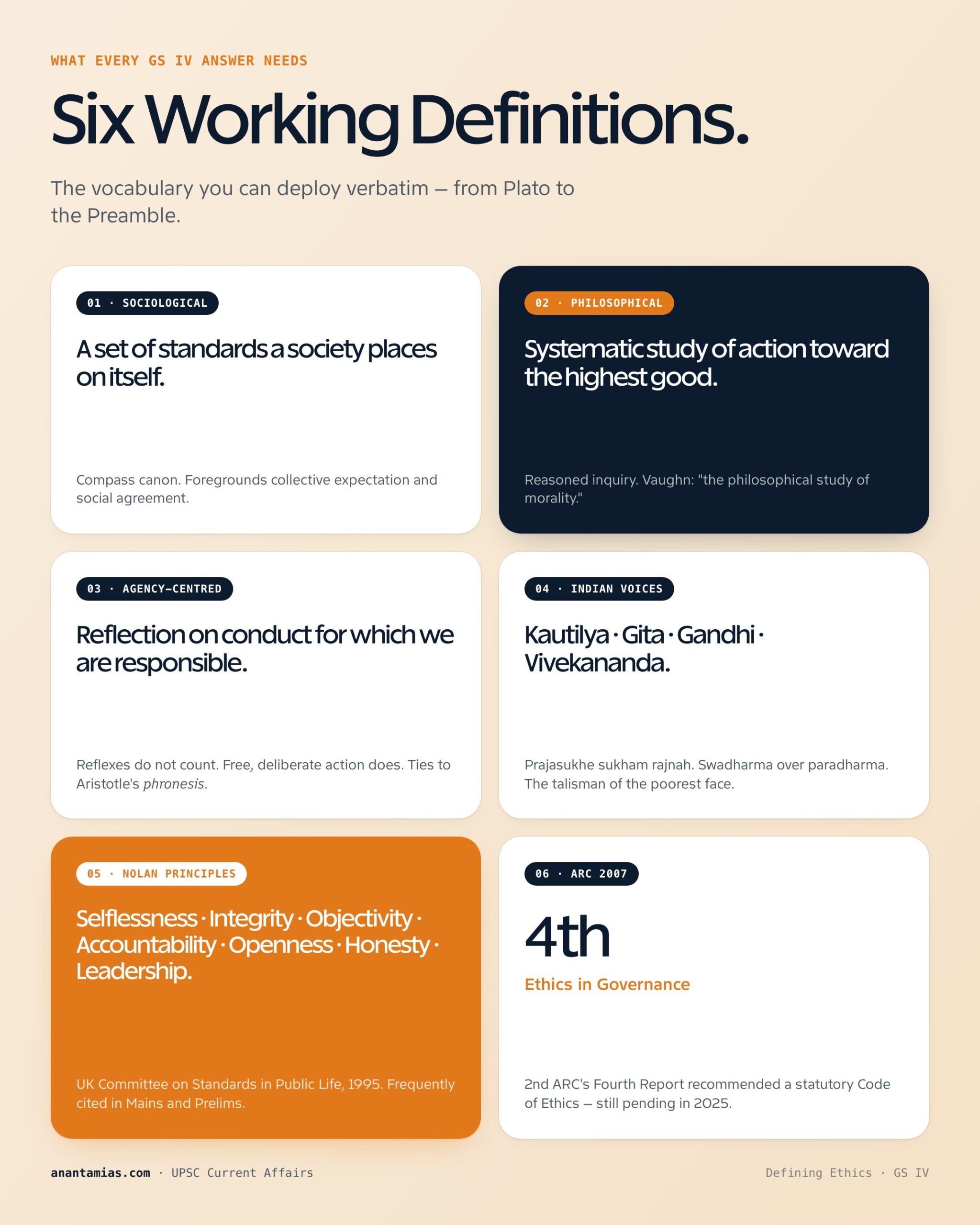
The compass extract offers three definitions that an aspirant can use almost verbatim in answers.
Ethics is a set of standards that society places on itself, which helps guide people's choices, actions, and behaviour.
Ethics is the systematic study of human action from the point of view of their rightfulness or wrongfulness as a means for attaining the highest good.
Ethics is the reflective study of what is good or bad in that part of human conduct for which a human being has some responsibility.
Each definition foregrounds a different feature.
- The first is sociological — ethics is what a community has agreed to expect of itself.
- The second is philosophical — ethics is reasoned inquiry into right action and the highest good.
- The third is agency-centred — ethics covers only that part of conduct for which a person is responsible. Reflexes do not count. Free, deliberate action does.
Lewis Vaughn frames ethics as "the philosophical study of morality" — the discipline that asks not what people do believe is right but what they ought to believe is right and why.
Etymology and Roots
The word ethics derives from the Greek ethos, meaning character or custom. The Latin equivalent is mores, from which "morality" descends. The two words travel together in everyday English but have a useful technical distinction:
- Morality refers to the actual codes a community lives by — the do's and don'ts inherited and practised.
- Ethics refers to the systematic study and reasoned justification of those codes.
A person can act morally (in line with received custom) without being ethical (without ever having reasoned through why). A reflective civil servant must be both.
Scope of Ethics
Ethics covers any area of human life where a free agent can act differently and where the action affects others — or even her future self.
Branches Under the Ethics Umbrella
| Branch | Question Asked | Example |
|---|---|---|
| Meta-ethics | What does "good" mean? | Are moral facts objective? |
| Normative ethics | What ought I to do? | Should I tell the truth even when it hurts? |
| Applied ethics | How does theory apply here? | Is surveillance of citizens justified? |
| Descriptive ethics | What do people actually believe is right? | Survey of attitudes to corruption |
For UPSC, the working zone is mostly normative and applied ethics — the candidate must take stances on what officers should do in concrete situations.
Ethics, Morality and Law — The Three Circles
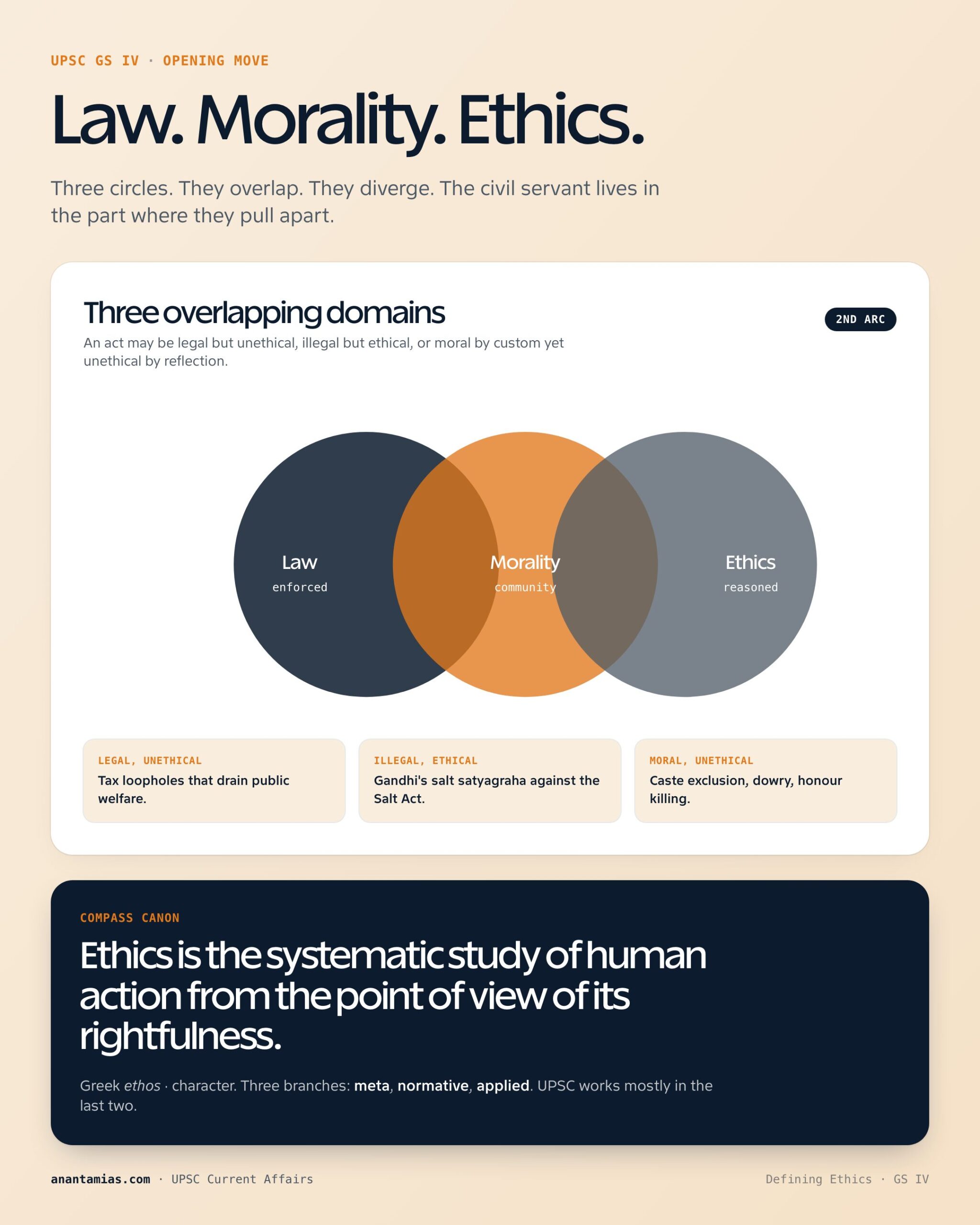
A useful mental model is three overlapping circles.
- Law — what the state enforces with sanction.
- Morality — what a community judges good or bad, often without state enforcement.
- Ethics — what reasoned reflection concludes one ought to do.
The three rarely coincide perfectly.
- An act may be legal but unethical — e.g., a tax loophole exploited to deprive the exchequer of revenue meant for public welfare.
- An act may be illegal but ethical — Gandhi's salt satyagraha defied the Salt Act on grounds higher than the colonial law.
- An act may be moral by local custom but unethical by reflection — caste-based exclusion, dowry, honour killing.
"An unjust law is no law at all." — St. Augustine, echoed by Martin Luther King Jr.
The civil servant operates inside the law but is judged by ethics. When the two diverge, the conscience clause of the All India Services rules and Article 19(1)(a) of the Constitution leave room for principled dissent through legitimate channels.
Why Ethics Matters in Public Life
Three reasons why a definition of ethics is foundational for an Indian civil servant.
- Discretion is unavoidable. Every officer holds discretionary power that statutes cannot fully anticipate. Ethics fills the gap between rule and judgement.
- Power amplifies action. A citizen's small lapse is a private matter; an officer's small lapse multiplies through institutional reach. The ethical bar must rise with the power held.
- Public trust is the operating capital of governance. As the 2nd Administrative Reforms Commission (ARC) Report on Ethics in Governance (2007) put it, the integrity of public servants is the single most important determinant of citizens' faith in the state.
Indian Foundations of the Ethical Idea
The Indian tradition has its own thick vocabulary for ethics.
- Kautilya in the Arthashastra defines dharma-based statecraft: the ruler's happiness lies in the happiness of his subjects (prajasukhe sukham rajnah, prajanam ca hite hitam).
- The Bhagavad Gita distinguishes swadharma (one's own duty) from paradharma (another's duty). For the civil servant, swadharma is the dispassionate discharge of constitutional responsibility.
- Gandhi offered the talisman: recall the face of the poorest and weakest person you have seen, and ask if the step you contemplate is going to be of any use to him.
- Vivekananda insisted that ethics without strength is sentimental: strength is life, weakness is death.
"Manliness consists in making circumstances subservient to ourselves." — Swami Vivekananda
These are not ornamental quotations. They are operative ethical positions a candidate can deploy when grounding an answer.
Two Indian Case Studies
Case 1 — The District Magistrate's Definition Test
A district magistrate during a flood in a Bihar district faced a choice: divert relief lorries away from a politically influential village to a remote tribal hamlet that had received nothing for three days. Diverting risked the wrath of an MLA; not diverting violated the basic ethical premise of equal citizenship. She diverted. The ensuing transfer was reversed after media coverage and a senior secretary's intervention. Her own definition of ethics — the standards I place on myself when no one is checking — guided her.
Case 2 — Ashok Khemka and the Idea of Reflective Conduct
The repeated transfers of IAS officer Ashok Khemka (54+ transfers in his career) followed his refusal to compromise on procedure in land mutation, sports federation accounts, and seed subsidy decisions. His public conduct illustrates the third compass definition — reflective study of what is good or bad in that part of human conduct for which one has responsibility. He treats every signature as a deliberate act, not a routine.
UPSC Syllabus Relevance
GS IV explicitly names ethics and human interface, dimensions of ethics, ethics in private and public relationships. A clean definition is therefore the opening move of almost every Mains answer. It signals to the examiner that the candidate has a working philosophical vocabulary.
Past-Year Prompts
- "What do you understand by ethics? Discuss its dimensions in private and public life." — tested in 2013 (in spirit, the inaugural GS-IV paper).
- "In the context of defending the integrity of the civil services, define ethics." — tested in 2015.
- "Distinguish between ethics, morality and law with examples from Indian public life." — tested in 2017.
- "What does ethical governance mean? Why is it essential in administration?" — tested in 2022.
The examiner is testing whether the candidate can move beyond dictionary phrasing to applied definitions that fit the Indian state.
Mains Answer-Writing Tips
- Open with one clean definition — not three. Pick the one that fits the question's framing.
- Distinguish ethics from morality and law in two sentences if the question allows.
- Anchor with one Indian thinker (Kautilya, Gandhi, Vivekananda) and one Western thinker (Aristotle, Kant, Mill, Rawls).
- Use a brief case — a real serving officer or a known incident — rather than abstractions.
- Close with a constitutional anchor — Articles 14, 21, the Preamble — that grounds ethics in the constitutional order.
Prelims Pointers
- Greek ethos → character / custom.
- Three branches in modern philosophy — meta, normative, applied.
- ARC's 4th Report — Ethics in Governance, 2007 — recommended a Code of Ethics for public servants.
- Code of Conduct exists; Code of Ethics (recommended by 2nd ARC) is yet to be statutorily enacted as a single instrument.
- Nolan Committee Principles (UK, 1995) — Selflessness, Integrity, Objectivity, Accountability, Openness, Honesty, Leadership — frequently cited in answers and Prelims questions.
Common Misunderstandings
- Ethics ≠ moralising. Ethics is reasoned reflection, not finger-wagging. Personal preference is not ethics.
- Ethics is not always written. A code helps but cannot substitute for character. Codes regulate behaviour; ethics regulates character.
- Ethics is not the absence of dilemma. A dilemma is ethics in operation; the ethical agent is one who resolves dilemmas with reasons others can publicly endorse.
- Ethics is not luxury. Resource constraints make ethics more, not less, important. The poorer the public, the higher the cost of an unethical officer.
FAQ
Is there one universal definition of ethics?
No single definition is universally accepted. The compass extract gives three; Vaughn, Velasquez and Subba Rao offer their own. For UPSC, a candidate should internalise one or two definitions deeply enough to deploy them in any answer.
How is ethics different from values?
Values answer what is important?; ethics answers what is right? Values motivate; ethics constrains. A society's ethics is shaped by but is not identical to its dominant values.
Are ethics culturally relative?
Some elements (e.g., specific dietary rules) are culturally bound; the core principles of honesty, fairness, non-maleficence and the dignity of persons recur across traditions. The Indian Constitution itself rests on a moral consensus that is both Indian and universal.
Does the law of the land settle ethics?
No. Many laws codify ethics; some lag behind ethics; some violate ethics. The constitutional order is itself the most authoritative ethical framework available to an Indian civil servant — but officers are still expected to bring reasoned conscience to its application.
Can ethics be taught?
Aristotle's answer was that ethical character is built through habituation (hexis). It can be cultivated, modelled, and practised. UPSC's GS-IV exists precisely on the premise that public-service ethics can be taught and assessed.
Ethics is the silent operating system on which every visible decision in public life runs. A definition is therefore not a philosophical luxury for the aspirant — it is the framing device that turns every other answer in GS-IV into a coherent argument.
Ethics is the silent operating system on which every visible decision in public life runs. A definition is therefore not a philosophical luxury for the aspirant — it is the framing device that turns every other answer in GS-IV into a coherent argument.
Tell Google you want more of this.
Add Anantam IAS as a preferred sourceOne tap, and this site shows up more often in your own Top Stories, AI Overviews and AI Mode. Remove it any time.