Pick up almost any consumer good in your home and the label still tells a globalised story: designed in one country, assembled in another, shipped through a third. So the idea that the world is “deglobalising” can feel counter-intuitive. And yet the trend lines have bent. The share of world trade in the global economy stopped climbing more than fifteen years ago, tariffs are back as a headline instrument of statecraft, and the institutions that once policed open commerce are running on fumes.
That gap between the still-global surface of daily life and the slowing machinery underneath is exactly what makes deglobalization one of the most contested debates in economics and international relations today. For an export-oriented, remittance-dependent economy like India, the stakes are immediate. Whether the world is genuinely retreating from integration or simply rewiring it along new lines decides which way Indian factories, jobs and foreign earnings tilt over the next decade.
What Deglobalization Actually Means
Let’s define the terms cleanly, because they get muddled. Globalisation is the deepening interdependence between economies through trade, capital, technology and the movement of people. Deglobalization, or reverse globalization, is the opposite tendency: cross-border trade, investment and migration shrink, and countries lean back toward self-reliance, controls and strategic autonomy. It is a tilting of the balance away from liberal integration, not a return to autarky.
But here a crucial distinction matters, and examiners reward candidates who hold it. Most economists do not think the world is in outright deglobalization at all. What they describe is “slowbalisation” — a term the IMF popularised — meaning globalisation has not reversed so much as stalled and slowed after the 2008 global financial crisis. Trade is still vast; it just stopped growing faster than output. A second framing goes further still: “geoeconomic fragmentation,” which the IMF defines as a policy-driven reversal of integration, where trade and investment increasingly follow geopolitical lines rather than pure economics. So the honest picture sits on a spectrum — from slowbalisation (a pause) to fragmentation (a reordering) to full deglobalization (a genuine retreat) — and most of the evidence clusters in the middle.
This matters because the policy response differs at each point. If the world is merely slowing, you wait it out and keep your trade engine warm. If it is fragmenting into blocs, you have to pick partnerships and build resilience. India’s strategy, as we’ll see, is built for the second reading.
The Data: A Plateau, Not a Collapse
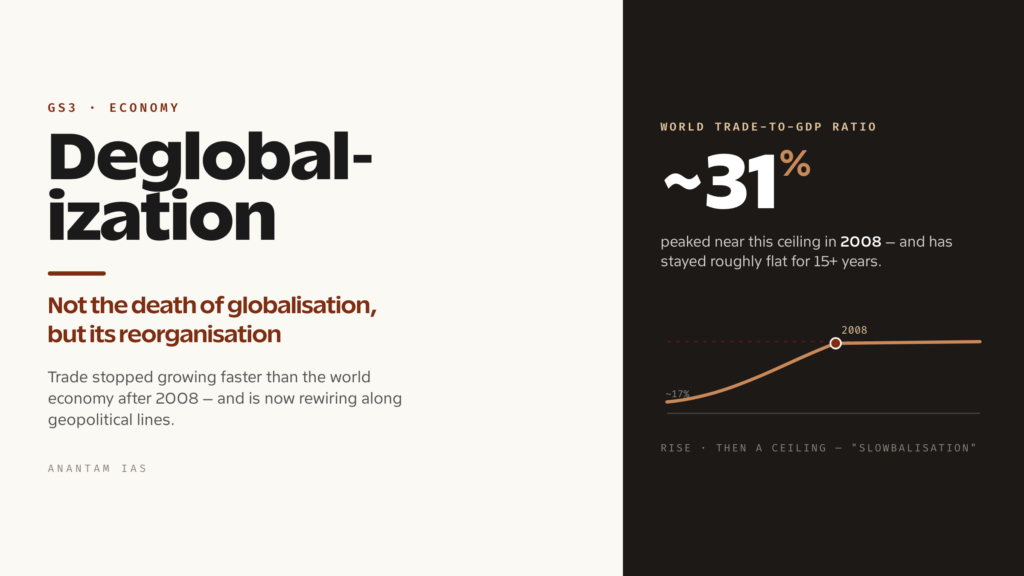
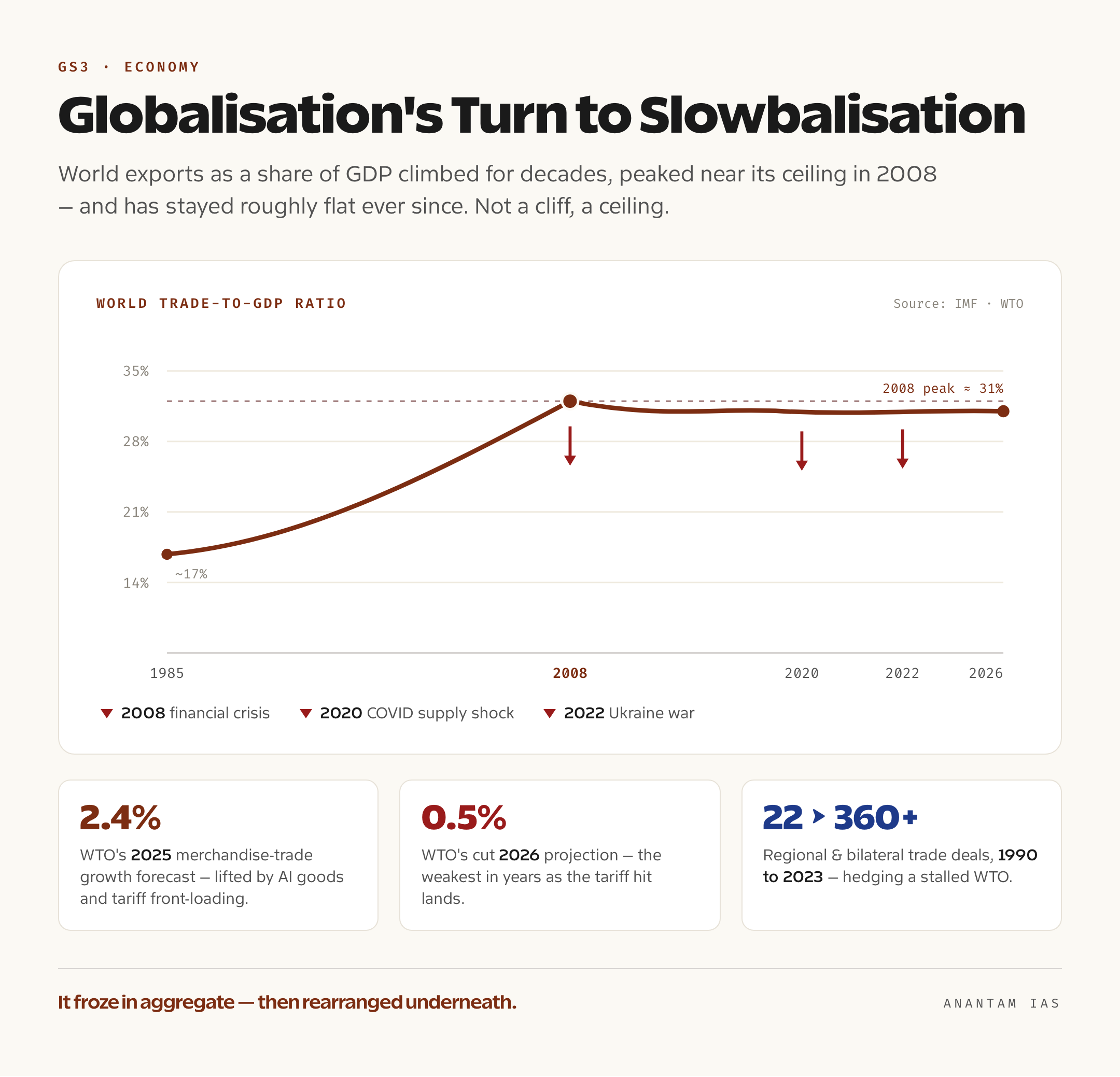
The single most telling number is the trade-to-GDP ratio — the value of world exports measured against the size of the world economy. It climbed almost without interruption from about 17% in the mid-1980s to a peak near 31% in 2008. Then it stalled. According to the IMF, that ratio has hovered around the pre-crisis peak ever since, broadly flat for more than fifteen years. The WTO expects it to stay roughly unchanged through 2026. That is the empirical core of slowbalisation: not a cliff, but a ceiling.
The flow data tells a similar story of plateau punctuated by shocks. The WTO’s October 2025 outlook actually raised its forecast for world merchandise trade growth in 2025 to 2.4%, helped by a surge in AI-related goods and by importers front-loading orders ahead of new American tariffs. But the same report cut its 2026 projection to just 0.5%, the weakest in years, because the tariff hit was being pushed into the following year. Services trade is cooling too, from 6.8% growth in 2024 to a forecast 4.4% in 2026. Foreign direct investment has been volatile and reorienting rather than collapsing.
Two other indicators capture the reordering. First, regional and bilateral trade agreements have exploded — from around 22 in 1990 to more than 360 by 2023 — as countries hedge against a stalled multilateral system by cutting their own deals. Second, the cost of getting this wrong is large: the IMF has estimated that severe geoeconomic fragmentation could shave anywhere from a fraction of a percent up to nearly 7% off global GDP, with developing economies hurt most because they rely on open markets to catch up. So the data does not show globalisation dying. It shows it freezing in aggregate while quietly rearranging underneath.
The Drivers: Three Shocks and a Policy Turn
The retreat from hyper-globalisation was not one event but a chain of them, each one hardening the trend.
It begins with the 2008 global financial crisis. Cheap credit and frictionless capital flows had powered the boom of the 1990s and 2000s; the crash discredited that model, banks pulled back from cross-border lending, and the political backlash against globalisation’s losers — stagnant wages and hollowed-out factory towns in the West — began in earnest. This is when the trade-to-GDP line flattened. Brexit and the first US-China tariff war later in the 2010s were symptoms of that backlash, not its origin.
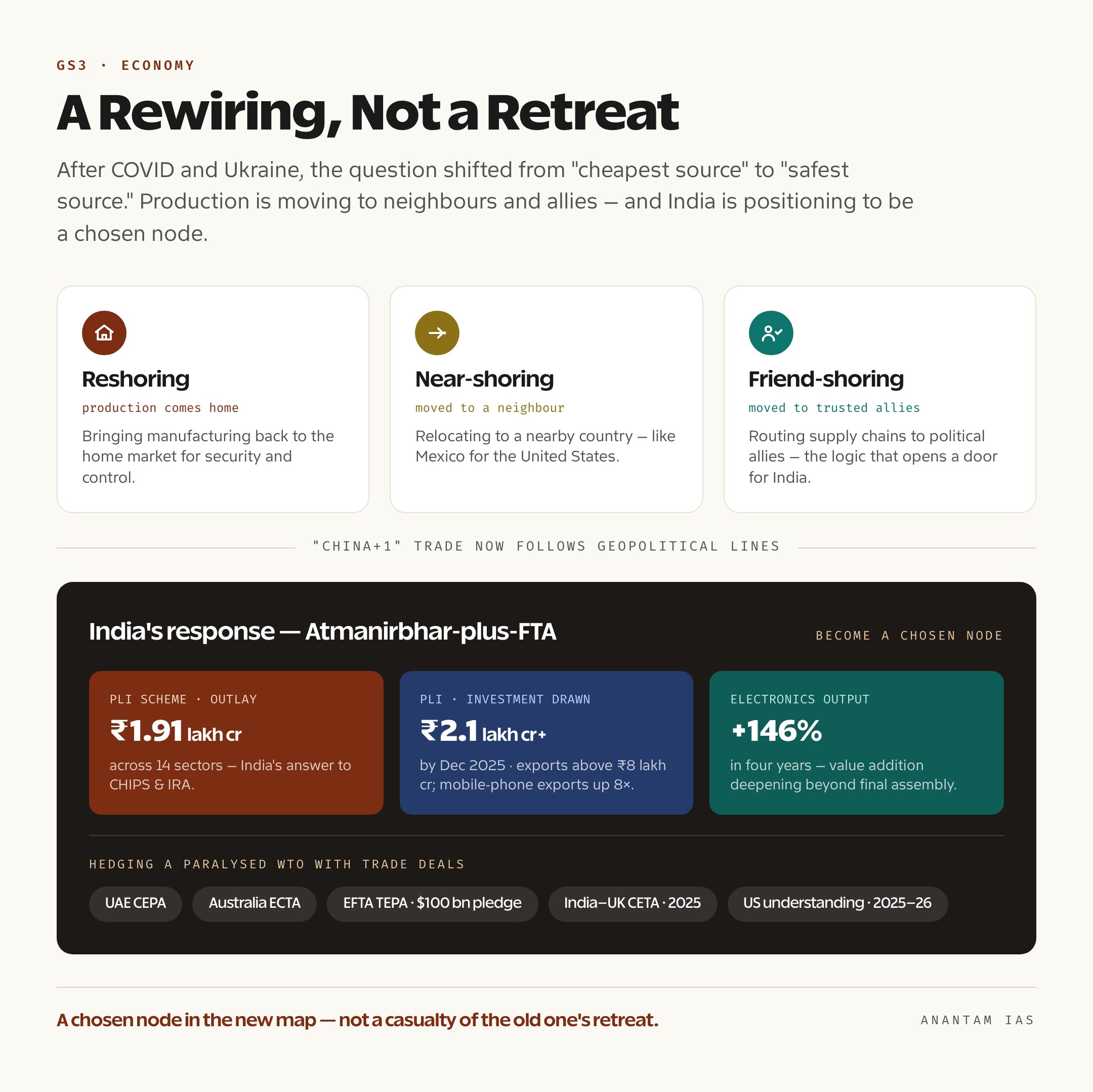
COVID-19 was the second shock, and it changed the conversation from economics to security. When borders slammed shut in 2020 and a single blocked port or chip shortage could halt car plants worldwide, governments rediscovered that efficiency and resilience are not the same thing. “Just-in-time” supply chains, optimised for cost, looked dangerously brittle. The response had names: reshoring (bringing production home), near-shoring (moving it to a neighbour, like Mexico for the US) and friend-shoring (relocating it to trusted allies). The instinct shifted from “cheapest source” to “safest source.”
The Russia-Ukraine war from 2022 was the third shock, and it weaponised interdependence. Energy, food, payments and shipping all became instruments of geopolitics. When trade itself can be cut off as a sanction, every country starts treating dependence as a vulnerability. This is the logic that turned supply chains into a national-security question.
On top of these shocks came a deliberate policy turn toward industrial strategy. The United States passed the CHIPS and Science Act and the Inflation Reduction Act, pouring subsidies into domestic semiconductors and clean energy and explicitly favouring home or allied production. Tariffs returned with force: in 2025 the second Trump administration declared a national emergency over the trade deficit and imposed a baseline “reciprocal tariff” on almost all imports, briefly pushing duties on Chinese goods to extraordinary levels before a partial truce, and lifting the average US tariff to its highest in roughly a century. Through it all, the WTO’s referee function has been broken — its Appellate Body has had no members and been unable to hear appeals since December 2019, after the US blocked new appointments, and by 2025 dozens of disputes had been “appealed into the void.” With no umpire, the rules-based order frays and the bloc-based one grows.
The Challenges: Who Pays for Fragmentation
The hardest truth about deglobalization is that its costs fall unevenly, and developing economies sit in the line of fire. Open trade was the ladder that lifted East Asia, then China, out of poverty; a more closed, bloc-divided world pulls that ladder up. The IMF’s warning that fragmentation hits poorer countries hardest is not abstract — it means slower industrialisation, costlier imports and fewer of the labour-intensive export jobs that absorb young workforces.
For India the exposure runs through several channels at once. The EU’s Carbon Border Adjustment Mechanism, moving to full implementation in 2026, will tax the carbon content of imports like steel, aluminium and cement — a green-sounding rule that lands hardest on developing-country exporters and looks, from Delhi, a lot like protectionism in disguise. American reciprocal tariffs squeeze textiles, leather and other labour-heavy Indian exports. Remittances, India’s quiet financial cushion and among the largest such inflows in the world, are exposed to tighter immigration regimes in the West and the Gulf. And FDI tells a cautionary tale: gross inflows actually rose to about US$81 billion in 2024-25, but net FDI nearly vanished — close to zero — as foreign investors repatriated record profits and Indian firms invested more abroad. So the friend-shoring opportunity is real but not automatic; the capital can flow out as easily as in.
There is also a competitive crowd. “China+1” — the corporate strategy of keeping China but adding a second manufacturing base — does not flow only to India. Vietnam, Mexico and the wider ASEAN region are aggressive rivals; Asia drew the lion’s share of developing-world FDI in 2024, and much of it went to Southeast Asia. India captures a share, not the whole prize.
The Way Forward
A balanced strategy treats deglobalization as a reordering to be navigated, not a tide to be resisted. India’s actual approach reads as “Atmanirbhar-plus-plurilateral,” and it points the right way.
- Build strategic capacity through industrial policy. The Production Linked Incentive (PLI) scheme, with an outlay of about ₹1.91 lakh crore across 14 sectors, is India’s answer to CHIPS and IRA-style support. By the government’s own December 2025 accounting it had drawn over ₹2.1 lakh crore in investment, generated cumulative sales above ₹20 lakh crore and exports of more than ₹8 lakh crore — electronics production alone rose roughly 146% in four years and mobile-phone exports jumped eightfold. The job is to deepen value addition, not just final assembly.
- Hedge against WTO paralysis with bilateral and plurilateral deals. With the multilateral umpire down, India has pivoted hard to FTAs: the UAE CEPA, the Australia ECTA, the EFTA TEPA (with its first-ever US$100 billion investment pledge, in force from October 2025), the India-UK CETA signed in July 2025 giving duty-free access to most exports, and a phased US trade understanding in 2025-26 that cut reciprocal tariffs and aims at a fuller bilateral pact.
- Lean into services, where the walls are lower. IT, global capability centres and professional services are far less exposed to goods tariffs and CBAM. They are India’s comparative strength and should be defended and expanded.
- Turn climate friction into negotiation. Push back on CBAM’s unilateralism while greening exports, so the carbon levy becomes a manageable cost rather than a wall.
- Secure mobility for the diaspora. Bilateral migration and mobility partnerships protect the remittance lifeline against tightening immigration.
- Invest in skills and supply-chain resilience. A volatile world rewards a flexible, high-skill workforce and diversified sources for pharma APIs, electronics and critical minerals.
For Your Mains Answer
This topic is a workhorse across GS Paper 1 (effects of globalisation on Indian society), GS Paper 2 (international relations, the crisis of multilateralism and the WTO) and GS Paper 3 (economy, trade, supply chains and industrial policy). It also feeds the Essay paper on themes of interdependence, nationalism and a fractured world order.
How to Build the Answer
Open by defining the spectrum — slowbalisation, fragmentation, deglobalization — and stake a position that the world is reconfiguring more than retreating. Then move outward: the data (the trade-to-GDP plateau), the drivers (2008, COVID, Ukraine, plus industrial policy and tariffs), the implications for developing economies, and India’s specific exposure. Close with India’s Atmanirbhar-plus-FTA response. That arc — define, evidence, drivers, impact, response — fits almost any phrasing of the question.
Common Mistakes to Avoid
Don’t claim globalisation is “dead”; the data won’t support it and an informed examiner will mark you down. Don’t confuse slowbalisation with deglobalization — naming the distinction is itself a marker of quality. Don’t list drivers without sequencing them (the 2008 crisis came first; Ukraine weaponised the trend). And don’t treat the China+1 windfall as automatic for India; flag the competition from Vietnam and ASEAN.
A Compact Answer Spine
Define the spectrum (slowbalisation → fragmentation → deglobalization) → evidence (trade-to-GDP flat near its 2008 peak; RTAs up from ~22 to 360+) → drivers (2008 crisis, COVID resilience turn, Ukraine weaponisation, CHIPS/IRA industrial policy, tariffs, dead WTO Appellate Body) → impact on developing economies and on India (CBAM, tariffs, remittances, near-zero net FDI) → India’s response (PLI, CEPA/ECTA/TEPA/CETA, services, IMEC) → conclusion: reorganisation, not death.
Diagram or Flowchart Idea
Draw a single line for trade-to-GDP rising to a peak at 2008 and then flattening, with three downward arrows marking the shocks — 2008, COVID 2020, Ukraine 2022 — and a side panel showing flows rerouting via reshoring, near-shoring and friend-shoring. A clean trend-line-plus-shocks diagram communicates the whole thesis fast.
A Balanced-Conclusion Line
“Deglobalization is less the death of globalisation than its reorganisation — and India’s task is to be a chosen node in the new map rather than a casualty of the old one’s retreat.”
How to Use Data Without Cramming
Anchor to two or three figures and attribute them in-prose: the trade-to-GDP ratio plateauing near its 2008 peak (IMF); the WTO’s 2026 trade-growth forecast cut to 0.5%; PLI investment crossing ₹2 lakh crore. Naming the source — IMF, WTO, Ministry of Commerce — reads as scholarship, not memorisation.
FAQ
What is the difference between deglobalization and slowbalisation? Slowbalisation, a term popularised by the IMF, means globalisation has stalled and slowed since the 2008 financial crisis — trade is still huge but stopped growing faster than the economy. Deglobalization is stronger: an actual reversal of integration, with trade, investment and migration shrinking. Most economists argue the world is in slowbalisation or “geoeconomic fragmentation” rather than full deglobalization.
What are the main causes of reverse globalization? Three shocks plus a policy turn. The 2008 crisis discredited frictionless finance and fuelled a backlash against globalisation’s losers. COVID-19 exposed fragile supply chains and triggered reshoring and friend-shoring. The Russia-Ukraine war weaponised trade and energy. On top came industrial policy (the US CHIPS Act and Inflation Reduction Act), rising tariffs, and the breakdown of the WTO Appellate Body, which has had no working judges since December 2019.
How does deglobalization affect India? It cuts both ways. Headwinds include the EU’s carbon border tax (CBAM) on steel and aluminium from 2026, American tariffs on labour-intensive exports, pressure on remittances from tighter immigration, and a near-zero net FDI figure in 2024-25 despite high gross inflows. The opportunity is “China+1” and friend-shoring, which India courts through PLI manufacturing incentives and a wave of trade deals — though it competes with Vietnam, Mexico and ASEAN for that investment.
Is this true deglobalization or just a reconfiguration of global trade? The weight of evidence points to reconfiguration. Aggregate trade has plateaued rather than collapsed, but its pattern is reorganising along geopolitical lines — over 360 regional trade agreements, friend-shoring, and rival blocs forming around the US and China. The honest framing is that globalisation is being rewired, not switched off, which is why India’s strategy is to become a preferred node in the new network rather than to retreat behind its own walls.
Practice Questions
Prelims MCQs
- The term “slowbalisation,” used to describe the stalling of global integration after the 2008 financial crisis, was popularised by which institution?
(a) WTO
(b) World Bank
(c) IMF
(d) OECD
Answer: (c) — The IMF popularised “slowbalisation” to capture globalisation slowing rather than reversing after 2008. - The trade-to-GDP ratio of the world economy peaked at roughly which level around 2008 before plateauing?
(a) 17%
(b) 24%
(c) 31%
(d) 42%
Answer: (c) — World exports as a share of GDP climbed from about 17% in the mid-1980s to a peak near 31% in 2008, then stayed broadly flat. - With respect to the WTO Appellate Body, consider the following: it has been unable to hear appeals since December 2019 because the United States blocked the appointment of new members. Which is correct?
(a) Both the cause and effect stated are correct
(b) The effect is correct but the cause is wrong
(c) The cause is correct but the effect is wrong
(d) Both are wrong
Answer: (a) — The US blocked new appointments, leaving the Appellate Body without the quorum to hear appeals since December 2019. - The EU’s Carbon Border Adjustment Mechanism (CBAM), moving to full implementation in 2026, taxes the embedded carbon in imports such as:
(a) software and IT services
(b) steel, aluminium and cement
(c) pharmaceuticals and APIs
(d) textiles and leather
Answer: (b) — CBAM targets carbon-intensive goods like steel, aluminium and cement, hitting developing-country exporters hardest. - “Friend-shoring,” as a response to supply-chain risk, refers to:
(a) bringing production back to the home country
(b) moving production to a neighbouring country
(c) relocating production to trusted geopolitical allies
(d) outsourcing to the cheapest available source
Answer: (c) — Friend-shoring relocates production to trusted allies, distinct from reshoring (home) and near-shoring (neighbours).
Mains Practice Questions
- “The world is not deglobalising so much as reconfiguring.” Critically examine this statement with reference to trade and investment data since 2008. (15 marks, 250 words)
- Discuss the three shocks — the 2008 financial crisis, COVID-19 and the Russia-Ukraine war — that have driven the retreat from hyper-globalisation, sequencing their distinct contributions. (15 marks, 250 words)
- Geoeconomic fragmentation hurts developing economies the most. Analyse this claim with specific reference to India’s exposure through tariffs, CBAM, remittances and FDI. (15 marks, 250 words)
- Evaluate India’s “Atmanirbhar-plus-plurilateral” strategy as a response to a fragmenting trade order. (10 marks, 150 words)
- The breakdown of the WTO’s dispute-settlement function has accelerated the shift from a rules-based to a bloc-based trade order. Examine the implications for a trading economy like India. (15 marks, 250 words)
Tell Google you want more of this.
Add Anantam IAS as a preferred sourceOne tap, and this site shows up more often in your own Top Stories, AI Overviews and AI Mode. Remove it any time.