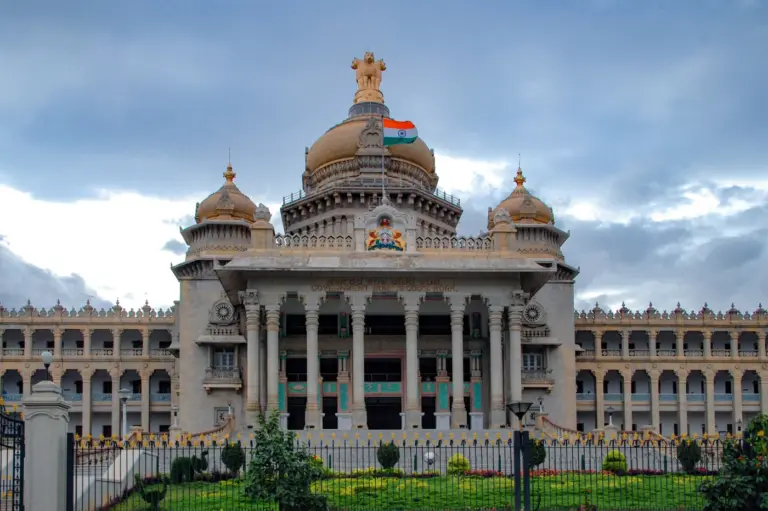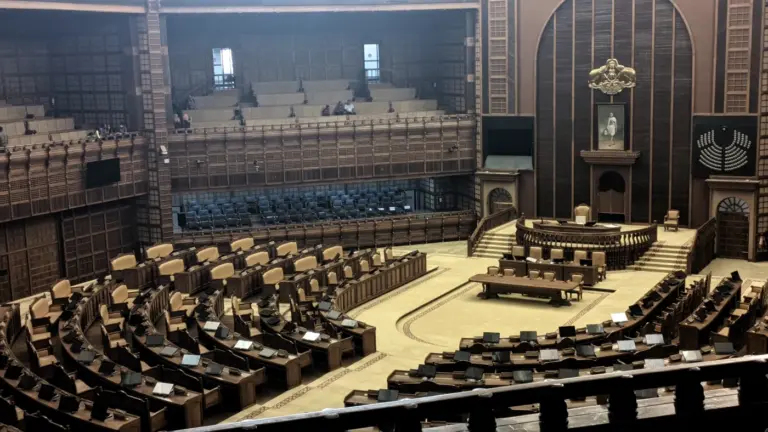

The Deputy Speaker of Lok Sabha is the second-highest presiding officer of the Lower House of India's Parliament, constitutionally mandated under Article 93. Elected by the members of the Lok Sabha from among themselves, the Deputy Speaker presides when the Speaker is absent, enjoys identical powers in that chair, and plays a stabilising role in legislative business. The office gained renewed prominence as the post remained vacant throughout the entire 17th Lok Sabha (2019-2024), triggering constitutional and parliamentary debates. For UPSC, the topic fuses Articles, Rules of Procedure, historical conventions, and recent controversies.
Constitutional and Legal Basis
The office of the Deputy Speaker is grounded in the Constitution of India.
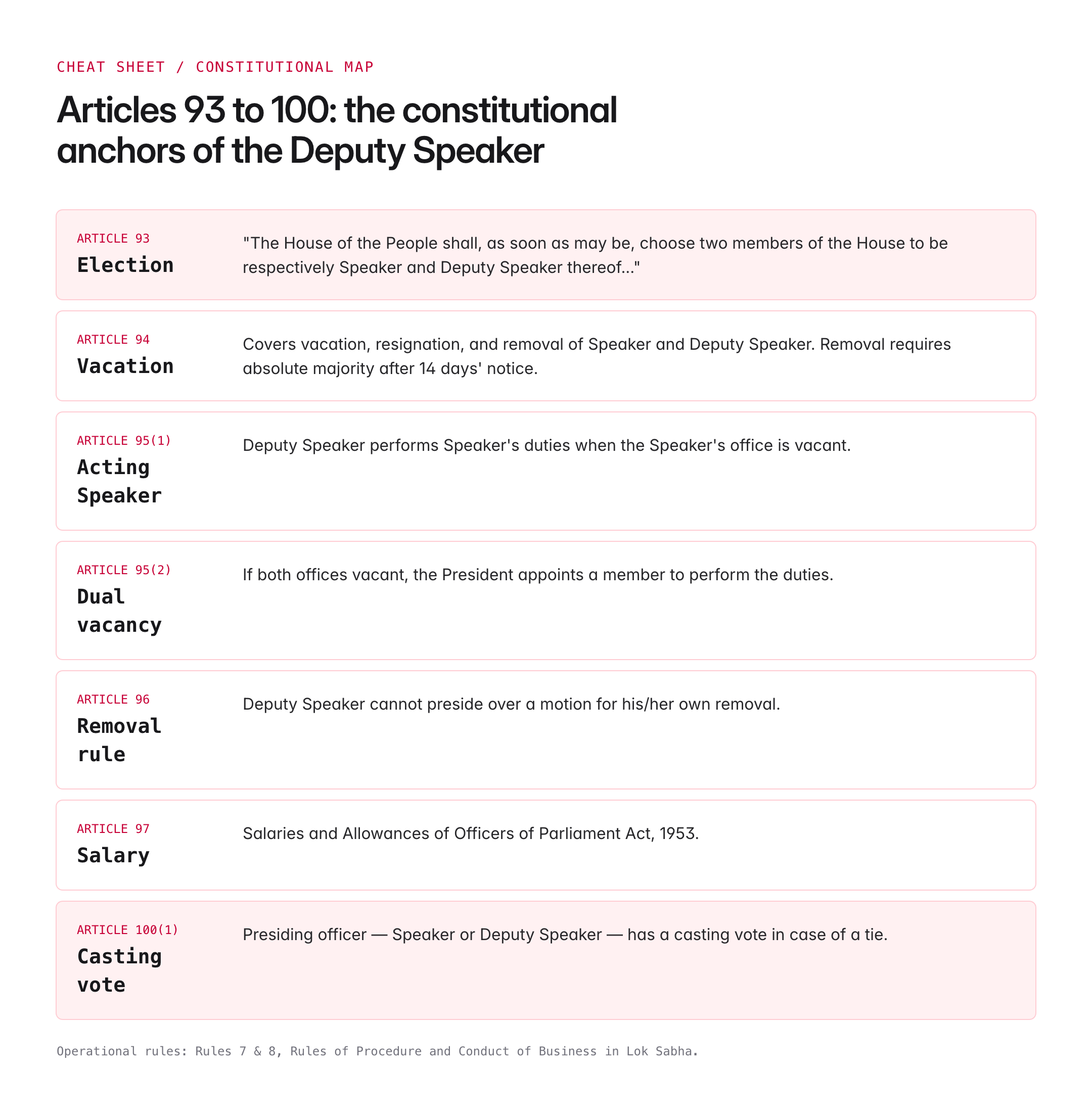
- Article 93: "The House of the People shall, as soon as may be, choose two members of the House to be respectively Speaker and Deputy Speaker thereof…"
- Article 94: Deals with vacation, resignation, and removal of the Speaker and Deputy Speaker.
- Article 95(1): When the office of Speaker is vacant, the Deputy Speaker performs the duties.
- Article 95(2): When both offices are vacant, the President appoints a member to perform the duties.
- Article 96: Provides that the Deputy Speaker cannot preside over a motion for his/her own removal.
The Rules of Procedure and Conduct of Business in Lok Sabha operationalise these provisions, especially Rules 7 and 8.
Election of the Deputy Speaker
- Elected by the Lok Sabha from among its own members.
- Date of election is fixed by the Speaker.
- A simple majority of members present and voting is required.
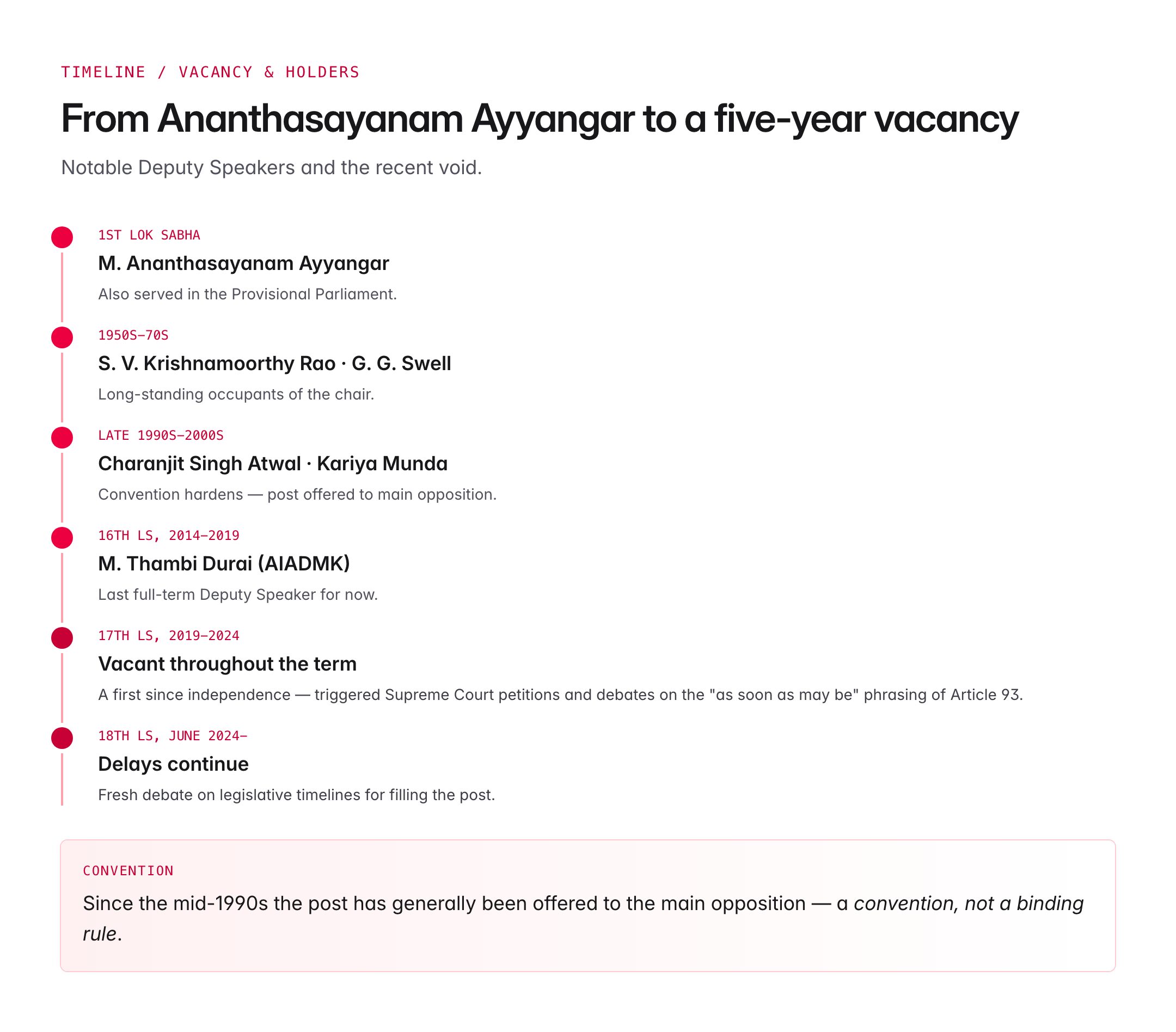
- Convention: since the mid-1990s, the post has generally been offered to the main opposition party or its alliance, as a gesture of parliamentary tradition. However, this is a convention, not a binding rule.
Notable Deputy Speakers include:
- M. Ananthasayanam Ayyangar (Provisional Parliament and 1st Lok Sabha).
- S. V. Krishnamoorthy Rao, G. G. Swell, M. Thambi Durai.
- Charanjit Singh Atwal and Kariya Munda.
- M. Thambi Durai (AIADMK) in the 16th Lok Sabha (2014-2019).
- The 17th Lok Sabha (2019-2024) concluded without any Deputy Speaker, a first since independence for the entire term.
- The 18th Lok Sabha, constituted in June 2024, also witnessed delays in electing a Deputy Speaker.
Tenure, Vacation, and Removal
Tenure:
- The Deputy Speaker holds office normally for the duration of the Lok Sabha, i.e., five years, unless the House is dissolved earlier.
- However, unlike the Speaker, the Deputy Speaker does not continue to hold office after dissolution until the next House meets.
Vacation and resignation (Article 94):
- By ceasing to be a member of the Lok Sabha.
- By resignation, addressed to the Speaker (whereas the Speaker resigns to the Deputy Speaker).
- By removal through a resolution passed by the Lok Sabha with the support of a majority of all the then members (absolute majority, not just those present and voting), after at least 14 days' notice.
Powers and Functions
When presiding, the Deputy Speaker exercises the same powers as the Speaker under the Constitution and Rules.
As presiding officer
- Maintains order and decorum in the House.
- Puts questions to vote and announces results.
- Interprets the Constitution, Rules of Procedure, and parliamentary precedents with respect to proceedings.
- Casting vote: Under Article 100(1), in case of a tie, the presiding officer – whether Speaker or Deputy Speaker – has a casting vote.
- Certifies Money Bills only if acting as Speaker during a vacancy of the Speaker's office, as Article 110(4) specifically empowers the Speaker to do so.
- Administers the Anti-Defection Law under the Tenth Schedule when acting as presiding officer.
Committee role
- Can be appointed as Chairperson of a Parliamentary Committee, where he/she enjoys a special position – not subject to the Speaker while presiding over that committee.
- Often chairs important committees such as the Committee on Private Members' Bills and Resolutions or panels of chairpersons.
Panel of Chairpersons
- The Speaker nominates a panel of members, from which any can preside in the absence of both the Speaker and the Deputy Speaker. The Deputy Speaker's role is thus embedded in a hierarchy of presiding officers.
Salary and Status
- The Deputy Speaker is paid a salary and allowances determined by Parliament by law, under Article 97 and the Salaries and Allowances of Officers of Parliament Act, 1953.
- Ranks after the Speaker in the Indian Order of Precedence, alongside cabinet ministers.
- Enjoys protocol facilities including residence and staff.
Independence and Impartiality
Like the Speaker, the Deputy Speaker is expected to act impartially, once elected.
- Traditionally, the Deputy Speaker's post in India (and in the UK) has been offered to a member of the opposition to symbolise bipartisanship.
- Upon election, he/she is expected to rise above partisan considerations while presiding.
- Unlike in some Westminster systems, Indian presiding officers are not required to resign from their party, which has been a subject of long-standing debate, especially around Kihoto Hollohan vs Zachillhu (1992) and anti-defection rulings.
The Vacancy Debate
The prolonged vacancy during the 17th Lok Sabha generated significant debate.
- Article 93 uses the phrase "as soon as may be", creating ambiguity over the timeline.
- Critics argued that failure to elect a Deputy Speaker:
- Violated the spirit of Article 93, even if not its strict letter.
- Undermined parliamentary conventions of giving the post to the opposition.
- Concentrated presiding functions in the office of the Speaker and the panel of chairpersons.
- Supreme Court petitions were filed, but the Court was cautious about judicial intervention in the internal affairs of the House.
- Parliamentary scholars and former Speakers have called for legislative or rule-based timelines to ensure timely election.
Comparison with Speaker
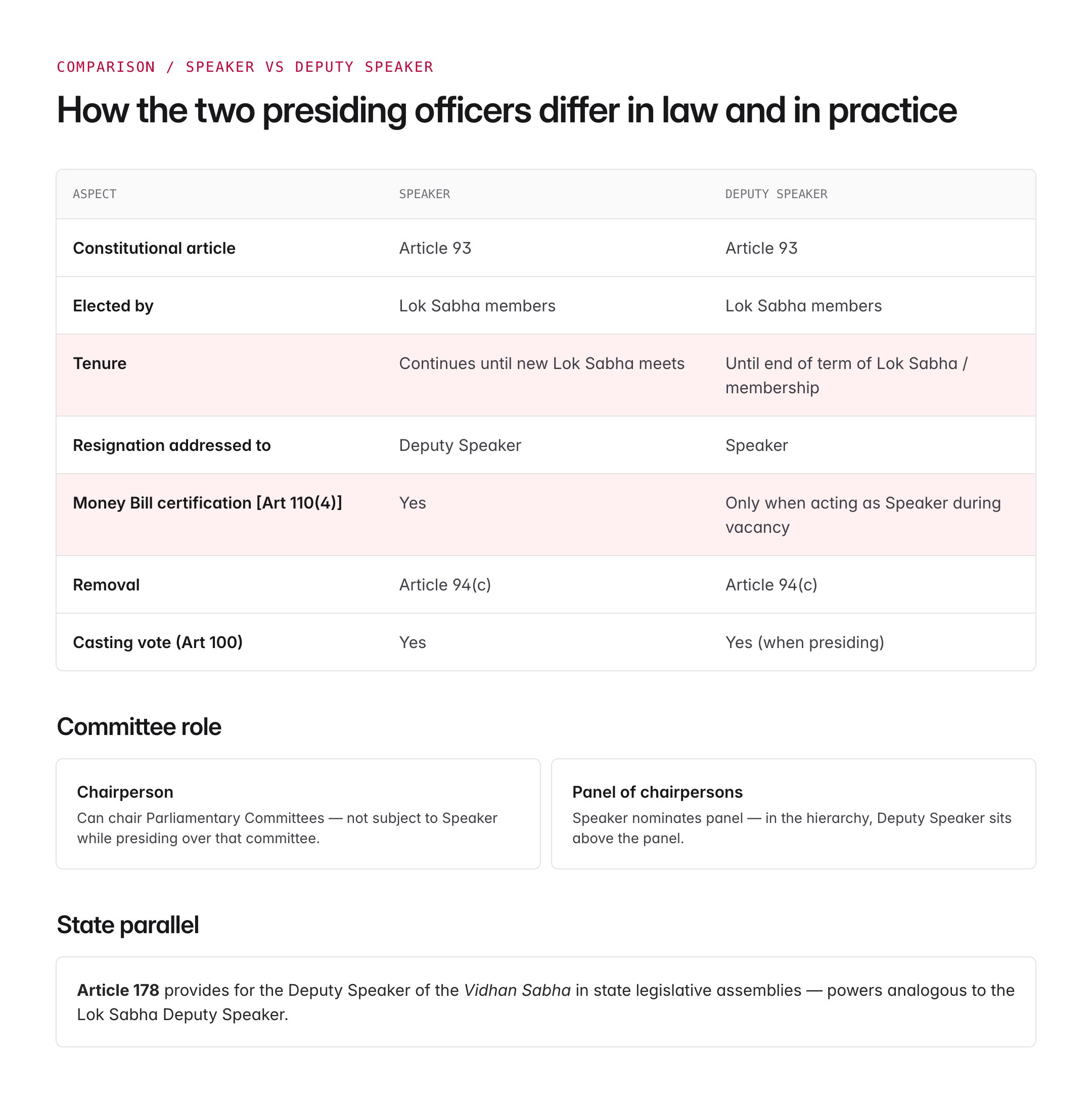
| Aspect | Speaker | Deputy Speaker |
|---|---|---|
| Constitutional article | Article 93 | Article 93 |
| Elected by | Lok Sabha members | Lok Sabha members |
| Tenure | Continues until new Lok Sabha meets | Till end of term of Lok Sabha/membership |
| Resignation to | Deputy Speaker | Speaker |
| Certification of Money Bill | Yes (Article 110(4)) | Only when acting as Speaker in vacancy |
| Removal | Article 94(c) | Article 94(c) |
| Casting vote | Yes (Article 100) | Yes when presiding |
Deputy Speaker and the State Legislatures
- State legislative assemblies have a parallel office: the Deputy Speaker of the Vidhan Sabha, elected under Article 178, with powers analogous to those of the Lok Sabha Deputy Speaker.
- Similar debates about vacancy and convention have emerged in several state assemblies.
UPSC Relevance
Prelims focus:
- Article 93: election of Speaker and Deputy Speaker.
- Article 94, 95, 96, 97, 100, 110(4): allied provisions on tenure, removal, salary, casting vote, and Money Bills.
- Difference between the Speaker and Deputy Speaker in resignation and Money Bill certification.
- Anti-defection decisions and the role of presiding officers.
- Notable historical Deputy Speakers.
Mains GS-II angle:
- Functioning of Parliament and the importance of presiding officers for institutional integrity.
- Conventions regarding offering the Deputy Speaker's post to the opposition.
- Consequences of a prolonged vacancy of the Deputy Speaker for parliamentary democracy.
- Need for reforms – fixed timelines, neutrality, and institutional independence of presiding officers.
Sample PYQ angle: "Discuss the role of the Speaker of the Lok Sabha" or "Parliamentary sovereignty in India is a myth." Deputy Speaker-centric questions allow students to show command over Articles, conventions, recent developments, and reforms – producing structured, multidimensional answers.
Tell Google you want more of this.
Add Anantam IAS as a preferred sourceOne tap, and this site shows up more often in your own Top Stories, AI Overviews and AI Mode. Remove it any time.